wayground logo

Free Printable Worksheets

Font size

S
M
L
XL
Worksheets

Bio A Exam Review

Total questions: 114

Worksheet time: 1hrs 23mins

Name
Class
Date
1.
The smaller molecules linked together to make protein are 
a)
amino acids
b)
nucleotides
c)
fatty acids
d)
simple sugars
2.
Which molecule does the cell use for energy?  For example, a muscle cell uses this molecule to power a contraction and create movement.
a)
DNA
b)
RNA
c)
Glucose
d)
ATP
3.
Cell structure controlling movement of substances into and out of the cell.
a)
cell wall
b)
cell membrane
c)
cytoplasm
d)
centrioles
4.
Proteins that cause changes.
a)
enzymes
b)
channel proteins
c)
myosin and actin
d)
collagen and elastin
5.
A eukaryote is the only cell type that has
a)
a cell wall
b)
 cytoplasm
c)
a nucleus
d)
DNA molecules
6.
What is a monomer of lipids?
a)
phospholipids
b)
monosaccharides
c)
fatty acids
d)
polar molecules
7.
What is the function of the cell membrane?
a)
makes ATP
b)
control center of the cell
c)
controls what enters and leaves the cell
d)
gets rid of wastes
8.
Which organelle stores the cells DNA or genetic information?
a)
chloroplast
b)
mitochondria
c)
lysosome
d)
nucleus
9.
What is the difference between the rough and smooth ER?
a)
the rough ER has ribosomes on it
b)
the rough ER is outside of the cell
c)
the rough ER is protected by vesicles
d)
the rough ER makes energy
10.
The movement of water through a semipermeable membrane is called:
a)
active transport
b)
osmosis
c)
endocytosis
d)
exocytosis
11.
Which of the following is NOT found in an animal cell?
a)
chloroplast
b)
cell membrane
c)
mitochondria
d)
lysosome
12.
What is a reactant of photosynthesis?
a)
oxygen
b)
sugar
c)
carbon dioxide
d)
protein
13.
Which organisms carry out cellular respiration?
a)
only animals
b)
only plants
c)
both plants and animals
d)
neither plants nor animals
14.
the factor measured or observed in an experiment is called?
a)
control variable
b)
independent variable
c)
experimental variable
d)
dependent variable
15.
what is biology?
a)
study of the environment
b)
study of cells
c)
study of living organisms
d)
study of science
16.
what element is found in and organic compound?
a)
oxygen
b)
nitrogen
c)
carbon
d)
hydrogen
17.
makes up the DNA and RNA molecules
a)
protein
b)
carbs
c)
nucleic acid
d)
lipids
18.
the sum of all biochemical reactions in an organism is
a)
metabolism
b)
enzyme
c)
biochemical reactions
d)
activation energy
19.
a/an is a protein that speeds up a biochemical reaction
a)
metabolism
b)
enzyme
c)
catalyst
d)
chemical
20.
_____________is when a substance crosses the plasma membrane without any input of energy from the cell
a)
passive transport
b)
facilitated diffusion
c)
active transport
d)
osmosis
21.

This molecule makes energy for the cell

a)

protein

b)

carbohydrates

c)

nucleic acid

d)

lipids

22.

The process of maintaining stable conditions inside a cell

a)

cell transport

b)

exocytosis

c)

endocytosis

d)

homeostasis

23.

A simple carbohydrate food molecule that the majority of living things use is...

a)

ATP

b)

glucose

c)

glycolysis

d)

energy

24.

__________ is the energy carrying molecule that cells use for energy

a)

ATP

b)

glucose

c)

glycolysis

d)

energy

25.
When you step out into the cold, your body shivers in order to keep its temperature at 98.6F.
a)
All living things use energy
b)
All living things contain cells
c)
All living things maintain homeostasis
d)
All living things grow
26.
Green plants produce their own food through the process of photosynthesis.
a)
All living things use energy
b)
All living things contain cells
c)
All living things maintain homeostasis
d)
All living things grow
27.
A baby song bird hatches from its egg with both parent songbirds watching.
a)
All living things reproduce
b)
All living things maintain homeostasis
c)
All living things use energy
d)
All living things grow
28.
A pill bug (roly poly) eats a carrot.
a)
All living things contain cells
b)
All living things use energy
c)
All living things maintain homeostasis
d)
All living things grow
29.
A caterpillar hibernates in a cocoon and emerges as a butterfly.
a)
All living things adapt to their environment
b)
All living things use energy
c)
All living things respond to their environment
d)
All living things grow
30.
A tulip opens in the morning at sunrise and closes in the evening at sunset.
a)
All living things have cells
b)
All living things use energy
c)
All living things respond to their environment
d)
All living things grow
31.
YOU are a multi-celled organism but an amoeba is a single celled organism.
a)
All living things have cells
b)
All living things grow
c)
All living things use energy
d)
All living things respond to their environment
32.
Used for short term (quick) energy.
a)
carbohydrates
b)
lipids
c)
proteins
d)
nucleic acids
33.
Provides long term energy and insulation,
a)
lipids
b)
carbohydrates
c)
nucleic acids
d)
proteins
34.
Contains a phosphate, sugar and nitrogen base
a)
nucleic acid
b)
lipid
c)
carbohydrate
d)
protein
35.
Is found in the cell membrane as a bilayer. 
a)
lipids
b)
protein
c)
nucleic acid
d)
carbohydrate
36.
Proteins are made of monomers called ___________
a)
Nucleotides
b)
Monosaccharides
c)
Amino Acids
d)
Glycerol and fatty acids
37.
The element _______is found in all of the organic compounds.
a)
Iron
b)
Nitrogen
c)
Carbon
d)
Oxygen
38.
_________ are composed out of carbon (C), hydrogen (H), oxygen (O), nitrogen (N), and phosphorus (P)
a)
Carbohydrates
b)
Lipids
c)
Proteins
d)
Nucleic Acids
39.
Nucleotides are monomers of
a)
Carbohydrates
b)
Lipids
c)
Proteins
d)
Nucleic Acids
40.
Monosaccharides are monomers of
a)
Carbohydrates
b)
Lipids
c)
Proteins
d)
Nucleic Acids
41.
Waxes, oils and fats are examples of
a)
Carbohydrates
b)
Lipids
c)
Proteins
d)
Nucleic Acids
42.
The organic compounds that have many structural purposes and are used in many processes within the
cell are called ____________________.
a)
Carbohydrates
b)
Lipids
c)
Proteins
d)
Nucleic Acids
43.
What is the function of nucleic acids?
a)
store genetic information
b)
store energy (long-term)
c)
store energy (short-term)
d)
build skin, hair, nails, muscles
44.
Which macromolecule is shown?
 View Figure 2 (if not visible)
a)
lipid
b)
protein
c)
nucleic acid
d)
carbohydrate
45.
Which macromolecule is shown?
 View Figure 3 (if not visible)
a)
lipid
b)
protein
c)
nucleic acid
d)
carbohydrate
46.
Which macromolecule is shown?
 View Figure 4 (if not visible)
a)
lipid
b)
protein
c)
nucleic acid
d)
carbohydrate
47.
What type of macromolecule are enzymes?
a)
Protein
b)
Carbohydrate
c)
Lipid
d)
Nucleic Acid
48.
Carbohydrates are made of... 
a)
C H O
b)
C H O N
c)
C H O N P
d)
C H O N S
49.
Lipids are made of... 
a)
C H O
b)
C H O N
c)
C H O N P
d)
C H O N S
50.

Proteins are made of...

a)

C H O

b)

C H O N

c)

C H O N P

d)

C H O N S

51.
This is one job proteins do NOT have in the body
a)
insulation
b)
structure for tissues and organs
c)
speed up chemical reactions
d)
transport things through cell membrane
52.
Which macromolecule is made of simple and complex sugars?
a)
lipids
b)
proteins
c)
carbohydrates
d)
nucleic acids
53.

How do enzymes speed up chemical reaction?

a)

Increasing activation energy

b)

Decreasing activation energy

c)

Increasing deactivation energy

d)

Decreasing deactivation energy

54.
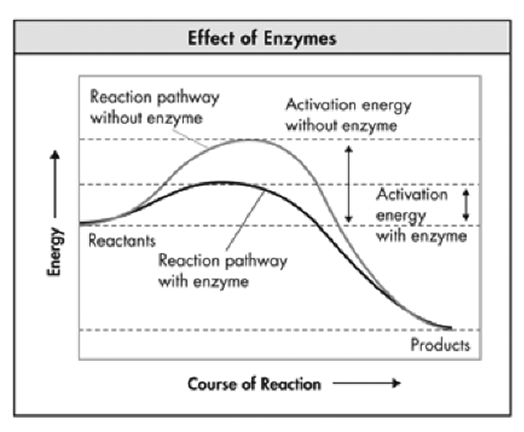
The graph shows how enzymes affect reactions in cells. Which statement best summarizes the information shown in the graph?
a)
Enzymes increase the energy of the reactants.
b)
Enzymes decrease the energy level of the products.
c)
Enzyme decrease the activation energy of the reaction.
d)
Enzymes reverse the direction of the reaction.
55.
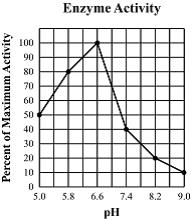
Which of the following conclusions can be drawn from this graph?
a)
The optimum pH of the enzyme is 6.6.
b)
The optimum pH of the enzyme is 5.8
c)
The enzyme’s activity increases as pH increases 5.0 to 9.0
d)
The enzyme’s activity is greater around pH of 8.0 .
56.
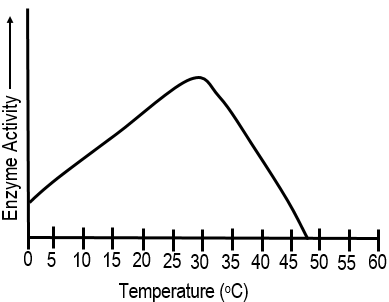
Based on the graph, what is the optimal temperature for this enzyme? 
a)
15oC
b)
40oC
c)
30oC
d)
35oC
57.
What happens when enzymes are heated to a high temperature?
a)
The enzymes die.
b)
The shapes of the enzyme are altered denature
c)
The enzymes' amino acid sequence changes.
d)
The enzymes remain the same
58.
Which of these is NOT true?
a)
Enzymes can denature (change shape) when the temperature gets too high.
b)
Enzymes can only be used once in a chemical reaction. 
c)
Extreme pH can denature enzymes.
d)
Enzymes speed up chemical reactions. 
59.
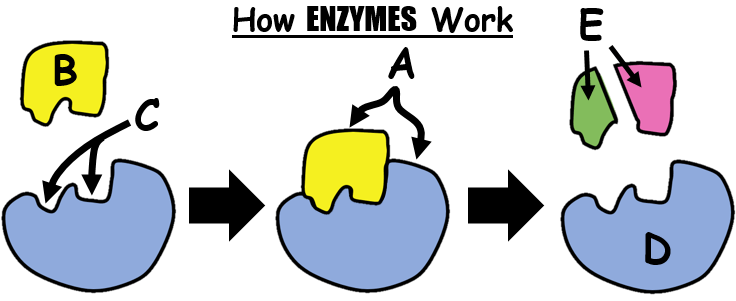
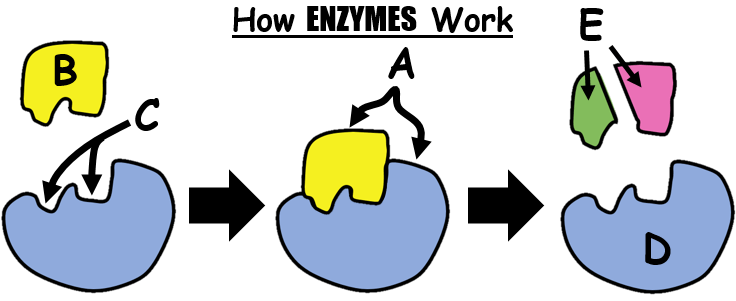
Letter C...
a)
active site
b)
enzymes
c)
substrate
d)
products
60.
Letter E...
a)
active site
b)
enzyme
c)
substrate
d)
products
61.
Sac within the cytoplasm that is full of fluid; plants have one large; stores food, water, etc.
a)
vacuole
b)
cell wall
c)
lysosome
d)
ribosome
62.
Gives the cell a rigid, box-like shape; outside of the cell membrane; in plants.
a)
cytoplasm
b)
chromatin
c)
cell wall
d)
cell membrane
63.
Which organelle uses energy from sunlight to make sugar?
a)
mitochondria
b)
nucleus
c)
chloroplasts
d)
vacuoles
64.
Which part of the cell is often called "the brain of the cell"?
a)
nuclear membrane
b)
endoplasmic reticulum
c)
nucleus
d)
ribosomes
65.
You might think of me as the trash collector or recycler is maybe more accurate. What am I?
a)
cytoplasm
b)
lysosme
c)
vacuole
d)
ribosome
66.
I am a protein packaging and shipping machine! Who am I?
a)
vacuole
b)
ribosome
c)
endoplasmic reticulum
d)
golgi apparatus
67.
What is this?
a)
mitochondria
b)
lysosomes
c)
chloroplast
d)
endoplasmic reticulum
68.
Where is the DNA found in a prokaryotic cell? 
a)
floating around in the cytoplasm 
b)
in the nucleus 
69.
What type of cell has a nucleus? 
a)
eukaryotic
b)
prokaryotic 
70.
Controls what enters/leaves a cell
a)
cell membrane
b)
Nuclear membrane
c)
cell wall
d)
cytoplasm
71.
releases energy for cells to use, most common in animal cells
a)
mitochondria
b)
ribosomes
c)
lysosomes
d)
nucleolus
72.
Amino acids link together to form proteins. In which organelle would this process occur?
a)
Lysosome
b)
Ribosome
c)
Centriole
d)
Mitochondria
73.
What process occurs when WATER diffuses across a membrane?
a)
endocytosis
b)
mitosis
c)
osmosis
d)
nuclear fission 
74.
Which way will the water molecules move during osmosis?
a)
Out of the cell, so the cell shrinks.
b)
Out of the cell, so the cell swells.
c)
Into the cell, so the cell shrinks.
d)
Into the cell, so the cell swells.
75.
A person would never have pure water put into their veins in a hospital because their cells would...
a)
Shrink/Dehydrate
b)
Expand
76.
A person should never drink salty water because their cells would
a)
shrink
b)
expand
77.
Passive transport requires no
a)
concentration gradients
b)
osmosis
c)
motion
d)
energy
78.
 If the volume of a cell increases when it is placed in a solution, that solution is said to be __________ to the cell
a)
 hypertonic
b)
subatomic
c)
 isotonic
d)
 hypotonic 
79.
What is the goal of diffusion?
a)
hypertonic environment
b)
hypotonic environment
c)
equilibrium
d)
passive transport
80.
The cell membrane is
a)
impermeable
b)
selectively permeable
c)
the same as the cell wall
d)
only crossed with active transport
81.
Which organisms perform Photosynthesis?
a)
Only Autotrophs
b)
Only Heterotrophs
c)
Autotrophs and Heterotrophs
82.
Which of the following is the correct equation for PHOTOSYNTHESIS?
a)
6CO2 + 6H2O --> 6O+ C6H12O6
b)
6CO+ C6H12O6 + 6H2O --> O
c)
6O2 + 6H2O --> 6CO+ C6H12O6
d)
C6H12O6 + 6O2 ---> 6H2O + 6CO2 
83.
Which gas is removed from the atmosphere during photosynthesis?
a)
hydrogen
b)
oxygen
c)
nitrogen
d)
carbon dioxide
84.
What gas is released by plants during photosynthesis?
a)
sulfur
b)
carbon dioxide
c)
oxygen
d)
hydrogen
85.
What is the name of the 1st step of cellular respiration?
a)
Glycolysis
b)
Kreb's Cycle
c)
ETC
d)
Anaerobic respiration
86.
What are the two reactants of cellular respiration?
a)
C6H12O6 & 6CO2
b)
6 CO2 & 6H2O
c)
C6H12O& 6O2
d)
6CO2 & 6O2
87.
Why is photosynthesis important for plants?
a)
It collects sunlight which is used to make food for plants
b)
It gets rid of plant waste products
c)
It changes plant sugar into stronger chemicals
d)
It helps attract insects to flowers
88.
Which of the following is NOT a characteristic that all living things share?
a)
using energy
b)
a cellular organization
c)
response to surroundings
d)
movement
89.
In the given scenario what will happen to the organism: salt is poured onto eggplant.
a)
Water will move out of the eggplant cells and the cells will shrink.
b)
Water will move out of the eggplant cells and the cells will swell.
c)
Water will move into the eggplant cells and the cells will swell.
90.
The variable that is being measured or observed is called the _______________. Hint: this is the variable that is the result or effect 
a)
independent variable
b)
dependent variable
c)
control variable
91.
Why do we want to test one variable at a time?
a)
Because it is hard to setup a data table with more
b)
To know what is causing the changes. This helps us understand cause and effect.
c)
It is what has always been done
92.
What is a constant/control in an experiment?
a)
Things that do not change inana experiment.  It's the variable that stays the same.  You can have many variables stay the same.
b)
It's the variables that the scientist changes in the experiment
c)
It's the variables that are being measured in an experiment
93.
What is a constant/control in an experiment?
a)
Things that do not change inana experiment.  It's the variable that stays the same.  You can have many variables stay the same.
b)
It's the variables that the scientist changes in the experiment
c)
It's the variables that are being measured in an experiment
94.
I have cell walls
I am an autotroph
I am multicellular
What am I?
a)
Plant
b)
Animal
c)
Eubacteria
d)
Unicorn
95.
I have no cell walls
I am eukaryotic
I reproduce sexually
I am multicellular
What kingdom do I belong to?
a)
Plantae
b)
Animalia
c)
Protista
d)
Fungi
96.
I am unicellular
I am prokaryotic
I am found in extreme ecosystems
What kingdom do I belong to?
a)
The Candy Kingdom
b)
Kingdom Plantae
c)
Kingdom Animalia
d)
Kingdom Archaebacteria
97.
I can be either a heterotroph or an autotroph-
I can be either multicellular or unicellular-
I can have cell walls or not-
The only thing for sure about me is that I have a nucleus in my cells...
I am Kingdom ____________ .
a)
Plantae
b)
Protista
c)
Animalia
d)
of Oz
98.
The purpose of cellular respiration is to
a)
make glucose
b)
break glucose
c)
capture the energy in sunlight
d)
change carbon dioxide
99.
The purpose of photosynthesis is ...
a)
to make glucose
b)
to break glucose
c)
to capture energy from the sun
d)
to change carbon dioxide
100.
If there is 5 percent water inside a cell and 5 percent water outside a cell
a)
more water will move inside the cell
b)
more water will move outside the cell
c)
There will be no movement of water cells
101.
In the given scenario what will happen to the organism: salt is poured onto eggplant.
a)
Water will move out of the eggplant cells and the cells will shrink.
b)
Water will move out of the eggplant cells and the cells will swell.
c)
Water will move into the eggplant cells and the cells will swell.
102.
Which organelle belongs in plant cells only?
a)
Cell Membrane
b)
Mitochondrion
c)
Chloroplast
d)
Nucleus
103.
Which organelle belongs in plant cells only?
a)
Cytoplasm
b)
Mitochondrion
c)
Cell Wall
d)
Nucleus
104.
Which organelle belongs in plant cells only?
a)
Cytoplasm
b)
Mitochondrion
c)
Large Central Vacuole
d)
Cell Membrane
105.
Which organelle belongs in both plant and animal cells?
a)
Cytoplasm
b)
Chloroplast
c)
Large Central Vacuole
d)
Cell Wall
106.
Which organelle belongs in both plant and animal cells?
a)
Chloroplast
b)
Cell Wall
c)
Large Central Vacuole
d)

Nucleus

107.
Which of the following would be considered quantitative data?
a)
Color
b)
Smell
c)
6.84 cm
d)
texture
108.
Explaining the color of a chemical would be what kind of observation?
a)
Qualitative 
b)
Quanitative
109.
What is a factor that the experimenter has full control over and changes to see what happens?
a)
Dependent Variable
b)
Independent Variable
c)
Control group 
d)
Hypothesis
110.
What is a factor that changes because of what the experimenter does?
a)
Dependent Variable
b)
Independent Variable
c)
Control Group
d)
Hypothesis
111.

What is a substance that is dissolved in another substance?

a)

solvent

b)

solute

112.
Identify the macromolecule in the picture
* cholesterol and triglycerides
a)
carbohydrate
b)
protein
c)
lipid
d)
nucleic acid
113.

Which word does Not belong with cell membrane?

a)

Polypeptide (protein)

b)

Semi-permeable

c)

Fatty acid

d)

Glycerol

e)

They all do

114.

Which of the following is an organic compound?

a)

KBr

b)

H2SO4

c)

C3H8

d)

H2O

e)

All of these