wayground logo

Free Printable Worksheets

Font size

S
M
L
XL
Worksheets

BIOLOGY EOC Review Part 1

Total questions: 112

Worksheet time: 2hrs 10mins

Name
Class
Date
1.

Identify all of the following that are living?

a)

Fungus

b)

Rock

c)

Bacteria

d)

Sun

2.

Which Characteristics of Living Things is represented by the picture?

a)

Maintain Homestasis

b)

Made of Cells

c)

Respond to stimuli

d)

same chemical make up

3.

You are cooking dinner. You accidentally touch the hot pan and pull your hand back. Which characteristics of living things does this represent?

a)

Response to stimuli

b)

made up of cells

c)

Evolve as a species

d)

maintain homeostasis

4.

Identify the characteristic: A man and a woman have 3 children.

a)

Respond to stimuli

b)

reproduce

c)

evolve as a species

d)

homeostasis

5.
To maintain stable internal conditions is  __________________________________.
a)
growth
b)
adaptation
c)
homeostasis
d)
development
6.
An amoeba is a unicellular organism. Which characteristic of life is this?
a)
All living things use energy
b)
All living things contain cells
c)
All living things respond to their environment
d)
All living things grow
7.

What type of cell has a nucleus?

a)

eukaryotic

b)

prokaryotic

c)

neither

d)

both

8.

Plants and animal cells are examples of ___ cells

a)

prokaryotic cells

b)

eukaryotic cells

c)

both eukaryotic and prokaryotic

d)

neither

9.

Which do BOTH prokaryotes and eukaryotes contain?

a)

nucleus

b)

mitochondria

c)

ribosomes

d)

cell wall

10.

Prokaryotes do NOT have....

a)

membrane bound organelles

b)

DNA or RNA

c)

Cell membrane

d)

Life

11.

Bacteria are considered what?

a)

Eukaryotes

b)

Prokaryotes

12.
All polymers are made up of...
a)
monosaccharides
b)
monomers
c)
proteins
d)
None of these
13.
Which biomolecule is responsible for insulation and energy storage?
a)
Protein
b)
Nucleic Acid
c)
Lipid
d)
Carbohydrate
14.
What is the function of nucleic acids?
a)
Stores energy
b)
Stores genetic information
c)
Movement
d)
Physical structure
15.
What biomolecule do enzymes belong to? 
a)
Carbohydrate
b)
Lipid
c)
Nucleic Acid
d)
Protein
16.
Which biomolecule is a main source of quick energy?
a)
Nucleic Acid
b)
Protein
c)
Lipid
d)
Carbohydrate
17.
What is the monomer for a protein?
a)
Monosaccharide
b)
Triglyceride
c)
Amino Acid
d)
Nucleotide
18.
Lipids are made up of which of the following?
a)
glycerol and fatty acids tails
b)
glycerol and monolipids
c)
fatty acids and phosolipids
d)
amino acids and nucleotides
19.
What is the monomer of nucleic acids?
a)
Glycerol
b)
Monosaccharides
c)
Amino Acids
d)
Nucleotides
20.
Which biomolecule has sugars and starches?
a)
Lipids
b)
Proteins
c)
Carbohydrates
d)
Nucleic Acid
21.
Which sequence of DNA bases would pair with this partial strand
ATG TGA CAG
a)
ATG TGA CAG
b)
TAC ACT GTC
c)
GTA AGT GAC
d)
CAT TCA CTG
22.
Which of the following best describes a DNA molecule?
a)
double helix
b)
contains ribose
c)
made of amino acids
d)
contains Uracil
23.
Which of the following units are repeatedly joined together to form a strand of DNA?
a)
amino acids
b)
nucleotides
c)
fatty acids
d)
polysaccharides
24.
In a molecule of double-stranded DNA, the amount of Adenine present is always equal to the amount of
a)
cytosine
b)
guanine
c)
thymine
d)
uracil
25.
Adenine bonds with ______________.
a)
Guanine
b)
Thymine
c)
Cytosine
d)
Adenine
26.
Guanine bonds with ______________.
a)
Adenine
b)
Guanine
c)
Cytosine
d)
Thymine
27.
What determines the code, or information, of a DNA molecule?
a)
the shape (structure) of the nitrogen bases
b)
the order (sequence) of the nitrogen bases
c)
the color of the nitrogen bases
d)
the frequency (number) of nitrogen bases
28.
Which 2 molecules form the sides (backbone) of the DNA ladder?
a)
deoxyribose sugar and adenine
b)
deoxyribose sugar and a hydrogen bond
c)
deoxyribose sugar and the nucleus
d)
deoxyribose sugar and phosphate
29.
Which organelle is DNA usually found in?
a)
cell membrane
b)
vacuole
c)
chloroplast
d)
nucleus
30.
Nitrogenous bases are joined by which type of bond?
a)
polar bonds
b)
ionic bonds
c)
covalent bonds
d)
hydrogen bonds
31.
What type of RNA carries the DNA message out of the nucleus to the ribosomes?
a)
mRNA
b)
tRNA
c)
RNA
d)
DNA
32.
What do we call the process of turning DNA into mRNA?
a)
Translation
b)
Transcription 
c)
Replication
33.
When DNA is transcribed to RNA.... 
a)
A pairs with U
b)
C pairs with U
c)
A pairs with T
d)
C pairs with T
34.
When the RNA gets to the ribosomes, which molecule transfers to the mRNA to amino acids?
a)
DNA
b)
mRNA
c)
tRNA
d)
Replicated RNA
35.
Amino acids are the building blocks of... 
a)
DNA
b)
RNA
c)
Atoms
d)
Proteins
36.
What is a Codon?
a)
4 base pairs that transfer to amino acids
b)
3 base pairs that transfer to amino acids
c)
3 base pairs that transfer to DNA
d)
3 base pairs that transfer to mRNA
37.
What process is occurring in this photo?
a)
Transcription
b)
DNA unwinding
c)
Translation
d)
Transfer RNA is creating bases
38.
In translation, C pairs with 
a)
U
b)
G
c)
A
d)
T
39.
What is the correct amino acid sequence for the mRNA code AUGCCAGUAUGA?
a)
 Met-Pro-Val-Stop
b)
Met-Pro-Arg-Stop
c)
 Tyr-Gly-His
d)
Tyr-Gly-Arg-His
40.
Which RNA bases would pair with TACGAA in transcription? 
a)
AUGCUU 
b)
ATGCTT
c)
GCATCC
d)
GCAUCC
41.
Where does Translation occur?
a)
Proteins
b)
Mitochondria
c)
Ribosomes
d)
Cytoplasm
42.

What are the "X" shaped things in the drawing.

a)

PMATs

b)

Chromosomes

c)

Ribosomes

d)

Telophase

43.

During what phase of Mitosis do the chromosomes line up in the Middle

a)

Metaphase

b)

Prophase

c)

Telophase

d)

Anaphase

44.

PMAT helps us remember the correct order of the phases of Mitosis. Which of the following has the phases of Mitosis in the correct Order

a)

Interphase, Mitosis, Cytokinesis

b)

Prophase, Metaphase, Anaphase, Prophase

c)

Anaphase, Telophase, Prophase, Telophase

d)

Prophase, Metaphase, Anaphase, Telophase

45.

In which phase of Mitosis do the Chromosomes pull Apart

a)

Metaphase

b)

Prophase

c)

Anaphase

d)

Telophase

46.

What is the purpose of Mitosis?

a)

Growth of an organism and Repair of damaged tissue

b)

To help the body get rid of extra cells

c)

To increase the amount of classwork you have to do

d)

To get rid of the nucleus

47.
Cells spend 90% of their time in this stage of the cell cycle. This is the reason you would see most cells in this stage if viewed under a microscope.
a)
Prophase
b)
Metaphase
c)
Anaphase
d)
Interphase
48.
What do the cells look like at the end of mitosis?
a)
different from original cell
b)
similar to the original cell
c)
identical to the original cell
d)
none of these
49.

What is the correct order of the cell cycle?

a)

Interphase, Cytokinesis, Mitosis

b)

Interphase, Mitosis, Cytokinesis

c)

Cytokinesis, Mitosis, Interphase

d)

Anaphase, Telophase, Cytokinesis

50.
Osmosis is a form of ______________. 
a)
Passive Transport
b)
Active Transport
51.
This picture represents what type of cell transport?
a)
endocytosis
b)
exocytosis
c)
osmosis
d)
passive transport
52.
Osmosis is the movement of _____ across a membrane.
a)
food
b)
energy
c)
oxygen
d)
water
53.
Which is true about active transport?
a)
It requires energy
b)
it does not require energy
c)
It moves substances down the concentration gradient
d)
it moves material from high to low concentration
54.
This cell organelle helps organisms maintain homeostasis by controlling what substances may enter or leave cells.
a)
vacuole
b)
nucleus
c)
cell membrane
d)
cell wall
55.
The cell below is in a _________ solution.
a)
Hypotonic
b)
Hypertonic
c)
Isotonic
56.
The cell below is in a _____________ solution.
a)
Hypertonic
b)
Hypotonic
c)
Isotonic
57.
A cell in an isotonic solution will
a)
swell
b)
shrink
c)
stay the same size
d)
impossible to tell
58.
When a cell is placed in a hypertonic solution water
a)
moves from the inside of the cell to the solution
b)
moves from the solution to the inside of the cell
c)
moves equally in and out of the cell
d)
none of these
59.
A cell will __________________ in a hypotonic solution.
a)
swell and perhaps burst (lyse)
b)
shrink
c)
the size of the cell will not change
d)
the size of the cell will change from large to small and from small to large
60.
Active transport requires _____ to move materials across the cell membrane.
a)
proteins
b)
sunlight
c)
oxygen
d)
energy
61.
Particles are removed from a cell (pushed out).
a)
Endocytosis
b)
Exocytosis
c)
Permeable
d)
In high concentration
62.

During which phase of meiosis does crossing over occur?

a)

Prophase II

b)

Anaphase I

c)

Telophase II

d)

Prophase I

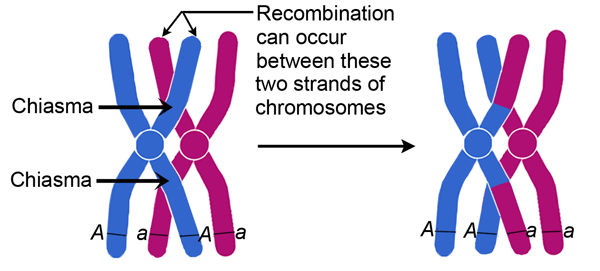
63.
This image shows chromosomes during Prophase 1. Which of the following correctly describes the process shown?
a)
segregation of sister chromatids
b)
condensation and segregation of alleles
c)
mutationin which the DNA content of the gene is altered
d)
crossing - over in which alleles are exchanged
64.

a)

Metaphase 1

b)

Telophase 1

c)

Anaphase 1

d)

Prophase 1

65.

a)

Metaphase 1

b)

Telophase 1

c)

Anaphase 1

d)

Prophase 1

66.

a)

Metaphase 1

b)

Telophase 1

c)

Anaphase 1

d)

Prophase 1

67.

Individual chromatids are being pulled to the poles of two separate cells in:

a)

Telophase I

b)

Metaphase I

c)

Prophase II

d)

Anaphase II

68.

Chromosomes are lined up at the equator, they are arranged in pairs, and attached to the poles by spindle fibres.

a)

Metaphase I

b)

Metaphase II

c)

Anaphase I

d)

Anaphase II

69.

Four daughter cells have been produced, each cell contains individual chromatids.

a)

Telophase II

b)

Anaphase I

c)

Prophase II

d)

Metaphase I

70.
What phase is shown here?
a)
Telophase I
b)
Metaphase II
c)
Telophase II
d)
Anaphase I
71.
What phase is shown here?
a)
Telophase II
b)
Anaphase II
c)
Metaphase I
d)
Interphase I
72.
What phase is shown here?
a)
Anaphase I
b)
Prophase I
c)
Metaphase II
d)
 Metaphase I
73.
What phases is shown here?
a)
Prophase II
b)
Prophase I
c)
Anaphase II
d)
Interphase I
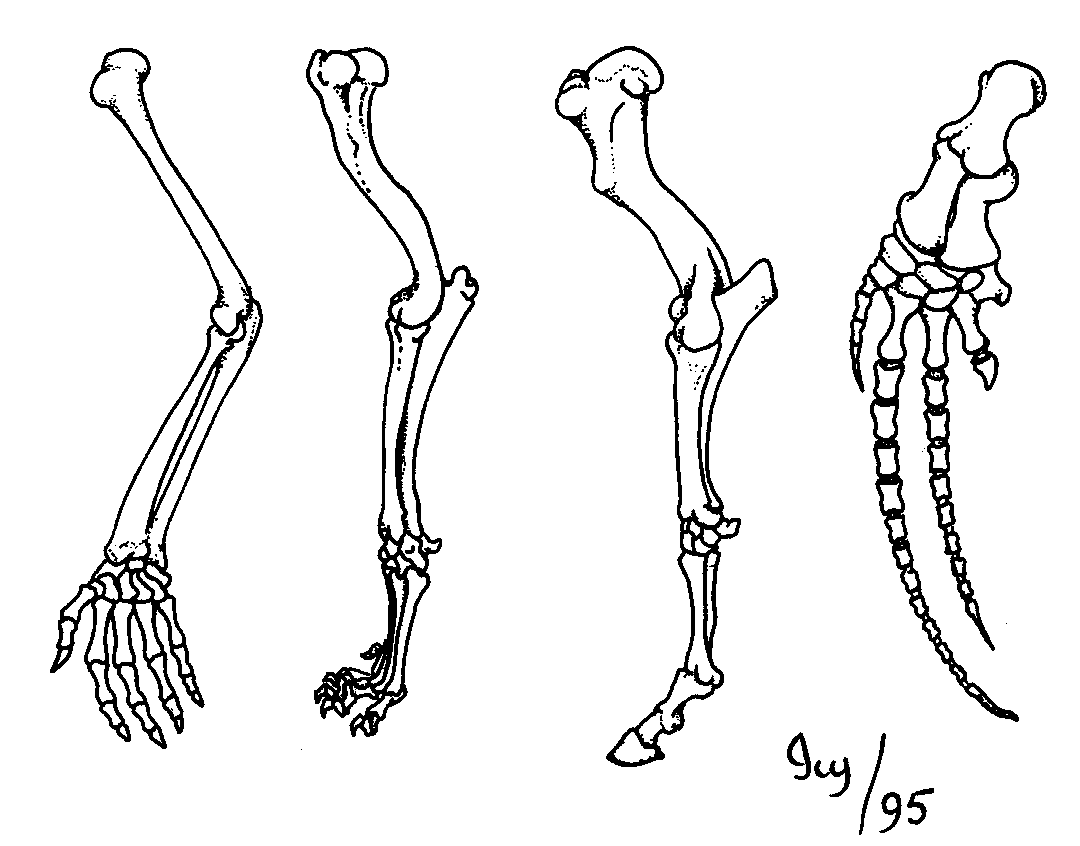
74.
Structures with the same parts have different functions; suggests that organisms share a common ancestry
a)
vestigial structures
b)
homologous structures
c)
adaptive radiation
d)
fossil
75.
Study of embryos of various organisms to show a common ancestor because of similarities in development
a)
natural selection
b)
embryology
c)
speciation
d)
evolution
76.
Some organisms that share a common ancestor have features that have different functions, but similar structures.  These are known as
a)
vestigial structures
b)
analogous structures
c)
homologous structures
d)
fossil structures
77.
How do fossils provide evidence that evolution has happened on Earth?
a)
Fossils show how the sizes of certain animals has changed drastically over millions of years
b)
Fossils show that some species have gone extinct
c)
Fossils show how life forms present today are different than those from the past
d)
Different sedimentary rock layers provide evidence for how the environment has changed over time
78.
The diagram illustrates an embryonic stage of two organisms.

Which of the following can be determined by observing the embryos shown in the diagram
a)
The organisms share a common ancestry.
b)
The organisms belong to the same genus.
c)
The organisms are native to the same geographic areas.
d)
The organisms will grow into anatomically similar adults.
79.
Humans, birds, whales, and lizards all have similar arm bones. What is the reason for this?
a)
The function of these bones is the same in all animals
b)
They live in similar environments
c)
They have a common ancestor
d)
All organisms resemble humans
80.

Vestigial structures

a)

structures that perform a similar function but are not similar in origin

b)

remnants of once-important structures that have slowly lost all or most of their function

c)

features found in different organisms that share structural similarities but may have very different functions

d)

preserved remains of an organism

81.
Which layer is the youngest
a)
1
b)
2
c)
3
d)
4
82.
The changes of species over time
a)
Embryonic 
b)
Natural selection 
c)
Mimicry 
d)
Evolution 
83.

The picture shows a/an ___________

a)

homologous structure

b)

vestigial structure

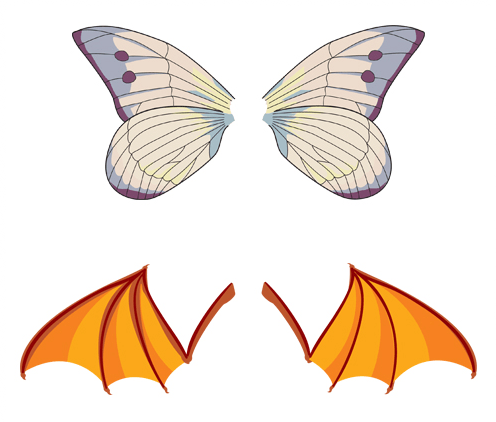
84.

What is this an example of?

a)

Homologous structure

b)

Analogous structure

c)

Vestigial organs

d)

Functional adaption

85.
Study of embryos of various organisms to show a common ancestor because of similarities in development
a)
natural selection
b)
embryology
c)
speciation
d)
evolution
86.
How do fossils provide evidence that evolution has happened on Earth?
a)
Fossils show how the sizes of certain animals has changed drastically over millions of years
b)
Fossils show that some species have gone extinct
c)
Fossils show how life forms present today are different than those from the past
d)
Different sedimentary rock layers provide evidence for how the environment has changed over time
87.
The diagram illustrates an embryonic stage of two organisms.

Which of the following can be determined by observing the embryos shown in the diagram
a)
The organisms share a common ancestry.
b)
The organisms belong to the same genus.
c)
The organisms are native to the same geographic areas.
d)
The organisms will grow into anatomically similar adults.
88.

What best describes the hind leg bones seen in the whale?

a)

The bones are analogous structures to the fins of living fish.

b)

The bones are vestigial structures that had a function in an ancestor.

c)

The bones are homologous structures to the wings of butterflies.

d)

The bones are fossil structures from an extinct ancestor.
89.
Which layer is the youngest
a)
1
b)
2
c)
3
d)
4
90.
If two organisms have similar traits of DNA they are probably
a)
share a common ancestor
b)
share a common environment
c)
share a common population
d)
speciation
91.
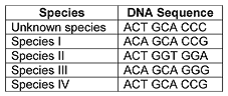
According to this data, the unknown bacterial species is most closely related to: 
a)
Species I
b)
Species II
c)
Species III
d)
Species IV
92.

Mountains and now breeds on the Santa Rita Mountains with another established population.

a)

Gene Flow

b)

Genetic Drift

93.

A forest fire ignites in the Sam Houston State Forest and kills many members of a population of pigmy rattlesnakes.

a)

Gene Flow

b)

Genetic Drift

94.

Select the best answer based on the image.

a)

Gene Flow

b)

Genetic Drift

95.

Genetic diversity is decreased through this process.

a)

Gene Flow

b)

Genetic Drift

96.

Maria Concepcion Soto settled in the northern area of Venezuela. She suffered from a rare genetic disorder called Huntington’s Disease. As a result, the now 20,000 individuals who live there also have a high risk of Huntington’s Disease.

a)

Gene Flow

b)

Genetic Drift

97.

Select the best answer based on the image.

a)

Gene Flow

b)

Genetic Drift

98.

One of the original Amish settlers who founded a new area for them had a rare, genetic disorder which causes short limbs and extra digits. Now, many within the population show this trait.

a)

Gene Flow

b)

Genetic Drift

99.

Genetic Diversity is increased through this process.

a)

Gene Flow

b)

Genetic Drift

100.

Select the best answer based on the image.

a)

Gene Flow

b)

Genetic Drift

101.

A population of flowers on one side of a river transports pollen to flowers on the other side of the river

a)

Gene Flow

b)

Genetic Drift

102.

In a pedigree, a male is represented by a

a)

circle

b)

rectangle

c)

diamond

d)

square

103.

How many alleles does a person carry for a trait?

a)

1

b)

2

c)

3

d)

4

104.

How many alleles does a child get from each parent for a trait?

a)

1

b)

2

c)

3

d)

4

105.

Aa, DD, Bb, yy are all examples of ---

a)

genotypes.

b)

phenotypes.

106.
What do we use pedigrees for?
a)
To look at families
b)
To make determinations about the offspring
c)
To track traits in families
d)
Nothing
107.

Which gender has an X and a Y chromosome?

a)

male

b)

female

108.

On a pedigree, this symbol represents a(n)

a)

not affected female.

b)

not affected male.

c)

affected male.

d)

affected female.

109.

On a pedigree, this symbol represents a(n)

a)

not affected male.

b)

not affected female.

c)

affected male.

d)

affected female.

110.

How many individuals are there in the 3rd generation?

a)

1

b)

2

c)

4

d)

6

111.

How are individuals III-2 and II-4 related?

a)

Brother and sister

b)

Dad and daughter

c)

Uncle and niece

d)

Grandfather and granddaughter

112.

The trait this pedigree traces is recessive because it skips a generation and individuals can be carriers. What is the most likely genotype for person III-3?

a)

GG

b)

Gg

c)

gg