
 Worksheets
Unit 4 Test Review -2nd SEM ( Evolution/Biodiversity)
Total questions: 112
Worksheet time: 1hrs 21mins

What is the definition of evolution?
populations that change over time
ability to survive and reproduce
individuals that change over time
natural variations in populations
Why does high genetic diversity/variation help populations survive?
high genetic diversity means a bigger population
high genetic diversity means a smaller population
lower chance that some organisms will survive in a changing environment
higher chance that some organisms will survive in a changing environment
In Darwin's theory of evolution, do individual organisms or populations of organisms evolve?
Individuals evolve in their own lifetimes
populations evolve over a period of time
What allows organisms to survive in changing environments over time?
mutations provide variation, which increases chance of survival
mutations are always harmful and do not benefit the organism
all mutations in body cells get passed on
mutations in gametes are always deadly

Individuals can not evolve.


Which of the following is the collection of life's remains found in sedimentary rock?
natural selection
homologous structures
Charles Darwin
the fossil record
Similar structures with different purposes found in different species are known as _____
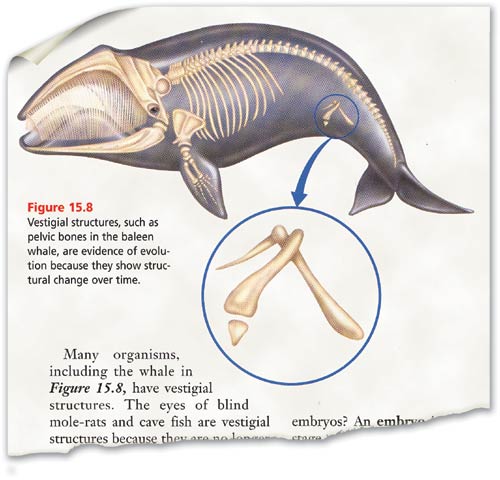
vestigial structures
DNA
homologous structures
the fossil record

The picture shows a/an ___________
homologous structure
vestigial structure
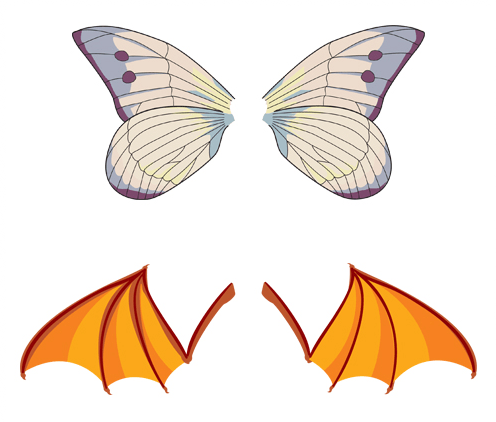
What is this an example of?
Homologous structure
Analogous structure
Vestigial organs
Functional adaption


Which two organisms are the least related?
lizard and salmon
hamster and salmon
chimpanzee and hamster
chimpanzee and salmon
Which describes a difference between prokaryotes and eukaryotes?
Prokaryotes have a nucleus and eukaryotes do not
Nucleic acids are only found in eukaryotes
Eukaryotes have more mitochondria than prokaryotes
Prokaryotes have DNA but no nucleus
Which is an example of using biochemical evidence to determine ancestry?
Humans, whales and bats have similar bone structure in their forelimbs.
Digestion in all organisms follows a similar pathway.
Chimps and humans have a similar gene sequence
Fish, birds, and rabbit embryos have similar structures in early stages
If two species of squirrels live on either side of a canyon, what is the likely reason they became a separate species?
They mate at different times.
The gametes cannot fertilize each other.
Geography prevents mating from occurring.
They have different courtship rituals.
What determines if organisms are classified as the same species?
produce fertile offspring
live in the same area
eat the same foods
evolve the same adaptations
The Endosymbiotic Theory explains
the origin of prokaryotes
how bacteria lives
the origin of eukaryotes
how species develop
_____ and _____ are organelles that arose from endosymbiosis
nucleus and cell membrane
mitochondria and chloroplasts
cell wall and chloroplasts
mitochondria and nucleus
Which of the following is evidence to support the endosymbiotic theory?
Mitochondria and chloroplasts have their own DNA, which is similar to prokaryotic DNA.
Fossil evidence shows that the first forms of life were prokaryotic cells.
All eukaryotic cells have a double-layered membrane composed of phosplipids and proteins.
Prokaryotes have the same number and types of enzymes as eukaryotes.
Match the following pictures with the words they represent

Analogous Structure

Homologous Structure

Adaptation

Artificial selection

Natural selection

Organism

Population

Community

ecosystem

biosphere
vestigial structures, like the tail bone, are
No longer used
Serve an important role in our body
allow us to connect with animals
serve multi-purposes
Structures that serve a similar purpose but the organisms do not share ancestors are
Homologous
Analogous
Vestigial
Dichotomous

Codominance

incomplete dominance

genetic variation

Convergent evolution

divergent evolution
(a) evolution is when different species have a similar structure, like fins on a shark and on a dolphin, but have different ancestors
The theory of evolution states that...
Change happens rappidly
Genes point to common ancestry
Change happens to individuals
Change happens gradually, over time
Change happens in populations

Humans breed corn with specific charateristics
artificial selection
Genetic characteristics of a population of deer change
Natural selection
Insects eating crops are not killed by insecticide
Resistance
Thick fur keeps deer warm in cold environments
adaptation
More deer with thick fur survive
Evolution

The process of two species changing genetically in response to long-term interaction with each other is
artificial selection
coevolution
selective breeding
resistance

For evolution to occur in a population, individuals with a trait that is "naturally selected for" must
live a long time
leave the area
reproduce
coevolve

An organism is resistant to a chemical if it
has a gene that protects it from the chemical
has been exposed to a small amount of the chemical over time
was not in the area where the chemical was applied
did not eat anything with the chemical on it

Some organisms are more likely to survive because they
have certain physical traits
lack certain physical traits
have certain behaviors
all of the above
Species with similar evolutionary histories are classified more closely together.
true
false
Two organisms that both develop the ability to breathe underwater because they live in watery environments is an example of...?
natural selection
evolutionary history
convergent evolution
divergent evolution
none of the answers are correct

Which of the following is an example of the founder effect?
Humans choose two dogs they like the characteristics of and breed them together.
Affected individuals with blue skin can trace their ancestry back to one of the first settlers in the region.
The environment of a fox population changes and over time foxes who are white survive and pass on their genes to their offspring.
Cheetah populations reach their lowest levels with reduced diversity and as they rebound are so genetically similar they appear to be inbred.
All of the genetic information found in a population.
population
genetic drift
evolution
gene pool
Which form of genetic drift will change the frequency of alleles in a population?
Founder's Effect
Bottleneck Effect
Neither
Both

What is genetic drift?
A change in DNA.
The change of a gene pool as a result of chance or random event.
Survival of the fittest.
Movement of genes into or out of a population due to immigration or emigration.
Non-random mating can result in...
Genetic mutations
Decreased variation
Increased gene pool
Decreased population
What are random changes of an organism due to changes in the DNA
Genetic Drift
Non-random mating
Natural Selection
Mutations
The movement of alleles into, or out of, a population as a result of immigration or emigration
Genetic Drift
Gene Flow
Adaptations
Natural Selection
What is genetic drift?
the changes in allele frequencies (genes) ,in a population, happening due to random events/circumstances.
It is an example of primary succession
Genetic drift are different organisms in a population due to inherited traits from their parents
It is part of symbiotic relationships such as mutualism, commensalism, parasitism
How do populations change due to genetic drift?
Something occurs to the population, either bottle neck or founder and the new population has different genes from the original population.
The population undergoes competition with each other for limited resources.
The organism/animal with the most favorable trait will be able to produce more offspring than others creating the new population.
organisms within a population undergo symbiotic relationships with each other.
what are two types of genetic drift?
Bottleneck effect and primary succession
Bottleneck effect and mutualism
Secondary effect and founder effect
Bottleneck effect and founder effect
True or false: Genetic drift is predictable
True
False
A population of mice undergoes disruptive selection for size. What will happen to the population?
The mice will get bigger
The mice will get smaller
The mice will stay the same size
There will be some large mice and some small mice
Which of the following is the collection of life's remains found in sedimentary rock?
natural selection
homologous structures
Charles Darwin
the fossil record

Similarities in bone arrangements, like those in the picture, support the hypothesis that...
these organisms are not well adapted
these organisms share a common ancestor
these organisms all share the same DNA sequences
these organisms are members of the same species
Hawks eat snakes. Snakes evolved to have skin coloration that lets them blend into their environment. Hawks evolved to have excellent eyesight. What is this an example of?
Coevolution
Character displacement
Resource partitioning
Mutualistic partner
What are the three main parts of Biodiversity? (Check all that apply)
Endangered
Species
Genetic
High Risk
Ecosystem
The level of biodiversity that involves a variety of habits and communities is _____ diversity.
ecosystem
population
genetic
species
Why is biodiversity important to ecosystems?
It helps populations adapt to ecological changes.
It increases at each level of the food chain.
It provides more abiotic factors for the ecosystem.
Which statement best describes an example of low species diversity?
A population of frogs has a wide variety of skin colors
A marsh ecosystem is covered by a single species of cattail bulrushes
A state park includes multiple forest, wetland, and freshwater ecosystems
Narrative:
In 1957, Brazil imported wild African honeybees to help increase honey production, but the bees displaced some native honeybee populations, which led to a reduced honey supply.
-----
These African honeybees are an example of a _____ species.
invasive
keystone
native
specialist
extinct
Narrative:
In 1935, insect pests were destroying the sugarcane fields of Australia. Scientists brought in giant cane toads, which had voracious appetites, to eat the pests. Unfortunately, the cane toads were not interested in eating the field pests. Even worse, the toads themselves were toxic to predators. As a result, populations of birds and lizards that hunted the cane toads begin sharply decreasing. Cane toad populations exploded.
---
Which conclusion can you draw from the paragraph?
Nonnative species are always harmful.
Nonnative species often lack natural controls found in their native habitat.
Another species will need to be introduced to control the cane toad populations.
Scientists should have known that the toads would be a nuisance.
Native species cannot compete with nonnative species.
Which statement is true with regard to keystone species?
A species must be present in large numbers in order to be a keystone species.
Top predators can be keystone species but other animals cannot.
Keystone species can control the distribution of other species in an ecosystem.
Animals can be keystone species but plants cannot.
Keystone species tend to negatively impact ecosystems.
Species whose roles have a large effect on the types and abundance of other species in an ecosystem are called _______ species
endemic
indicator
keystone
specialist
native
________ species is an organism that plays a uniquely important role in the way an ecosystem functions.
native
keystone
invasive
indicator
The place, or type of ecosystem, in which a species lives and obtains what it needs to survive.
habitat
niche
biome
biosphere
Ecologists describe the role that a species plays in an ecosystem as its
adaptation
niche
habitat
species function
Which of the following provide evidence for the hypothesis that prokaryotes evolved before eukaryotes.
prokaryotes are more complex
eukaryotes are multicellular which makes them simpler
prokaryotes have no nucleus and fewer genes
prokaryotes grow into eukaryotes
Where is the DNA found in a prokaryotic cell?
in the ribosomes
floating around in the cytoplasm
attached to the cell membrane
in the nucleus
______ and ________ are organelles that arose from the endosymbiotic theory
flagellum and chloroplast
mitochondria and chloroplasts
Smooth and Rough ER
mitochrondria and cell wall
The Theory of Endosymbiosis explains:
how bacteria live
the origin of Eukaryotes
Why cells rely on one another
how species develop
Which of the following is evidence to support the endosymbiotic theory?
Mitochondria and chloroplasts have their own DNA, which is similar to prokaryotic DNA.
Fossil evidence shows that the first forms of life were prokaryotic cells.
All eukaryotic cells have a double-layered membrane composed of phosplipids and proteins.
Prokaryotes have the same number and types of enzymes as eukaryotes.
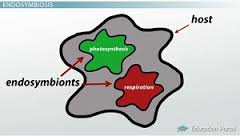
Both eukaryotic and prokaryotic cells have:
ribosomes
cell membranes
false
true
Which statement below correctly explains and gives the importance of the endosymbiotic theory?
The endosymbiotic theory states that the inner and outer membrane of the endoplasmic reticulum indicates these were once free living organisms which were taken into an early cell via endocytosis. The theory was further supported by the presence of prokaryotic ribosomes and replication of the endoplasmic reticulum via binary fission.
The endosymbiotic theory states that the inner and outer membrane of the mitochondria indicates these were once free living organisms which were taken into an early cell via endocytosis. The theory was further supported by the presence of prokaryotic ribosomes and replication of mitochondria via binary fission.
The endosymbiotic theory states that through endocytosis, early prokaryotic cells were able to bring in additional nutrients. These additional nutrients provided important energy that drove evolution of these prokaryotic cells into the eukaryotic cells seen today in more advanced organisms.
The endosymbiotic theory states that through endocytosis, early prokaryotic cells were able to bring in early energy rich eukaryotic cells. The energy provided drove evolution of these prokaryotic cells into the eukaryotic cells seen today in more advanced organisms.
Which is not a domain?
archaea
eukarya
botany
all of the answers to the left are correct
none of the answers to the left are correct
The Eukarya Domain includes which kingdoms?
Bacteria
Archaea
Plantae, Animalia
Plantae, Animalia, Protista, Fungi
An organism that is multicellular, reproduces sexually, and makes its own food (autotrophic) is classified into which taxonomic kingdom?
Fungi
Animalia
Plantae
Protista
What kingdom include prokaryotic organisms that live in hot, salty environments?
Plantae
Animalia
Archaea
Bacteria

An organism is multicellular, eukaryotic, and is a
heterotroph that breaks down dead organisms. Which kingdom may this organism belong to?
Kingdom Bacteria
Kingdom Fungi
Kingdom Plantae
Kingdom Animalia
I am a unicellular, autotrophic eukaryote that lives in a pond. What kingdom am I in?
Protista
Bacteria
Fungi
Animalia

What is the closest relative of humans shown in this diagram?
horse
turtle
monkey
dog

Which species is a common ancestor for species B and D?
C
F
G
H
K

Which two living organisms are most closely related?
A and B
B and C
C and D
B and D
A and D

Which species are extinct? (Check all that apply)
Asian elephant
Mammoth
Mastadon
Stellar's sea cow
Dugong
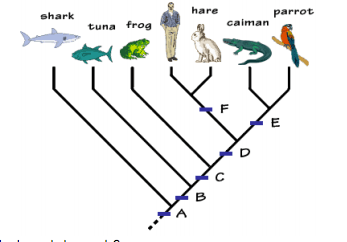
On the cladogram, which organism is the closest relative of the parrot?
Frog
Hare
Caiman
Parrot
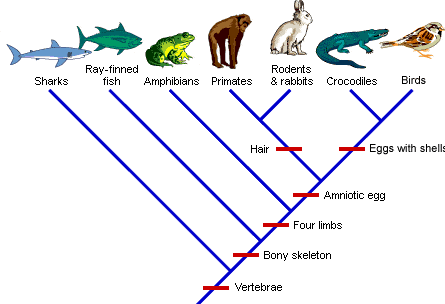
According to this cladogram, primates are most closely related to....
Amphibians
Rodents & rabbits
Crocodiles
Birds

Kangaroos and opossums both carry their immature offspring in pouches. This is evidence of
a common ancestor
living in the same habitat
similar skeletal structures
analogous structures

