
 Worksheets
Q2 Foundation Doc Biology
Total questions: 111
Worksheet time: 2hrs 47mins

distributes oxygen and nutrients to cells all over the body and carries carbon dioxide and waste away from the cells.
Circulatory System
Respiratory
Digestive System
Nervous System
Muscular System

absorbs oxygen gas (O2) into the body which is needed for cellular respiration.
Circulatory System
Respiratory
Digestive System
Nervous System
Muscular System
releases carbon dioxide gas (CO2) from of the body.
Circulatory System
Respiratory
Digestive System
Nervous System
Muscular System

breaks down food and absorbs nutrients needed for the growth and repair of the body.
Circulatory System
Respiratory
Digestive System
Endocrine System
Muscular System
It is aided by bacteria that live in the intestines and help break down complex nutrients.
Circulatory System
Respiratory
Digestive System
Endocrine System
Muscular System

responds to stimuli from inside and outside the
body.
Circulatory System
Muscular System
Skeletal System
Nervous System
Integumentary System
It controls the body’s actions and its responses to any
changes. All five senses are part of the nervous system.
Circulatory System
Muscular System
Skeletal System
Nervous System
Integumentary System

Hormones are chemical signals produced by the glands of the _______________. Hormones help maintain homeostasis and control growth and development.
Circulatory System
Muscular System
Skeletal System
Nervous System
Endocrine System

Skin is the primary organ of the
Integumentary System
Muscular System
Skeletal System
Nervous System
Immune System
serves as a protective barrier around your body preventing
water loss and helping to control body temperature.
Integumentary System
Muscular System
Skeletal System
Nervous System
Immune System

The bones of the _____________ provide the structure and support needed for movements and protect your internal organs. Bones store minerals and produce blood cells in the bone marrow.
Integumentary System
Muscular System
Skeletal System
Circulatory System
Immune System

responsible for all of the body’s movements, both voluntary
(jumping, chewing, walking, etc.) and involuntary (breathing,
stomach churning, heart pumping, etc.).
Integumentary System
Muscular System
Skeletal System
Circulatory System
Immune System

made of white blood cells and antibodies that protect your body from infection. HIV attacks a special type of white blood cell called a T helper cell.
Integumentary System
Muscular System
Skeletal System
Circulatory System
Immune System

Produces the gamete cells needed for sexual reproduction inside the gonads (testes or ovaries). The male gamete cells are called sperm, and the female gamete cells are called eggs.
Excretory System
Endocrine System
Reproductive System
Circulatory System
Immune System

As this fluid passes through lymph nodes, white
blood cells attack and kill parasites found in the fluid.
Excretory System
Endocrine System
Lymphatic System
Circulatory System
Immune System
removes fluid from around cells and returns it to the circulatory system.
Excretory System
Endocrine System
Lymphatic System
Circulatory System
Immune System

removes waste from the body and helps the body maintain homeostasis by preventing the buildup of excess fluid and solid material within the body.
Excretory System
Endocrine System
Reproductive System
Circulatory System
Digestive System

The information in DNA is written according to the genetic code and carried by the -
sequence of nitrogen bases/nucleotides
direction of the phosphate groups
hydrogen bonds between nitrogen bases
enzymes which unwind the double helix
The genetic code describes the way that information is coded in DNA. This code is -
unique to organisms like a fingerprint
similar between closely related organisms
determined by organism’s environment
the same among all living organisms
The genetic code seems to suggest that all organisms are related. This conclusion is based on the fact that –
all living things have unique coding systems
each species has some form of a code
every living thing uses the same code
living things pass DNA to offspring

The three parts of a nucleotide are:
Ribose sugar, phosphate group, nitrogenous base
Hydrogen bond, Deoxyribose sugar, nitrogenous base
Deoxyribose sugar, phosphate group, nitrogen base
Glucose sugar, phosphate group, nitrogen base

Every nucleotide has ___________ parts
1
2
3
4

Nucleic acids like DNA are long chains of:
Carbohydrates
Proteins
Nucleotides
Lipids

What holds the strands of DNA together?
Sugar phosphate backbone
Nitrogenous bases
Hydrogen bonds
Nucleotides

What provides the shape and structure of DNA?
Hydrogen bonds
Double helix
Nitrogenous bases
The sugar-phosphate backbone

What is the shape of DNA called?
A twisted ladder
X-ray
Sugar Phosphate
Double Helix

Which nitrogen base pairs with A?
A
T
C
G

Which nitrogen base pairs with G?
A
T
G
C

What carries the instructions for specific traits?
the sequence of nucleotides
the double helix shape
the sugar phosphate backbone
the number of proteins
The information in DNA is written according to the genetic code and carried by the -
sequence of nitrogen bases/nucleotides
direction of the phosphate groups
hydrogen bonds between nitrogen bases
enzymes which unwind the double helix
What is a change to the sequence of nucleotides in DNA called?
Foundation
Simulation
Mutation
Remediation

What causes an insertion mutation?
Adding nucleotide bases
Removing nucleotide bases
Replacing nucleotide bases
Shortening nucleotide bases

What causes a deletion mutation?
Adding nucleotide bases
Removing nucleotide bases
Replacing nucleotide bases
Shortening nucleotide bases

What causes a substitution mutation?
Adding nucleotide bases
Removing nucleotide bases
Replacing nucleotide bases
Shortening nucleotide bases

Mutations can cause codon sequences to be incorrect. What does this change?
The DNA
The RNA
The amino acids that make a protein
The carbohydrates

What is a silent mutation?
An insertion to a sequence of amino acids
A deletion to a sequence of amino acids
No change to a sequence of amino acids
A replacement to a sequence of amino acids

What is a frameshift mutation?
A silent mutation that causes no change
An insertion or deletion that changes the reading frame of a gene
Adding a new frame to the gene
A stop codon causes the gene to be shorter than normal

Any mutation to the DNA can be passed on to that organism's offspring.
True
False

Only mutations to what cells will be passed on to offspring?
Brain Cell
Skin Cell
Eye cell
Gamete Cell

Inherited diseases are the result of what?
Changes to the DNA
Meiosis
Mitosis
Cellular Division

Mutations are also a source of what?
Sexual reproduction
Genetic Variation
Cloning
Asexual reproduction


T-G-A-C-C-A
T-G-A-G-C-A
The mutated DNA segment is TTCGCAAG. This is an example of ___ mutation.

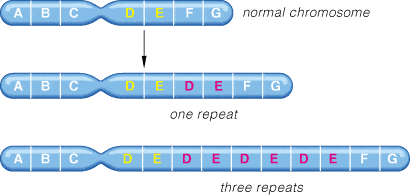
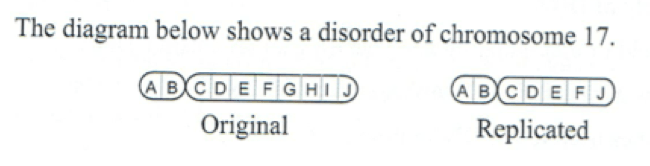
What term does this image represent?
Insertion
Inversion
Translocation
Nondisjunction
Duplication

A certain mutation in the gene for hemoglobin results in the red blood cells becoming sticky, rigid, and irregularly shaped. These irregularly shaped red blood cells block the flow of blood throughout the body. A single base mutation is responsible for these irregularly shaped blood cells.
Which of these mutations most likely results in the mutated hemoglobin gene?
Insertion
Deletion
Duplication
Substitution
Which of the following is a true statement about the process of Transcription?
Transcription is a process in which information from DNA is copied into mRNA. The product of Transcription is mRNA.
Transcription is a process in which mRNA is decoded into proteins. The product of Transcription are proteins.

What process is this?
Transcription
Translation

What process is this?
Transcription
Translation

What process is this?
Transcription
Translation

Using a codon chart, what does the codon GUC translate into?
Leucine
Lysine
Valine
Alanine
Using a codon chart, what does the codon UAA translate into?
Leucine
Stop
Valine
Tyrosine
Using a codon chart, what does the codon AUG translate into?
Methionine
Stop
Valine
Isoleucine
What is the product of Translation?
mRNA
proteins

Which process is defined as copying information in DNA so that it can be used by the cell?
Replication
Transcription
Translation
Mutation

What is the product of transcription?
DNA
mRNA
Uracil
Proteins

How is base pairing in RNA different than DNA?
A pairs with C
A pairs with U
C pairs with T
G pairs with A

Which cellular process turns the genetic code into a sequence of amino acids?
Replication
Transcription
Translation
Mutation

The product of Translation is:
DNA
mRNA
Uracil
Proteins

Proteins are made of:
nucleic acids
sugars
lipids
amino acids

Which organelle makes proteins?
nucleus
ribosomes
endoplasmic reticulum
the cell membrane
The purpose of cellular division is to create what?
Four identical daughter cells
Two identical daughter cells
Gamete cells
Skin cells
Repeated cell divisions help an organism do what?
reproduce
create proteins
grow
communicate
What percent of the cell cycle is spend in interphase?
10%
50%
90%
100%
Interphase contains the G1, S, and G2 phases. G stands for gap, but also what other process that occurs during the g stage?
Grunt
Go
Gain
Growth
What is the purpose of a checkpoint during the cell cycle?
To ensure that daughter cells are healthy and functional
To create additional proteins
To slow down the cycle
To allow communication with the cell membrane
What does the "S" in S phase stand for?
Sign
Synchronize
Super
Synthesis
What is created during the S phase?
A second set of DNA
A new cellular membrane
Additional proteins
mRNA
How many complete sets of DNA exist after the S phase?
1
2
4
0
What is the purpose of mitosis?
To allow new cells to create proteins
To synthesize a new set of DNA
To allow each new daughter cell to have a complete set of DNA
To allow cells to grow before separating
What are the four stages of mitosis?
1,2,3,4
Prophase, Monotone, Anaphase, Telephone
Protest, Metalphase, Anniephase, Telophase
Prophase, Metaphase, Anaphase, Telophase
What occurs during prophase?
Spindle fibers attach to chromosomes and line them up
Spindle fibers separate the chromosomes into two sets
Chromosomes condense and the nucleus dissolves
Nuclei reform around each set of DNA
What occurs during metaphase?
Spindle fibers attach to chromosomes and line them up
Spindle fibers separate the chromosomes into two sets
Chromosomes condense and the nucleus dissolves
Nuclei reform around each set of DNA
What occurs during anaphase?
Spindle fibers attach to chromosomes and line them up
Spindle fibers separate the chromosomes into two sets
Chromosomes condense and the nucleus dissolves
Nuclei reform around each set of DNA
What occurs during telophase?
Spindle fibers attach to chromosomes and line them up
Spindle fibers separate the chromosomes into two sets
Chromosomes condense and the nucleus dissolves
Nuclei reform around each set of DNA
When does cytokinesis occur?
After prophase
After Telophase
After Anaphase
After Metaphase
Every cell in your body contains a full set of DNA.
True
False
Gene expression is regulated, which means it is controlled by the:
Brain
Skin
Heart
Cell
Stem cells are undifferentiated. They can later transform/specialize/differentiate into a specialized cell.
True
False
What disease can occur if the cell cycle is disrupted?
HIV
Measles
Diabetes
Cancer
When cells divide too rapidly, they can create:
Tumors
Blisters
Pustules
Nodules
What is a change to the sequence of nucleotides in DNA called?
Foundation
Simulation
Mutation
Remediation
Meiosis is important to the reproduction of organisms. Meiosis prevents the accumulation of extra genetic material by producing -
haploid gamete cells
mutations that destroy extra DNA
genetically identical daughter cells
offspring through asexual reproduction
Meiosis benefits a population by allowing for sexual reproduction. Unlike asexual reproduction, sexual reproduction actively increases the amount of –
autosomal DNA
genetic variations
available nutrients
dominant alleles
Animals that reproduce sexually differ from animals that reproduce asexually in that sexually reproducing animals have
a larger number of offspring
more genetic variation among their offspring
offspring that are nearly identical to their parents
offspring that are perfectly adapted to their parent’s habitat
Which situation is a result of crossing-over during meiosis?
Genes are duplicated exactly, ensuring that offspring will be identical to the parents.
Chromatids thicken and align themselves, helping to ensure genetic continuity.
Genes are rearranged, increasing the variability of offspring.
Chromatids fail to sort independently, creating abnormal chromosome numbers.
Crossing-over most commonly results in
new species
new populations
new combination of genes
new numbers of chromosomes

The diagram above shows the process of meiosis. The segregation that occurs during meiosis results in a -
decrease in the number of cells per organism
reduction in the number of chromosomes per cell
single fertilized egg cell
group of genetically identical cells
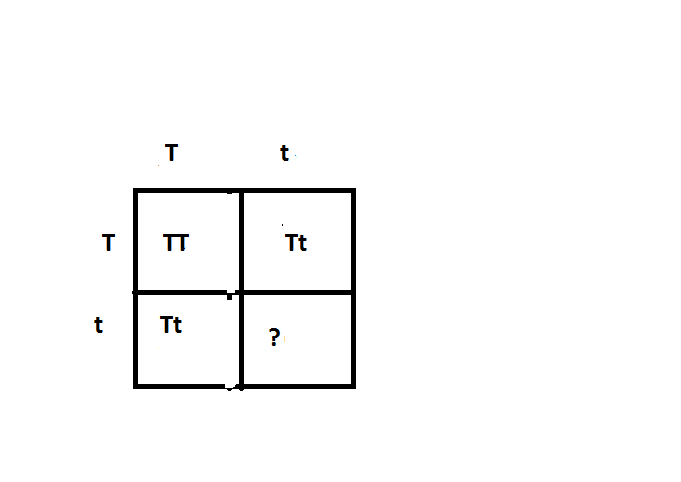
In the punnett square below, what belongs in the missing square
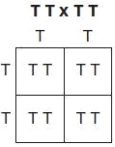


What type of inheritance pattern is shown here?
Codominance
Incomplete Dominance

the science that studies how traits are inherited through the interactions of alleles
heredity
genetics
biology
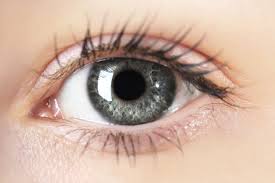
blue eyes, curly hair
genotype
phenotype
the weaker trait; you need 2 genes for the trait to show up in an organism
dominant
recessive

