
 Worksheets
Unit 1 Genetics Practice Test Pre-AP Biology
Total questions: 107
Worksheet time: 3hrs 29mins
Name
Class
Date
1.
Which significance level
(column) do you look at when finding the critical value?
(column) do you look at when finding the critical value?
a)
.50
b)
.10
c)
.05
d)
.01
2.
How do you find degrees of freedom?
a)
one less than the possible genotypes
b)
one less than the possible phenotypes
c)
total number divided 2
d)
total number times 2
3.
How do you find critical value?
a)
where degrees of freedom lines up with significance level
b)
where significance level lines up with chi-square
c)
the difference between total and chi-square
d)
degrees of freedom minus significance level
4.
Observed in the wild are 10 circles, 20 squares and 30 triangles. The ratio for this particular population is 2:3:5
observed: 10 circles expected: 12
observed 20 squares expected : 18
observed 30 triangles expected: 30
What is the degrees of freedom?
observed: 10 circles expected: 12
observed 20 squares expected : 18
observed 30 triangles expected: 30
What is the degrees of freedom?
a)
1
b)
2
c)
3
d)
4
5.

What are the degrees of freedom for the following χ² test?
a)
6
b)
2
c)
5
d)
36
6.
How do you find the expected number?
a)
ratio from punnett square multiplied to total
b)
ratio from punnett square divided by total
c)
ratio from punnett square multiplied by observed number
d)
ratio from punnett square minus observed number
7.

What are the degrees of freedom?
a)
3
b)
2
c)
1
d)
9.488
8.

How many degrees of freedom will be present?
a)
4
b)
5
c)
6
d)
7
9.

The manager of a high school cafeteria is planning to offer several new types of food for student lunches in the following school year. She wants to know if each type of food will be equally popular so she can start ordering supplies. To find out, she selects a random sample of 100 students and asks them, "Which type of food do you prefer: Asian food, Mexican food, pizza, or hamburgers?" Here are the data in the table provided. Identify the p-value and decide which of the following is the most appropriate conclusion?
a)
Because 0.0129 is less than α = 0.05, fail to reject H0. There is convincing evidence that the food choices are equally popular.
b)
Because 0.0129 is less than α = 0.05, reject H0. There is convincing evidence that the food choices are not equally popular.
c)
Because 0.0289 is less than α = 0.05, reject H0. There is convincing evidence that the food choices are not equally popular.
d)
Because 0.0289 is less than α = 0.05, fail to reject H0. There is not convincing evidence that the food choices are equally popular.
10.
How do you find degrees of freedom?
a)
one less than the possible genotypes
b)
one less than the possible phenotypes
c)
total number divided 2
d)
total number times 2
11.
Observed in the wild are 10 circles, 20 squares and 30 triangles. The ratio for this particular population is 2:3:5
observed: 10 circles expected:
observed 20 squares expected : 18
observed 30 triangles expected: 30
What is the expected number for circles?
observed: 10 circles expected:
observed 20 squares expected : 18
observed 30 triangles expected: 30
What is the expected number for circles?
a)
6
b)
12
c)
18
d)
24
12.
Observed in the wild are 10 circles, 20 squares and 30 triangles. The ratio for this particular population is 2:3:5
observed: 10 circles expected: 12
observed 20 squares expected : 18
observed 30 triangles expected: 30
What is the critical value?
observed: 10 circles expected: 12
observed 20 squares expected : 18
observed 30 triangles expected: 30
What is the critical value?
a)
3.841
b)
5.991
c)
7.815
d)
9.488
13.
Observed in the wild are 10 circles, 20 squares and 30 triangles. The ratio for this particular population is 2:3:5
observed: 10 circles expected: 12
observed 20 squares expected : 18
observed 30 triangles expected: 30
What is the X2 of this problem?
observed: 10 circles expected: 12
observed 20 squares expected : 18
observed 30 triangles expected: 30
What is the X2 of this problem?
a)
.22
b)
.33
c)
.44
d)
.55
14.
Observed in the wild are 10 circles, 20 squares and 30 triangles. The ratio for this particular population is 2:3:5
observed: 10 circles expected: 12
observed 20 squares expected : 18
observed 30 triangles expected: 30
Would you accept or reject?
observed: 10 circles expected: 12
observed 20 squares expected : 18
observed 30 triangles expected: 30
Would you accept or reject?
a)
accept
b)
reject
15.

What gamete possibilities could come from this parent's genotype?
a)
AB, AB, aB, aB
b)
Ab, AB, Ab, ab
c)
Ab, Ab, Ab, Ab
d)
AB, aB, ab, aB
16.

What gamete possibilities could come from this parent's genotype?
a)
aB, ab, AB, Ab
b)
aB, Ab, AB, AB
c)
AB, aB, AB, Ab
d)
aB, ab, aB, ab
17.

What gamete possibilities could come from this parent's genotype?
a)
aB, ab, AB, Ab
b)
Ab, AB, Ab, AB
c)
AB, AB, Ab, AB
d)
Ab, AB, ab, aB
18.

What goes in box 1
a)
AABb
b)
AABB
c)
aabb
d)
AaBb
19.
What goes in box 2
a)
AABb
b)
AaBb
c)
aabb
d)
AaBB
20.
What goes in box 3
a)
Aabb
b)
AABB
c)
AAbb
d)
aaBb
21.
What goes in box 4
a)
AABb
b)
AABB
c)
AAbb
d)
AaBB
22.
What goes in box 6
a)
AaBB
b)
AABB
c)
aaBB
d)
AAbb
23.
Cross Two Homozygous plants
(RRYY x rryy)
R = round seeds, r = wrinkled seeds Y = yellow seeds, y = green seeds
What percent will have Round and Yellow seeds?
(RRYY x rryy)
R = round seeds, r = wrinkled seeds Y = yellow seeds, y = green seeds
What percent will have Round and Yellow seeds?
a)
0%
b)
25%
c)
50%
d)
100%
24.

What genotype is missing from this Punnett Square?
a)
RrYy
b)
RRYY
c)
rryy
d)
RrYY
25.

Based off this punnett square, what fraction of the offspring will have wrinkled, yellow seeds?
a)
9/16
b)
3/16
c)
1/16
d)
16/16
26.

What genotype is missing from this Punnett Square?
a)
RrYy
b)
RRYY
c)
rryy
d)
RrYY
27.
What is the genotype for a pea plant heterozygous for round seeds (R), and homozygous recessive for green seeds (y)?
a)
Ry
b)
RRyy
c)
RrYy
d)
Rryy
28.
Cross Two Homozygous plants
(RRYY x rryy)
R = round seeds, r = wrinkled seeds Y = yellow seeds, y = green seeds
What percent will have Round and Yellow seeds?
(RRYY x rryy)
R = round seeds, r = wrinkled seeds Y = yellow seeds, y = green seeds
What percent will have Round and Yellow seeds?
a)
0%
b)
25%
c)
50%
d)
100%
29.

A calico cat shows both the traits for orange fur and black fur. What kind of allele expression is this?
a)
Incomplete Dominance
b)
Co dominance
c)
Independent assortment
d)
Recessive inheritance
30.

This type of inheritance pattern is a MIXTURE of both traits.
a)
incomplete dominance
b)
co-dominance
c)
complete dominance
d)
recessive pattern
31.

This type of inheritance pattern shows BOTH traits in possible offspring
a)
complete dominance
b)
incomplete dominance
c)
co-dominance
d)
dominant pattern
32.

This image is an example of a _____________ cross.
a)
Monohybrid
b)
Dihybrid
c)
Purebred
d)
Heterozygous
33.
In guinea pigs, black hair is dominant to white hair and short hair is dominant to long hair. What would be the phenotype of a guinea pig with the genotype Bbss?
a)
Black hair, long hair
b)
Black hair, short hair
c)
White hair, long hair
d)
White hair, short hair
34.
Based off this punnett square, what fraction of the offspring will have wrinkled, yellow seeds?
a)
9/16
b)
3/16
c)
1/16
d)
16/16
35.
Cross Two Homozygous plants
(RRYY x rryy)
R = round seeds, r = wrinkled seeds Y = yellow seeds, y = green seeds
What percent will have Round and Yellow seeds?
(RRYY x rryy)
R = round seeds, r = wrinkled seeds Y = yellow seeds, y = green seeds
What percent will have Round and Yellow seeds?
a)
0%
b)
25%
c)
50%
d)
100%
36.
The cells produced via meiosis are called:
a)
sex cells
b)
somatic cells
c)
body cells
d)
skin cells
37.
A human usually has xx amount of chromosomes.
a)
6
b)
22
c)
4
d)
46
38.
What is it called when a sperm and egg meet?
a)
meiosis
b)
fertilization
c)
cell division
d)
mitosis
39.

Meiosis makes sperm and egg cells. In humans, sperm and egg cells each have _____ chromosomes. Therefore a fertilized human egg cell (sperm and egg cell combined) would create a cell with _____ chromosomes.
a)
23, 46
b)
46, 23
c)
2, 4
d)
50, 100
40.
What causes genetic variation in meiosis?
a)
chromosomes lining up
b)
crossing over of chromosomes
c)
separation of chromosomes
d)
chromosomes pulling apart
41.
Unlike mitosis, meiosis in male mammals results in the formation of
a)
one haploid gamete
b)
three diploid gametes
c)
four diploid gametes
d)
four haploid gametes
42.

When an area of a chromatid is exchanged with the matching area on a chromatid of its homologous chromosome, _________________ occurs
a)
crossing over
b)
mutagenesis
c)
hybridization
d)
fertilization
43.
What kind of cells are made in MEIOSIS?
a)
Haploid Gametes
b)
Diploid Somatic Cells
c)
Skin Cells
d)
Liver Cells
44.
Diploid Cells are represented by
a)
2n
b)
n
c)
4n
d)
1/2 n
45.
If the Diploid number of Carrots is 18, the haploid number is
a)
18
b)
9
c)
27
d)
36
46.
Goes through P.M.A.T two rounds
a)
Mitosis
b)
Meiosis
c)
Osmosis
d)
Transcription
47.

Which process and type of resulting cells are represented?
a)
mitosis, gametes
b)
mitosis, body cells
c)
meiosis, gametes
d)
meiosis, body cells
48.
If a somatic cell in a butterfly contains 24 chromosomes, a butterfly egg would contain
a)
3
b)
6
c)
12
d)
24
49.
The chromosomes that pair up during meiosis, are called __________ chromosomes.
a)
homozygous
b)
asexual
c)
homologous
d)
genes
50.
Crossing over helps promote
a)
male genotype
b)
genetic variation
c)
DNA replication
d)
mitosis
51.
A male shark has 40 chromosomes in each of its sex cells. How many would be present in its body cells?
a)
20
b)
40
c)
80
d)
160
52.
What is another reason we need meiosis?
a)
So the offspring has genes from both parents
b)
So the offspring has genes from one parent
c)
So the offspring has genes from neither parents
d)
So the offspring makes its own genes
53.
Why do we need meiosis?
a)
To double the number of chromosomes going into sex cells
b)
To halve the number of chromosomes going into sex cells
c)
To triple the number of chromosomes going into sex cells
d)
To not change the number of chromosomes going into sex cells
54.
Chromosomes exchange genetic material during
a)
crossing over
b)
replication
c)
synthesis
d)
translation
55.
A human zygote should have _____ chromosomes inside.
a)
46
b)
23
c)
92
d)
64
56.
Why do we need meiosis?
a)
To double the number of chromosomes going into sex cells
b)
To halve the number of chromosomes going into sex cells
c)
To triple the number of chromosomes going into sex cells
d)
To not change the number of chromosomes going into sex cells
57.
The chromosomes that pair up during meiosis, are called __________ chromosomes.
a)
homozygous
b)
asexual
c)
homologous
d)
genes
58.
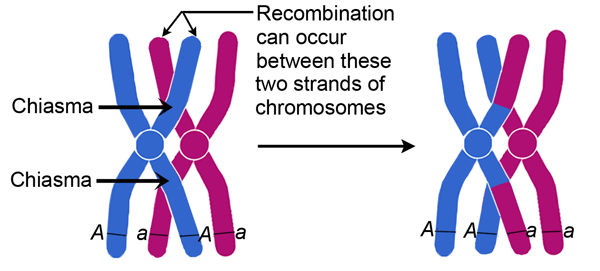
This image shows chromosomes during Prophase 1. Which of the following correctly describes the process shown?
a)
segregation of sister chromatids
b)
condensation and segregation of alleles
c)
mutationin which the DNA content of the gene is altered
d)
crossing - over in which alleles are exchanged
59.
How many daughter cells are produced from meiosis ?
a)
10
b)
6
c)
4
d)
2
60.
How are your chromosomes inherited?
a)
most of your chromosomes from your mother
b)
most of your chromosomes from your father
c)
a random number of chromosomes from each parent
d)
half your chromosomes from your mother and half from your father.
61.
Human eggs and sperm are _____, and each has ____ chromosomes.
a)
diploid, 23
b)
diploid, 46
c)
haploid, 23
d)
haploid, 46
62.
Why do we need meiosis?
a)
To double the number of chromosomes going into sex cells
b)
To halve the number of chromosomes going into sex cells
c)
To triple the number of chromosomes going into sex cells
d)
To not change the number of chromosomes going into sex cells
63.

A human usually has xx amount of chromosomes.
a)
6
b)
22
c)
4
d)
46
64.
If a somatic (body) cell in a butterfly contains 24 chromosomes, a butterfly egg would contain
a)
3
b)
6
c)
12
d)
24
65.

What process, and which type of resulting cells are represented?
a)
mitosis, gametes
b)
mitosis, body cells
c)
meiosis, gametes
d)
meiosis, body cells
66.
______________ is the normal number of chromosomes or 2n.
a)
haploid
b)
daughter
c)
diploid
d)
gamete
67.
Mitosis has ___ division(s). Meiosis has ___ division(s).
a)
1 ; 2
b)
2 ; 1
c)
1 ; 1
d)
2 ; 2
68.
What is the diploid number of chromosomes for a human cell?
a)
46
b)
23
c)
9
d)
2
69.
What is the haploid number of chromosomes for a human cell?
a)
46
b)
23
c)
9
d)
2
70.
Which of the following produces identical nuclei in cells?
a)
pollination
b)
mitosis
c)
osmosis
d)
fertilization
71.
Which of the following cell types is formed by meiosis?
a)
muscle cells
b)
skin cells
c)
sperm cells
d)
blood cells
72.

Which cellular process is shown?
a)
meiosis
b)
endocytosis
c)
mitosis
d)
phagocytosis
73.
Which statement correctly describes meiosis?
a)
cells divide only once
b)
meiosis does not occur in reproductive cells
c)
the cells produced at the end of meiosis are genetically identical to the parent cell
d)
The cells produced at the end of meiosis contain half the number of chromosomes as the parent cell
74.

Which best describes the process shown?
a)
mutation in which the DNA content of the gene is ltered
b)
segregation of sister chromatids
c)
condensation and segregation of the alleles
d)
crossing-over which alleles are exchanged
75.

Fruit fly body cells have 8 chromosomes. After mitosis, you would expect a resulting fruit fly daughter cell to have ...
a)
16 chromosomes.
b)
46 chromosomes.
c)
8 chromosomes.
d)
4 chromosomes.
76.
The process by which the nuclear material is divided equally between two new cells
a)
mitosis
b)
cancer
c)
spindle
d)
centromere
77.

Structure (b) is a ____.
a)
chromosome
b)
chromatid
c)
centromere
78.

Structure (a) is a ____.
a)
chromosome
b)
chromatid
c)
centromere
79.
The process by which the nuclear material is divided equally between two new cells
a)
mitosis
b)
cancer
c)
spindle
d)
centromere
80.

Why would it be important to replicate DNA before a cell divides in mitosis or meiosis?
a)
In order for genetic information to be transferred into daughter cells.
b)
In order for the cell to be able to increase in size.
c)
In order for the DNA to be contained in the nucleus.
d)
In order for the cell to re-order the DNA sequencing in the new cells.
81.

In mitosis, the two resulting cells are
a)
different from the starting cell and identical to each other.
b)
different from the starting cell and different from each other.
c)
identical to the starting cell and different from each other.
d)
identical to the starting cell and identical to each other.
82.

How many chromosomes do humans have?
a)
46
b)
21
c)
10
83.

Fruit fly body cells have 8 chromosomes. After mitosis, you would expect a resulting fruit fly daughter cell to have -
a)
16 chromosomes.
b)
46 chromosomes.
c)
8 chromosomes.
d)
4 chromosomes.
84.
The process by which the nuclear material is divided equally between two new cells
a)
mitosis
b)
cancer
c)
spindle
d)
centromere
85.
A dog has 78 chromosomes in its body cells. What is the diploid number?
a)
78
b)
39
c)
1
d)
100
86.
A Goat has 60 chromosomes in its body cells. What is the haploid number?
a)
60
b)
30
c)
100
d)
120
87.
Mitosis produces cells with haploid or diploid number of chromosomes?
a)
Haploid
b)
Diploid
88.
Meiosis produces cells with a haploid or diploid number of chromosomes?
a)
Haploid
b)
Diploid
89.
Body cells have diploid or haploid number of chromosomes?
a)
Haploid
b)
Diploid
90.
Gametes have haploid or diploid number of chromosomes?
a)
Haploid
b)
Diploid
91.
How many cells are produced in Mitosis?
a)
1
b)
2
c)
3
d)
4
92.
Are the cells in Mitosis identical or unique?
a)
Identical
b)
Unique
c)
It's random
93.
What occurs during interphase?
a)
Two cells are formed
b)
The nucleus disappears
c)
Chromosomes line up in the middle of the cell
d)
DNA synthesized and cell grows
94.
What type of cells are produced in meiosis?
a)
Body Cells
b)
Gametes
c)
Hair cells
d)
Liver cells
95.
How many cells are produced in meiosis?
a)
1
b)
2
c)
3
d)
4
96.
Are the cells produced in meiosis identical or unique?
a)
Identical
b)
Unique
c)
It's random
97.
Aa, DD, bB, yy are all examples of
a)
genotypes
b)
phenotypes
98.
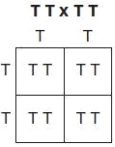
What ratio of the offspring from the cross shown will be homozygous recessive for the trait of tallness?
a)
0 in 4
b)
1 in 4
c)
2 in 4
d)
4 in 4
99.
In a flowering plant species, red flower color (R) is dominant over white flower color (r). What is the genotype of any red-flowering plant resulting from this species?
a)
rr
b)
R
c)
RR
d)
RR or Rr
100.
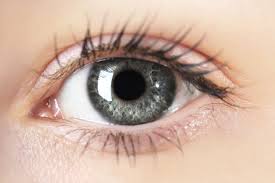
What you see, or the physical appearance.
a)
Genotype
b)
Phenotype
c)
Homozygous
d)
Heterozygous
101.
B = brown eyes
b = blue eyes
What is true about these two brothers that have brown eyes?
One has genotype BB the other Bb.
b = blue eyes
What is true about these two brothers that have brown eyes?
One has genotype BB the other Bb.
a)
they have same phenotype and genotype
b)
they have different genotypes and phenotypes
c)
they have same phenotype but different genotypes
d)
they have same genotype but different phenotypes
102.
A red flower (Rr) is crossed with a white flower (rr). What is the genotype?
a)
0 RR; 0 Rr: 4 rr
b)
2 RR; 0 Rr: 2 rr
c)
4 RR; 0 Rr: 0 rr
d)
0 RR; 2 Rr: 2 rr
103.
A homozygous dominant brown mouse is crossed with a heterozygous brown mouse (tan is the recessive color).
a)
100 % tan
b)
100 % brown
c)
50 % brown and 50% tan
d)
75 % brown and 25 % tan
104.
A tall plant (TT) is crossed with a tall plant (Tt). What is the genotype?
a)
2 TT: 2 Tt: 0 tt
b)
1 TT: 2 Tt: 1 tt
c)
2 TT: 1 Tt: 1 tt
d)
0 TT: 0 Tt: 4 tt
105.
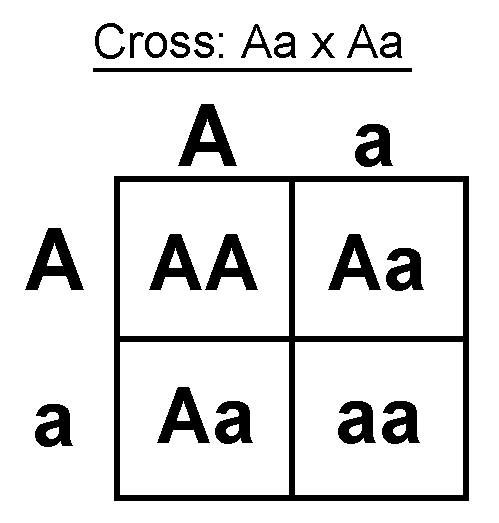
What is the phenotype of the offspring? (A-Brown hair; a-blond hair)
a)
50 % Brown Hair and 50% Blond Hair
b)
25 % Brown Hair and 75% Blond Hair
c)
75 % Brown Hair and 25% Blond Hair
d)
0% Brown Hair and 100% Blond Hair
106.
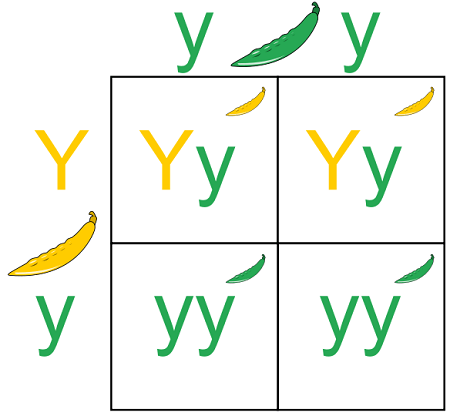
Which choice best represents the genotype of this cross?
a)
1 Yy: 2 yy: 0 YY
b)
2 Yy: 2 yy: 0 YY
c)
3 Yy: 1 yy: 0 YY
d)
1 Yy: 3 yy: 0 YY
107.

What allele combination should go in the missing box?
a)
AA
b)
Aa
c)
aa
d)
none of these
100 %

