
 Worksheets
2nd RC3 Quiz
Total questions: 107
Worksheet time: 4hrs 43mins


What is another name for natural selection?
survival of the smartest
survival of the fastest
survival of the biggest
survival of the fittest
Genetic drift is change in the allele frequency of a population due to...
random chance
natural selection
non-random mating (sexual selection)
artificial selection

The 8 levels of classification, most broad to most specific.
Domain, Genus, Family, Order, Class, Phylum, Kingdom, Species
Domain, Species, Kingdom, Genus, Phylum, Family, Class, Order
Domain, Kingdom, Phylum, Class, Order, Family, Genus, Species
Order, Kingdom, Species, Domain, Phylum, Family, Class, Genus

Scientists use eight major classification levels to group and name organisms. Which level is the broadest (most general) classification level listed below?
kingdom
domain
family
class
The binomial (2-part naming) system of classification was developed by the Father of Taxonomy, a scientist named
Darwin
Hooke
Linnaeus
Mendel
What is taxonomy?
the scientific study of how living things are classified based on similarities
the name of Aristotle's classification system
the process used by geologists to classify rocks
the process of observing an organism's behavior

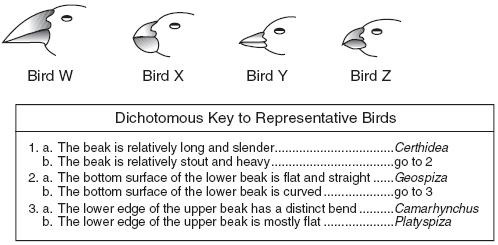
The first part of a scientific name is an organism's _______________ and the second part is its ________________.
species, genus
phylum, order
class, spices
genus, species


What would the scientific name of this organism be?
Kingdom: Animalia
Phylum: Chordata
Class: Mammalia
Order: Carnivora
Family:Canidae
Genus: Canis
species: mesomelas
Mammalia carnivora
Canidae mesomelas
Canis mesomelas
Animalia chordata
What is the scientific name of this organism?
Kingdom:Animalia
Phylum: Chordata
Class: Mammalia
Order: Rodentia
Family: Sciuridae
Genus: Ratufa
species: indica
Indica ratufa
Ratufa indica
Chordata Amimalia
Sciuridea rodenta


According to the branching dichotomous key given, the next step for a chocolate candy with no nuts should be
a. The candy is round
b. The candy is rectangular
a. The candy is caramel
b. The candy is not caramel
a. The candy is square
b. The candy is long and skinny
a. The candy is with nuts
b. The candy is without nuts

According the the dichotomous key given, what trait separates M&Ms from KitKats?
having caramel
shape of candy
number of candies
having nuts
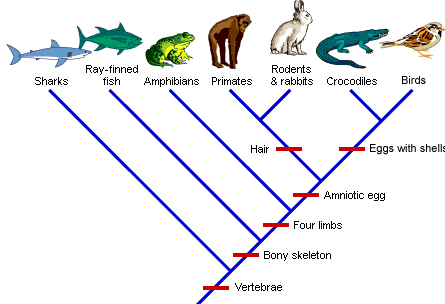
According to this cladogram, primates are most closely related to....
Amphibians
Rodents & rabbits
Crocodiles
Birds

Which trait do only humans have, according to the cladogram?
jaws
mammary glands & hair
terrestrial during all life stages
bipedal & opposable thumbs
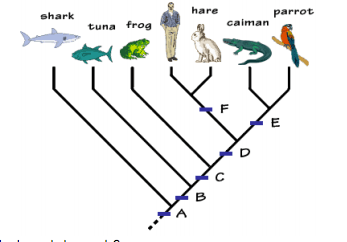
On the cladogram, which organism is the closest relative of the parrot?
Frog
Hare
Caiman
Parrot
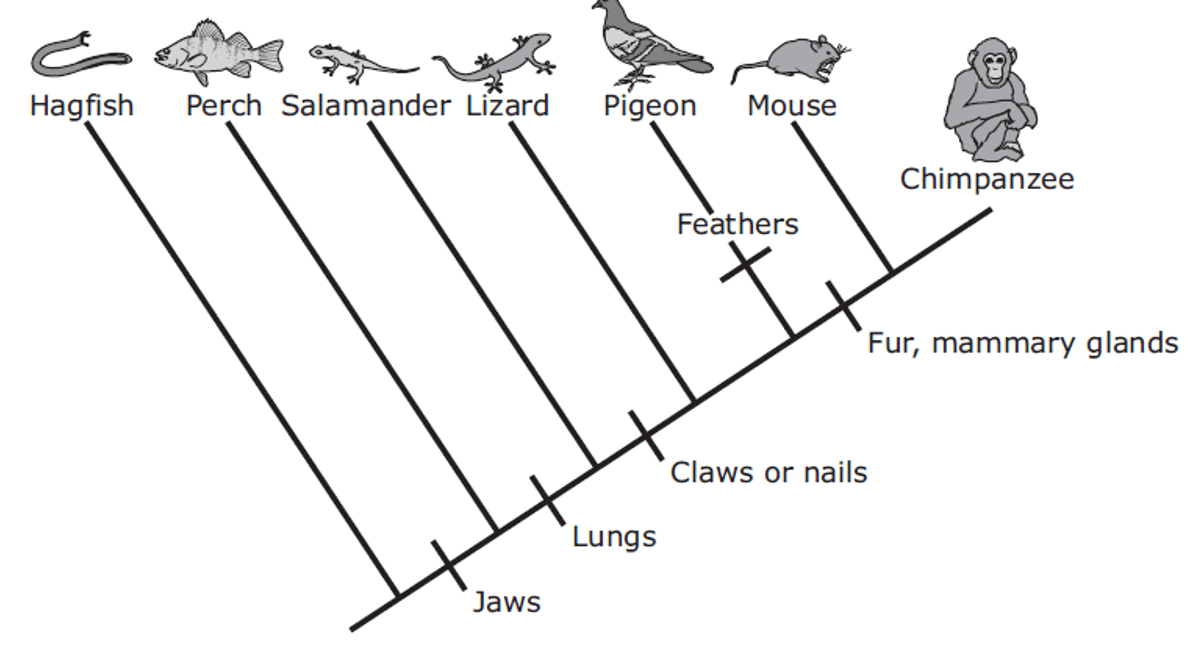
All the animals to the right of the salamander would have the common characteristic of...
Fur
Claws or nails
Lungs
Jaws
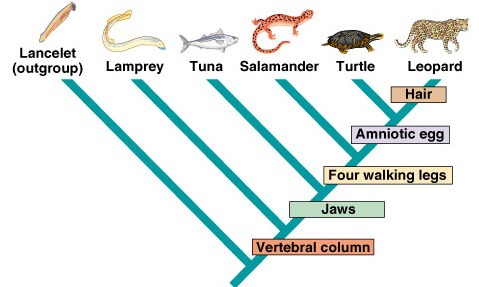
Which is the newest trait?
Amniotic egg
Walking legs
Jaws
Hair
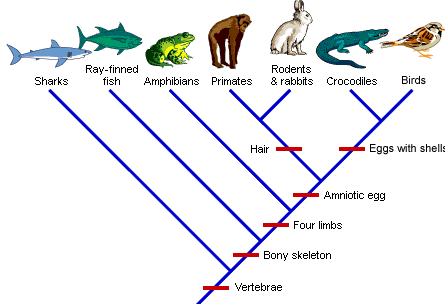
According to this cladogram, sharks are MOST closely related to which organism?
Amphibians
Ray finned fish
Crocodiles
Birds

What is this a picture of?
Pedigree
Cladogram
Family Tree
Oak Tree
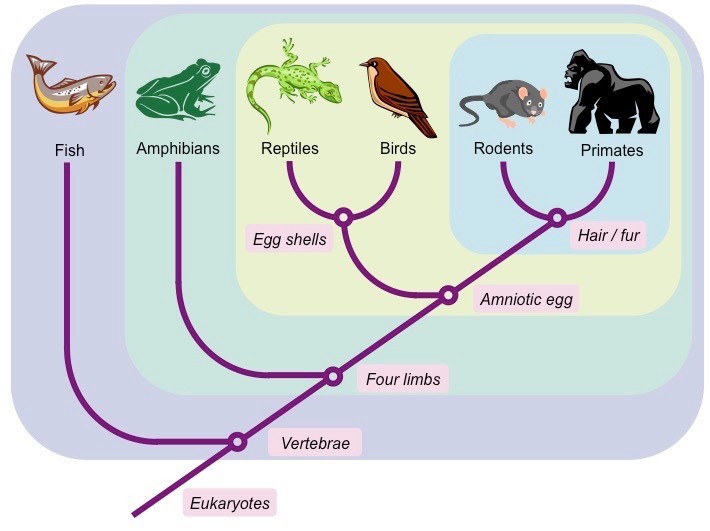
What characteristic distinguishes amphibians from birds and reptiles?
Amniotic egg
Egg shells
Vertebrae
Hair/fur

What distinguishes zebras from from giraffes?
un-branching horns (in males)
even number of toes
fur
carnivorous teeth

What characteristic do all the organisms on this cladogram share?
Being bi-pedal & having language
Complex brains
Fully binocular vision
Partial binocular vision & opposable thumbs

The limbs of several organisms are shown in the illustrations below. Scientists sometimes compare the limbs of these organisms to look for evidence of common ancestry.
These limbs provide evidence of common ancestry because they-
have the same basic structure
perform the same function
are the same size
are parts of mammals

Cetaceans are whales and their relatives. The diagram show fossils of cetaceans.
Which statement provides the best evidence that Amulocetus natans is an ancestor of the Basilosaurus isis?
Homologous structures occur in each fossil
Similar nitrogenous basis are found in the DNA of each fossil
The fossils were found in different locations
The youngest fossil is smaller than the older fossils

The cladogram shows the evolution of land plants as indicated by the fossil records.
Which discovery would challenge the validity of this cladogram?
A large aquatic vascular plant about 200 million years old
A species of algae that existed for less than one million years
A moss species that that has existed for less than 380 million years
A fossil of a fern more than 425 million years old

Zoogeographic regions are characterized by the presence of specific groups of animals. These regions are determined by the taxonomic or phylogenetic relationships of animals. The map shows zoogeographic regions proposed by the naturalist Alfred Russell Wallace in 1876.
The similarities of organisms in which two regions numbered above provide the best evidence for common ancestry between organisms in both locations?
1 and 2
3 and 4
5 and 6
7 and 8

Researchers studying populations of lizards from the genus Gallotia on the Canary Islands compared the protein cytochrome B in different populations. The table shows the number of differences in the cytochrome B protein between different populations.
Which conclusion about the relatedness of the lizard do these data support?
G. atlantica and G. stehlini are the least closely related
G simonyi and G. bravoana are the most closely related
G. galloti eisentrauti and G. galloti palmae are the most closely related
G. galloti eisentrauti and G. galloti galloti are the least closely related
Lord Howe Island is a volcanic island in the Tasman Sea that is about 11 km long and 2.8 km wide. The island has two species of palm trees, Howea fosteriana and the more abundant Howea belmoreana. The two species do not interbreed even when they grow very close to each other. Which evolutionary process fails to occur?
Genetic drift of Howea fosteriana
Natural selection of adaptive traits in both species
Gene flow between the two species
Mutations in Howea belmoreana

In Madagascar scientists have discovered a moth, Xanthopan morganii praedicta, that has a 30.5 cm proboscis and feeds from and pollinates Darwin's orchid, Angraecum sesquipedale. The orchid has a nectar-producing tube that is 27.9 cm long.
How is the moth's proboscis size an adaptation for it's environment?
the moth can avoid larger animals
the moth can pollinate other flowers
the moth has little competition for food
the moth has time to feed during the day
The white cattail is a hybrid species of plant that is a result of the cross between the broad-leaved cattail and the narrow-leaved cattail. Over time, the white cattail has established itself in the wetlands of the midwestern states.
Which of these explains the success of the white cattails?
favorable genes from parental generations provide advantageous characteristics to the hybrid species
Hybridization produces offspring traits that allow different species to survive in different environments
Inherited traits passed on from parental generations make hybrid species more susceptible to disease
Hybrid species display more adaptations due to their reduced genetic diversity

Based on the DNA sequences shown, the unknown species is most closely related to ________.
Species I
Species II
Species III
Species IV

The example shown of these 2 mammals incubating their offspring in a pouch provides evidence that they______.
belong to the same species
must range great distances to eat
have very similar skeletal structures
are descended from a common ancestory

Based on the map shown, which organisms are more closely related?
1 and 4
2 and 6
7 and 8
2 and 3

Which beetles are more fit for the environment?
Green beetles
Brown beetles
What is biological fitness?
Being able to escape from predators
Being among the strongest in a population
Being able to survive, find a mate, and produce offspring.
Being ale to survive long enough to reach adult age.

Based on the cladogram, the chimp will be more closely related to the _________.
Hagfish
Salamander
Lizard
Mouse

Based on the dichotomous key, which organism is purple and has a pointy hump?
Deerus octagis
Deerus humpis
Derus purplinis
Derus deafus
Which is the correct order?
Kingdom Phylum Order Class
Class Order Family Genus
Domain Phylum Kingdom Species
Order Family Species Genus

If two organisms belong to the same order, then they must also belong to the same...
Species
Class
Family
Genus
An organism's scientific name is based on how it is classified. Which of the following levels of classification determine the name?
kingdom & phylum
class & species
domain & order
genus & species
Which of the following organisms are most DISTANTLY related?
organisms that share a domain
organisms that share a family
organisms that share a genus
organisms that share a species
Which of the following is the correct order of organization in living things from most basic (simple) to most complex?
organism, cell, tissue, organ, organ system
organ system, organ, tissue, cell, organism
cell, tissue, organ, organ system, organism
cell, organ, tissue, organism, organ system
The basic unit of structure and function of living organisms
organ
organ system
cell
tissue
organism
A group of similar cells that work together to form the same function is called .......
organ
cell
organ system
organism
tissue
What is the difference between a cell and a tissue?
cell is basic unit of life; tissue is group of cells that work as one
cell is group of tissues; tissue is basic unit of life
cell is basic unit of life; tissue is groups of different cells
cell is group of organs; tissue is group of different cells
A structure that is composed of different kinds of tissues
organ
cell
organ system
organism
tissue
A group of organs that work together to perform a major function....
organ
cell
organ system
organism
tissue
Any living thing made up of one or more cells....
organ
cell
organ system
organism
tissue
Please choose from the options below, which are levels of organization.
cells
organ
face
skin
tissue
What is another name for natural selection?
survival of the smartest
survival of the fastest
survival of the biggest
survival of the fittest
Genetic drift is change in the allele frequency of a population due to...
random chance
natural selection
non-random mating (sexual selection)
artificial selection
What is natural selection?
inherited characteristic that increases chances of survival
organisms with traits well suited to their environment survive and reproduce at a greater rate
a growing population causes a scarcity of resources
differences in the DNA sequence
The process of choosing parent organisms for desired characteristics is called
natural selection
Artificial selection
random selection
genetic manipulation

Evolved from different ancestors, but due to living in similar environments have a similar function.
Homologous structures
Analogous structures
Vestigial structures
All of the above
What characteristic do all the organisms on this cladogram share?
Being bi-pedal & having language
Complex brains
Fully binocular vision
Partial binocular vision & opposable thumbs
An anatomical feature that no longer seems to have a purpose in the current form of an organism
Homologous structure
Analogous structure
Vestigial structure
None of the above
Which of the following is an example of the founder effect?
Bald Eagles are hunted until near extinction, population recovers.
Small group of iguanas floats to an island, starts a new population.
Red fox pups are more likely to survive in a snowy environment if they are born white.
Farmer chooses seeds from largest apples to plant next year. This results in larger apples from year to year.

List the 4 closest human relatives based on this biochemical comparison.
What is an example of artificial selection?
Letting dogs choose their own mate
Letting plants pollinate on their own
Crossing a labrador and a poodle to create a labradoodle
When the Grand Canyon in Arizona formed, two populations of one squirrel species were separated by the giant canyon. This is an example of _____________ speciation.
Allopatric
Sympatric
Simple
Divergent
A speciation in which new species evolve from a single ancestral species while inhabiting the SAME geographic region.
Sympatric speciation
Allopatric speciation
Complex speciation
Divergent speciation
How do you "win" at natural selection?
survive
go extinct
survive & reproduce

Which animals have amniotic eggs?
Turtle and Tuna
Turtle and Leopard
Lancelet and Lamprey
Tuna and Slaamander

What number is the common ancestor of C and D
1
2
3
4
organism survive in its surroundings
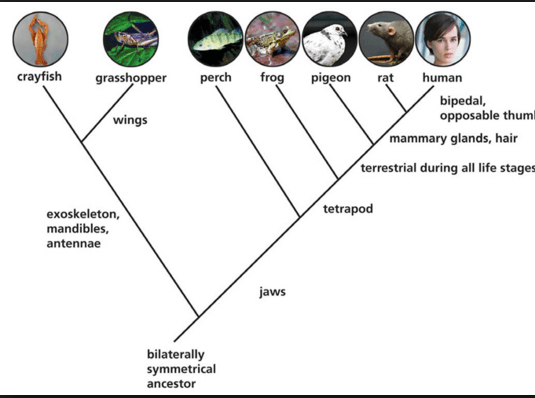
According to the cladogram, which organism is most distantly related to the human?
crayfish
pigeon
perch
frog

What was Charles Darwin's job on the H.M.S. Beagle?
cook food for the crew
navigate the ship
collect biological and geological specimens

What island group did the Beagle visit, where Darwin's observations lead to him develop the theory of natural selection?
Hawaiian Islands
Madagascar
Gilligan's Island
Galapagos Islands

What did Darwin notice in the animals of the Galapagos Islands that helped him develop the theory of evolution?
Large islands had large animals; small islands had smaller animals.
Animals in the Galapagos where exactly the same as those on the mainland.
Different islands all seemed to have their own, slightly different varieties of animals.

Directed breeding to produce offspring with desired traits is called _________. (An example is humans breeding dogs to highlight specific traits)
artificial selection
natural selection
cross breeding

Darwin described the process of ___________: some competitors would be better equipped for survival than others, those less equipped would die.
artificial selection
natural selection

Which of the following are principles of natural selection (check all that apply)
Individuals show variation
Variations are heritable
More offspring are born than can survive
Offspring must be genetically identical to parents
Variations that increase reproductive success will be more common in the next generation

Term for the cumulative change in a group of organisms through time.
evolution
inheritance
mutation
inbreeding

