
 Worksheets
Unit 5 Exam: Nucleic Acids
Total questions: 110
Worksheet time: 2hrs 12mins
Which of the following are differences in the structure between RNA and DNA
DNA uses deoxyribose sugar, RNA uses sugar ribose
DNA pairs Adenine with Uracil, RNA pairs Adenine with Thymine
DNA is a double helix, RNA is a single helix
DNA pairs Adenine with Thymine, RNA pairs Adenine with Uracil
During transcription, this type of ribonucleic acid is responsible for copying the DNA and brining it out of the nucleus.
tRNA
mRNA
rRNA
dRNA
When these bond together, they form a protein
Amino Acids
Peptide Bonds
Ribose
Nucleotides
These building blocks consist of a sugar, phosphate, and nitrogen base.
Ribose
Nucleotide
Gene
Protein
A string of nucleotides that contain the information to make a specific protein
Ribose
Amino Acids
tRNA
Gene
During translation, this type of ribonucleic acid is responsible for delivering amino acids to help make a protein.
mRNA
rRNA
tRNA
dRNA
There are a total of ____ different amino acids
20
1
4
unlimited
mRNA occurs during this process
Translation
Transcription
Replication
Delivery
How many amino acids are found on one tRNA?
20
4
1
3

Why must transcription occur in the nucleus?
because DNA can't leave the nucleus
because ribosomes are in the nucleus
because DNA polymerase is found there
because helicase unzips the DNA
How are DNA and RNA different? (CHECK ALL THAT APPLY)
Only DNA can leave the nucleus
RNA contains Thymine; DNA contains Uracil
DNA is double stranded, RNA is a single stranded
DNA contains Thymine, RNA contains Uracil
Which organelle contains rRNA and reads the mRNA to synthesize a protein?
Ribosome
Nucleus
Cytoplasm
Nucleotide
Choose the sequence of the mRNA strand that would match up with to the following DNA strand:
GTACAT
CATGTA
GAUCUA
CAUGUA
CUTGTU

What brings the amino acids to the ribosome to assemble a protein?
DNA
How many nucleotides code for 1 amino acid?
1
2
3
4
When these bond together, they form a protein
Amino Acids
Peptide Bonds
Ribose
Nucleotides
How can a mutation in the DNA sequence result in NO change to the protein that is made?
There are multiple codons that can code for the same amino acid and result in the same protein
There is always a change in the protein when a mutation occurs
Only the mRNA is used in protein synthesis so a mutation in the DNA would have no effect on the protein
During Transcription, DNA is converted into ____
mRNA
tRNA
rRNA
a Protein
During Translation, mRNA is converted into a _______
DNA
Protein
tRNA
rRNA

the tRNA carries an
Amino Acid
Polysaccaride
Lipid
DNA
Many amino acids and put together and folded up to form a ______
Protein
DNA strand
mRNA strand
Carbohydrate

During transcription, DNA is converted in mRNA inside the _______.
Cell Membrane
Ribosome
Nucleus
Cytoplasm

During Translation, mRNA finds a ________ to make a protein.
Nucleus
Ribosome
Amino Acid
Mitochondria
Which nitrogen base is in the DNA, but is NOT in the mRNA?
Thymine
(T)
Cytosine
(C)
Guanine
(G)
Adenine
(A)
Transcribe the DNA codon ATC to the correct mRNA codon.
UAG
AUC
TAG
UUG
Transcribe the DNA codon GCA to the correct mRNA codon
CCU
GCT
CGU
CGA

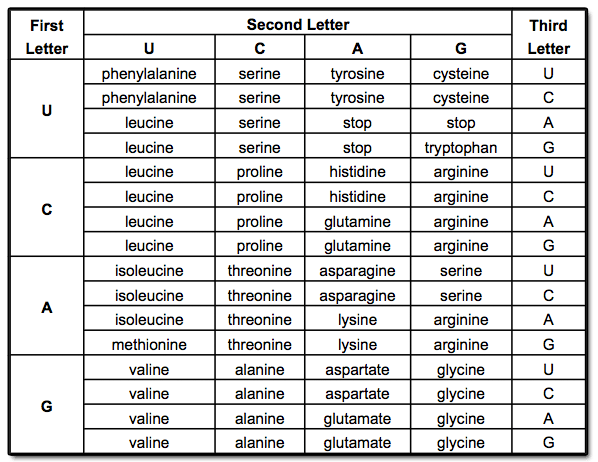
Use your codon chart to translate the mRNA CUU to the correct amino acid
VAL
TYR
LEU
PHE

Use your codon chart to translate the mRNA ACU to the correct amino acid.
Thr
Ala
Val
Gly

Use your codon chart to find the amino acid that codes for AGU
Tyr
Gly
Arg
Ser

Use your codon chart to find the amino acid that codes for the mRNA codon GCA
Thr
Ala
Pro
Ser

Use your codon chart and find the amino acid that codes for the mRNA codon UAA
Phe
Tyr
START
STOP
Ribosomes make ________
DNA
Proteins
Amino Acids
Lipids
Use your codon chart to figure out what amino acid codes for the mRNA codon AUG
START
(Met)
Ile
Val
Leu
Transcribe the following DNA strand: CTG AAT
GAC TTA
CTG AAT
GAC UUA
CUG AAU
Process of copying a nucleotide sequence of DNA to form a complementary strand of mRNA
Translation
Transcription
Replication
Synthesis
Carries copies of DNA's genetic material from the nucleus to ribosomes in the cytoplasm.
messenger RNA (mRNA)
transfer RNA (tRNA)
ribosomal RNA (rRNA)
Ribosome
In RNA, the base thymine is replaced with this base that will bond Adenine instead in RNA.
Cytosine
Guanine
Uracil
Ribose
Organelle that is the site of protein synthesis
ribosomes
Golgi body
cell membrane
chloroplasts
A codon is a group of ___ RNA bases.
1
3
5
6
What is the location in the cell for translation?
nucleus
mitochondria in cytoplasm
ribosome in cytoplasm
chloroplast in cytoplasm
T-G-A-C-C-A
T-G-A-G-C-A
ATTGAGCC - Mutated
The example above is an example of a


Which Nucleic Acids can be found in the nucleus?
DNA only
DNA & RNA
RNA only
enzymes only
What is the correct order to make a protein?
Protein, DNA, RNA
RNA, DNA, Protein
DNA, RNA, Protein
Protein, RNA, DNA
If the DNA sequence of a gene is TAC CCC GGA GAG, what mRNA sequence will be produced in transcription?
RNA Polymerase
AUG GGG CCU CUC
ATG GGG GGT GTG
AUG GGG CCU CUG
AUG CCG GCA CGG

What type of mutation is this?
Substitution
Deletion
Insertion
What is it called when a mutation has no effect on the amino acid sequence in the final polypeptide?
Substitution mutation
No mutation
Silent mutation
Replication mutation


A point mutation where one nucleotide base replaces an original nucleotide base
Inversion Mutation
Chromosomal Mutation
Translocation
Substitution Mutation

A substitution mutation that has no effect
on amino acids sequence
Insertion Mutation
Translocation
Silent Mutation
Deletion Mutation

A frameshift mutation where a nucleotide base
is removed from the DNA sequence.
Deletion Mutation
Substitution Mutation
Translocation
Silent Mutation

A frameshift mutation where a nucleotide base is added
to the DNA sequence
Insertion Mutation
Deletion Mutation
Substitution Mutation
Chromosomal Mutation
The mutated DNA segment is TTCGCAAG. This is an example of ___ mutation.
Which 2 processes are involved in protein synthesis?
Replication & Transcription
Replication & Translation
Transcription & Translation
Mutation & Replication
Proteins are chains of amino acids bonded together. Which is the correct sequence for making proteins?
Information in DNA is formed into protein directly
Information in RNA mutates into DNA, then is made into protein
Information in DNA is transcribed to RNA, then made into protein
Information in RNA uses thermal energy to make protein
A substitution in DNA sequence of a single nitrogenous base is:
chromosomal mutation
frameshift mutation
point mutation
deletion mutation
How many amino acids are coded for by this sequence of nucleotides:
ATGGGAACTCCA
(a)
Which type of RNA functions as part of the ribosome?
tRNA
dRNA
rRNA
mRNA
Causes of mutations may include:
sewer gas
radiation
chemicals
high temperatures
Which of the following would result in a frameshift mutation?
Insertions only
Substitution only
Deletion only
Insertions and Deletions
Why are insertion and deletion (frameshift) mutations so harmful?
They change all of the codons from the mutation on down the line, which changes the amino acid sequence
They insert things that an organism doesn't need.
They often delete things that organisms need.
Insertion and deletions are not any more harmful than substitution mutations.
A mutation in which only one nucleotide is altered is called a:
Frameshift Mutation
Deletion Mutation
Point Mutation
Insertion Mutation
Genetic mutations can be...
beneficial, harmful, or neutral
beneficial only
harmful only
neutral only

Original DNA: CAT GAT CCA
New DNA: CAT TGA TCC A
What mutation occurred?
deletion
substitution
tranverse
insertion
All of the following are TRUE about ribonucleic acid EXCEPT
It contains the sugar deoxyribose
It contains the bases adenine, uracil. guanine and cytosine.
It is typically single stranded.
It has three main distinct types.
Locations for ALL processes involved in protein synthesis.
nucleus
nucleolus
ribosome
mitochondria
What amino acid is coded for with the segment of DNA that reads CAA?
Glutamine
Valine
Methionine
Aspartic acid
AUG corresponds to the
stop codon.
start codon.
intron sequence.
exon sequence.
UAA, UAG, and UGA are all
stop codons.
start codons.
intron sequences.
exon sequences.
Small segments of DNA that code for proteins are
mRNA
gene
chromosome
exon

Based on this diagram, what kind of mutation is the sickle cell mutation?
Point, missense
Point, nonsense
Point, silent
Frameshift

What kind of mutation is shown in this diagram?
Point, missense
Point, nonsense
Point, silent
Frameshift

What kind of mutation is shown in this diagram?
Point, missense
Point, nonsense
Point, silent
Frameshift
The graphs show the reaction rate for an enzyme across a range of temperatures and pH. Based on these data, this enzyme functions best at what temperature and pH?
What is the role of mRNA in expressing specialized structures?
Making energy available for cellular activities
Creating bonds to form biomolecules
Producing sugars that assist with replication
Providing information to form proteins
This model of the cell cycle includes two arrows that each represent a process in the cycle. What do the two arrows represent?
Interphase
Mitosis
DNA Replication
Cancer

A certain mutation in the gene for hemoglobin results in the red blood cells becoming sticky, rigid, and irregularly shaped. These irregularly shaped red blood cells block the flow of blood throughout the body. A single base mutation is responsible for these irregularly shaped blood cells. Which of these mutations most likely results in the mutated hemoglobin gene?
Insertion
Deletion
Duplication
Substitution

Different types of mutations can occur in DNA. The diagram represents a type of mutation. Which statement describes the mutation in the diagram?
A silent mutation results in the insertion of a different amino acid.
A substitution occurs with the adenine base.
A deletion of a cytosine base occurs.
A base is inserted into one strand of the DNA.
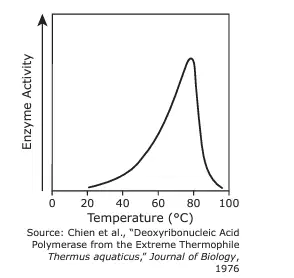
Taq polymerase is an enzyme used in the polymerase chain reaction (PCR) to replicate fragments of DNA. A study published in 1976 examined the properties of Taq polymerase after the enzyme was isolated from Thermus aquaticus, a thermophilic bacterium that lives in the hot springs of Yellowstone National Park. The graph shows one of the results of the study. Which statement about enzyme activity is best supported by this graph?
An enzyme must be composed of multiple polypeptides, or subunits, to be active.
An enzyme’s rate of activity increases with time until it becomes inactive.
An enzyme functions best under specific temperature conditions.
An enzyme works equally well in bacteria that are adapted to high temperatures and in eukaryotic cells such as human cells.

The diagram represents a theory about cells. Which theory is represented in this diagram?
The theory that all living organisms are made of cells
The theory that all living organisms share the same basic genetic components
The theory that organisms function best when their internal conditions are maintained within narrow limits
The theory that complex cells evolved after primitive cells engulfed bacterial cells that continued functioning
Which of these is the direct result of an error in the transcription of a DNA nucleotide?
The nuclear membrane is ruptured.
Amino acids do not bond to tRNA.
A codon sequence is incorrect.
Transportation of mRNA does not occur.
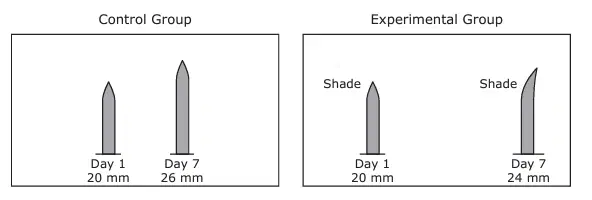
A student conducted an investigation to study phototropism in grasses. The only difference between the control group and the experimental group was light conditions. The control group was provided full light, while the experimental group was shaded on one side. The diagrams show the average heights and positions of blades of grass in the investigation. Which statement best explains why the grass tips of the experimental group bent toward the light?
Water evaporated faster on the side of the plant having full light.
Light sensors in the grass tips stimulated a hormone in the shoot system.
The xylem in the root system absorbed more nutrients from the shaded side.
The side facing the light has a greater chance of absorbing carbon dioxide from the atmosphere.
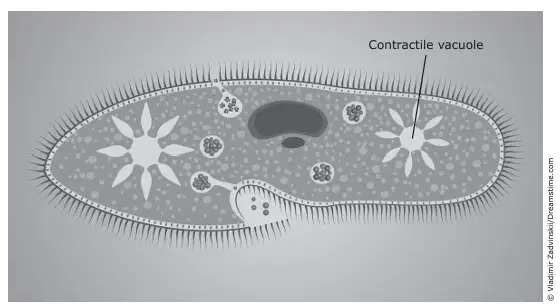
The picture shows a contractile vacuole of a unicellular freshwater organism. The contractile vacuole regulates the flow of water into and out of the cell in an aquatic environment. What conditions cause the contractile vacuole to fill with water?
The concentration of water is greater outside the cell than inside the cell.
The temperature of water in the vacuole is higher than the temperature of its environment.
The concentration of water inside the cell is the same as the concentration outside the cell.
The temperature of water in the vacuole is lower than the temperature of its environment.

Proteins and carbohydrates have many functions in the body of an organism. Specific proteins and carbohydrates perform specific tasks. Information about a protein and a carbohydrate is given below. How are ferritin and glycogen similar in their primary functions for an organism?
Both store materials needed by the organism.
Both store energy used by the organism.
Both support the structure of the organism.
Both store information for the organism.
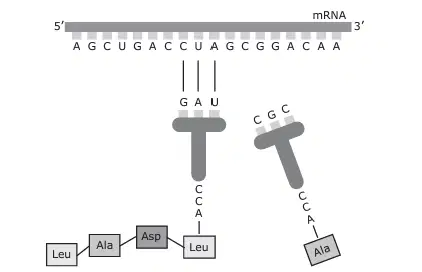
A model of a biological process is shown. What is the purpose of this process?
To replicate the DNA of an organism before cell division
To assemble nucleotides in an mRNA chain along a DNA template
To synthesize amino acids used to unzip strands of DNA and copy the genetic code
To translate the genetic code into a specific sequence of amino acids
Photosynthesis and cellular respiration both involve the use and release of gases. Which statement correctly identifies the role of gases in the two processes?
Photosynthesis and cellular respiration both use carbon dioxide and release oxygen.
Photosynthesis and cellular respiration both use oxygen and release carbon dioxide.
Cellular respiration uses oxygen and releases carbon dioxide, while photosynthesis uses carbon dioxide and releases oxygen.
Cellular respiration uses carbon dioxide and releases oxygen, while photosynthesis uses oxygen and releases carbon dioxide.

A student used poster board to construct this model of a section of DNA. Which statement describes this model of DNA?
The model is inaccurate because the base pairs are incorrect.
The model is accurate because it contains correctly paired bases.
The model is accurate because it shows each base splitting to form a double helix.
The model is inaccurate because some typical bases in DNA are missing.

