wayground logo

Free Printable Worksheets

Font size

S
M
L
XL
Worksheets

Bio I Sem II Final Review

Total questions: 107

Worksheet time: 1hrs 16mins

Name
Class
Date
1.
Which sequence of complementary DNA bases would pair with this partial strand
ATG TGA CAG?
a)
ATG TGA CAG
b)
TAC ACT GTC
c)
GTA AGT GAC
d)
CAT TCA CTG
2.
Which of the following best describes a DNA molecule?
a)
double helix
b)
contains ribose
c)
made of amino acids
d)
contains uracil
3.
Which of the following monomers are repeatedly joined together to form a strand of DNA?
a)
amino acids
b)
nucleotides
c)
fatty acids
d)
polysaccharides
4.
In a molecule of double-stranded DNA, the amount of adenine present is always equal to the amount of _________.
a)
cytosine
b)
guanine
c)
thymine
d)
uracil
5.
What determines the code, or information, of a DNA molecule?
a)
the shape (structure) of the nitrogen bases
b)
the order (sequence) of the nitrogen bases
c)
the color of the nitrogen bases
d)
the frequency (number) of nitrogen bases
6.
Which 2 molecules form the sides (backbone) of the DNA ladder?
a)
deoxyribose sugar and adenine
b)
deoxyribose sugar and a hydrogen bond
c)
deoxyribose sugar and the nucleus
d)
deoxyribose sugar and phosphate
7.
The two strands of nitrogenous bases in DNA are joined by which type of bond?
a)
polar bonds
b)
ionic bonds
c)
covalent bonds
d)
hydrogen bonds
8.

A process in which DNA has the unique ability to make an exact copy of itself.

a)

Replication

b)

Translation

c)

Transcription

d)

Protein Synthesis

9.
The drawing shows the structure of what molecule?
a)
A DNA molecule
b)
A lipid molecule
c)
A carbohydrate molecule
d)
A protein molecule
10.
What are the three components of a nucleotide?
a)
sugar, hydrogen, nitrogen base
b)
sugar, oxygen, nitrogen base
c)
sugar, phosphate, nitrogen base
d)
sugar, phosphate, protein
11.
Who was given credit for determining the shape of DNA? 
a)
Avery
b)
Watson and Darwin
c)
Watson and Crick
d)
Franklin and Crick
12.
Identify #2.
a)
nitrogen base
b)
phosphate group
c)
deoxyribose sugar
d)
nucleotide
13.
What process is shown in the diagram?
a)
replication
b)
transcription
c)
mitosis
d)
translation
14.
X outlines a(n) ___________.
a)
amino acid
b)
nitrogen base 
c)
nucleotide
d)
nitrogen base pair
15.
The molecule pictured is a monomer of _______.
a)
RNA
b)
DNA
c)
a carbohydrate
d)
a protein
16.
which process is shown?
a)
diffusion
b)
repiration
c)
recombination
d)
translation
17.
Which of the following is the template for the production of RNA within a cell?
a)
DNA
b)
protein
c)
ATO
d)
carbohydrate
18.
When an extra base is inserted into the DNA sequence of a gene, the protein doesn't work. Which explains why?
a)
the base increases rate of translation
b)
the base causes DNA to be transcribed in opposite direction
c)
the inserted base causes the codons in the sequence to be incorrect for the desired protein
d)
the base signals enzymes to translate DNA rather than RNA
19.
The DNA sequence ATCAGCGCTGGC is part of a gene. how many amino acids are coded for by this message?
a)
4
b)
8
c)
12
d)
20
20.
A scientist puts nucleotide chains of UUUUUU in a test tube under conditions allowing protein synthesis. Soon they are only amino acids chains of phenylalinine. What does the experiment indicate?
a)
phenylalanine is composed of uracil
b)
UUU codes for phenylalanine
c)
protein synthesis malfunctions in test tubes
d)
proteins contain one kind of amino acids
21.
One human disease is caused by a change in one codon in a gene from GAA to GUA. The disease is a result of 
a)
a mutation
b)
crossing-over
c)
a meiosis error
d)
polyploidy
22.
DNA sequence is ACAGTGC. How would this be coded on mRNA?
a)
TGTCACG
b)
UGUCACG
c)
GUGACAU
d)
CACUGUA
23.
What is the relationship between a protein, the cell, and DNA?
a)
DNA is produced by protein which is produced in the cell
b)
Protein is composed of DNA which is produced in the cell
c)
DNA controls the production of protein in the cell
d)
A cell is composed of DNA and protein
24.
Genetic info flows in one direction. Which best represents this flow?
a)
DNA-protein-RNA
b)
Protein-RNA-DNA
c)
RNA-protein-DNA
d)
DNA-RNA-protein
25.
Which process?
a)
mutation
b)
transcription
c)
respiration
d)
translation
26.
Who is considered the "father" of modern genetics?
a)
Einstein
b)
Mendel
c)
Disney
d)
Trump
27.
A single cross such as flower color.
a)
mono hybrid
b)
dihybrid
c)
crossing over
d)
homozygous
28.
TT,tt,PP,pp,SS,ss are examples of alleles that are?
a)
homozygous
b)
heterozygous
c)
different
d)
homologous 
29.
The exact genetic makeup of an organism, such as RR, Tt, PP is its?
a)
phenotype
b)
dominance
c)
genotype
d)
trait
30.
Y for yellow body is dominant over y for blue body.  What alleles would produce yellow bodies?
a)
YY,yy
b)
Yy,yy
c)
YY only
d)
YY,Yy
31.
Females-XX; MalesXY.  A couple has 4 girls.  What is the chance the next child will be a boy?
a)
75%
b)
100%
c)
25%
d)
50%
32.
If "T" is the allele for tall and "t" is the allele for short, then Tt would produce?
a)
tall
b)
short
c)
medium
d)
not enough info
33.
Genotype refers to the ...
a)
physical expression of the genes
b)
the possible combination of alleles in a gene
c)
whether an allele is dominant or recessive
d)
how an organism will appear
34.
An offspring will receive how many alleles from each parent to determine a specific trait?
a)
one
b)
two
c)
three
d)
five
35.
Which of the following is a phenotype?
a)
BB
b)
Bb
c)
bb
d)
Blue eyes
36.
the passing of genetic traits from parent to offspring.
a)
heredity
b)
trait
c)
gene
d)
allele
37.
having two of the same genes for the trait (sometimes called purebred).
a)
homozygous
b)
hetrozygous
c)
protein
d)
chromosome
38.
having two different genes for a trait (sometimes called hybrid).
a)
protein
b)
homozygous
c)
heterozygous
d)
genotype
39.
Two brown eyed parents (Bb) have a baby. What is the chance the baby is blue eyed?
a)
0 %
b)
25%
c)
50%
d)
75%
40.
An allele whose trait only shows up when no dominant allele is present.
a)
hidden allele
b)
dominant allele
c)
recessive allele
d)
present allele
41.
Snapdragon flowers come in red, pink and white.  What type of inheritance is this?
a)
Complete Dominance
b)
Incomplete Dominance
c)
Codominance
d)
Polygenic Inheritance
42.
Incomplete dominance means that the traits are
a)
expressed equally
b)
dominant
c)
recessive
d)
blended
43.
One form of a gene is called_______________
a)
a DNA
b)
a Phenotype
c)
a trait
d)
an allele
44.
Which of the following genotypes is a purebred?
a)
Bb
b)
Gg
c)
bb
d)
Dd
45.
If green is dominant over purple, then what is the genotype for this individual?
a)
Purple
b)
Green
c)
GG
d)
gg
46.
Brown fur color is dominant over black fur color. Which of the following is the actual genotype of ALL of the offspring in the next generation of this cross for fur color?
AA x aa
a)
AA
b)
Aa
c)
aa
d)
brown fur
47.
Tt is-
a)
homozygous dominant
b)
homozygous recessive
c)
heterozygous
d)
none of these
48.

Evolution is best defined as:

a)

the process which organisms die.

b)

the process which organisms change over time.

c)

the process which organisms that are extinct become revived.

d)

the process which non-living things fossilize.

49.

What type of evidence is represented in the picture above:

a)

Fossils

b)

Vestigial Structures

c)

DNA

d)

Homologous Structures

50.

What type of evidence is shown in this picture?

a)

Fossils

b)

Homologous Structures

c)

Vestigial Structures

d)

DNA

51.

Adaptations are:

a)

physical or behavioral tendencies.

b)

physical or behavioral characteristics that help an organisms survive and reproduce.

c)

physical or behavioral characteristics that do not help the organism in any way.

d)

genetic mutations that have gone wrong.

52.
The similarities of the bones in the diagram provide evidence that---
a)
The organisms shown lived in the same natural envionrment
b)
The organisms shown may have developed from a common ancestor
c)
The organisms shown have the same genetic diseases
d)
All vertebrate species have identical forelimbs
53.
The diagram shows fossils in different rock layers. Which of these statements about the age of these fossils is most likely correct?
a)
Fossil A and C are the same age
b)
Fossil B is older than fossil C
c)
Fossils A is older than fossil B
d)
Fossil D is older than fossil C
54.
What process is being shown in this image?
a)
Variation
b)
Natural Selection
c)
Selective Breeding
d)
Homeostasis
55.

Which scientist is known for his work that he did on the Galapagos Islands to develop his theory of natural selection?

a)

Gregor Mendel

b)

Charles Darwin

c)

Anton Van Leewenhoek

d)

Robert Brown

56.

The process by which two populations of the same species become so different that they can no longer interbreed.

a)

natural selection

b)

artificial selection

c)

speciation

d)

fossilization

57.

Overproduction, Genetic Variation, Struggle to Survive, and Successful Reproduction are the 4 parts of:

a)

Natural Selection

b)

Speciation

c)

Artificial Selection

d)

Fossilization

58.

A species is defined as:

a)

a group of organisms that are extremely different.

b)

a group of organisms that have similar characteristics and always live in the same place.

c)

a group of organisms with similar characteristics and can reproduce to make fertile offspring.

d)

any two organisms to make a hybrid.

59.

Which of the following is true about the picture above?

a)

Camels are highly adapted to cold climates.

b)

There are no benefits to using a camel vs. a horse in the desert.

c)

Camels have directly evolved from whales.

d)

A camels long large intestine, long eyelashes and wide feet allow it to be very adapted to the desert.

60.

Which of the following is true regarding the evidence of evolution

a)

Vestigial structures are not real evidence of evolution.

b)

Homologous structures and fossils are the most dependable forms of evidence.

c)

Comparing DNA is the most definitive and accurate method to show evolutionary relationships.

d)

Embryology and Homologous structures do not support the theory of evolution.

61.
In natural selection, the selective agent is the
a)
humans
b)
mutations
c)
breeders
d)
environment
62.
what did Charles Darwin observe in finch populations of the Galapagos Islands off the coast of South America?
a)
different species on different islands
b)
all species on one of the islands
c)
identical species on all the islands
d)
the same species as North America
63.
Mutations are important because they bring about
a)
death of the organism in which they develop
b)
genetic variation needed for a population to evolve
c)
benefits for the individual, not for the population
d)
Hardey-Weinberg equilibrium within a population
64.
What is the process in which humans breed organisms for certain traits?
a)
natural selection
b)
inheritance
c)
artificial selection
d)
descent withOUT modification
65.
Tiktaalik is a...
a)
Fish with huge legs
b)
An alligator
c)
Fish with arm like fins
66.
Hox gene 
a)
controls the growth plan for the embryo
b)
makes flies wings glow
c)
grows the brain
67.
A structure that is inherited from ancestors but has long lost much or all of its original use.
a)
vestigial structure
b)
miniscule structure
c)
analogous structure
68.
a bird that can easily outcompete other birds for food and that can produce many eggs has a high
a)
sexuality
b)
mutation rate
c)
fitness
d)
adaptability
69.
Genetic variation can arise from a random change in the DNA of a gene.  The change is called a(n)
a)
mutation
b)
gene flow
c)
gene pool
d)
allele
70.
How would you describe these two features?
a)
Homologous structure
b)
Analogous structure
c)
Structural adaption
d)
Functional adaption
71.
What phase of mitosis is shown in the picture?
a)
Prophase
b)
Anaphase
c)
Telophase
d)
Metaphase
72.
Chromatid pairs line up in the middle of the cell.
a)
Metaphase
b)
Telophase
c)
Anaphase
d)
Interphase
73.
What phase of mitosis is shown in the picture?
a)
Prophase
b)
Anaphase
c)
Telophase
d)
Metaphase
74.
What phase of mitosis is shown in the picture?
a)
Prophase
b)
Anaphase
c)
Telophase
d)
Metaphase
75.
Chromosomes duplicate, the cell grows and develops
a)
Metaphase
b)
Telophase
c)
Interphase
d)
Anaphase
76.
What phase of mitosis is shown in the picture?
a)
Prophase
b)
Anaphase
c)
Telophase
d)
Metaphase
77.
Results of cell division or mitosis include all of the following EXCEPT?
a)
growth
b)
repair damaged cells
c)
replace damaged cells
d)
dead cells
78.
Chromatid pairs can be seen, spindle fibers form and nuclear membrane disappears
a)
Metaphase
b)
Telophase
c)
Anaphase
d)
Prophase
79.
How many chromosomes does a human cell have?
a)
42
b)
46
c)
24
d)
64
80.
Which of the following lists, in order, the phases of mitosis?
a)
interphase, metaphase, anaphase, telophase
b)
prophase, metaphase, anaphase, telophase
c)
prophase, metaphase, anaphase, interphase
d)
prophase, anaphase, metaphase, telophase
81.
How many daughter cells are produced in mitosis?
a)
1
b)
2
c)
4
d)
6
82.

The most common type of cancer is

a)

non-melanoma skin cancer

b)

breast cancer

c)

lung cancer

d)

prostate cancer

83.

The result of a cross between to dissimilar parents

a)

purebred

b)

hybrid

c)

homozygous

d)

mutation

84.

All science begins with

a)

using a microscope

b)

questions

c)

observations

d)

answers

85.

Basis of comparison

a)

experimental group

b)

control group

c)

mutation group

d)

hypothesis group

86.
a)

incomplete dominance

b)

Mendelian inheritance

c)

codominance

d)

sex-linked inheritance

87.

Which of the following is inherited via multiple alleles?

a)

human blood groups

b)

muscular dystrophy

c)

sickle cell anemia

d)

cystic fibrosis

88.

Percent of DNA you share with all other human beings

a)

50%

b)

90%

c)

99%

d)

99.9%

89.

Chain of amino acids

a)

protein

b)

carbohydrate

c)

nucleic acid

d)

lipid

90.

During _____, the cell uses information from mRNA to produce proteins.

a)

transcription

b)

replication

c)

translation

d)

transmutation

91.

What is B?

a)

tRNA

b)

mRNA

c)

rRNA

d)

DNA

92.

What is D?

a)

rRNA

b)

mRNA

c)

tRNA

d)

DNA

93.

Meiosis produces

a)

2 daughter cells identical to the original

b)

4 daughter cells identical to the original

c)

2 daughter cells with half the # of chromosomes

d)

4 daughter cells with half the # of chromosomes

94.

Location of transcription

a)

nucleus

b)

cytoplasm

c)

ribosome

d)

Golgi

95.
Which of the following organisms are LEAST closely related?
a)
organisms that share a domain
b)
organisms that share a family 
c)
organisms that share a genus 
d)
organisms that share a species 
96.
The scientific name for an organism is made from the:
a)
class and family name
b)
genus and species name
c)
domain and kingdom name
d)
kingdom and phylum name
97.
The 8 levels of classification, most broad to most specific.
a)
Domain, Genus, Family, Order, Class, Phylum, Kingdom, Species
b)
Domain, Species, Kingdom, Genus, Phylum, Family, Class, Order
c)
Domain, Kingdom, Phylum, Class, Order, Family, Genus, Species
d)
Order, Kingdom, Species, Domain, Phylum, Family, Class, Genus
98.
Cells that do not have a true nucleus are called....
a)
eukaryote
b)
prokaryote
c)
unicellular
d)
multicellular
99.
Cells that have a true nucleus are called....
a)
eukaryotes
b)
prokaryotes
c)
unicellular
d)
multicellular
100.
Which organisms are most closely related?
a)
Equus caballas (Horse) & Equus burchellii (Zebra)
b)
Cyanea artica (Jellyfish) &
Ctenodiscus crispatus (Mud Starfish)
c)
Naja naja (cobra) & Glycine max (soya bean)
d)
Ophiocomina nigra (black brittle star) & Brassica nigra (black mustard)
101.
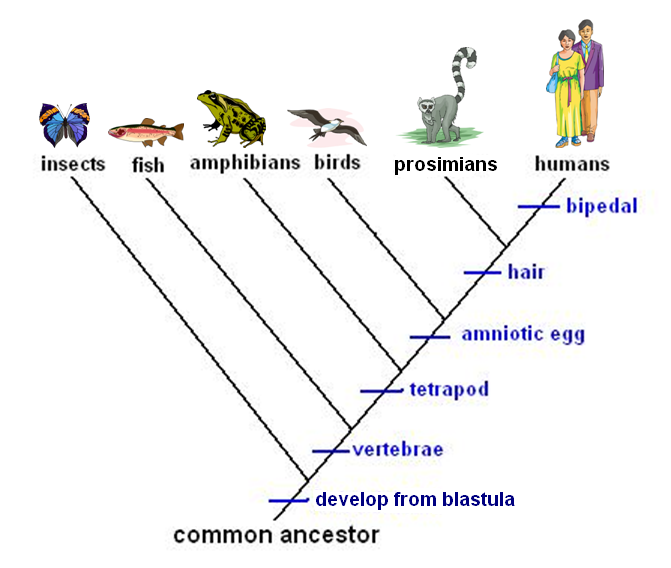
Which organisms pictured on the cladogram have hair?
a)
prosimians only
b)
prosimians and humans
c)
humans only
d)
prosimians and birds
102.
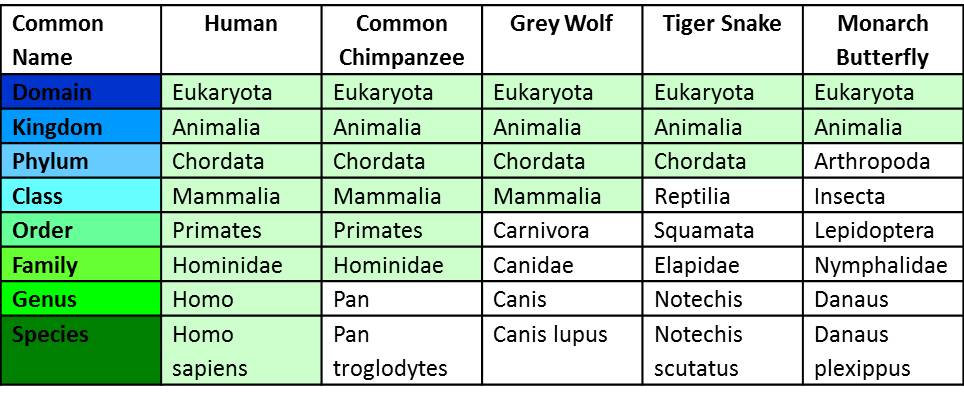
Which organism in the table is least closely related to the chimpanzee?
a)
human
b)
grey wolf
c)
tiger snake
d)
monarch butterfly
103.

Which 2 organisms would be able to reproduce and produce fertile offspring?

a)

2 organisms in the same class

b)

2 organisms in the same family

c)

2 organisms in the same genus

d)

2 organisms in the same species

104.
A Chicago Cubs baseball cap costs $30.  Michael has a coupon that will save him 30% of the  price. How much money will Michael pay for the cap?
a)
$9.00
b)
$22.00
c)
$21.36
d)
$21.00
105.

There are 1000 points right now in Biology. You have 850 points. What is your current grade?

a)

A

b)

B

c)

C

d)

D

106.

According to the best available scientific evidence, the age of the Earth is approximately

a)

4600 years

b)

460,000 years

c)

4.6 million years

d)

4.6 billion years

107.

Antibiotics are used to fight

a)

bacteria

b)

viruses

c)

bacteria and viruses

d)

fungi and viruses