
 Worksheets
Biology Benchmark 1
Total questions: 108
Worksheet time: 1hrs 26mins
Which building blocks are correctly matched to the macromolecule they form?
Amino acids make proteins.
Glucose molecules make lipids.
Nucleotides make carbohydrates.
Fatty acid chains make nucleic acids.
Which of the following statements illustrates why carbon atoms are so important in living organisms?
Carbon atoms contain large stores of energy.
Carbon is found in most inorganic compounds.
Carbon atoms are polar which allows them to dissolve many compounds.
Carbon is able to bond to many other atoms to form large and complex molecules.
Which of the following groups of macromolecules are composed of three fatty acid chains bonded to a glycerol?
lipids
proteins
nucleic acids
carbohydrates

Which of the following structures is represented by the figure?
amino acid
nucleotide
triglyceride
monosaccharide

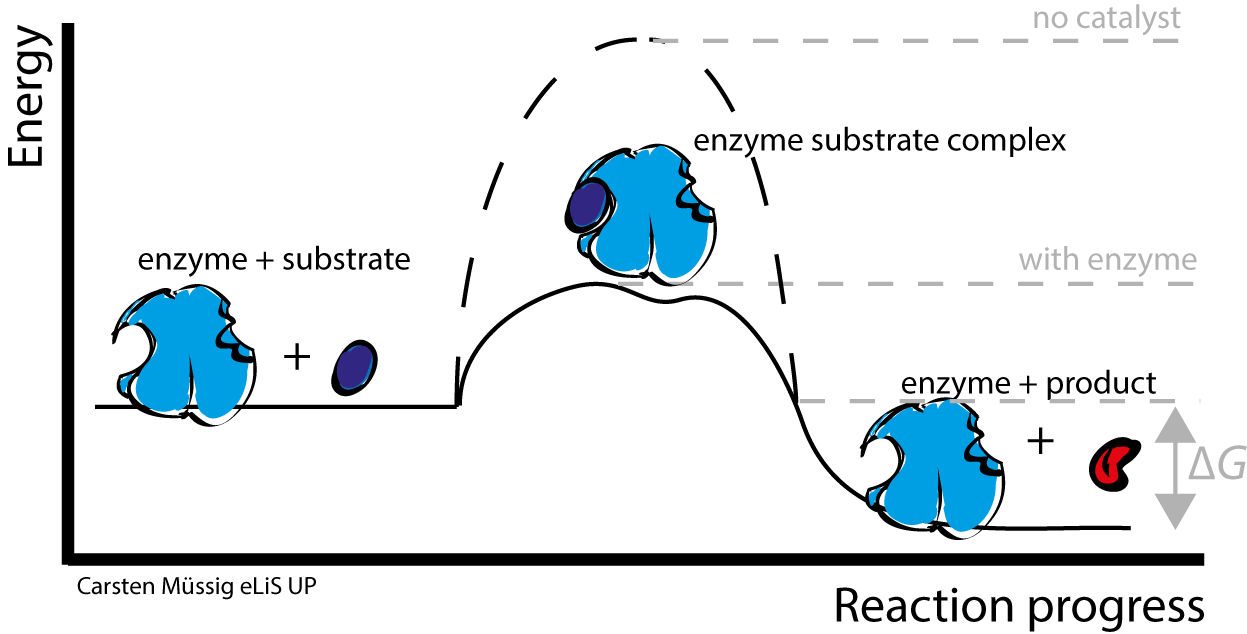
The graph shows the progress of a biochemical reaction. What effect would an enzyme have on the reaction?
An enzyme would increase the amount of energy at Point 3.
An enzyme would increase the amount of energy needed at Point 1.
An enzyme would decrease the energy needed to move from Point 1 to Point 2.
An enzyme would cause the amount of energy at Point 1 and Point 3 to switch places.

The diagram shows three repeating units of a polymer. Which of the following molecular structures make up the repeating units shown in the diagram?
amino acid
nucleotide
triglyceride
monosaccharide
Which group of macromolecules is responsible for storing genetic information?
lipids
nucleic acids
proteins
carbohydrates
At very high temperatures, most enzymes do not increase the rate of the reactions they regulate. What is the most likely reason for this lack of enzyme activity at very high temperatures?
The enzyme denatures and can no longer function properly.
The enzyme would have already broken down at a much lower temperature.
The products would have already been used up in the reaction by the time it reaches that high temperature.
The enzyme would have already sped up the rate of reaction as much as it could and would not be affected by the increase in temperature.
Which statement correctly describes a property of enzymes?
Enzymes react at identical rates under all circumstances.
Enzymes are destroyed and then reformed after each reaction.
Enzymes form permanent structures when they bind to substrates.
Enzyme structures are specific to the type of substrate they bond to.
Which of the following correctly matches the elements present in macromolelcule?
CHO-Lipids
CHO-Proteins
CHON-Nucleic Acids
CHONP- Carbohydrates

Factors such as temperature affect enzyme activity. They can cause them to speed up or slow down, and even completely destroy the protein in high heat.
True
False

In living cells, enzymes act as catalysts, which may reduce the amount of activation energy required for a chemical reaction to occur. In the graphs below, pathway x is a solid line representing the uncatalyzed reaction. The dotted line shows the catalyzed reaction. Which graph best illustrates the changes in a reaction when the catalyst reduces the amount of energy required?
Graph A
Graph B
Graph C
Graph D

The diagram below shows the general structure of an amino acid. Which type of molecule is formed from amino acids?
lipids
proteins
carbohydrates
nucleic acids
You are analyzing a compound in the laboratory. You find that it is made up of carbon, hydrogen, and oxygen in a ratio of two hydrogen atoms for each carbon atom. How will you classify the compound?
lipid
protein
carbohydrate
nucleic acid
Fats, oils and cholesterol are all types of what?
cell membranes
hormones
lipids
fatty acids
RNA and DNA are which type of macromolecules?
carbohydrate
lipid
nucleic acid
protein
The human body maintains a temperature of around 98.6 degrees at all times. Enzymes are involved in almost every chemical reaction in the body. Which of the following describes the connection between these two statements?
Enzymes function best at a specific temperature.
The body needs to be warm to prevent hypothermia.
The body is kept relatively warm to prevent too much enzyme action.
There is no connection between the two statements.
The enzyme lactase will break down the sugar lactose into which of the following components?
monosaccharides
nucleic acids
amino acids
phospholipids

Four different types of macromolecules and their characteristics are listed in the chart.
What type of macromolecule is A?
Lipid
Carbohydrate
Protein
Nucleic Acid
Four different types of macromolecules and their characteristics are listed in the chart.
What type of macromolecule is D?
Lipid
Carbohydrate
Protein
Nucleic Acid
organism referred to?


T/F: All enzymes have the same optimum pH range.
true
false

The graph for substrate concentration vs enzyme activity begins to flatten out because
all active sites are full and the enzymes are working at their maximum efficiency.
the enzymes are used up and there aren't any left.
We eat food to obtain our macromolecules. Pasta, breads, & candy are all good sources of (a) . Meats, dairy products, eggs & nuts are all good sources of (b) . While, oils, butter, avocados are all good sources of (c) . However, we don't eat food to obtain our (d) . Insted we utilize the other elements gained from eating to build our (e) .
What is a habitat?
A place where living things live and grow
A place where Frodo lives
Non-living things home address
Plants only live here
Who are producers?
Eat other living things
Break down living things
Make their own food
Tell if the item is an abiotic factor or biotic.....
TREE
Abiotic
Biotic


Food webs show you everything an animal eats. Food chains show you one thing.
Bacteria convert the nitrogen in the atmosphere into_______.
Usable Nitrogen
Glucose
The first trophic level always consists of
Producers
secondary consumers
tertiary consumers
primary consumers


The non-living parts of an ecosystem, such as climate, temperature, water, and soil type.
Abiotic factors
Biotic factors
Community
Population

Bees are insects that belong to the group of:
BIOTIC
ABIOTIC


If there is 1000 Kcal for the producers, how much energy would be transferred to the Primary Consumers?
10 Kcal
1 Kcal
100 Kcal
1000 Kcal
Why are there generally a maximum of five trophic levels?
It's far easier to draw a pyramid that way.
Because energy is lost at each level, there isn't enough energy left to support any more consumers.
Generally a top predator is so fierce it has no predators and therefore can rule the top trophic level without fear.
There simply is not a word beyond quaternary.
BTW the word after quaternary is quinary (always read all the options in multiple choice questions)


Which is a producer consumer relationship?
Grass and Owel
Fox and Rabbit
Grass and mouse
Carrot and Grains

How many Tertiary consumers are there
1
2
3
4


The term for the number of individuals per unit area is (a)
Fill in the blank: The number of males and females of each age in a population is known as ____.
Population Density
Age Structure
Demography
Limiting Factor
What is the movement of individuals into a population called?
A) Emigration
B) Immigration
C) Logistic Growth
D) Exponential Growth
The movement of individuals out of an area is known as (a) .
Match the following growth patterns with their descriptions.
Logistic Growth
Growth pattern where population growth slows as it reaches the carrying capacity.
Exponential Growth
Growth pattern where individuals in a population reproduce at a constant rate.
Carrying Capacity
The maximum population size that an environment can sustain indefinitely.
Density Dependent Factors
Factors that affect population size in relation to the population's density.
Fill in the blank: A growth pattern where a population's growth rate slows or stops following a period of exponential growth is called ____.
Exponential Growth
Logistic Growth
Limiting Factor
Demography
What is a limiting factor that depends on population size called?
Density Independent Factor
Density Dependent Factor
Exponential Growth
Logistic Growth
Match the following terms with their definitions.
A) Density Dependent Factor
Factors that affect population size based on the population density.
B) Density Independent Factor
Factors that affect population size regardless of the population density.
C) Carrying Capacity
The maximum population size that an environment can sustain indefinitely.
D) Age Structure
The distribution of individuals among different ages in a population.
What is a population?
What varies with size of population?
Births, deaths, emigration and immigration
Emigration and immigration
Survivorship curves, deaths, emigration and immigration
Type I, II, III curves
Increased population density makes finding a mate easier but ________ _______ for resources.
Decreases: Predation
Increases; Competition
Decreases: Competition
Increases; Predation

What does the following image represent?
Population Density
Population Demographics
Population Distribution
Population Rates
What is population distribution?
Population distribution is the way in which males are spread across a given area.

Primary succession

pioneer species

abiotic factor

secondary sucession

climax community
Primary succession occurs in an area that has:
Has Soil
Has No Soil
Has Some Soil
none of these
What is the main difference between primary and secondary ecological succession?
Primary begins WITHOUT soil; Secondary begins WITH soil
Primary is the first state and secondary is the second stage
Primary builds plant community; secondary builds animal community.
Primary begins WITH soil; Secondary begins WITHOUT soil

After a volcanic eruption, volcanic rock is present (but no soil). Which of the following states the most likely order of succession that would be seen?
Lichens → Shrubs → Grasses → Trees
Lichens → tree → shrubs→Grasses
Grasses → Lichens → Shrubs → Trees
Lichens → Grasses → Shrubs → Trees
What is an example of an area that is likely to undergo primary succession?
Glaciers melt and leave exposed rock
Plants die from drought and decompose
Land is bulldozed and soil remains
A forest fire occurs
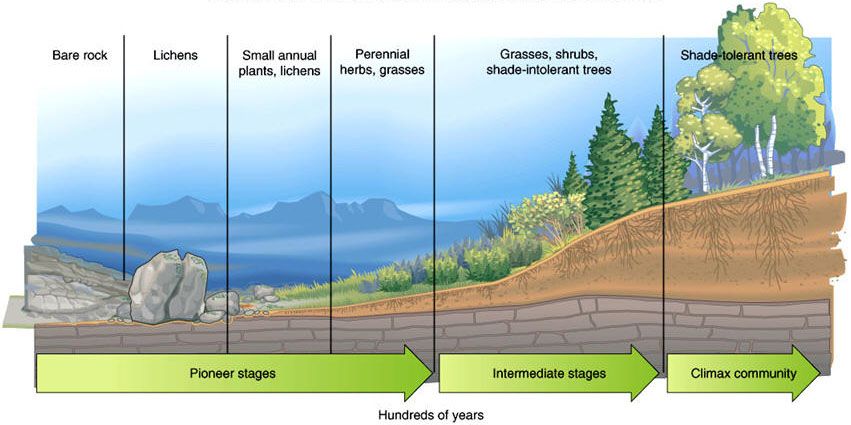
The picture display which type of succession?
primary
secondary
tertiary
all of the above
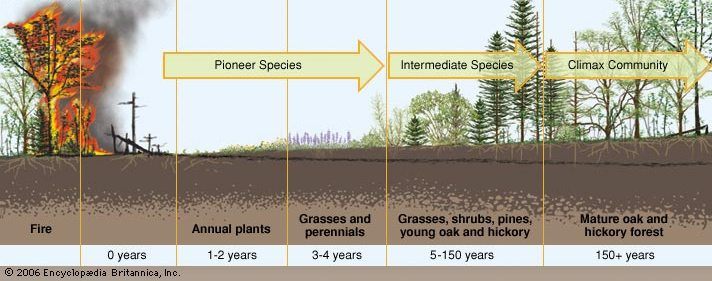
The picture displays which type of succession?
primary
secondary
tertiary
all of the above
The final stage of ecological succession can typically be observed when evidence of a _____________________ is present.
Mature Tree Growth
Climax Community
Pioneer Community
housing community


Match the following
Groundwater
water retained beneath the surface of the earth
Condensation
when water vapor cools off and turns back into liquid
Evaporation
When surface water is heated up and turns back into water vapor
Transpiration
evaporation of water from plants
In the biogeochemical cycle (a) are absorbed or ingested by organisms are passed on through the (b) chain and returned to the soil, air, and (c) by such mechanisms as (d) excretion and decomposition.
Which is NOT one of the 4 major substances that cycle through living organisms
Carbon
Water
Nitrogen
Phosphorus
Cobalt
Carbon returns to the atmosphere by (a) through or burning, Carbon is stored in the bottom of the (b) but due to (c) and pressure is changed to (d) fuels.
Carbon (a) are natural or artificial (b) areas for carbon. The (c) is by far the largest natural carbon sink. (d) are the largest carbon sink on land.
The producing of something at the same rate that it is consumed (a)
A natural resource that can be replaced by nature in a short period of time. (a)
A substance that enters Earth's geochemical cycles and can harm the well-being of living things or adversely affect their activities.
pollutant
fossil burn
geochemical fuel
ultraviolet rays


The greenhouse effect is caused by
more heat arriving at the Earth from the sun
the Earth releasing more heat at night
gases in the air trapping heat released by the Earth

The graph shows us that
the earth temperature is always increasing
the earth's temperature has steadily increased since 1900
the earth's temperature has steadily rising since the 1960s
the earth's temperature decreased during the 19th and 20th centuries
Without the Greenhouse Effect the Earth would be
warmer
colder
using a resource is ways that maintain it at a certain quality or quantity for a certain period of time.
sustainable
pollution
overpopulation
deforestation

