
 Worksheets
Quarter 2 Exam Review Questions
Total questions: 109
Worksheet time: 27hrs 15mins
BEFORE YOU BEGIN...take out your Unit 3B notes and your Unit 3B handouts!
the tendency of the particles in a substance to take up more space as the temperature of the substance increases
thermal expansion
fluid
apparent density
any matter that flows when force is applied
thermal expansion
fluid
apparent density
the total mass divided by the total volume of an object that is made up of more than one material (including air if the shape encloses air)
thermal expansion
fluid
apparent density

Pure water and another substance are graphed above. If the line for A represents pure water, what can be said about the other substance (B)?
Substance B is more dense than water (A) and will float on water.
Substance B is less dense than water (A) and will float on water.
Substance B is more dense than water (A) and will sink in water.
Substance B is less dense than water (A) and will sink in water.
How do the densities of hot air and cold air compare?
Hot air is less dense than cold air because the particles are closer together in hot air.
Hot air is more dense than cold air because the particles are closer together in hot air.
Cold air is less dense than hot air because the particles are closer together in cold air.
Cold air is more dense than hot air because the particles are closer together in cold air.
The density of a liquid is greater than the density of a gas because:
gas particles are smaller than liquid particles.
gas particles are larger than liquid particles.
particles in a liquid are closer together than particles in a gas.
particles in a gas are closer together than particles in a liquid.
In general, the solid phase of a substance is more dense than the liquid phase of the same substance. An exception to this is solid
copper.
water.
solder.
steel.
What is the density of carbon dioxide gas if 0.3 grams of CO2 is in a 50-mL sealed container?
0.006 g/mL
167 g/mL
15 g/mL
0.3 g/mL
Which of the following fluid materials is most likely to float on water?
oil
honey
milk
corn syrup
How can a boat made of steel metal float on the surface of the ocean?
Because the steel is hollow, the apparent density of the boat is less than the density of a block of steel.
Because the steel is hollow, the apparent density of the boat is more than the density of a block of steel.
The density of steel is less than the density of water no matter what shape the steel is made into.
The density of steel is more than the density of water no matter what shape the steel is made into.
What is the apparent density of a ping pong ball that has a volume of 33.51 cm3 and is made with 2.65 grams of plastic and 0.05 grams of air?
0.081 g/cm3
0.079 g/cm3
12.6 g/cm3
0.077 g/cm3
the measure of a fluid’s resistance to flowing
viscosity
buoyancy
pressure
the measure of the upward force that a fluid exerts on an object that is submerged in the fluid
viscosity
buoyancy
pressure
the amount of force exerted per unit of area
viscosity
buoyancy
pressure
The same number of air particles are pumped into two containers. Container A has a volume of 10 liters. Container B has a volume of 5 liters. Both containers are held at the same temperature. Which statement below is true?
The pressure in container A is half of the pressure in container B.
The pressure in container A is twice the pressure in container B.
The pressure in container B is half of the pressure in container A.
The pressure in both containers is the same.
Which of the following statements is NOT TRUE about viscosity in a fluid?
Fluid materials with long chain molecules have higher viscosity compared to fluid materials with small molecules.
Higher viscosity fluids have more resistance to flow.
Ketchup has a higher viscosity than water.
The viscosity of a fluid usually increases with temperature.
Henry was taking rocks from the riverbed to build a wall. He waded into the water until it was waist deep, picked up a rock, and carried it to the shore. He observed that the rock felt lighter while it was under the water. What accounted for Henry’s observation?
The buoyant force from the water pulled down on the rock.
The buoyant force from the water pushed up on the rock.
The gravitational force decreased while the rock was under water.
The gravitational force increased when the rock was out of water.
a mixture of two or more substances that is homogeneous at the microscopic level
solution
solvent
solute
solubility
the component of a solution that is present in the greatest amount
solution
solvent
solute
solubility
aqueous
any component of a solution that is not the solvent
solution
solvent
solute
solubility
aqueous
describing a solution in which the solvent is water
solution
solvent
solute
solubility
aqueous
the amount of solute that can be dissolved in a given amount of solvent
solution
solvent
solute
solubility
aqueous
Each of the following is an example of a solution EXCEPT
grape juice.
steel.
14-karat gold.
mercury.
Of the following, the solution that represents an alloy is
air.
sugar water.
14-karat gold.
mercury.
An example of a mixture that is NOT a solution is
salt and pepper in the same shaker.
iron and carbon mixed to make steel.
sugar, water, and flavoring in a drink.
gold and silver mixed into an 18-karat gold ring.
Which of the following is central to the process of dissolving?
the density of the substances
the collisions between the particles
the conductivity of the particles
the mass of the particles
During the physical process of dissolving, the ___ overcomes the intermolecular forces of attraction between particles of the ____.
solute; solvent
solution; solvent
solvent; solute
solute; solution
Which of the following statements about dissolving is true?
Most solids dissolve faster in colder solvents.
Most solids dissolve faster in hotter solvents.
Most solids dissolve slower in hotter solvents.
Temperature has no effect on the speed at which a solid substance dissolves.
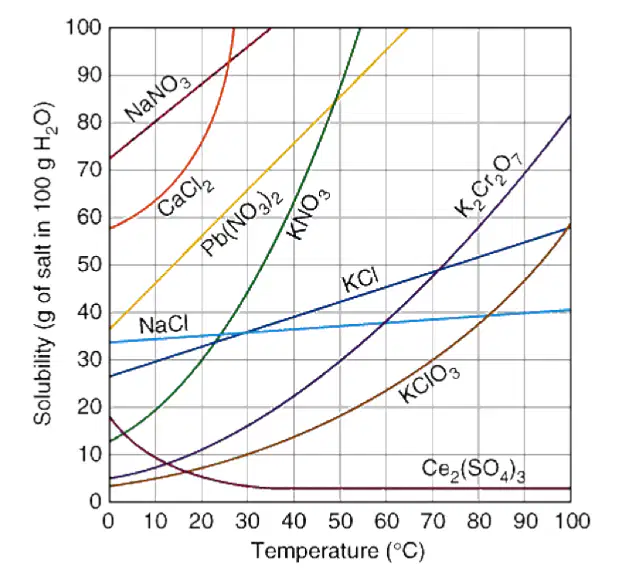
According to the graph, which of the following substance’s solubility decreases as the temperature increases?
NaNO3
KClO3
Ce2(SO4)3
NaCl
To cause the greatest increase in the solubility of a solid in a liquid, a scientist would
increase the temperature of the solution.
decrease the temperature of the solution.
decrease the amount of solvent.
decrease the amount of solute.
If large amounts of hot water are released from a power plant into a lake
the amount of dissolved oxygen (O2) in the lake increases.
the amount of dissolved O2 in the lake decreases.
the fish in the lake would be unaffected.
the warm water would decrease the need for O2 in fish.
the measure of the acidity or basicity of a solution
pH
acid
base
neutral
a substance that dissolves in water to produce a solution with a pH less than 7
pH
acid
base
neutral
a substance that dissolves in water to produce a solution with a pH greater than 7
pH
acid
base
neutral
a substance or solution with a pH of 7
pH
acid
base
neutral
A basic solution would
have no effect on red litmus paper.
turn blue litmus paper red.
turn red litmus paper blue.
turn pH paper orange.
An example of a basic solution is
ammonia.
vinegar.
carbonated soda (seltzer water).
lemon juice.
An acidic solution would
have no effect on red litmus paper.
have no effect on blue litmus paper.
turn red litmus paper blue.
turn pH paper green.
An example of an acidic solution is
liquid soap.
pure water.
coffee.
baking soda and water.
BEFORE YOU CONTINUE...take out your Unit 4 notes, your Unit 4 handouts, and a periodic table!
the smallest particle of an element that still retains the properties of a larger sample of the element
atom
subatomic particle
charge
atomic number
any particle that is smaller than an atom
atom
subatomic particle
charge
atomic number
a fundamental property of matter that can be either positive or negative
atom
subatomic particle
charge
atomic number
the number of protons in atoms of an element
atom
subatomic particle
charge
atomic number
Of the particles listed below, the least massive is the:
electron.
proton.
neutron.
atom.
Compared to protons, electrons have:
much smaller mass and opposite charge.
about the same mass and opposite charge.
much larger mass and the same charge.
much larger mass and opposite charge.
Which of the following statements is most accurate?
All lithium contains the same number of protons.
All lithium contains the same number of neutrons.
All lithium contains the same number of electrons.
All lithium contains the same number of subatomic particles.
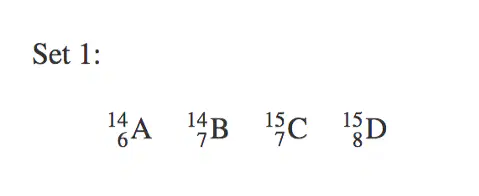
Do any of the atoms represent the same element?
No, they are all different elements.
Yes, atom A and atom B are the same element.
Yes, atom B and atom C are the same element.
Yes, atom C and atom D are the same element.
the center of an atom
nucleus
electron cloud
isotope
an attractive or repulsive force of nature that exists between charges
gravity
electromagnetic force
strong force
weak force
an attractive force of nature that exists between protons and neutrons
gravity
electromagnetic force
strong force
weak force
Of the regions/particles listed below, the most massive is the
electron cloud.
nucleus.
atom.
subatomic particle.
The charge of the nucleus of an atom is
neutral.
negative.
positive.
zero.
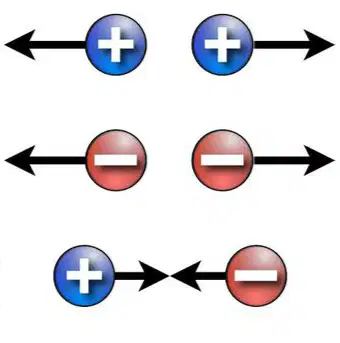
The diagrams represent charged particles placed near each other. The diagram that correctly represents the force between the electron cloud and the nucleus is
the top diagram.
the middle diagram.
the bottom diagram.
none of these diagrams.
a region of the electron cloud within which certain electrons can be found
energy level
valence shell
valence electron
electron cloud
the furthest energy level from the nucleus
energy level
valence shell
valence electron
electron cloud
an electron in the outermost energy level of an atom
energy level
valence shell
valence electron
electron cloud
An atom of silicon has how many electrons?
2
7
14
28
When drawing the Bohr model for sodium (Na), how many energy levels are required?
1
2
3
4

How many valence electrons are shown in the Bohr model?
2
5
7
8
two or more atoms of the same element that have different numbers of neutrons
isotopes
mass number
atomic number
nucleus
the sum of the protons and neutrons in an atom
isotopes
mass number
atomic number
nucleus
Atoms of the same element may contain
the same number of neutrons but a different number of protons.
the same number of protons but a different number of neutrons.
a different number of protons and a different number of neutrons.
the same number of electrons but a different number of protons.
A common isotope of iron has a mass number of 56. The total number of subatomic particles in the nucleus is
26.
56.
30.
4.
How many neutrons does a carbon atom with a mass number of 14 (and an atomic number of 6) have?
6
8
14
20
a type of matter formed from only one type of atom
element
compound
homogeneous mixture
heterogeneous mixture
a column (vertical; top/bottom) on the periodic table
group
period
metalloid
a row (horizontal; left/right) on the periodic table
group
period
metalloid
when elements are listed in order of increasing atomic number, patterns/trends in properties can be seen
periodic law
physical property
metalloid
chemical property
a property that can be observed when a substance is isolated from other substances (for example: luster, specific heat, density, or boiling point)
periodic law
physical property
metalloid
chemical property
an element that has some properties similar to metals and some properties similar to nonmetals
periodic law
physical property
metalloid
chemical property
a property that can be observed when a substance interacts with another substance (for example: reactivity, pH, or flammability)
periodic law
physical property
metalloid
chemical property
Which of the following best describes the location of elements with metallic characteristics within the periodic table?
top left
top right
bottom left
bottom right
Which of the following elements likely has the most metallic properties?
phosphorus (atomic number 15)
boron (atomic number 5)
aluminum (atomic number 13)
carbon (atomic number 6)
Which of the following physical properties is common for a nonmetal element?
shiny
ductile
thermal conductor
brittle
Calcium (atomic number 20) is an element within the family of
alkali metals.
alkaline earth metals.
transition metals.
inner transition metals.
an atom with any electrical charge
ion
cation
anion
an atom with a negative electric charge
ion
cation
anion
an atom with a positive electric charge
ion
cation
anion
How many valence electrons does indium (In) in group 13 have?
13
7
3
5
The Mg atom becomes the Mg2+ ion when it
gains two electrons
loses two electrons
gains two protons
loses two protons

If the atom shown were to become an ion, which is most likely true?
it would gain 7 electrons
it would gain 5 electrons
it would lose 1 electron
it would lose 3 electrons
An atom has 3 valence electrons. Which of the following is mostly likely true?
The atom will gain electrons to complete the current energy level.
The atom will lose electrons to eliminate the current energy level.
The atom will gain electrons to eliminate the current energy level.
The atom will lose electrons to complete the current energy level.
a group of highly reactive metal elements
alkali metals
alkaline earth metals
halogens
noble gases
a group of moderately reactive metal elements
alkali metals
alkaline earth metals
halogens
noble gases
a group of highly reactive nonmetal elements
alkali metals
alkaline earth metals
halogens
noble gases
a group of mostly unreactive gaseous elements
alkali metals
alkaline earth metals
halogens
noble gases
Which element below is likely to be most chemically reactive?
lithium (atomic number 3)
sodium (atomic number 11)
potassium (atomic number 19)
rubidium (atomic number 37)
Which element below is likely to be most chemically reactive?
potassium (atomic number 19)
calcium (atomic number 20)
scandium (atomic number 21)
titanium (atomic number 22)
Which element below is likely to be most chemically reactive?
oxygen (atomic number 8)
sulfur (atomic number 16)
selenium (atomic number 34)
tellurium (atomic number 52)
Which element below is likely to be most chemically reactive?
arsenic (atomic number 33)
selenium (atomic number 34)
bromine (atomic number 35)
krypton (atomic number 36)
Which element below is considered a noble gas?
hydrogen (atomic number 1)
helium (atomic number 2)
nitrogen (atomic number 7)
fluorine (atomic number 9)
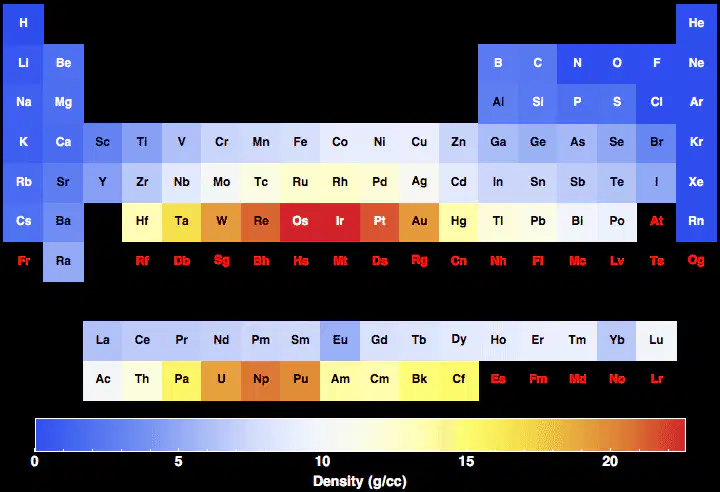
Based on the periodic table heat map, the density of elements
is greatest for alkali metals.
is greatest for transition metals.
is greatest for halogens.
is greatest for noble gases.
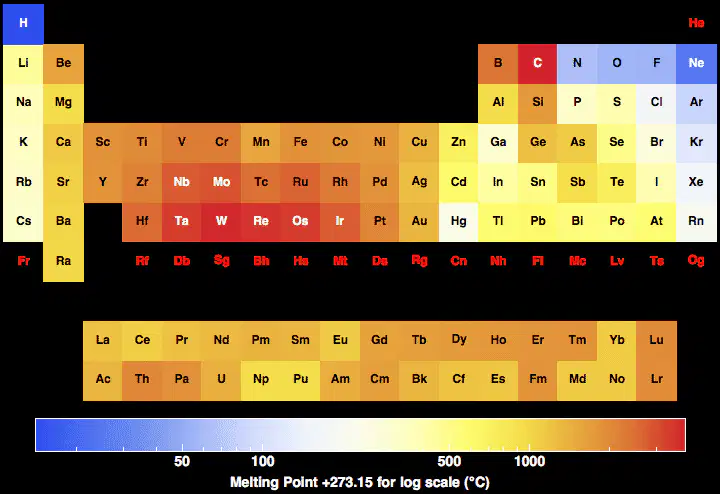
Based on the periodic table heat map, the melting point of carbon is similar to the melting point of some
metalloids.
alkaline earth metals.
transition metals.
nonmetals.
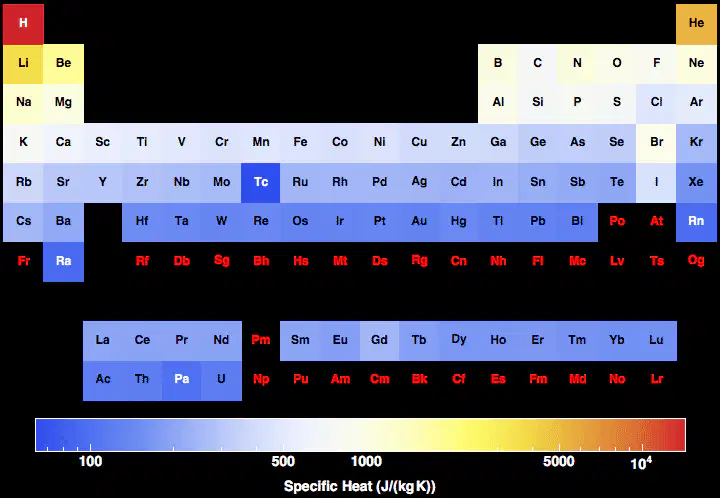
Based on the periodic table heat map, _____ has the highest specific heat of any element on the periodic table.
technetium
helium
hydrogen
carbon
BEFORE YOU CONTINUE...take out your Unit 5 notes, your Unit 5 handouts, and a periodic table!
the joining of two or more atoms because they are more stable when joined together than when existing alone
chemical bond
compound
binary
chemical formula
type of particle formed from two or more different elements
compound
binary
chemical formula
ionic bond
consisting of only two elements
binary
chemical formula
ionic bond
covalent bond
a representation of a substance that includes the symbols and ratios of atoms of each element in the substance
chemical formula
ionic bond
covalent bond
ionic charge
the electrostatic force of attraction between two oppositely charged ions
ionic bond
covalent bond
ionic charge
formula unit
the chemical joining of two atoms when their nuclei share valence electrons
covalent bond
ionic charge
formula unit
lattice
a positive or negative charge resulting when an atom loses or gains one or more electrons
ionic charge
formula unit
lattice
ionic bond
the smallest number of bonded ions with a net zero charge
formula unit
ionic bond
lattice
covalent bond
a three-dimensional arrangement of particles that are bonded in every direction
lattice
formula unit
chemical formula
chemical bond
Which statement best explains why atoms form chemical bonds with other atoms?
Most atoms are less stable when they combine with other atoms.
When atoms collide with other atoms, they bond automatically.
Atoms are always attracted to other atoms.
Most atoms are unstable unless they are combined with other atoms.
Covalent bonding occurs:
in salts like NaCl.
when electrons are shared between two atoms.
only when electrons are shared between two identical atoms.
when electrons are transferred from one atom to another.
An ionic bond is most likely to form between:
carbon and oxygen atoms.
lithium and fluorine atoms.
two oxygen atoms.
nitrogen and oxygen atoms.
Which of the following has the most covalent character?
NaCl
H2O
Fe2O3
LiOH
Covalent bonds would most likely form between:
an alkali metal and helium.
magnesium and a halogen.
a metalloid and oxygen.
sodium and chlorine.
This activity helped you review units 3B through the first lesson of 5A. I did not have time to add the rest of the questions for 5A, 5B, 6A, or 6B. You can find those practice questions in Google Classroom (Classwork, Semester 1 Exam, Exam Study Resources, Practice Multiple Choice Questions pages 32-41)
I understand the paragraph.
I didn't read the paragraph.

