
 Worksheets
Science Summer Term Assessment Revision Practice 2025
Total questions: 108
Worksheet time: 1hrs 21mins


Minerals come in many different ________ which can sometimes be helpful in identification.
rocks
streaks
Nalence
colors
A mineral is a __________ formed, inorganic solid that has a definite ___________structure.
solid, rock
naturally, crystalline
man-made, nice
Nalence, salt
A minerals ________________ is its resistance to being scratched.
hardness
luster
colors
streak
The _________________ of a mineral is how it interacts with light.
color
luster
streak
hardness
The ___________________ of a mineral is the color of its powder when rubbed on a white tile.
color
luster
streak
hardness
The _________________ of a mineral can be found by using its mass and volume.
luster
color
weight
density
Silver would have a _________luster
glassy
metallic
non-metallic
resinous
A metallic mineral is ____
shiny, looks like it is made of metal
dull, does not look like it was made of metal
A nonmetallic mineral is ____
shiny, looks like it is made of metal
dull, does not look like it was made of metal
What does naturally occurring mean?
found in nature
man-made
made from living things
What does organic mean?
came from living things
it does not come from living things
What does inorganic mean?
came from living things
it does not come from living things
Minerals are ____
inorganic
organic
Adaptation in relation to animals is...
How an animal adapts to survive in its environment
What an animal eats
How an animal breeds
How animals manage to eat more than one type of food
Evolution in relation to animals is...
The different things animals eat
How animals have evolved over time into different species
How to classify different animals
How animals have learnt to eat other animals
Inheritance in relation to animals is...
How animals behave in an environment.
What animals do to survive in an environment.
What animals like to eat.
Certain things that animals get from their parents.

How has a polar bear adapted to live in the Arctic? Tick one or more that you think are correct.
It has thick white fur to keep it warm.
It can swim
It is a mammal
it is warm blooded
Why is adaptation important for animals?
So they can live in a range of different habitats
So they can have more young
So they don't get scared by humans
so they can live in groups
The most obvious adaptation of a giraffe is what?
Big feet to walk steadily
They can be tamed to live in zoos.
Long neck to reach leaves that other animals cannot.
A long tail to flick flies away.
If evolution didn't exist we wouldn't have as many different species of animals and plants?
True
False
Which famous person discovered the theory of evolution?
Carl Linnaeus
Charles Darwin
David Attenborough
Chris Packham
Evolution is linked to how new species have evolved whereas adaptation is how species adapt to live in different environments.
True
False
Which of these did you not inherit from your parents?
Hair colour
Height
Weight
Eye Colour

Which of these enables the calf in the picture to look different to its Mum?
Adaptation
Inheritance
Evolution
Can you inherit a sense of humour from your parents?
Yes
No

Which of these could a tiger cub inherit from its parents?
Where it lives when it is older.
How it hunts.
What the best food is to eat.
Colour of its fur.

Here is Mr Preston's dog Poppy. Which of these did Poppy inherit - tick as many as you think are correct.
Fur colour
How to sit
Eye Colour
Height
To go to for a wee in the garden
Scientists say humans evolved from apes.
True
False
A process of change over many generations, where animals or plants slowly change some of their physical characteristics is called...
breeding
adaptation
evolution
inheritance
Sophie is a tall, 11 year old drummer. She has a scar on her right cheek. She is good at swimming. Which of her traits did Magda most likely inherit?
Scar
Height
Ability to swim
Ability to play the drums
When an organism completely dies out, it is called...
Fossilisation
Adaptation
Mutation
Extinction
The white feathers of a snowy owl allow it to blend in with its environment during the winter months (snow). This is an example of _______
Adaptation
Environmental change
Variation
Species
A change or difference between animals of the same species is called...
Behaviour
Environment
Offspring
Variation
Mary Anning was a very famous palaeontologist. This means she...
Studied evolution
Selectively bred animals
Studied living plants and animals
Studied and collected fossils
Tick the statements you believe to be true. Fossils...
are the remains or traces of plants and animals that lived long ago.
are shells.
are always found on a beach.
give scientists clues about the past.
Adaptation in relation to animals is...
How an animal adapts to survive in its environment
What an animal eats
How an animal breeds
How animals manage to eat more than one type of food
Evolution in relation to animals is...
The different things animals eat
How animals have evolved over time into different species
How to classify different animals
How animals have learnt to eat other animals
Inheritance in relation to animals is...
How animals behave in an environment.
What animals do to survive in an environment.
What animals like to eat.
Certain things that animals get from their parents.
Why is adaptation important for animals?
So they can live in a range of different habitats
So they can have more young
So they don't get scared by humans
so they can live in groups
When organisms are better adapted to their environment they will survive and reproduce more successfully than organisms less adapted. This process is called what?
Selective breeding
Natural Selection
Cloning
Evolution of all species
Which scientist visited the Galapagos Islands and came up with the theory of natural selection?
Theodor Schwann
Gregor Mendel
Charles Darwin
Rudolf Virchow

Gigantopithecus were very large primates that lived 500,000 years ago. Since none of these mammals are still today, they are said to be....
Extinct
Threatened
Endangered
Declining

Scientists have collected millions of fossils of different organisms, and have developed a timeline of life on Earth. What do we call this?
Mutation
Natural Selection
The theory of evolution
Fossil Record

Sometimes bones in the front limbs of animals are very similar in structure. What do we call similar bone structures that indicate a link to a common ancestor?
Adaptations
Gradualism
Homologous Structures
Extinction
A physical or behavioral trait that helps an organism survive and reproduce in its environment is called a what?
An adaptation
A response to a stimulus
A mutation
Evolution
What most likely caused the finches on the Galapagos Islands to have beaks that were different from the finches on the mainland?
There were different types of predators on the island.
There were different types of food available on the island.
The finches had no water to drink.
The finches on the mainland could not fly high enough.
What do we call a change in a species over time?
Adaptation
Evolution
Extinction
Environmental influences

Evolution is best defined as:
the process which organisms die.
the process which organisms change over time.
the process which organisms that are extinct become revived.
the process which non-living things fossilize.

The solidified remain or imprint of a once living thing are called:
Fossils
Homologous Structures
Vestigial Structures
DNA

Which two animals are closer relatives?
Dolphin and Wolf
Wolf and Shark
Shark and Dolphin

Which two animals are closer relatives?
Bear and Raccoon
Bear and Opossum
Opossum and Raccoon

Which two animals are closer relatives?
Human and Sponge
Sponge and Tunicate
Human and Tunicate
What caused the Horse and Whale to evolve?
They wanted to become bigger so they ate as much as they could.
Their environments changed so they had to adapt.
They wanted to look different so they changed their appearance.

Which animal is the MOST similar to the Human from the list below?
Bat
LIzard
Whale
Bird
Which animal is the LEAST similar to the Human from the list below?
Bat
LIzard
Whale
Bird
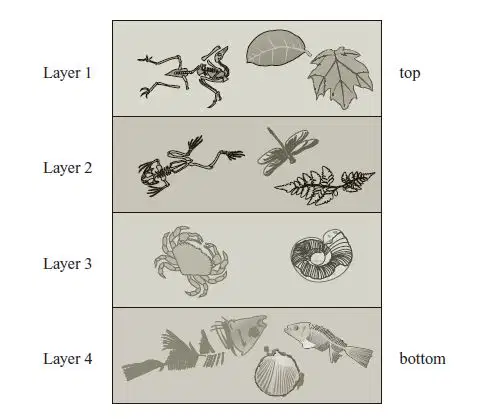
According to the picture, how has the environment led to changes over time?
Animals were able to walk in the past, but now they swim.
A species has lived there and never changed.
Animals used to swim in the past, but now they walk.
The environment was changed when animals decided to walk instead of swim.
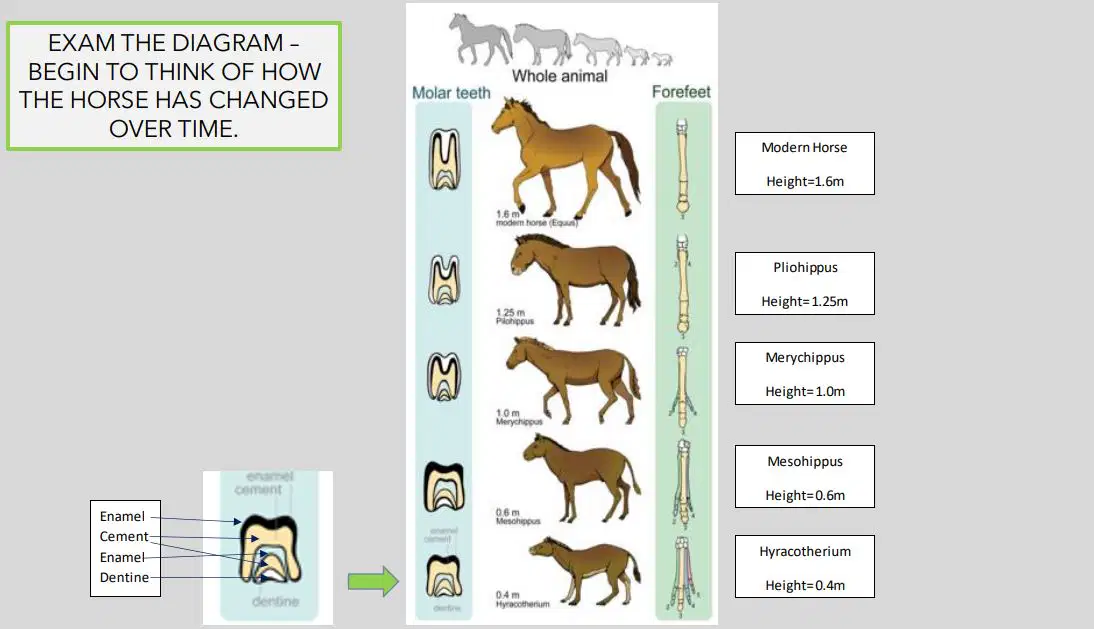
What are some changes that have occurred in the Horse over time?
teeth, feet, body
hair, color, feet
body, feet, color
Which trait MOST likely helps an animal survive in a very cold environment?
Long ears
Large eyes
Thick fur
Sharp Claws
The solidifed remain or imprint of a once living thing is called:
Who or what were the first living things existed on Earth?
Bacteria
Fish
Humans
Dinosaur
What is Biological Evolution?
The proces in which animals drink water.
The process in which plants and animals reproduce.
The process in which living organisms change through the passed of the years.
The process in which explains the cycle of life.
According to the scientists, what is the ancestor of the amphibians?
Fish
Whales
Sharks
Crabs
Which animals were the first amphibians that existed?
Toads, plants, frogs, salamaders.
Toads, frogs, salamanders, dinosaurs.
Toads, frogs, salamanders, fish.
Toads, frogs, salamanders.
According to the path of the evolution, which animals were the last that evolved?
Snakes and crocodiles.
Monkeys and apes.
Reptiles
Dinosaurs.
Which animal was first?
Whales
Fish
Which animal was first?
Reptiles
Dinosaurs.
Wich animal was first?
Horses
Birds
Wich animal was first?
Lizards.
Dinosaurs.
What is a real example of a biological evolution?
A man becomes a spiderman
A man becomes an alien.
Lizard becomes a crocodile.
Dinosaur becomes a horse.



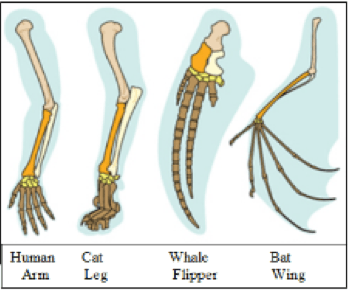
The bones in the figure above are-
Evidence of a common ancestor
Evidence that animals can walk
Evidence that fossils are old
Evidence of nothing

The picture shows a/an ___________
homologous structure
vestigial structure

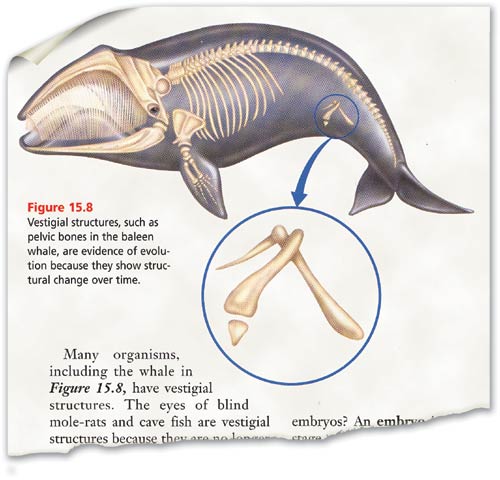
Whales have pelvic bones. What type of structure does this best represent?
Homologous structure
Analogous structure
Vestigial structure
None of the above
Which of the following are vestigial structures humans have? Select all that apply.
Appendix
Tailbone
Forearm bones
Goosebumps

When scientists see similarities between a hippopotamus embryo and a rabbit embryo, this suggests:
Rabbits evolved from hippopotamus.
Hippopotamus share a common ancestor with rabbits.
Hippopotamus evolved from rabbits.
Hippopotamus and rabbits share the same traits.
body parts that perform a similar function but differ in structure
homologous structures
analogous structures
vestigial structures
comparative anatomy

Penguin flipper and fish fin
Homologous
Vestigial
Analogous
None of the above
The analysis of embryos can prove...
fossils
extinction
common ancestry
Similar structures with different purposes found in different species are known as _____
vestigial structures
DNA
homologous structures
the fossil record

