wayground logo

Free Printable Worksheets

Font size

S
M
L
XL
Worksheets

Meteorology Midterm Review

Total questions: 107

Worksheet time: 2hrs 25mins

Name
Class
Date
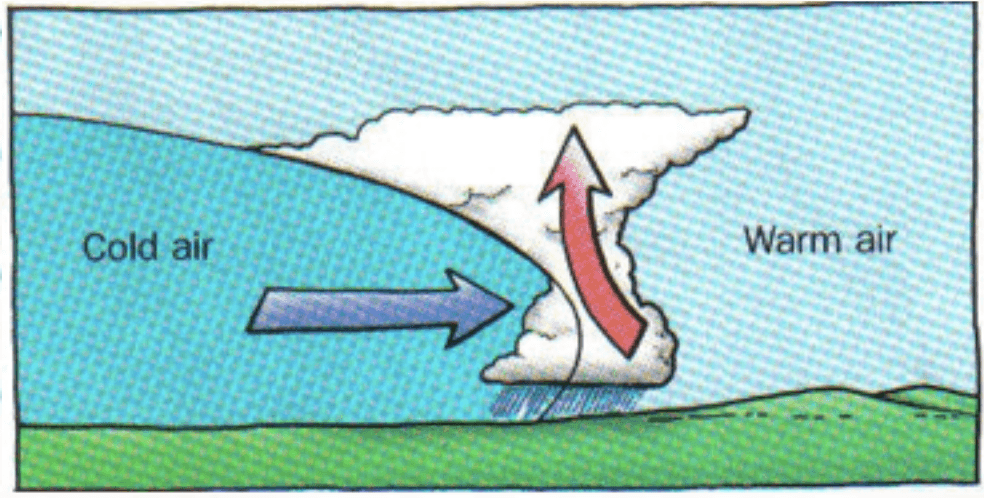
1.
Which front is this?
a)
Warm front
b)
Cold front
c)
Occluded front
d)
Stationary Front
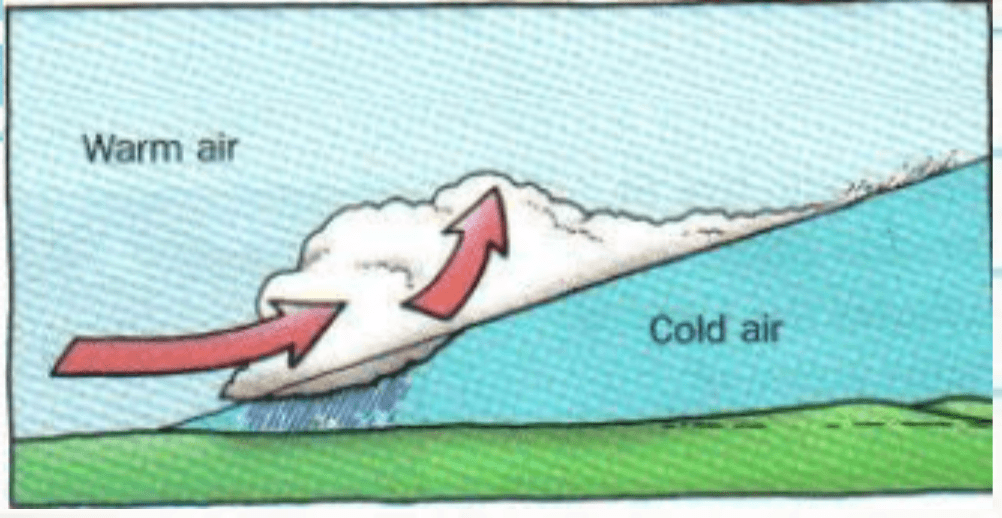
2.
Which front is this?
a)
Warm front
b)
Cold front
c)
Occluded front
d)
Stationary front
3.

Name that front.

a)

Cold Front

b)

Warm Front

c)

Stationary Front

d)

Occluded Front

4.

Name that front.

a)

Cold Front

b)

Warm Front

c)

Stationary Front

d)

Occluded Front

5.

What happens when two air masses meet?

a)

a hurricane occurs

b)

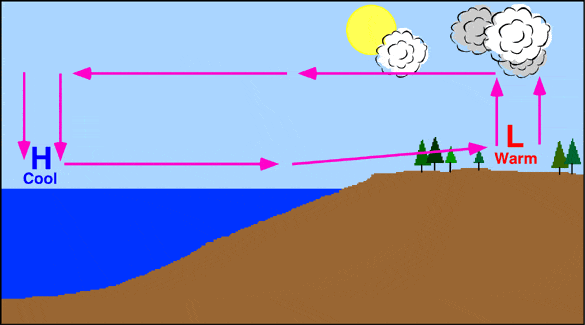
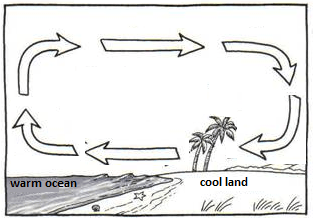
a dog barks

c)

a front is created

d)

warm air enters

6.

What kind of front results in thunderstorms?

a)

warm front

b)

cold front

c)

occluded front

d)

stationary front

7.

With what type of pressure are hurricanes associated?

a)

High

b)

Low

c)

Equal

8.

Why does a hurricane slow down when it hits land?

a)

The wind stops it

b)

It stops raining

c)

It loses its energy source

d)

The air is different

9.

The name of the system that causes the winds to spin in a hurricane

a)

The Coriolis Effect

b)

The Corleone Affect

c)

The Circular Wind Phenomenon

d)

The East-West Effect

10.

A _____________ is a large, rotating low-pressure system that forms over the warm waters of oceans near the equator.

a)

tornado

b)

hurricane

c)

thunderstorm

d)

flooding

11.

Most hurricanes

a)

cannot be seen from space

b)

cross exposed land

c)

become dangerous category 5 storms

d)

lose their power when they move into cooler waters or moves over land

12.

Winds are generated when air flows from a high pressure area into a ____.

a)

region of intense moisture

b)

cold front

c)

low pressure area

d)

storm that is already in progress

13.

Thunderstorms, hurricanes, and tornadoes form at __________ pressure systems, where you have warm (typically moist/humid) air quickly rising.

a)

low

b)

high

14.
What happens if a hurricane moves over land or cold ocean water?
a)
it will get stronger
b)
it will get weaker
c)
it will upgrade its category
d)
it will morph into a typhoon
15.
_____________ air is more dense and tends to sink
a)
cold
b)
warm
c)
moist
d)
dry
16.
________ air is less dense and tends to  rise
a)
cold
b)
warm
c)
moist
d)
dry
17.
rapidly moving cold air  mass runs into a warm air mass the cold air slides under the warm air. This is called a  .....
a)
cold front
b)
warm front
c)
stationary front
d)
occluded front
18.
_________ fronts are associated with more violent weather
a)
cold
b)
warm
c)
stationary
d)
occluded
19.
When cold and warm air masses meet but neither one moves past the other it is called a _________
a)
cold front
b)
warm front
c)
stationary front
d)
occluded front
20.
in a warm front, if the air is dry _________ occurs.
a)
dry, scattered clouds
b)
thunder storms
c)
showers and light rain
d)
snow
21.
In a warm front, if the warm air is humid __________ occurs
a)
dry, scattered clouds
b)
thunder storms
c)
showers and light rain
d)
snow
22.
A hurricane gains strength from _____ ______ _____ a the ocean's surface.
a)
Cold Dry Air
b)
Cold Humid Air
c)
Warm Humid Air
d)
Warm Dry Air
23.
A cold, dry air mass would be called - 
a)
continental tropic
b)
continental polar
c)
maritime polar
d)
continental maritime
24.
The boundary between two air masses is called a/an - 
a)
flood
b)
front
c)
climate
d)
storm
25.
When a warm air mass gently slides on top of a cold air mass, and you have drizzly rain and then warmer weather, what type of front is it?
a)
warm front
b)
cold front
c)
occluded front
d)
stationary front
26.
What type of weather would a continental tropical air mass bring?
a)
dry and cold weather
b)
wet and cold weather
c)
dry and warm weather
d)
wet and warm weather
27.
A wet, cold air mass would be - 
a)
maritime tropical 
b)
maritime polar
c)
continental tropical 
d)
continental polar
28.
What type of storm front is this? 
a)
warm front
b)
cold front
c)
stationary front
d)
occluded front
29.
What type of storm front is this?
a)
warm front
b)
cold front
c)
stationary front
d)
occluded front
30.
What type of front is this?
a)
Warm Front
b)
Cold Front
c)
Stationary Front
31.
What type of weather does a low pressure system bring?
a)
stormy, cloudy weather
b)
clear skies
32.
What type of weather does a high pressure system bring?
a)
Stormy weather
b)
Clear skies, little rain
33.
 Air masses are classified by which 2 characteristics?
a)
temperature and air pressure
b)
     temperature and humidity
c)
air pressure and wind speed
d)
air pressure and humidity
34.
It's been like this for the last 3 days. What kind of front is shown?
a)
warm front
b)
cold front
c)
occluded
d)
stationary
35.
 What conditions can lead to the formation of a hurricane?
a)
 low-pressure over warm tropical ocean 
b)
low-pressure system over artic tundra
c)
 high-pressure over warm tropical ocean
d)
high-pressure system over hot, dry land
36.
The uneven heating of the surface results in 
a)
in seasons 
b)
ocean currents
c)
differences in weather
d)
differences in organisms
37.
What type of of air mass is wet and warm?
a)
mP
b)
mT
c)
cT
d)
cP
38.
What type of of air mass is dry and warm?
a)
cP
b)
cT
c)
mP
d)
mT
39.

Beaches have frequent thunderstorms why?

a)

The thunderstorms like the coast

b)

There are too many people there

c)

The uneven heating of the earth

d)

Thunderstorms only happen in Flordia

40.

What type of fronts create a Tornado?

a)

Cold Front

b)

Warm and Cold Front

c)

Stationary Front

d)

Warm Front

41.

What type of weather is Georgia going to experience in 3 days?

a)

Warm front with stormy weather

b)

High pressure system with clear skies

c)

Cold front with thunderstorms

d)

Low pressure system with cloudy skies

42.
Storms with high winds and heavy rain that form over warm ocean waters are called _____
a)
hurricanes
b)
blizzards
c)
tornadoes
d)
droughts
43.

How does the Fujita scale measure a tornado's intensity?

a)

by analyzing the damage the tornado has done & matching that to wind speeds

b)

by only looking at the wind speed

c)

by looking at the number of buildings the tornado destroys

d)

by analyzing the wind speeds and width of the tornado

44.

Do the center of hurricanes and tornadoes have high or low pressure?

a)

high

b)

low

45.
Hurricanes develop in ________ regions.
a)
Arctic
b)
Tropical
c)
Arid
d)
None of the above
46.

What is the difference between a hurricane and a typhoon?

a)

A hurricane is larger

b)

A typhoon does not have an "eye"

c)

They occur in different oceans

d)

They spin in different directions

47.

Someone who studies weather is called ____?

a)

a geologist

b)

a meteorologist

c)

a chemist

d)

an astronomer

48.
What causes wind?
a)
movement of high pressure to low pressure
b)
movement of low pressure to high pressure
49.
The tropical winds running from 0 to 30 degrees latitude are called:
a)
subtropical westerlies
b)
polar westerlies
c)
trade winds
d)
polar winds
50.
Which global winds directly effect weather in the U.S.?
a)
Trade Winds
b)
Prevailing Westerlies
c)
Polar Easterlies
d)
Doldrums
51.
Which global winds are found at the poles? 
a)
Polar Westerlies
b)
Prevailing Easterlies
c)
Polar Easterlies
d)
Trade Winds
52.
In which direction do prevailing westerlies flow?
a)
from east to west
b)
from west to east
c)
from north to south
d)
from south to north
53.

Which statement correctly defines wind?

a)

The movement of air from areas of low pressure to areas of high pressure

b)

The movement of air to a colder area in the atmosphere.

c)

The movement of air from areas of high pressure to areas of low pressure.

d)

The movement of air pushed around and bouncing off Earth's surface.

54.
The black arrows on the picture represents the:
a)
Westerlies
b)
Trade winds
c)
Polar Easterlies
55.
The red arrows represent the:
a)
Polar Easterlies
b)
Westerlies
c)
Trade winds
56.
The purple arrow represents the:
a)
Polar Easterlies
b)
Westerlies
c)
Trade winds
57.
The region in red is known as the:
a)
tropical region
b)
temperate region
c)
polar region
58.
This is the reason why winds and ocean curve due to the rotation of the Earth.
a)
Conduction Effect
b)
Coriolis Effect
c)
Condensation Effect
59.
What kind of breeze would you expect to sea in this picture?
a)
sea breeze
b)
land breeze
c)
no breeze
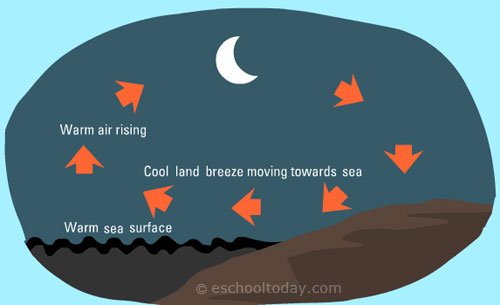
60.
What kind of breeze do you expect to see in this picture?
a)
sea breeze
b)
land breeze
c)
no breeze
61.
During the day, the _________ is warmer, but at night the __________ is warmer.
a)
land, sand
b)
ocean, land
c)
land, ocean
62.
Where ever warm air is rising, expect to see an area of ________ pressure.
a)
low
b)
high
c)
medium
63.
What are 2 Greenhouse gases?
a)
water vapor and carbon dioxide
b)
carbon dioxide and oxygen
c)
oxygen and nitrogen
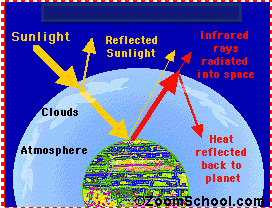
64.
The picture shows the sun's heat being trapped by the Earth's atmosphere. This is known as the:
a)
Coriolis Effect
b)
Greenhouse Effect
c)
Precipitation Affect
65.
True or False
Trade winds are found near the Equator and blow from west to east.
a)
True
b)
False
66.

Coriolis Effect

a)

bands of high and low pressure found about every 30 degrees of latitude

b)

the curving of a path of a moving object from an otherwise straight path due to Earths rotation

c)

winds that blow from east to west between 60 and 90 degrees latitude in both hemispheres

d)

narrow belts of strong winds that blow in the upper troposphere

67.

jet stream

a)

bands of high and low pressure found about every 30 degrees of latitude

b)

the curving of a path of a moving object from an otherwise straight path due to Earth's rotation

c)

winds that blow from east to west between 60 and 90 degrees latitude in both hemispheres

d)

narrow belts of strong winds that blow in the upper troposphere

68.

Local winds blow over:

a)

short distances

b)

long distances

c)

the poles

d)

the equator

69.

What causes differences in air pressure?

a)

even heating of the Earth

b)

Even cooling of the earth

c)

uneven heating of the earth

d)

global warming

70.
Is this a land or a sea breeze?
a)
land breeze
b)
sea breeze
71.
What kind of breeze is this and when would it form?
a)
Land breeze - daytime
b)
Land breeze - nighttime
c)
Sea breeze - daytime
d)
Sea breeze - nighttime
72.

sea breeze

a)

cool mountain air moves down a mountain slope towards a valley

b)

warm air rises up a mountain slope from a valley

c)

cool land flows to the ocean at night, causing warm ocean air to rise

d)

cool ocean air flows to land during the day, causing warm land air to rise
73.

land breeze

a)

cool air moves down a mountain slope toward a valley

b)

warm air rises up a mountain slope from a valley

c)

cool land air flows to the ocean at night, causing warm ocean air to rise

d)

cool ocean air flows to land during the day, causing warm land air to rise

74.
Is this a land or a sea breeze?
a)
land breeze
b)
sea breeze
75.
This local wind happens during the day when the air over the ocean is cooler than the air over the land. The cool air flows FROM the SEA to the land producing this:
a)
land breeze
b)
global wind
c)
Coriolis effect
d)
sea breeze
76.
This local wind happens at night when the air over the ocean is warmer than the air over the land. The cool air moves FROM the LAND toward the ocean creating a
a)
El Nino
b)
sea breeze
c)
land breeze
d)
transpiration
77.
How does the air move in a land breeze?
a)
From east to west
b)
From west to east
c)
From the land to the ocean
d)
From the ocean to the land
78.
When warm air rises, ______ pressure forms at the surface of the land or sea.
a)
high
b)
some
c)
low
d)
none
79.
Why does warm air rise?
a)
Warm air is more dense than cooler air.
b)
Warm air has more pressure than cooler air.
c)
Warm air is less dense than cooler air.
d)
Warm air has a higher dew point than cooler air.
80.
Wind blows from ______ pressure areas to _____ pressure areas.
a)
high; low
b)
warm; cool
c)
cool; warm
d)
low; high
81.
Where you will find the ozone layer.
a)
stratosphere
b)
thermosphere
c)
exosphere
d)
mesosphere
82.
Where weather occurs.
a)
stratosphere
b)
thermosphere
c)
troposphere
d)
mesosphere
83.
The coldest layer.
a)
troposphere
b)
thermosphere
c)
exosphere
d)
mesosphere
84.
The hottest layer.
a)
troposphere
b)
thermosphere
c)
exosphere
d)
mesosphere
85.
Which order is correct from the earth to space?
a)
thermosphere
 troposphere
 exosphere
mesosphere
stratosphere
 ionosphere
b)
thermosphere
 troposphere
 stratosphere
 exosphere
mesosphere
 ionosphere
c)
exosphere
ionosphere
thermosphere
mesosphere
 stratosphere
troposphere
d)
troposphere
thermosphere
 troposphere
 stratosphere
 exosphere
mesosphere
86.
What does the earth's atmosphere do?
a)
help to regulate the temperature on Earth
b)
Help UV rays to reach the Earth's surface
c)
Creates meteors in the sky
d)
Keep ocean waters cold
87.
As you go higher in the troposphere, the temperature _______________.
a)
decreases
b)
increases
c)
stays the same
d)
gets very hot
88.
As you go higher in the stratosphere, the temperature _______________.
a)
decreases
b)
increases
c)
stays the same
d)
gets very hot
89.
What is the function of the ozone layer?
a)
to allow UV rays to get to Earth
b)
to block UV rays from getting to Earth
c)
To keep oxygen in
d)
to allow meteors to get to Earth
90.
Which layer has the highest pressure?
a)
thermosphere
b)
stratosphere
c)
troposphere
d)
ionosphere
91.
 Which of the following activities contributes the most to carbon emissions globally?
a)
Deforestation
b)
Agriculture
c)
Burning fossil fuels
d)
Respiration
92.
What does this diagram illustrate?
a)
Ozone Layer
b)
The Greenhouse Effect
c)
Ultraviolet Radiation
d)
Layers of the atmosphere
93.
What is the transfer of heat by movement of liquids or gases?
a)
conduction
b)
convection
c)
radiation
94.
What is the transfer of heat by direct contact?
a)
conduction
b)
convection
c)
radiation
95.

What is a transfer of heat energy by electromagnetic waves through space?

a)

conduction

b)

convection

c)

radiation

96.
You are stirring a bowl of hot soup with a metal spoon. The spoon starts to feel warmer because of _?_.
a)
conduction
b)
convection
c)
radiation
97.
You buy a lava lamp from the store. As the lamp heats up, blobs of liquid rise to the top then sink back down to the bottom. This process continues because of _?_.
a)
conduction
b)
convection
c)
radiation
98.
You are doing your homework at a desk that is underneath a lamp. You start to feel hotter because of _?_ from the lamp.
a)
conduction
b)
convection
c)
radiation
99.
Your best friend has a bunk bed. You move from the bottom bunk to the top bunk and notice that the air is warmer. The warm air rises because of _?_.
a)
conduction
b)
convection
c)
radiation
100.

You are in science class and want to see if the hot plates were used recently. You place your hand near the side of the hot plate. Without touching the hot plate, your hand feels warmer. Heat is transferred to your hand by _?_.

a)

conduction

b)

convection

c)

radiation

101.
What happens when ice cubes melt in a glass?
a)
Heat travels from the ice to the warmer water.
b)
No energy is transferred.
c)
Heat is transferred from the warmer water to the ice cubes.
102.
Which of the following is the best example of conduction?
a)
A light bulb warming a lampshade
b)
An egg cooking in a frying pan
c)
Water boiling in a pot
d)
Gases circulating in the atmosphere
103.

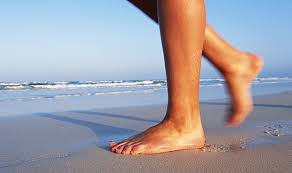
Walking on the warm sand sand with your bare feet demonstrates this type of heat transfer. This is an example of _?_.

a)

conduction

b)

convection

c)

radiation

104.

A group of friends gather around a fire to stay warm. This is an example of _?_.

a)

conduction

b)

convection

c)

radiation

105.

The candle will slowly heat the metal and transfer the heat directly to the mans hand. This is an example of _?_.

a)

conduction

b)

convection

c)

radiation

106.
What causes the circulation of air in the atmosphere?
a)
Air in the atmosphere is heated by the sun and sinks to the ground.
b)
The ground is heated by the sun and then heats the air, causing the air to rise.
c)
Air loses heat to the ground and then rises upward to obtain more energy.
d)
The sun heats the clouds which forces the cooler air to move away and sink.
107.

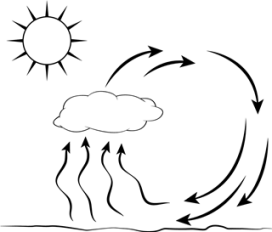
The moving of air in the image is an example of _?_.

a)

radiation

b)

convection

c)

conduction