wayground logo

Free Printable Worksheets

Font size

S
M
L
XL
Worksheets

Review Questions for Earth, Moon, Sun, and Solar System

Total questions: 100

Worksheet time: 2hrs 55mins

Name
Class
Date
1.
How many high and low tides occur each day?
a)
2 each
b)
4 each
c)
8
d)
6
2.
When the Earth's shadow falls on the moon, the shadow causes what to happen?
a)
Lunar eclipse
b)
Solar eclipse
c)
Partial eclipse
3.
a)
New moon
b)
Full moon
c)
1st Quarter
d)
3rd Quarter
4.
a)
Waxing Crescent
b)
Waning Crescent
c)
Waxing Gibbous
d)
Waning Gibbous
5.
a)
New moon
b)
Full moon
c)
1st Quarter
d)
3rd Quarter
6.
a)
New moon
b)
Full moon
c)
1st Quarter
d)
3rd Quarter
7.
a)
Waxing Crescent
b)
Waning Crescent
c)
Waxing Gibbous
d)
Waning Gibbous
8.
a)
Waxing Crescent
b)
Waning Crescent
c)
Waxing Gibbous
d)
Waning Gibbous
9.
What is the next phase?
a)
New Moon
b)
Last Quarter
c)
Waxing Gibbous
d)
Waning Crescent
10.
What is illuminating the Moon?
a)
Nuclear Fusion
b)
Sunlight
c)
Mirrors
d)
Flood Lights
11.

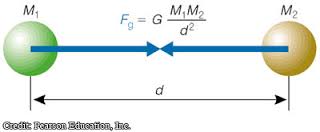
The pull between two objects in the universe is known as the force of —

a)

acceleration

b)

energy

c)

gravity

d)

orbit

12.

The Earth revolves —

a)

on its axis

b)

around the Sun

c)

causing day and night

d)

every 30 days

13.

The Moon produces its own light.

a)

True

b)

False

14.

As the Moon phases moves from being a New Moon to a Full Moon, it appears as though the Moon is getting bigger, or ________.

a)

waning

b)

waxing

15.

How does the gravitational pull of the Moon affect the Earth?

a)

causes moon phases

b)

causes seasons

c)

causes tides

d)

causes weather

16.

The time it takes for the moon to make one full orbit (revolution) around Earth is

a)

24 hours

b)

365.25 days

c)

about 30 days

d)

5 days

17.
Which moon phases are "gibbous"?
a)
1 and 5
b)
2 and 8
c)
4 and 6
d)
3 and 7
18.
Which moon phases are "crescents"?
a)
1 and 5
b)
2 and 8
c)
4 and 6
d)
3 and 7
19.

The moon ____________ around the Earth.

a)

revolves

b)

rotates

c)

up

d)

down

20.

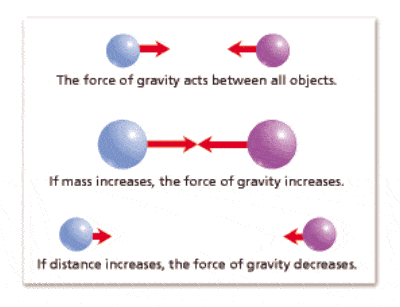
What effect does increasing the distance between the two objects do to the gravitational force?

a)

The distance between two objects has no effect on the gravitational force

b)

It increases

c)

It stays the same

d)

It decreases

21.

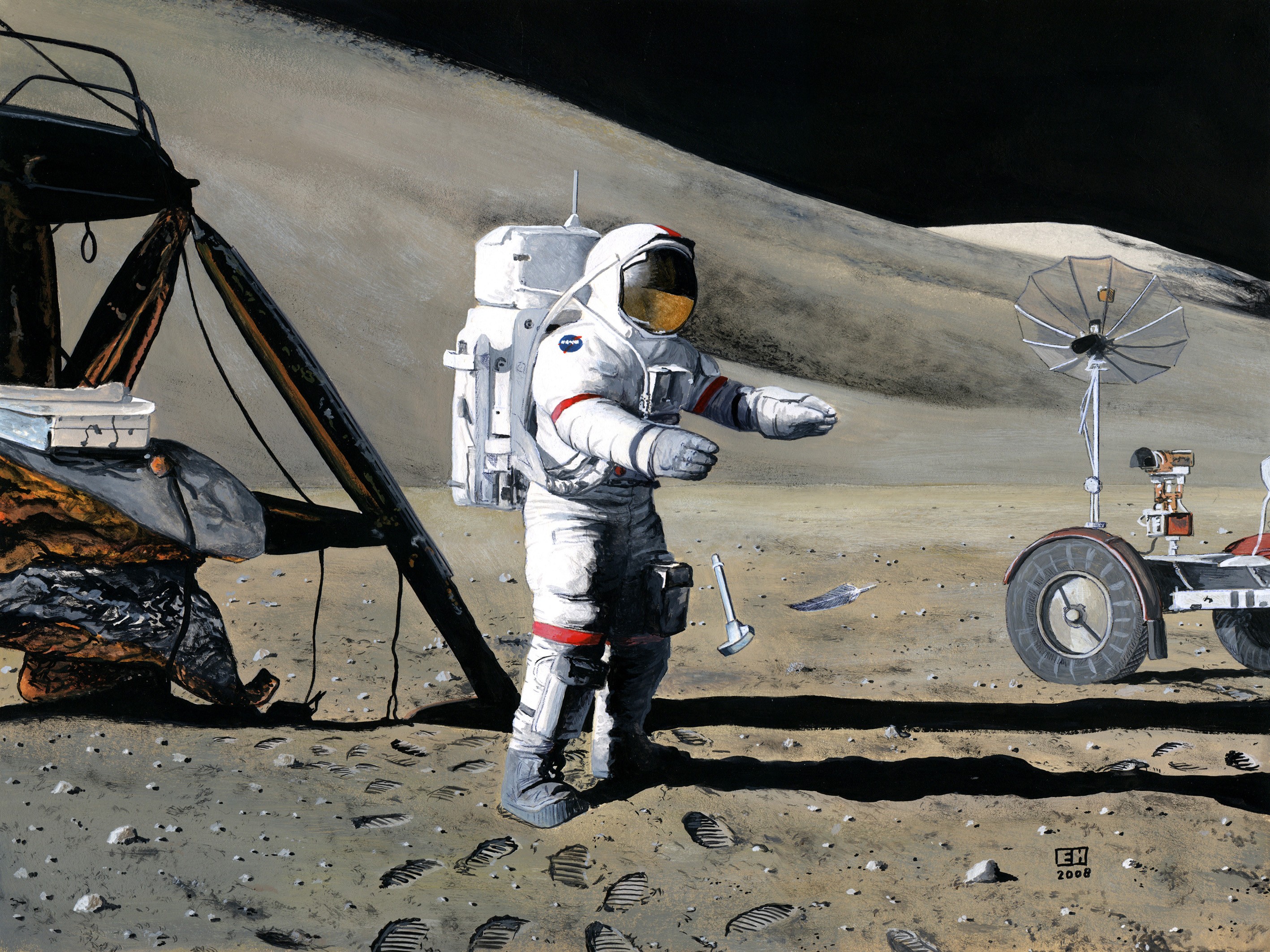
If a feather and a hammer are dropped at the same time on the moon, where there is no atmosphere, which one will hit the ground first?

a)

Neither, there is no gravity on the moon.

b)

hammer because it has more mass

c)

feather because it has less mass

d)

both will hit at the same time, there is no wind resistance
22.
What does the strength of gravity between two objects depend upon?
a)
Mass & distance
b)
Mass & weight
c)
Gravity & inertia
d)
Inertia & mass
23.
Which of these best describes why your weight (on Earth) would change on another planet?
a)
Dehydration effects on different planets change weight.
b)
In general, the smaller the planet, the greater weight
c)
Different planets have different gravitational pulls
d)
Weight does not change, no matter where you are.
24.
Which of the following will not change in different gravitational fields?
a)
weight
b)
force
c)
mass
d)
pounds
25.

When placed at equal distances apart, the greatest gravitational attraction will be between two

a)

skateboards

b)

bowling balls

c)

school buses

26.
As the product of two objects' masses increases, the pull of gravity
a)
Increases
b)
Decreases
c)
Stays the same
27.
Mass is a measurement of 
a)
how much matter is present in an object
b)
how much weight is present in an object
c)
the amount a spring is compressed on a scale
d)
none of the answers are correct
28.

What is the relationship between mass and gravitational pull?

a)

Higer mass creates higher gravitational pull

b)

Lower mass creates higher gravitational pull

c)

Lower gravitational pull creates more mass

29.

Gravity on moon is less than the gravity on earth because

a)

a. moon's mass is less

b)

b. moon's mass is more

c)

c. moon's mass is equal to Earth

d)

d. moon has no mass

30.
Complete the following statement: The farther away two planets are the _______ the gravitational force between them.
a)
more
b)
same
c)
dosen't matter
d)
less
31.

Mass and weight are the same thing.

a)

True

b)

False

32.
What is the definition of "weight"?
a)
measure of the force of gravity on your body
b)
the time it takes to get on a ride 
c)
the amount of matter in an object
d)
the size of an object
33.
As an object's mass increases, its gravitational pull will ____________.
a)
decrease
b)
increase
c)
stay the same
d)
get weaker
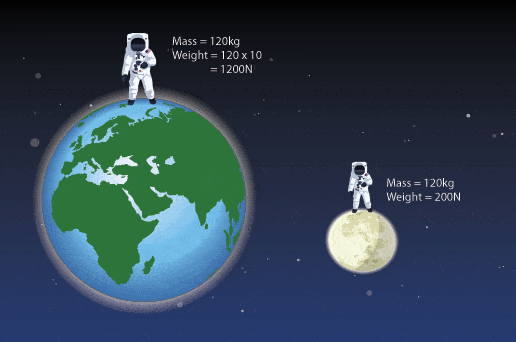
34.
Why would you weigh less on the moon compared to Earth?
a)
less air
b)
less sunlight
c)
more gravitational pull
d)
less gravitational pull
35.
Which of the following never changes no matter where in the universe?
a)
weight
b)
force
c)
mass
d)
pounds
36.
As mass increases, what happens to gravitational force?
a)
increases
b)
decreases
c)
stays the same
d)
i don't know
37.
Which model has greater gravitational attraction (if any)
a)
Model A
b)
Model B
c)
Both Model A and Model B (same gravity)
38.
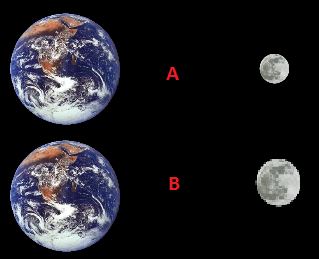
Which system has the greater gravitational attraction between the two objects (if any)?
a)
System A
b)
System B
c)
Same gravitational attraction fro System A and System B
39.

The gravitational force between two objects changes with the distance between the two objects

a)

True

b)

False

40.
The farther apart two objects are, the _______ the gravitational force.
a)
weaker
b)
stronger
c)
less stable
d)
more stable
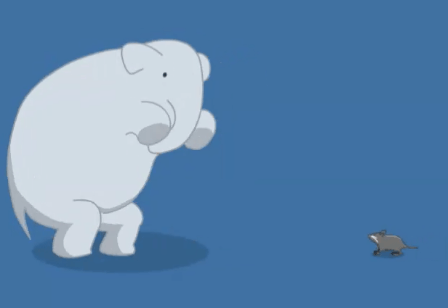
41.
Which objects have a STRONG force of gravity?
a)
Objects with GREATER mass, like elephants
b)
Objects with LESS mass, like mice
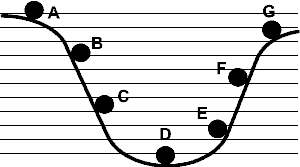
42.

At which point does the ball has the greatest gravitational potential energy (GPE)?

a)

A

b)

G

c)

D

d)

C

e)

G

43.

You throw a ball into the air as shown in the diagram. At what point does the ball have the most gravitational potential energy?

a)

W

b)

X

c)

Y

d)

Z

44.

If the following objects were dropped from the same height, which one would hit the floor first?

a)
b)
c)
45.
Day and night are caused by...
a)
the tides
b)
the tilt of the Earth's axis
c)
the revolution of the Earth around the Sun
d)
the rotation of the Earth on its axis
46.
What causes the Earth to have seasons?
a)
the revolution of the Earth around the Sun
b)
The tilt of the Earth's axis
c)
The tilt of the Earth's axis and the revolution of the Earth around the Sun
d)
the distance of the Earth from the sun
47.
When the South pole is tilted towards the Sun, it is...
a)
Summer in both hemispheres
b)
Winter in both hemispheres
c)
Summer in the Northern Hemisphere and Winter in the Southern Hemisphere
d)
Winter in the Northern Hemisphere and Summer in the Southern Hemisphere
48.
When the moon appears to be getting smaller, it is said to be...
a)
waxing
b)
decreasing
c)
eclipsing
d)
waning
49.
What is the main cause of tides on Earth?
a)
the gravitational pull of the Earth
b)
The rotation of the Earth on its axis
c)
The gravitational pull of the moon
d)
the revolution of the Earth around the sun
50.
What is the name of the larger, lighter part of the moon's shadow?
a)
umbra
b)
penumbra
c)
ellipse
d)
orbit
51.
About how often does the moon revolve around the earth?
a)
about a year
b)
about a month
c)
about a week
d)
about a day
52.
What causes moon phases?
a)
the rotation of the Moon 
b)
the rotation of the Earth
c)
the revolution of the Moon around the Earth
d)
the tilt of the Earth around the sun
53.
When the moon is getting smaller, this is described as ___________________.
a)
waning
b)
waxing
c)
rotating
d)
revolving
54.
Which phase of the moon occurs when you cannot see any reflection of the sun on the moon?
a)
Full Moon
b)
Waning Crescent
c)
Waxing Gibbous
d)
New Moon
55.
Which phase of the moon shows an entire circle reflected by the sun?
a)
New
b)
Full Moon
c)
Waxing Crescent
d)
Waning Crescent
56.

An equinox occurs when

a)

neither hemisphere is tilted toward or away from the sun.

b)

the Northern Hemisphere is tilted away from the sun.

c)

the Northern Hemisphere is tilted toward the sun.

d)

Earth’s axis is parallel to the sun’s rays.

57.

At which location in Earth's rotation is it summer in the Northern Hemisphere?

a)

SS

b)

VE

c)

WS

d)

AE

58.

How would the seasons be different if Earth were not tilted on its axis?

a)

Temperatures would remain mostly constant year-round.

b)

The length of daylight hours would not change throughout the year.

c)

Both hemispheres would receive the same amount of sunlight all year.

d)

All of the above

59.

What happens when a part of Earth tilts away from the Sun?

a)

It is summer.

b)

It is spring.

c)

It is winter.

d)

It is fall.

60.
Why does the area around the equator stay the same temperature all year?
a)
The equator rotates slower than the poles.
b)
The equator remains the same distance from the sun.
c)
The equator always receives direct sunlight.
d)
The equator has 18 hour days.
61.

Neap tide is when...

a)

When the moon and the sun pull the water in directions perpendicular to one another

b)

When the moon and the sun both pull the water the same way

62.
Which  of the following best describes the tilt of the earth during the spring and fall equinoxes?
a)
The earth is tilted away from the sun (Northern hemisphere)
b)
The earth is tilted neither toward or away from the sun (tilt is side to side)
c)
The earth is tilted toward the sun (Northern hemisphere)
d)
The earth is not tilted during spring and fall
63.

During the phases of the Moon, the Moon appears to change shape. This change in appearance is due to the Moon...

a)

physically changing size and shape.

b)

moving closer and then farther away from Earth.

c)

seeing different amount of light reflected due to alignment with Earth and the Sun.

d)

having craters on its surface.

64.

Which type of eclipse occurs when the Moon comes directly between Earth and the Sun?

a)

Lunar eclipse

b)

Solar eclipse

65.

Which type of eclipse occurs when the Earth comes directly between the Sun and Moon?

a)

Lunar eclipse

b)

Solar eclipse

66.
Which body has the greater effect on Earth's tides?
a)
Sun
b)
Saturn
c)
Moon 
d)
Venus
67.
Sometimes I am called a "dirty snowball". I have a hydrogen cloud, coma, and a nucleus. I am invisible except when near the sun. What am I?
a)
Asteroid
b)
Star
c)
Meteor
d)
Comet
68.
When a meteor hits Earth, what is it called?
a)
meteorite
b)
comet
c)
asteroid
69.

What keeps the planets in orbit around the sun?

a)

gravity and inertia together

b)

gravity

c)

inertia

d)

neither gravity or inertia

70.

Where does the moon get its light from?

a)

The moon makes its own light

b)

The moon gets light from Earth

c)

The Moon gets light from the sun

d)

None of the above

71.

What is the terminator on the moon?

a)

The light side of the Moon

b)

The dark side of the Moon

c)

the border between light and dark on the Moon

d)

When the Moon casts a shadow on Earth

72.

Our Solar System_________

a)

Is an arrangement of 8 planets that are very close together

b)

Has 8 planets, but is mostly empty space

c)

Has 9 planets that are very close together

d)

Has 9 planets and is mostly empty space

73.

Is Pluto still considered a planet?

a)

Yes, Pluto is still a planet because it still orbits the sun

b)

Yes, Pluto is considered a planet because it is big enough to be a planet

c)

No, pluto is not considered a planet because it is too small, and it its orbit is affected by another star

d)

No, because pluto does not have any moons.

74.

Which planet is the farthest away from our sun?

a)

Mars

b)

Jupiter

c)

Neptune

d)

Uranus

75.

Which planet is the closest to our sun?

a)

Mars

b)

Earth

c)

Mercury

d)

Venus

76.

What is the center of our solar system?

a)

The sun

b)

Earth

c)

Jupiter

d)

Saturn

77.
What is in the center of the Heliocentric Model?
a)
Sun
b)
Comet 
c)
Jupiter
d)
Earth
78.
What holds the planets in their orbits around the sun?
a)
gravity
b)
speed
c)
string
d)
air currents
79.
In which type of model are the Sun, other planets, and the Moon in orbit around the Earth?
a)
heliocentric model
b)
tetrahedral model
c)
concentric model
d)
geocentric model
80.
An _______ is between the orbits of Mars and Jupiter. 
a)
Oort Cloud
b)
Asteroid belt
c)
Kuiper belt
d)
Photosphere
81.
Venus, Mercury, Earth, and Mars are what type of planet?
a)
Gas Giants
b)
Ice Giants
c)
Terrestrial Planets
d)
Exterior Planets
82.
Jupiter, Saturn, Uranus, and Neptune are what type of planets?
a)
Gas Giants
b)
Ice Giants
c)
Terrestrial Planets
d)
Exterior Planets
83.
The four terrestrial planets all have
a)
Rocky surfaces
b)
Hot temperatures
c)
Deep atmospheres
d)
Large size
84.
The curved path in which a planet, satellite, or spacecraft moves in a circle around another object.  The path one object takes around another.
a)
rotate
b)
orbit
c)
moon
d)
revolve
85.
Planets that are closer to the sun
a)
take more time to orbit
b)
take less time to orbit
86.
What celestial body is made of ice and cosmic dust?
a)
Meteor
b)
Meteoroid
c)
Asteroid
d)
Comet
87.

What causes day and night?

a)

Earth's rotation

b)

Earth's tilted axis

c)

The moon

88.

How long does it take for Earth to rotate once on its axis?

a)

8 hours

b)

24 hours

c)

one week

d)

one month

89.

Which of the following causes seasons?

a)

Earth's rotation

b)

Earth's revolution around the sun

90.

About how long does it take for Earth to revolve around the sun?

a)

One day

b)

One Week

c)

One month

d)

One year

91.

What season would it be in the Northern Hemisphere?

a)

Summer

b)

Winter

c)

Spring

d)

Fall

92.

What happens during the summer solstice?

a)

Day and night are an equal length

b)

It is the longest day of the year.

c)

It is the longest night of the year.

93.

When do the solstices happen?

a)

March and September

b)

June and July

c)

June and December

d)

January and February

94.

When do the equinoxes happen?

a)

January and February

b)

June and December

c)

July and August

d)

March and September

95.

Tides are caused mainly by

a)

Earth’s rotation on its axis, which causes water to move.

b)

differences in how much the sun pulls on different parts of Earth.

c)

strong winds blowing water onto coasts.

d)

differences in how much the moon and the sun pull on different parts of Earth.

96.

What are the phases of the moon?

a)

The repeating pattern of night and day

b)

The monthly pattern of lunar and solar eclipses

c)

The sequence of seasons the moon causes on Earth

d)

The different shapes of the moon as seen from Earth
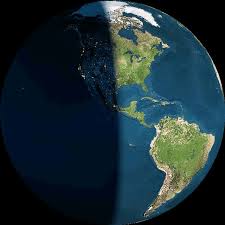
97.
Day and night is caused by the . . .
a)
revolution of Earth around the Sun
b)
orbit of Earth around the Moon
c)
rotation of earth on its axis.
d)
rotation of the Moon on it's axis
98.

The lineup for a solar eclipse is:

a)

Sun - Earth - Moon

b)

Sun - Moon - Earth

c)

Earth - Sun - Moon

d)

Earth - Moon - Mars

99.

When the phases of the moon appear to be growing:

a)

Waxing

b)

Waning

c)

Eclipse

d)

Orbit

100.

During this moon phase, you can't see the moon at all:

a)

New Moon

b)

Full Moon

c)

Gibbous Moon

d)

Quarter Moon