wayground logo

Free Printable Worksheets

Font size

S
M
L
XL
Worksheets

Unit 8 7th Grade

Total questions: 100

Worksheet time: 2hrs 40mins

Name
Class
Date
1.
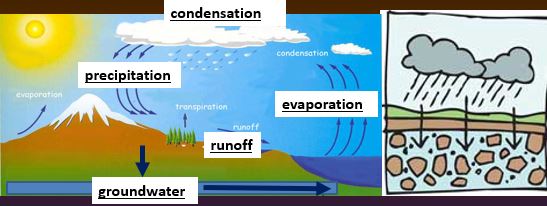
The arrows represent  air rising from the ocean to the atmosphere Rising warm air leads to the formation of
a)
Tsunamis
b)
High Tides
c)
Hurricanes
d)
Density Currents
2.
How does the convection of air produce thunderstorms?
a)
by causing warm air to sink and cold air to rise
b)
by causing warm air to rise and cold air to sink
c)
by causing both warm air and cold air to rise
d)
by causing both warm air and cold air to sink
3.
Which is not an impact to the ecosystem after a drought?
a)
Water is scarce and causes organisms to find new sources of water elsewhere.
b)
Floods will wipe out all the vegetation
c)
Herbivores will have to leave and find food elsewhere
4.
Which of these is not an impact to the ecosystem after a hurricane?
a)
Fires throughout the area
b)
Poor water quality in the area
c)
Erosion of beaches
d)
Massive flooding
5.
A recent flood in the area has caused many short term changes to the ecosystem. Which is a long term change?
a)
Standing water in the streets and sewers
b)
Temporary displacement of organisms
c)
Permanent change in the landscape
d)
Poor water quality in rivers and streams
6.
Which is the best synonym for catastrophic?
a)
Advantageous
b)
Successful
c)
Disaster
d)
Fortunate
7.
Lava or ash spewing from a mountain vent.
a)
Earthquake
b)
Flood
c)
Drought
d)
Volcano
8.
Caused by an unusually large amount of water for an area
a)
Earthquake
b)
Flood
c)
Drought
d)
Volcano
9.
A sudden shift in the earth's crust
a)
Earthquake
b)
Flood
c)
Drought
d)
Volcano
10.
A long period with no rain
a)
Earthquake
b)
Flood
c)
Drought
d)
Volcano
11.
A spinning funnel cloud which causes much destruction
a)
Tornado
b)
Hurricane
c)
Tsunami
d)
Meteor
12.
A large wave created by an underwater earthquake
a)
Tornado
b)
Hurricane
c)
Tsunami
d)
Meteor
13.
Debris from space
a)
Tornado
b)
Hurricane
c)
Tsunami
d)
Meteor
14.
A large storm associated with low pressure, forms over water
a)
Tornado
b)
Hurricane
c)
Tsunami
d)
Meteor
15.
An extensive amount of snow over a short period 
a)
Wildfire
b)
Blizzard
c)
Meteor
d)
Hurricane
16.
Starts by lightning or a camper
a)
Wildfire
b)
Blizzard
c)
Meteor
d)
Hurricane
17.
Changes to landscape due to erosion.
a)
Short term impact
b)
Long term impact
18.
Standing water and flooding.
a)
Short term impact
b)
Long term impact
19.
Temporary displacement of organisms.
a)
Short term impact
b)
Long term impact
20.
Permanent displacement of organisms.
a)
Short term impact
b)
Long term impact
21.
New land created due to volcanic eruption.
a)
Short term impact
b)
Long term impact
22.
Forests wiped out by a wildfire.
a)
Short term impact
b)
Long term impact
23.
Dry fields due to a drought.
a)
Short term impact
b)
Long term impact
24.
Wind damage to buildings.
a)
Short term impact
b)
Long term impact
25.

The breaking down of rocks and other materials on the Earth's surface.

a)

Weathering

b)

Erosion

c)

Deposition

d)

Exfoliation

26.

The process by which rock and soil are moved from one place to another is called-

a)

Chemical weatherin

b)

Erosion

c)

Mechanical weathering

d)

Deosition

27.

This type of weathering in which rock is physically broken into smaller pieces.

a)

Chemical weathering

b)

Erosion

c)

Mechanical weathering

d)

Deposition

28.

What do we call the process in which rock is broken down by changes in its chemical makeup.

a)

Chemical weathering

b)

Mechanical weathering

c)

Erosion

d)

Deposition

29.

The grinding/scratching away of rock by other rock particles carried in water, ice, or wind

a)

Frost wedging

b)

Exfoliation

c)

Oxidation

d)

Abrasion

30.

Plants/animals digging under ground with roots or claws to break apart rocks.

a)

Frost wedging

b)

Abrasion

c)

Burrowing

d)

Exfoliation

31.

The breaking off of the curved sheets or slabs from a rock's surface due to drastic changing temperatures.

a)

Frost wedging

b)

Exfoliation

c)

Abrasion

d)

Burrowing

32.

A type of chemical weathering in which a substance combines with oxygen, as when iron oxidizes, forming rust.

a)

Acid rain

b)

Oxidation

c)

Reaction to water

d)

Exfoliation

33.

The image above depicts the effects of chemical weathering breaking down limestone. Which type of chemical weathering causes this reaction?

a)

Acid rain

b)

Oxidation

c)

Exfoliation

d)

Abrasion

34.

Over millions of years, the shape of mountains on Earth's surface can change to low hills and then rolling plains. These changes are most likely caused by-

a)

Folding and faulting

b)

Volcanoes and Earthquakes

c)

Human activity

d)

Weathering and Erosion

35.

A student wanted to demonstrate weathering and erosion. The student put the same number/size of rocks into 2 tin cans, then added a small amount of water to both cans. Can A was shaken at a constant rate for 15 minutes, and can B was shaken for 60 minutes. The student then drained out all of the water and placed the rocks on the desk to observe. What is the best prediction of how how the rocks will look after this experiment?

a)

The rocks in can B will become larger and rounder than can A

b)

The rocks in can B will become smaller and rounder than can A

c)

The rocks in can A will become smaller and rounder than can B

d)

The rocks in can A will become Larger and rounder than can B

36.

Which type of sediment does wind erosion most strongly affect?

a)

Loose, sandy soil

b)

Wet rocks

c)

Wet, compacted soil

d)

Dry, compacted soil

37.

Which type of area is more likely to weather and erode? An area with a lot of vegetation (plants) or an area with very little? Why?

a)

The area with very little vegetation, because the roots won't be able to burrow through the rocks to weather it down.

b)

The area with a lot of vegetation, because the roots will burrow through the rocks causing a landslide.

c)

The area with very little vegetation, because it has not roots to absorb extra water or hold the soil together. The extra water and loose soil is likely to become a landslide/mudslide.

d)

The area with a lot of vegetation, because the roots will absorb any extra rain water, and will also hold the soil together preventing a landslide.

38.

Which of the following agents is the usually responsible for the formation of canyons?

a)

Gravity pulling

b)

Wind blowing

c)

Flowing water

d)

Glaciers moving

39.

What is the difference between weathering and erosion?

a)

Erosion breaks down the rocks, and weathering carries the broken pieces away.

b)

Erosion carries broken pieces away, and weathering builds the pieces back up into another land mass.

c)

Weathering carries broken pieces away, and erosion builds the pieces back up into another land mass.

d)

Weathering breaks down rocks, and erosion carries the broken pieces away.

40.

The tallest sand dunes in North America are found in Great Sand Dunes National Park and Preserve in Colorado. These dunes were formed from the sand at the bottom of a dry lake bed. Which of the following agents is most likely responsible for the formation of the sand dunes?

a)

Wind

b)

Water

c)

Ice

d)

Gravity

41.

A student prepares a model by filling a plastic bottle with water, capping it tightly, and placing it in the freezer for 24 hours. After 24 hours, there are large cracks on the bottle's sides. The student's model most likely represents which of the following types of weathering:

a)

Acid rain

b)

Oxidation

c)

Frost wedging

d)

Abrasion

42.

Which term best describes the graphic organizer in circle T?

a)

Ice wedging

b)

Abrasion

c)

Oxidation

d)

Burrowing animals

43.

Which of the following terms best describes the graphic organizer in circle S?

a)

Acid rain

b)

Oxidation

c)

Deposition

d)

Abrasion

44.

Which of the following pair of terms explains why pebbles in a river are smoother and more rounded than rocks found on land?

a)

Exfoliation and deposition

b)

Weathering and deposition

c)

Weathering and erosion

d)

Deposition and Burrowing

45.
What is a watershed?
a)
Water in an area
b)
Water that flows into a river or stream
c)
Land that water flows over and through
d)
Water that is salty
46.
What is all the water that runs off the surface of the land and washes into rivers, streams, and other waterways called?
a)
Runoff
b)
Storm Drain
c)
Surface Water
d)
Tributary
47.
What is the type of water that moves underground?
a)
surface water
b)
water table
c)
groundwater
d)
watershed
48.
Wastes produced by agriculture, households, industry, mining, and other human activities can end up in ______________.
a)
groundwater
b)
streams and rivers
c)
oceans
d)
All of these choices
49.

Fertilizer can seep through the ground to reach groundwater, what effect can it have?

a)

Fertilizer can cause groundwater to reverse flow

b)

Fertilizer can cause groundwater to freeze

c)

Fertilizer can cause groundwater to become undrinkable

d)

It will seep into the school

50.
The water that fills lakes and rivers
a)
groundwater
b)
surface water
c)
water table
d)
saturated zone
51.
An area of permeable layer of rock or soil that holds a large amount of water in the saturated zone is called what?
a)
Aquifer
b)
Spring
c)
Well
d)
Reservoir
52.
The use of pesticides and fertilizers is carefully monitored because of the effect they can have on the environment. Which of the following is a possible negative effect of the use of these chemical on the environment?
a)
Runoff carries these chemicals into lakes and streams.
b)
Theses chemicals cannot be purchased in large bulk.
c)

These chemicals are expensive to produce.
d)
Storage space for these chemicals is limited.
53.

If a homeowner dumps paint into the yard, the paint will ________________________.

a)

stay on the surface and cause no problems

b)

sink into the ground a cause no problems

c)

contaminate groundwater and surface water

d)

contaminate the air when it evaporates

54.
Water that collects in cracks and pores in underground soil and rock layers.
a)
surface water
b)
ground water
c)
aquifer
d)
watershed
55.
Water from precipitation that drains into a gully  that slows into a stream, which in turn flows into a river lake, reservoir, estuary, wetland, or the ocean.
a)
surface water
b)
ground water
c)
runoff 
d)
drainage
56.

Runoff from agricultural land carries chemicals from fertilizers that collect in a lake. The buildup of chemicals can eventually cause--

a)

aquatic life, such as fish and turtles, to die from lack of oxygen

b)

excess water to fill the aquifer

c)

river tributaries to reroute, changing the flow of waterways

d)

rainfall levels to drop

57.

Overflow during a heavy rainstorm from a wastewater treatment plant would result in –

a)

polluted runoff into nearby ponds.

b)

flooding in the local aquifer.

c)

weakened housing foundations.

d)

over-treated drinking water.

58.

A student drew the model below to represent a part of a watershed and some human activities that affect the watershed.


How do the industrial, agricultural, and residential activities of humans most likely affect the groundwater in the area

a)

The activities prevent most of the water from evaporating into the atmosphere.

b)

Pollutants from the activities percolate through the soil and enter the water table.

c)

The activities replace the groundwater used.

d)

All of the above

59.

A student sets up the investigation shown below.


The movement of colored water through the gravel best models —

a)

condensation of water vapor

b)

surface runoff of precipitation

c)

conservation of water

d)

pollution of groundwater

60.
Why is gravity a factor in watersheds? 
a)
it causes the water to flow away from a watershed
b)
it causes the water to flow down towards a watershed
61.
When fertilizers enter surface water, they cause problems in 
the watershed by -
a)
increasing the amount of nutrients available to fish in lakes and streams.
b)

clogging narrow streams and preventing water from flowing properly.
c)
raising the water level in nearby rivers to levels leading to flooding.
d)
causing rapid algal growth that decrease oxygen levels and choke aquatic life.
62.
Pollutants from a highway enter a stream or creek and travel to a river. River water tested with the pollutant found is called  
a)
point source pollution
Available space for crops
b)
nonpoint source pollution.
c)
eutrophic pollution
d)
riparian pollution
63.
If gasoline or oil or trash goes into a storm drain in the street, it goes directly...
a)
to the sewage treatment plant
b)
into the stream
c)
to groundwater
d)
none of the above
64.

Look at the diagram of the water cycle. When heat from the sun turns water into water vapor this is called:

a)

Evaporation

b)

Condensation

c)

Precipitation

d)

Runoff

65.

When water cools and again becomes liquid water; this is how clouds are formed. This is called:

a)

Evaporation

b)

Condensation

c)

Precipitation

d)

Runoff

66.

Rain, snow, sleet, hail are all types of:

a)

Evaporation

b)

Condensation

c)

Precipitation

d)

Runoff

67.

Water that flows over the land to streams, rivers, and lakes

a)

Evaporation

b)

Condensation

c)

Precipitation

d)

Runoff

68.

Water that is found underground in the cracks and spaces in soil, sand and rock is called:

a)

Groundwater

b)

River

c)

Surface water

d)

Snow

69.

The land area that water moves across or under while flowing to a stream, spring, pond, lake or river is a/an:

a)

mountain

b)

watershed

c)

ocean

70.

Watersheds includes surface water and ground water. Which of the following are surface water?

a)

Lakes, ponds, creeks streams, ocean, rivers

b)

Wells, water table, aquifers

71.

Which of the following are groundwater?

a)

Lakes, ponds, creeks streams, ocean, rivers

b)

Wells, water table, aquifers

72.

A natural, underground area where large quantities of groundwater fill the spaces between rocks is a/an:

a)

ocean

b)

river

c)

aquifer

73.

To use water found in an aquifer people would

a)

build a dam

b)

drill a well to below the water table

c)

purify ocean water

74.

Water collects in an aquifer because the layer below it is

a)

permeable (water can pass through it)

b)

impermeable (water can not pass through it)

c)

transparent

75.

True/false: Almost everything that happens on land, has an impact on surface water and groundwater.

a)

true

b)

false

76.

Runoff picks up whatever is on the ground including

a)

fertilizer and pesticides

b)

household chemicals and soap from washing cars

c)

chemicals from factories

d)

oil

e)

all the above

77.

Sources of water pollution include all of the following EXCEPT:

a)

Suburban homes

b)

Farms and golf courses

c)

Parking lots and city streets

d)

Water treatment plants

e)

Factories

78.

How can air pollution from cars and factories end up in our water??

a)

Oil drips from cars onto roads

b)

Air pollutants can dissolve in rain water

c)

We use soap to wash cars

79.

If there is a pollutant in the recharge zone it will likely end up in the

a)

air

b)

fire

c)

groundwater

80.

How can you help reduce water pollution?

a)

Use less fertilizer and pesticides

b)

Take paint, cleaners, and old medication to safe disposal sites

c)

Clean up pet waste and litter

d)

All the above

81.
What is limestone made of?
a)
skeletons of tiny sea creatures
b)
minerals and sand
c)
plants and animals
d)
lava
82.
Rock formations hanging from a roof are called ________.
a)
stalacites
b)
stalagmites
c)
troglodytes
d)
minerals
83.
Some examples of a cave dweller are ___________.
a)
panthers, elephants, giraffes
b)
birds, alligators, cats
c)
crickets, fish, spiders
d)
fish, dolphins, turtles
84.
What are some features of a cave?
a)
stalactites
b)
tunnels
c)
stalagmites
d)
all of the above
85.
What does dissolve mean?
a)
mix
b)
evaporate
c)
combine
d)
separate
86.
How are the tunnels and passages of a cave formed?
a)
columns of rock
b)
people mining
c)
acid in rainwater
d)
animals
87.
What is Lechuguilla?
a)
cave in the Europe
b)
cave in New Mexico
c)
cave in South America
d)
cave in Mexico
88.
What is the dark zone?
a)
where the air is hot and dry
b)
where there are no animals
c)
where sunlight never reaches
d)
where water is dirty
89.
What is the scientific name for cave dwellers?
a)
troglodytes
b)
stalactites
c)
stalamites
d)
columns
90.
What are stalactites and stalagmites made of?
a)
particles of dirt
b)
particles of clay
c)
particles of rock
d)
particles of animals
91.
What long-term impact could the destruction of large areas of forests have on Earth?
a)
decreased rates of erosion
b)
increased atmospheric carbon dioxide levels
c)
decreased amounts of acid rain
d)
increased atmospheric oxygen levels
92.
Why is it important to conserve the biodiversity of Earth?
a)
to decrease the amount of global predator populations
b)
to decrease the stability of major global ocean currents
c)
to increase the stability of ecosystems during environmental changes
d)
to increase the amount of nonrenewable resources located in the lithosphere
93.
If the population of a certain predator increases, there is often _______ its prey
a)
a decrease the population of
b)
an increase of the population of 
c)
great news for its prey of
d)
no  impact found on
94.
Invasive species are:
a)
non-native
b)
harmful to an ecosystem
c)
organisms that can lack predators in the new environment
d)
all of the answers are correct
95.
The number one threat to biodiversity
a)
pollution
b)
fragmentation
c)
habitat destruction
d)
limiting factors
96.
How can people reduce the amount of resources they use?
a)
make more landfills and garbage dumps
b)
buy products with lots of packaging 
c)
use water, electricity, and gas conservatively and recycle metal, paper, and glass
d)
Think only about what you need right now and don’t worry about the future
97.
Which is a main cause of soil erosion?
a)
strong winds
b)
flash floods
c)
human activity
d)
fossil fuels
98.
Which organism would have the greatest concentration of pollution?
a)
zooplankton
b)
large fish
c)
fish-eating birds of prey
d)
small fish
99.
Insecticides are sprayed over a large area in an effort to reduce the number of grasshoppers that are eating the corn plants. How will this change affect this food chain? 
a)
The number of grasshoppers will increase
b)
The number of lizards will increase
c)
The number of lizards and hawks will decrease
d)
The number of grasshoppers, lizards, and hawks will decrease
100.
All of the following are examples of environmental changes that can be caused by humans except - 
a)
clearing land for housing developments
b)
pesticides
c)
volcanic eruption
d)
pollution