wayground logo

Free Printable Worksheets

Font size

S
M
L
XL
Worksheets

Weather/Atmosphere

Total questions: 100

Worksheet time: 2hrs 47mins

Name
Class
Date
1.
Which gas in our atmosphere is most abundant?
a)
Argon
b)
Oxygen
c)
Nitrogen
d)
Carbon Dioxide
2.
In which layer of the atmosphere does weather occur?
a)
Mesosphere
b)
Thermosphere
c)
Stratosphere
d)
Troposphere
3.
What causes the temperature to increase in the stratosphere?
a)
Nitrogen
b)
Ozone
c)
Water Vapor
d)
carbon dioxide
4.
Which layer protects the earth from meteors?
a)
Troposphere
b)
Stratosphere
c)
Mesosphere
d)
Thermosphere
5.
Describe how the ozone layer protects the earth.
a)
Absorbs solar radiation, Protects Earth from UV Rays,  and emits heat
b)
Ozone in the lower atmosphere is a pollutant
6.
Which layer of the atmosphere contains the ozone layer? 
a)
Mesosphere
b)
Stratosphere
c)
Ionosphere
d)
Exosphere
7.
Warm air rises and the cool air sinks demonstrates this type of heat transfer. 
a)
conduction
b)
convection
c)
radiation
d)
Insolation 
8.

What is the energy source for the water cycle?

a)

sun

b)

wind

c)

rain

d)

oceans

9.

What are clouds made of?

a)

dry air

b)

water

10.
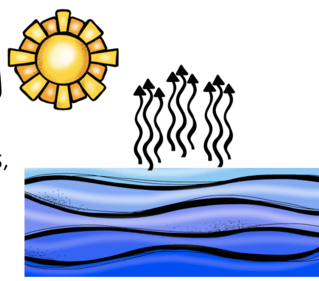
What part of the water cycle does this picture show?
a)
condensation
b)
precipitation
c)
evaporation
11.
What is the water cycle?
a)
the 3 forms of water
b)
the movement of water on, above, or below the surface of the Earth
c)
when water melts
d)
when clouds form
12.
Which best explains why runoff is important?
a)
It returns water to other locations on Earth
b)
It increases the chance of flooding
c)
It makes evaporation occur faster
d)
It increases condensation
13.
Snow, sleet, hail, and rain are all examples of  ________________. 
a)
evaporation
b)
condensation
c)
accumulation
d)
precipitation
14.
What is it called when plants give off water vapor as a waste product?
a)
condensation
b)
evaporation
c)
sublimation
d)
transpiration
15.
When water _________, dew forms.
a)
Melts
b)
Evaporates
c)
Condenses
d)
Precipitates
16.
Precipitation happens when clouds of water droplets are too ______________.
a)
cold
b)
light
c)
heavy
d)
hot
17.
Evaporation happens when the sun ___________ water and turns it into vapor.
a)
cools
b)
heats up
c)
freezes
d)
lights up
18.
Temperature in the stratosphere warms as altitude increases.
a)
True
b)
False
19.
Temperature decreases as altitude increases in the Thermosphere.
a)
True
b)
False
20.

What happens to the density (thickness)/air pressure of the air as you leave Earth?

a)

air gets thicker

b)

air gets thinner

c)

air stays the same

d)

air disappears

21.
The hottest layer.
a)
troposphere
b)
thermosphere
c)
exosphere
d)
mesosphere
22.
Where I find clouds.
a)
thermosphere
b)
stratosphere
c)
troposphere
d)
ionosphere
23.
An instrument that determines the direction from which the wind is blowing is called a(n) ______________.
a)
anemometer
b)
wind sock
c)
wind vane
d)
barometer
24.
A(n) ________________ measures air pressure.
a)
anemometer
b)
thermometer
c)
barometer
d)
hygrometer
25.
A tool that measures wind speed is called a(n) ________________.
a)
wind vane
b)
wind sock
c)
hygrometer
d)
anemometer
26.
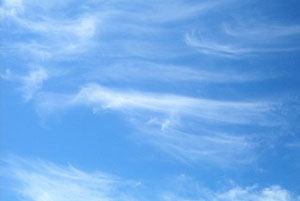
This type of cloud is thin, wispy, and made of ice crystals
a)
cumulus cloud
b)
stratus cloud
c)
cirrus cloud
d)
cumulonimbus cloud
27.
This type of cloud is thick and puffy on top, and generally flat on the bottom. It has well-defined edges and can change shape rapidly.
a)
cumulus cloud
b)
stratus cloud
c)
cirrus cloud
d)
cloud 9
28.
Nimbostratus and cumulonimbus clouds can signal what type of upcoming weather?
a)
fair skies
b)
hot, sunny weather
c)
windy weather
d)
rainy weather
29.
Cumulus and cirrus clouds can signal what type of upcoming weather?
a)
fair skies
b)
hot, sunny weather
c)
windy weather
d)
rainy weather
30.
Are stratus clouds or cirrus clouds found closer to the ground?
a)
Cirrus
b)
Stratus
31.

Which term best describes water vapor?

a)

Solid

b)

Liquid

c)

Gas

32.
Cirrus clouds are associated with _________ weather. 
a)
rainy
b)
snowy
c)
fair
d)
stormy
33.
Which clouds form near the ground?
a)
Fog
b)
Cirrocumulus
c)
Nimbostratus 
d)
Altocumulus 
34.

Where do MARITIME air masses form?

a)

Over water

b)

Over land

35.

Where do CONTINENTAL air masses form?

a)

Over water

b)

Over land

36.

Which type of air mass brings WARM and DRY weather?

a)

Maritime Polar (mP)

b)

Maritime Tropical (mT)

c)

Continental Polar (cP)

d)

Continental Tropical (cT)

37.

Which type of air mass brings WARM and WET weather?

a)

Maritime Polar (mP)

b)

Maritime Tropical (mT)

c)

Continental Polar (cP)

d)

Continental Tropical (cT)

38.

Which type of air mass bring COLD and WET weather?

a)

Maritime Polar (mP)

b)

Maritime Tropical (mT)

c)

Continental Polar (cP)

d)

Continental Tropical (cT)

39.

Which type of air mass bring COLD and DRY weather?

a)

Maritime Polar (mP)

b)

Maritime Tropical (mT)

c)

Continental Polar (cP)

d)

Continental Tropical (cT)

40.

An air mass is a portion of the atmosphere that has similar...

a)

Water and temperature

b)

Air pressure and wind speed

c)

Humidity and temperature

d)

Humidity and air pressure

41.

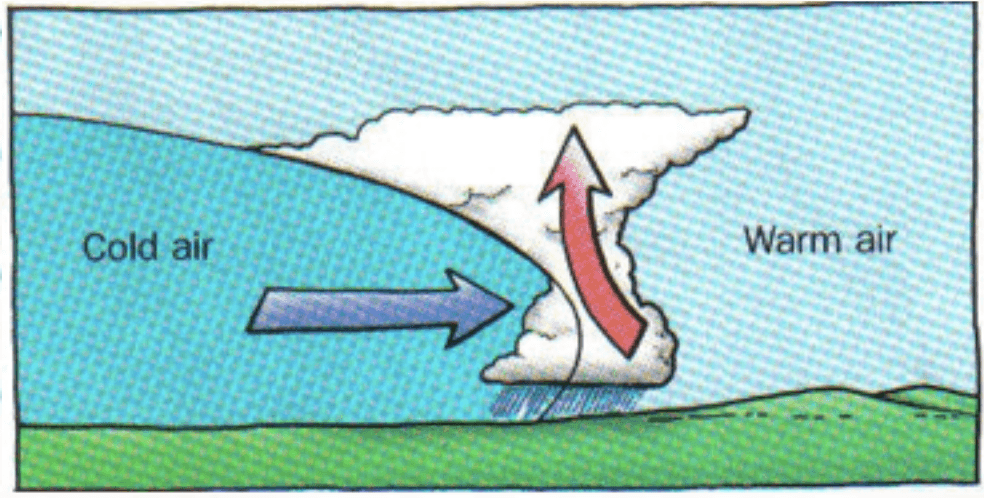
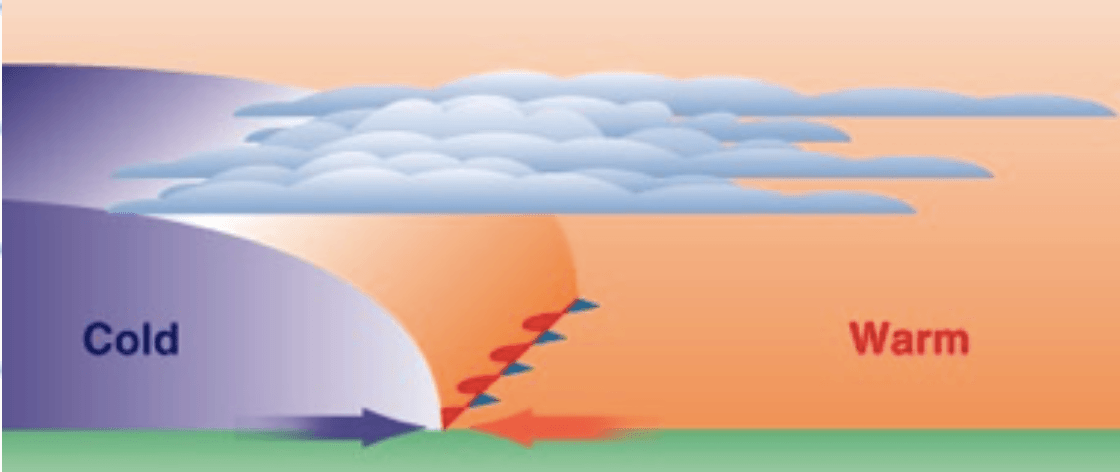
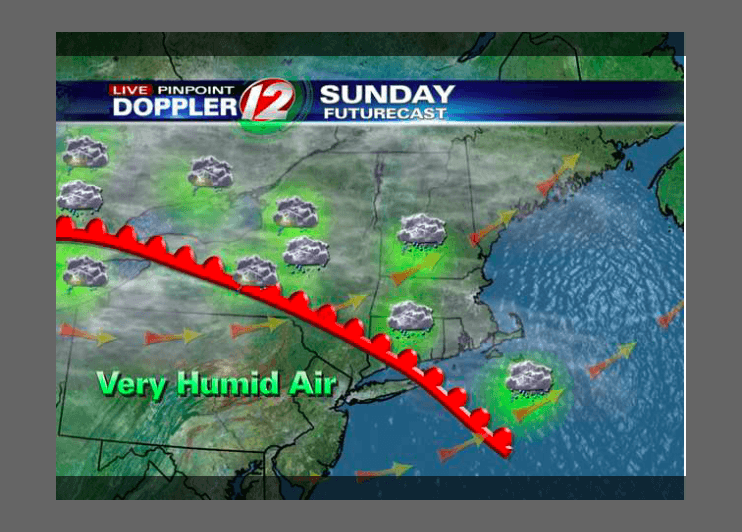
Name that front.

a)

Cold Front

b)

Warm Front

c)

Stationary Front

d)

Occluded Front

42.

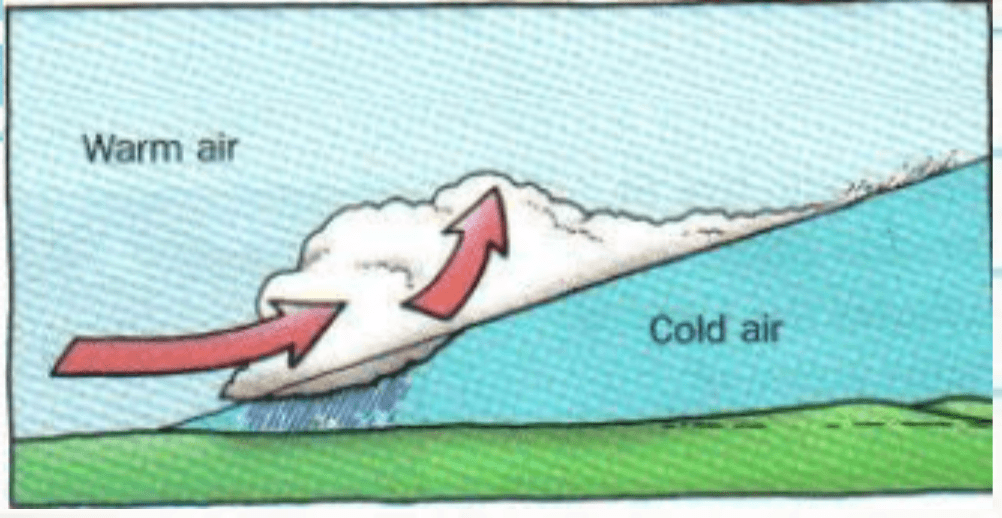
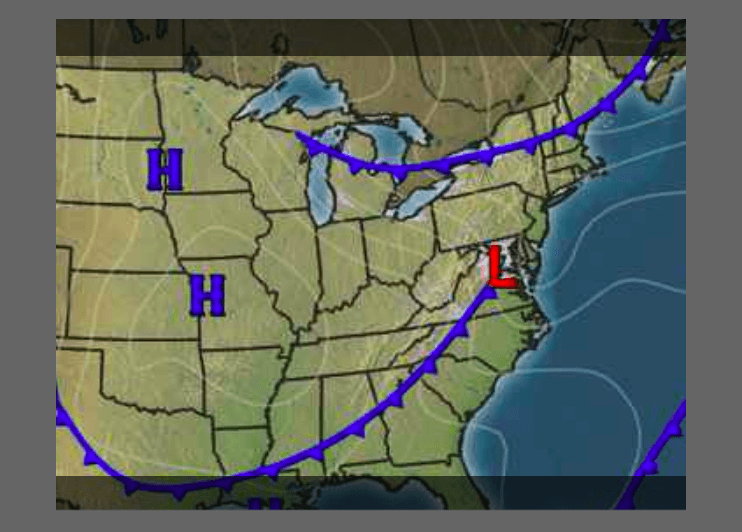
Name that front.

a)

Cold Front

b)

Warm Front

c)

Stationary Front

d)

Occluded Front

43.

Name that front.

a)

Cold Front

b)

Warm Front

c)

Stationary Front

d)

Occluded Front

44.

Name that symbol.

a)

Cold Front

b)

Warm Front

c)

Stationary Front

d)

Occluded Front

45.

Name that symbol.

a)

Cold Front

b)

Warm Front

c)

Stationary Front

d)

Occluded Front

46.

Name that symbol.

a)

Cold Front

b)

Warm Front

c)

Stationary Front

d)

Occluded Front

47.

Cold dense air slides underneath warm air. The warm air is forced up, cools, and condenses.

a)

Cold Front

b)

Warm Front

c)

Stationary Front

d)

Occluded Front

48.

What causes wind?

a)

differences in air pressure

b)

differences in gravity

c)

difference in oxygen

d)

differences in the thermosphere

49.
Which statement correctly defines wind?
a)
Wind is the movement of air from areas of low pressure to areas of high pressure
b)
Wind is the movement of air to a colder area in the atmosphere.
c)
Wind is the movement of air from areas of high pressure to areas of low pressure.
d)
Wind is the movement of air pushed around and bouncing off Earth's surface.
50.
Why does warm air rise?
a)
Warm air is more dense than cooler air.
b)
Warm air has more pressure than cooler air.
c)
Warm air is less dense than cooler air.
d)
Warm air has a higher dew point than cooler air.
51.

Air is warmer and less dense at the equator because the equator receives more____________________.

a)

wind

b)

solar radiation

c)

air pressure

d)

condensation

52.

In the Northern Hemisphere, winds traveling north appear to curve east because of the:

a)

trade winds

b)

convection currents

c)

Coriolis effect

d)

polar easterlies

53.
The Coriolis effect is the curving of wind across Earth. What causes winds to curve?
a)
Earth's revolution
b)
Earth's magnetic field
c)
Earth's rotation
d)
Earth's gravitational pull
54.
In which direction do prevailing westerlies flow?
a)
from east to west
b)
from west to east
c)
from north to south
d)
from south to north
55.
The tropical winds running from 0 to 30 degrees latitude are called:
a)
subtropical westerlies
b)
polar westerlies
c)
trade winds
d)
polar winds
56.
Wind belts are always named according to...
a)
how strong they are
b)
what temperature they are
c)
where they blow to
d)
where they come from
57.

Moving _________ is called wind

a)

rain

b)

force

c)

vapor

d)

air

58.
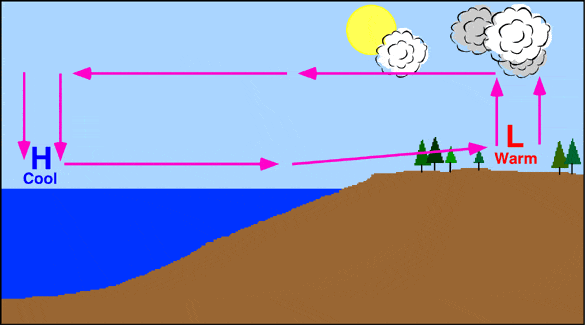
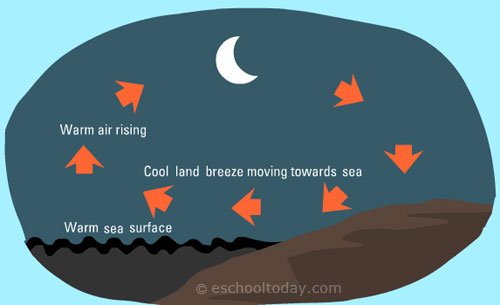
Is this a land or a sea breeze?
a)
land breeze
b)
sea breeze
59.
Wind blows from ______ pressure areas to _____ pressure areas.
a)
high; low
b)
warm; cool
c)
cool; warm
d)
low; high
60.

doldrums

a)

winds that blow from west to east between 30 and 60 degrees latitude in both hemispheres

b)

winds that blow from 30 degrees latitude almost to the equator in both hemishperes

c)

area around the equator where there is very little wind ("dull", "sluggish")

d)

area around 30 degrees latitude where there is very little wind

61.

sea breeze

a)

cool air moves down a mountain slope towards a valley

b)

warm air rises up a mountain slope from a valley

c)

cool land air flows to the ocean at night, causing warm ocean air to rise

d)

cool ocean air flows to land during the day, causing warm land air to rise

62.

These winds blow west-to-east in the temperate region.

a)

Trade Winds

b)

Westerly Winds

c)

Polar Winds

63.

These winds blow northeast to west in the polar regions, moving cold air in that climate zone from the post toward the west.

a)

Trade Winds

b)

Westerly Winds

c)

Polar Winds

64.
Is this a land or a sea breeze?
a)
land breeze
b)
sea breeze
65.
I am a fast-moving ribbon of AIR that moves from west to east in the Northern Hemisphere around the Earth.
a)
California Current
b)
Gulf Stream
c)
Jet Stream
d)
Atlantic Ocean
66.
What can humans do to reduce the effects of acid rain?
a)
Develop Alternate Energy Sources (Solar Power, Wind Energy)
b)
Use Less Energy
c)
Stop Burning Fossil Fuels
d)
All of the Answers are Correct
67.
CFC's cause harm to our 
a)
Troposphere
b)
Inversion Layer
c)
Ozone Layer
d)
Carbon Dioxide
68.

Where is the Ozone Layer found in our atmosphere?

a)

Troposphere (lower portion)

b)

Stratosphere (upper portion)

69.
These are two ways people can reduce air pollution.
a)
Drive vehicles that get low gas mileage / Burn trash at home
b)
Burn less fossil fuels / walk and ride bikes
c)
Create major forest fires / Use CFC's
d)
Burn styrofoam at landfills / Use more chlorine
70.
___________________ is a thick, brownish haze formed when certain gases in the air react with sunlight.
a)
Ozone
b)
Photochemical smog
c)
Carbon monoxide
d)
Methane
71.
The key to reducing air pollution is to control ______________.
a)
methane gas
b)
overpopulation
c)
ozone depletion
d)
emissions
72.
_____________________ is created when chemicals in polluted air react with water vapor to form harmful compounds which can damage plants, waterways, metals and stone. 
a)
Ozone
b)
Radon
c)
Toxic sludge
d)
Acid rain
73.

What are thunderstorms?

a)

a storm with thunder and lighting and typically also heavy rain or hail

b)

a storm with high winds and heavy snowfall.

c)

a mobile, destructive vortex of violently rotating winds having the appearance of a funnel shaped cloud and advancing beneath a large storm system.

d)

a huge storm with strong winds and storm surges

74.

What are tornadoes?

a)

a storm with thunder and lighting and typically also heavy rain or hail

b)

a storm with high winds and heavy snowfall.

c)

a mobile, destructive vortex of violently rotating winds having the appearance of a funnel shaped cloud and beneath a large storm system.

d)

a huge storm with strong winds and storm surges

75.

A supercell spawns a funnel cloud that touches the ground is called a:

a)

hurricane

b)

tornado

c)

thunderstorm

d)

blizzard

76.
These can be produced by thunderstorms
a)
stationary fronts
b)
tornadoes
c)
volcanoes
d)
tsunamis
77.

Hurricane force winds pushing down on the water creating high water levels and waves moving ashore is called:

a)

Storm Surge

b)

Hurricane

c)

Tropical Wave

d)

Tropical storm

78.

What do hurricanes need as fuel?

a)

warm and moist air

b)

hot and dry air

c)

cold and moist air

d)

dry and warm air

79.
Hurricanes develop in ________ regions.
a)
Arctic
b)
Tropical
c)
Arid
d)
None of the above
80.
Where is Tornado Alley located?
a)
Near the equator of the Earth
b)
Near the North Pole
c)
South Central Los Angeles
d)
Middle states of United States
81.
This person studies the Earth's atmosphere and monitors and forecasts the weather
a)
Seismologist
b)
Meteorologist
c)
Volcanologist
d)
Geologist
82.

What is the scale that is used to measure tornadoes damage?

a)

Mohs Scale

b)

Enhanced Fujita Scale

c)

Saffir Simpson Scale

d)

McDonalds Scale

83.
What are the effects of a thunderstorm?
a)
destruction of property, storm surge, tidal flooding, high winds, possible tornadoes, heavy rain, flooding and loss of life.
b)
Major destruction of property, loss of life, lightning and hail. 
c)
produces lightning, Strong winds, hail, and possible tornadoes.
d)
saturated soil, mud-slides, property damage and loss of life.
84.
What is the meaning of Drought 
a)
The process by which land becomes more and more dry until it turns into desert.This may be caused by climate change,human activities, or both
b)
Groups of herders who move with their animals from place to place in search of pasture and water
c)
An unusually long period in which little or no rain falls  
d)
Selection of players for a team
85.
What happens if a hurricane moves over land or cold ocean water?
a)
it will get stronger
b)
it will get weaker
c)
it will upgrade its category
d)
it will morph into a typhoon
86.
What causes weather on Earth?
a)
the sun 
b)
the lithosphere
c)
the oceans
d)
the atmosphere
87.
The average year-after-year conditions of temperature, precipitation, winds and clouds in an area is called 
a)
Climate
b)
Weather
c)
Conditions
d)
Temperature
88.

Winds are caused by

a)

equal heating

b)

unequal heating

89.

What is the jet stream?

a)

Precipitation in North Carolina

b)

Weather over a long period of time

c)

Strong winds above the Earth's surface

d)

Football flying over the Earth

90.

Which best explains what type of weather the Gulf Stream usually brings

to North Carolina?

a)

increased wind speed

b)

increased air pressure

c)

increased temperature

d)

increased evaporation

91.
Acid rain can damage
a)
Drinking water sources
b)
Aquatic life
c)
Architecture/buildings
d)
All options are correct
92.
What causes acid rain?
a)
High concentrations of sulfuric or nitric acid from pollution
b)
Fertilizer use
c)
Pesticide use
d)
CFCs
93.
Global warming is due to 
a)
Greenhouse gases
b)
Nitric and sulfuric acids
c)
CFCs
d)
Ozone depletion
94.
Dust, ash and pollen are examples of this air pollutant
a)
Lead
b)
Ground-level ozone
c)
Particulate matter
d)
Nitrogen oxides
95.
What is air pollution?
a)
Any harmful substance that builds up in the air 
b)
pollen, dust, gases
c)
industrial pollution
d)
chemicals in the water
96.

Where is the "GOOD" ozone located?

a)

troposphere

b)

stratosphere

c)

mesosphere

d)

thermosphere

97.

Which ones are consider primary air pollutants?

a)

Nitrogen oxides

b)

Sulfur dioxides

c)

Carbon monoxide

d)

all are correct!!!!

98.
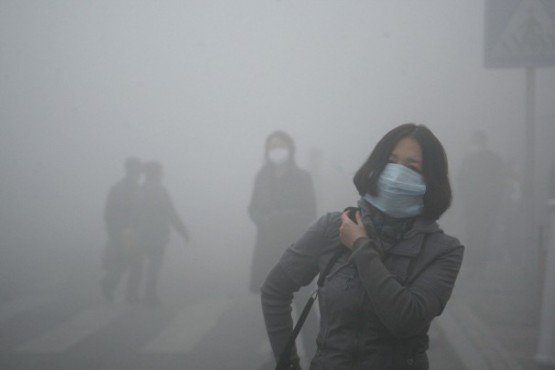
This picture shows people walking through a highly-polluted city in China. From what type of pollution are they protecting themselves based on what they are wearing?

a)
air pollution
b)
water pollution
c)
land pollution
d)
noise pollution
99.

Which pair below are the two main sources of air pollution in urban (populated) areas?

a)

vehicles, volcanoes

b)

vehicles, industries

c)

Industries, agriculture

d)

All of the above

100.

The following ailments are long-term effects of air pollution EXCEPT

a)

emphysema. (hardening of lungs)

b)

lung cancer.

c)

headaches.

d)

heart disease.