wayground logo

Free Printable Worksheets

Font size

S
M
L
XL
Worksheets

Unit Test on Motion

Total questions: 90

Worksheet time: 1hrs 8mins

Name
Class
Date
1.
What is the formula for force?
a)
F=M/A
b)
F=A/M
c)
F=M*A
d)
F=M*F
2.
What is Newton's First Law known as? The Law of
a)
Friction
b)
Mass
c)
Inertia
d)
Gravity
3.
A person is pushed forward into their seat belt when a car stops.  Which law is this?
a)
1st
b)
 2nd
c)
2 and 3
d)
3rd 
4.

The magician pulled the tablecloth out from under the dishes and the dishes were left undisturbed.

a)

1st law

b)

2nd law

c)

3rd law

5.

The books are applying a force to the table and the table is applying the same amount of force back on the books.

a)

1st law

b)

2nd law

c)

3rd law

6.

An empty wagon is easier to pull than a full wagon.

a)

1st law

b)

2nd law

c)

3rd law

7.

The water goes forward out of the hose and the fireman takes a step backwards.

a)

1st law

b)

2nd law

c)

3rd law

8.

It is easier to pull the small rock than it is to pull the larger rock.

a)

1st law

b)

2nd law

c)

3rd law

9.

When you push down on the diving board, the diving board pushes you back up again.

a)

1st law

b)

2nd law

c)

3rd law

10.

The bowling ball requires more force to move than the volleyball.

a)

1st law

b)

2nd law

c)

3rd law

11.

The skateboarder pushes back with one foot, but the skateboard moves forward.

a)

1st law

b)

2nd law

c)

3rd law

12.
What is the standard unit force is measured in?
a)
Newton
b)
Gram
c)
Pound
d)
Meter
13.
What Newton's law does this picture represent?
a)
Newton's 2nd law
b)
Newton's 1st law
c)
Newton's 3rd law
d)
Newton's 5th law
14.
Which has more inertia--
a)
Truck
b)
Cat
c)
Ant
d)
Skateboard
15.

Which law best explains why more force must be applied to the bowling ball to make it accelerate at the same rate as the tennis ball.

a)

Newton's 1st Law of Inertia

b)

Newton's 2nd Law of F=ma

c)

Newton's 3rd Law of Force Pairs (AKA Action/Reaction)

d)

Newton's Law of Biology

16.

Based on Newton's Law of action/reaction, what would be the reaction force, if the action force is 60 N to the right?

a)

60 N to the right

b)

60 N to the left

c)

30 N to the left

d)

9.8 N to the right

17.
What is the name for a push or pull?
a)
movement
b)
force
c)
speed
d)
density
18.

The law of inertia (Newton's first law) applies _____.

a)

to moving objects only

b)

only to objects that are not moving

c)

to both moving and nonmoving objects

19.

Inertia depends on ______

a)

Velocity

b)

Speed

c)

Distance

d)

Mass

20.
The momentum of an object depends upon the object's ___________&_____________.  
a)
size and shape
b)
mass and speed
c)
mass and veloctiy
d)
mass and energy
21.

According to Newton's Second Law when acceleration increases, force _______________.

a)

decreases

b)

increases

c)

stays the same

d)

doubles

22.

According to Newton's Second Law when mass increases, acceleration _______________.

a)

decreases

b)

increases

c)

stays the same

d)

doubles

23.
You and your dad are moving the couch from one side to another. Your dad pushes with a force of 35 N to the right and you push with a force of 25 N right. What is the net force on the couch?
a)
60 N right
b)
10 N left
c)
60 n right
d)
50 N left
24.
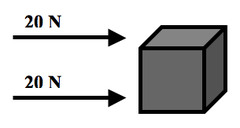
What is the net force?
a)
40 N left
b)
0 N Balalnced
c)
400 N right
d)
40 N right
25.
What is the net force?
a)
400 N Up
b)
400 N Down
c)
- 400 N Down
d)
800 N Down
26.

Which of the following is an example of an unbalanced force?

a)
b)
c)
d)
27.
How will this object move? 
a)
It won't move. 
b)
It will move to the right. 
c)
It will move to the left. 
d)
It will move up. 
28.

The sum of all forces acting on an object is

a)

balanced.

b)

unbalanced.

c)

friction.

d)

the net force.

29.
If there are two forces going in the same direction how would you find the net force?
a)
Subtract
b)
Add
c)
Neither
d)
Multiply
30.
You push on a tree with 20 N of Force. If the tree doesn't move, the tree is pushing back on you with _____of Force.
a)
20 N 
b)
40 N 
c)
10 N 
d)
0 N
31.
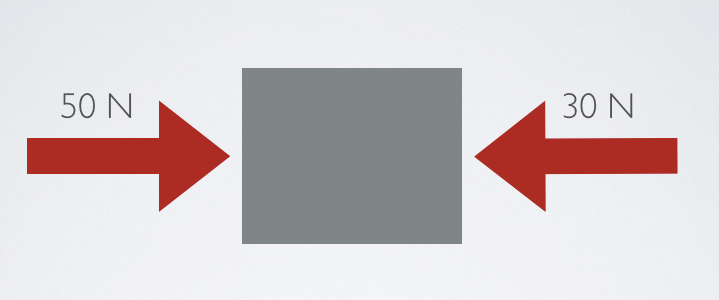
What is the net force?
a)
17 N Right
b)
3 N Right
c)
3 N Left
d)
17 N Left
32.

When Izzy and Zoe pull on the rope with the same amount of force, the forces are _____.

a)

increased

b)

unbalanced

c)

balanced

d)

decreased

33.

A person standing still while leaning on a wall

a)

Unbalanced force

b)

Balanced force

34.

Boy pushing against a wall

a)

Balanced Forces

b)

Unbalanced Forces

35.

What is the net force when forces are balanced?

a)

positive

b)

zero

c)

negative

d)

infinity

36.

What is the direction of motion when forces are balanced?

a)

Random direction

b)

Deceleration

c)

Stationary or constant velocity

d)

Acceleration

37.

Can balanced forces change the speed of an object (accelerate)?

a)

Yes

b)

No

38.
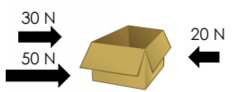
Calculate the Net Force. 
a)
60N, Left 
b)
40N, Right 
c)
0N
d)
60N, Right
39.
Calculate the Net Force. 
a)
40N, Left
b)
40N, Right
c)
0N, Balanced
d)
75N, Right
40.
Rougher surfaces have ...
a)
greater friction
b)
less friction
c)
the same level of friction
41.

Friction is a force that ________ the motion of an object.

a)

generates

b)

opposes

c)

creates

d)

adds to

42.
Swimming fish experience-
a)
Rolling Friction
b)
Sliding Friction
c)
Fluid Friction
d)
Static Friction
43.
The amount of friction depends on the weight of the objects pressing together.
a)
True
b)
False
44.

Applying WD-40 to a squeaky door turns _________ friction into __________ friction.

a)

sliding ---> rolling

b)

sliding ---> fluid

c)

rolling ---> sliding

d)

static ---> rolling

45.

A football player will use which items to increase friction while playing?

a)

cleats

b)

jersey

c)

gloves

d)

shoulder pads

e)

cleats and gloves

46.

How can friction be helpful?

a)

erosion of topsoil

b)

wearing down of engine parts

c)

allows brakes of a car to operate

d)

holes in socks

47.
Which of the following is an example of friction that is harmful?
a)
Pencil marking on paper
b)
Engine parts wearing out
c)
sand placed on ice in the winter
d)
Using an eraser to erase marks
48.
Friction is a force that acts in an ___________ direction of movement.
a)
similar
b)
opposite
c)
parallel
d)
west
49.

What type of friction is the person working against when the boulder is NOT moving?

a)

fluid

b)

static

c)

rolling

d)

sliding

50.

_____________ friction acts on objects that are not moving.

a)

Sliding

b)

Rolling

c)

Static

d)

Fluid

51.
The base for mass is the
a)
meter
b)
gram
c)
kilogram
d)
liter
52.
The base unit for length is the
a)
second
b)
gram
c)
meter
d)
liter
53.
The base unit for volume is the
a)
second
b)
gram
c)
meter
d)
liter
54.
There are ___ meters in 25 kilometers (km)
a)
250 m
b)
2500 m
c)
25000 m
d)
.025 m
55.
There are ___ millimeters(mm) in 2.7 centimeters (cm)
a)
270 mm
b)
.27 mm
c)
27 mm
d)
.027 mm
56.
Convert 1.7 km to m
a)
1700
b)
17
c)
170
d)
0.17
57.
Convert 0.25 m to mm
a)
25
b)
2.5
c)
250
d)
0.025
58.
How many millimeters are in 5 centimeters?
a)
5
b)
50
c)
500
d)
5,000
59.
How many centimeters are in a meter?
a)
100 centimeters 
b)
50 cent
c)
100 inches
d)
10 centimeters 
60.
How many meters are there in a kilometer?
a)
20 meters
b)
50meters
c)
100 meters
d)
1000 meters
61.
Convert:
3 kg = ______ g 
a)
3
b)
30
c)
300
d)
3,000
62.
6,000 millilters = ______ liters
a)
60
b)
600
c)
6
d)
6,000
63.
Which is greater? 
9,000 milliliters or 10 liters
a)
9,000 mL
b)
10 L
64.
7,000 milligrams = _____ grams
a)
7
b)
70
c)
700
d)
70,000
65.
4 kg 500 g = ______ grams
a)
450
b)
45,000
c)
4,500
d)
4,550
66.
8,000 g ____ 8 kg
a)
>
b)
<
c)
=
67.
1kg =_____ grams
a)
1000
b)
100
c)
1/1000
d)
.0001
68.
Convert 5 cm to mm:
a)
5,000mm
b)
0.5 mm
c)
0.05 mm
d)
50 mm
69.
Convert from meters to cm:  9 meters
a)
900 cm
b)
90 cm
c)
0.9 cm
d)
0.09 cm
70.
Convert 8 kilometers to meters
a)
800 m
b)
80,000 m
c)
8,000 m
d)
.008 m
71.
285 kg = ____ g
a)
285,000
b)
285
c)
2,850
d)
28,500
72.
1 L = _______ mL
a)
1
b)
10
c)
100
d)
1000
73.
7,000 g = ____ kg
a)
70
b)
700
c)
7
d)
0.07
74.
200 cm = ? m
a)
2
b)
20
c)
200
d)
2,000
75.
400 cm = ? m
a)
4
b)
40
c)
400
d)
4,000
76.
600 cm = ? m
a)
6
b)
60
c)
600
d)
6,000
77.
Which metric unit would you use to measure the weight of an elephant?
a)
pounds
b)
kilograms
c)
tons
d)
grams
78.
What metric unit would be used to measure the length of a pencil?
a)
inches
b)
centimeters
c)
feet
d)
meters
79.

______ is stored energy.

a)

Potential

b)

Kinetic

c)

None of the above

d)

All of the above

80.

Which of the following is not an example of gravitational potential energy?

a)

a marble held at the top of a ramp

b)

a picture hanging on the wall

c)

a car parked on a steep hill

d)

a tennis ball rolling across the court

81.

Which point has the most potential energy?

a)

A

b)

B

c)

G

d)

F

82.

_____ energy is the energy of motion.

a)

Chemical

b)

Sound

c)

Kinetic

d)

Light

83.

Gravitational potential energy depends on the ____ and ____ of the object.

a)

mass and movement

b)

height and friction

c)

height and weight

d)

friction and movement

84.

What kind of energy is in a rock at the edge of a cliff?

a)

Kinetic Energy

b)

Potential Energy

85.

The faster an object moves, the ___ kinetic energy it has.

a)

less

b)

more

c)

none of the above

d)

both are true

86.

When a pendulum swings, at which point is kinetic energy the highest?

a)

1

b)

2

c)

3

d)

4

87.

When a pendulum swings, at which point is potential energy at its greatest?

a)

1

b)

2

c)

3

d)

4

88.

At which point is potential energy the greatest?

a)

W

b)

Y

c)

Z

d)

X

89.

At which point is kinetic energy the greatest?

a)

X

b)

Y

c)

Z

d)

W

90.

What kind of energy is in a stretched rubber band?

a)

Potential

b)

Kinetic