wayground logo

Free Printable Worksheets

Font size

S
M
L
XL
Worksheets

Midterm Physical Science Review-Kougasian

Total questions: 94

Worksheet time: 2hrs 39mins

Name
Class
Date
1.
Which of the following might lead to the changing of a scientific idea?
a)
A scientist describes an experiment to a group of students
b)
A scientist gets the same results when repeating an experiment a second time
c)
a scientist gets results that do not fit a current idea and other scientists find his results are valid
d)
a scientist has to redo her experiment because she finds the correct procedure was not followed
2.
When using the scientific method, the problem is written as a(n)
a)
explanation
b)
statement
c)
question
d)
essay
3.
I want to see how the amount of water affects plant growth.  What is the independent variable?
a)
amount of water
b)
plant growth
c)
type of plant
d)
soil type
4.
A testable idea or explanation that leads to a scientific investigation is called (can be stated as an if/ then statement)
a)
conclusion
b)
experiment
c)
hypothesis
5.
The variable being tested.  The one thing you change.
a)
independent
b)
dependent
c)
control
6.
The variable that is your result.  Usually measured.
a)
independent
b)
dependent
c)
control
7.
I am conducting an experiment to determine if the amount of oxygen in the water affects the fish population?  What is the dependent variable?
a)
the number of the fish population
b)
amount of oxygen
c)
amount of water
8.
I see that Mrs. McDermott is holding a coffee cup, I assume that there is coffee in the coffee cup.  By making the assumption that there is coffee in the mug, I have made a(n)
a)
observation
b)
inference
c)
classification
d)
experiment
9.
A shoe company claims in an advertisement that its athletic shoes are "for winners only". The shoe company hopes that people who read the ad will infer which of the following
a)
they are designed for people who play only one sport
b)
they are more expensive than other brands of shoes
c)
they are likely to improve the athletic ability of people who wear them
10.
The freezing point of a substance is _____ the melting point of the same substance.
a)
GREATER THAN
b)
LESS THAN
c)
EQUAL TO
d)
UNRELATED TO
11.
Which model (or models) above could be Tyson’s drawing of particles in a liquid?
a)
MODEL 1
b)
MODEL 2
c)
MODEL 3
d)
MODEL 1 AND 2
12.
Sam's astronomy class is watching a film that shows astronauts walking on the surface of the Moon. The astronauts appear to bounce as they move. Why do astronauts move this way when walking on the Moon? ASTRONAUTS_______ ON THE MOON
a)
WEIGH LESS 
b)
HAVE LESS MASS  
c)
HAVE LESS DENSITY
d)
LESS VOLUME
13.
Which one is NOT matter?
a)
AIR
b)
ICE
c)
LIGHT
d)
PAPER
14.
If two groups of scientists are doing the same experiment but get different results, their next step should be for the teamS to
a)
IGNORE THE OTHER TEAMS RESULTS
b)
CONDUCT AN EXPERIMENT, CHANGING THE INDEPENDENT VARIABLE
c)
REPEAT THE EXPERIMENT AGAIN AND COMPARE THE TWO SETS OF RESULTS
d)
CHOOSE WHICH RESULTS TO KEEP
15.
Which object has the greatest force of gravity acting on it?
a)
a 5 gram flat object
b)
a 15 gram flat object
c)
a 5 gram round object
d)
a 10 gram round object
16.
The law of conservation of energy describes how energy can change in a closed system. Which of these statements correctly describes this law?
a)
The amount of kinetic energy in a system is a constant value.
b)
Energy can be converted from one form into another, but it cannot be destroyed.
c)
An object can have potential energy or kinetic energy, but not both at the same time.
d)
The amount of energy created when an object moves is equal to the energy destroyed when it stops moving.
17.
As energy in the form of heat is added to an ice cube, it begins to melt. What causes melting?
a)
Heat causes the molecules in the ice cube to expand and forces them apart.
b)
Heat removes thermal energy from the ice cube and causes it to become liquid water.
c)
The additional energy causes the bonds between hydrogen and oxygen in the ice cube to break.
d)
The transfer of thermal energy to the ice cube causes its molecules to move faster.
18.
Which of these statements describes a property that is shared by infrared waves and ultraviolet waves? Both waves

a)
HAVE THE SAME ENERGY
b)
HAVE THE SAME FREQUENCY
c)
HAVE THE SAME WAVELENGTH
d)
TRAVEL AT THE SAME SPEED IN A VACUUM
19.
A flashlight runs on a battery. If the light is left on, the battery runs out and the flashlight stops working. Which statement best describes what has happened to the battery’s energy?


a)
It has been destroyed.
b)
It has changed to potential energy
c)
It has been stored as kinetic energy.
d)
It has changed to thermal energy and light energy.
20.
Larry is warming a pot of soup on the stove. How are the particles that make up the soup different after the temperature of the soup increases?
a)
They move slower.
b)
They have less energy.
c)
They are farther apart.
d)
They have a fixed location.
21.
Wave frequency is 
a)
when a wave is taller
b)
how many waves pass a particular point per second
c)
how far apart the crests are
22.
A longer wavelength means the crests are
a)
closer together
b)
further apart
c)
lower
23.
Which type of energy change is occurring in the pictures?
a)
Mechanical energy to chemical energy
b)
Potential energy to kinetic energy
c)
Chemical energy to heat energy
d)
Solar energy to nuclear energy
24.
A student pushes against a wall with 20 N of force and the wall does not move. In this situation, the wall exerts

a)
0 N of force
b)
less than 20 N of force
c)
20 N of force
d)
more than 20 N of force
25.
Through which of the following will convection most likely occur?
a)
liquids and gases
b)
solids and liquids
c)
solids
d)
solids and gases
26.
Which statement describes the flow of thermal energy?
a)
Thermal energy moves from a warmer object to a cooler object.
b)
Thermal energy moves from a cooler object to a warmer object.
c)
Thermal energy moves only between two warm objects.
d)
Thermal energy moves only between two cold objects.
27.
What do we call a material that reduces the flow of heat by conduction, convection, and radiation?
a)
a conductor
b)
condensation
c)
an insulator
d)
a radiator
28.

Scenario: A researcher wants to see if light color affects a bean plant's size

a)

IV: Plant Type DV:Plant Size

b)

IV: Light Color DV: Plant Size

c)

IV: Plant Size DV: Light Color

d)

IV: Plant Size DV: Plant Type

29.

Which is not one of the three ways we can communicate our results?

a)

Conclusion

b)

Data table

c)

Procedure

d)

graph

30.

It is possible to "prove" a hypothesis to be correct.

a)

True

b)

False

31.

A scientific conclusion is based on

a)

variables and experiments

b)

observations and questions

c)

facts and observations

d)

tools and evidence

32.

How many variables should be tested at one time in a scientific investigation?

a)

1

b)

2

c)

3

d)

as many as possible

33.

A valid scientific investigation must be able to be

a)

replicated by others

b)

repeated by the same scientist

c)

observed

d)

graphed

34.

The number of steps of the scientific method are

a)

6

b)

7

c)

8

d)

unlimited

35.

What ways can you use to investigate different types of questions?

a)

models

b)

surveys

c)

samplings

d)

all of these

36.

Forces have reached equilibrium when they are

a)

unbalanced

b)

balanced

c)

inertia

d)

Newton's

37.
Which of the following statements is true about a THEORY
a)
A theory is a guess or hunch about something that has occurred in nature.
b)
A theory is a comprehensive set of ideas explaining a phenomenon in nature - in other words it is well tested - repeated and replicated, with peer review
c)
A theory is based on verifiable laws and can be proven true.
d)
A theory is a hypothesis that uses laws and observation to make an assumption
38.

Which type of wave would actually slow down when moving from the air into the ocean?

a)

Sound Waves

b)

Earthquake Waves

c)

Light Waves

d)

Ocean Surface Waves

39.

Which of these is a TRUE statement?

a)

Sound travels through solids, liquids, and gases at the same speed.

b)

Sound sometimes travels easier through gases than solids.

c)

Sound travels through solids easier than

liquids.

d)

Sound travels through gases easier than

liquids.

40.

Which would be the least effective medium for traveling sound waves?

a)

vacuum

b)

solid

c)

liquid

d)

gas

41.

An old movie poster used a quote "In space, no one can hear you scream!" Why this is true or not true?

a)

The quote is incorrect, you can hear sound in

outer space.

b)

Sound is an electromagnetic wave and needs no medium to travel through.

c)

Sound cannot be polarized. So, you cannot hear sound in space.

d)

Sound needs a medium for the wave to vibrate and there is nothing in space to vibrate.

42.
Describe the speed of the rocket in the speed vs. time graph.
a)
Constant speed
b)
Decreasing speed
c)
Increasing speed
d)
Not moving
43.
A child rides a bike around the block.
a)
Speed
b)
Velocity
c)
Acceleration
44.
A dog runs on the sidewalk 9 mi/hr.
a)
Speed
b)
Acceleration
c)
Velocity
45.
Describe the speed of the object from
0-2 seconds using the distance vs. time graph.
a)
Constant
b)
Speeding up
c)
Slowing down
d)
Not moving
46.
What two kinds of heat transfer are represented?
a)
stove→pot=radiation pot→egg=conduction
b)
stove→pot=conduction pot→egg=radiation
c)
stove→pot=convection pot→egg=conduction
d)
stove→pot=conduction pot→egg=convection
47.
Which of following is a conductor?
a)
Wooden Stick
b)
Styrofoam Cooler
c)
Metal Pot
d)
Plastic Container
48.

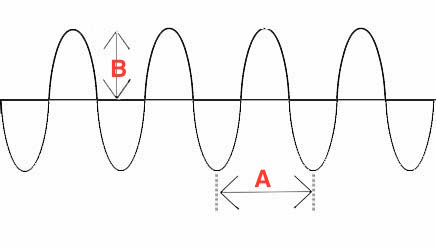
What property of this wave is represented by the letter "A"

a)

amplitude

b)

crest

c)

trough

d)

wavelength

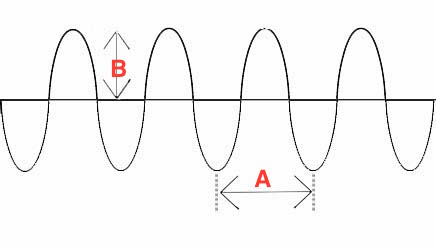
49.
What property of the wave is represented by the letter "B"?
a)
amplitude
b)
crest
c)
trough
d)
wavelength
50.
The highest point on a wave is:
a)
the crest
b)
the trough
c)
the top
d)
the coast 
51.
The type of waves that require medium to pass:
a)
Mechanical Waves
b)
Electromagnetic Waves
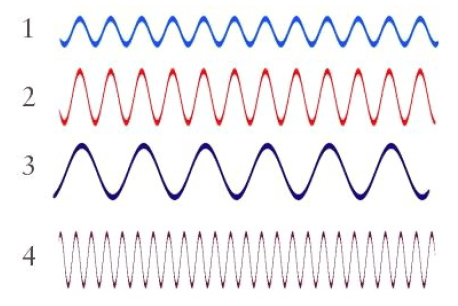
52.
Which wave in the diagram has the greatest frequency?
a)
1
b)
2
c)
3
d)
4
53.
When a wave strikes and object and bounces off. (example echo)
a)
medium
b)
refraction
c)
reflection
d)
interference
54.
When a wave bends as it passes through at an angle from one medium to another.(example: pencil in a glass of water-)
a)
medium
b)
refraction
c)
reflection
d)
interference
55.
A force that opposes motion between a surface in contact with the atmosphere.
a)
air resistance
b)
gravity
c)
momentum
d)
terminal velocity
56.
When all the forces on an object are equal and opposite, & the net force is zero, that's...
a)
balanced forces
b)
unbalanced forces
c)
terminal velocity
d)
reaction forces
57.
The combination of all the forces acting on an object is the...
a)
net force
b)
action force
c)
reaction force
d)
balance force
58.
An archer pulls the bowstring back, then releases the string and the arrow flies forward. The arrow flying forward is the...
a)
action force
b)
reaction force
c)
net force
d)
inertia
59.
An archer pulls the bowstring back, then releases the string and the arrow flies forward. Pulling the string back is the...
a)
action force
b)
reaction force
c)
net force
d)
inertia
60.
Gravity is increased with...
a)
greater mass & shorter distance
b)
greater mass & farther distance
c)
lower mass & shorter distance
d)
lower mass & farther distance
61.
In a controlled experiment, how many independent variables can be worked with at a time? 
a)
one
b)
none
c)
two or more
d)
how ever many makes sense.
62.
Mr. S. sets up an experiment to see how the mass of a ball affects the distance it rolls off a ramp.  Identify the dependent variable.
a)
height of the ramp
b)
 distance traveled by the ball
c)
mass of the ball
d)
weight of the ball
63.
Which contains the fastest moving molecules?
a)
ice
b)
liquid water
c)
gaseous vapor
64.
Stored energy that results from the position or shape of an object is called...
a)
Thermal
b)
Potential
c)
Kinetic
d)
Gravitational
65.
When a pendulum swings, at which point is kinetic energy highest?
a)
1
b)
2
c)
3
d)
4
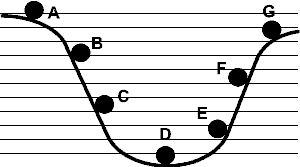
66.
Which point has the most potential energy?
a)
G
b)
f
c)
b
d)
a
67.

Which 2 letters have the most kinetic energy

a)

W & Y

b)

X & Z

68.

Which would have the greatest gravitational potential energy?

a)

A 4 pound rat on a school desk

b)

A 45 pound dog in an oak tree

c)

A 14 pound platypus on a swing

d)

A 45 pound child on a bike

69.
When light shines through a prism it creates a ________________
a)
colors
b)
ROY G. BIV
c)
spectrum
d)
electromagnetic wave
70.
Material that allows light to pass through allowing you to see "clearly" to the other side
a)
opaque
b)
translucent
c)
transparent
71.
Light is a form of 
a)
energy
b)
radiation
c)
reflection
72.
What does refract mean?
a)
To shrink
b)
To bend
c)
To widen
d)
To enlarge
73.
Which of these is our MAIN (most important) source of light?
a)
Lightbulbs
b)
The Sun
c)
Fire
d)
All of them
74.

An object that blocks all of the light from passing through is...

a)

transparent

b)

clear

c)

opaque

d)

translucent

75.
what is this
a)
translucent
b)
transparent
c)
opaque
76.
A light year is the 
a)
distance that light travels in one year
b)
Speed at which light travels 
77.
Water changes its state of matter when heat is added or taken away.  When water reaches its boiling point the particles-
a)
are closer together
b)
stay the same
c)
are moving more rapidly
d)
are moving more slowly
78.

Does the temperature, 0 degrees Celsius, show the melting, freezing, or boiling point of water?

a)

freezing point

b)

melting point

c)

boiling point

d)

both freezing point and melting point

79.
Efficiency is a ______ of what you put in versus what you get out of a system.
a)
source
b)
ratio
c)
multiplication
d)
addition
80.
Most destructive seismic wave
a)
P wave
b)
S wave
c)
Surface wave
81.
What does Reflecting Telescope have?
a)
Lens
b)
Mirrors
c)
Bat ears
82.
What does Refracting Telescope have?
a)
Sand
b)
Mirrors
c)
Lens
d)
Batmobile 
83.
The drops of water that appear on the outside of a glass of cold juice on a warm day are an example of?
a)
sublimation
b)
condensation
c)
evaporation
84.
Empirical evidence is data and measurements used to support a scientific explanation.
a)
True
b)
False
85.
A set of principles that explains and predicts a phenomena is called a _____. 
a)
scientific law
b)
scientific method
c)
scientific theory
d)
scientific instructor
86.
A scientific ____________ is a statement that describes what always happens under certain conditions in nature.
a)
law
b)
theory
c)
method
d)
variable
87.
If two objects have reached the same temperature they have reached:
a)
a melting point.
b)
a boiling point.
c)
thermal equilibrium.
d)
specific heat.
88.
Heat is the movement of ______.
a)
radiation
b)
thermal energy
c)
cold
d)
fire
89.
The measure of average kinetic energy of all the particles within an object is called ____________. 
a)
temperature
b)
conduction
c)
radiation
d)
heat 
90.
What causes you to stop after coasting on a bicycle?
a)
air resistance and sliding friction
b)
inertia
c)
friction and gravity
d)
friction and air resistance
91.

The Law of Conservation of Energy states:

a)

Energy can created or destroyed but not transformed

b)

Energy cannot be created or destroyed, it can only be transformed

c)

Energy can't be created, destroyed or transformed

92.
Students react baking soda & vinegar.
Which of the following would provide the evidence that the number of atoms present before a chemical reaction is equal to the number of atoms present after the chemical reaction?

a)
The mass of the plastic bag, baking soda, and vinegar before the reaction was equal to the mass after the reaction.
b)
Bubbles were produced during the reaction, which meant that a gas was being produced.
c)
The plastic bag did not change in any way, indicating that it was not involved in the reaction.
d)
The mass of the baking soda was exactly equal to the mass of the vinegar used to create the chemical reaction.
93.
If a piece of matter changes shape, what happens to its mass?
a)
It increases
b)
It decreases
c)
it changes randomly
d)
it stays the same
94.
Anything made of matter must _____________________.
a)
take up space and have mass
b)
have mass and be a solid
c)
be a solid and not move
d)
take up space and be a liquid