wayground logo

Free Printable Worksheets

Font size

S
M
L
XL
Worksheets

Earth Science Q1 Q2 Review

Total questions: 101

Worksheet time: 2hrs 52mins

Name
Class
Date
1.
The red shift of light from distant galaxies provides evidence that these galaxies are
a)
decreasing in size
b)
increasing in size
c)
decreasing in distance from Earth
d)
increasing in distance from Earth
2.
In which sequence are the celestial objects
correctly listed in order from the smallest mass to
the largest mass?
a)
Saturn, solar system, Milky Way, universe
b)
Saturn, universe, Milky Way, solar system
c)
Milky Way, Saturn, solar system, universe
d)
Milky Way, universe, solar system, Saturn
3.
As altitude increases in the troposphere and stratosphere, the air temperature
a)
decreases in the troposphere and increases in the stratosphere
b)
decreases in both the troposphere and stratosphere
c)
increases in the troposphere and decreases in the stratosphere
d)
increases in both the troposphere and stratosphere
4.

Points A through I are locations on the map. Elevations are shown in meters. Which locations have the same elevation?

a)

A and C

b)

B and E

c)

C and I

d)

F and G

5.

Which direction is Maple Stream flowing?

a)

North

b)

South

c)

East

d)

West

6.
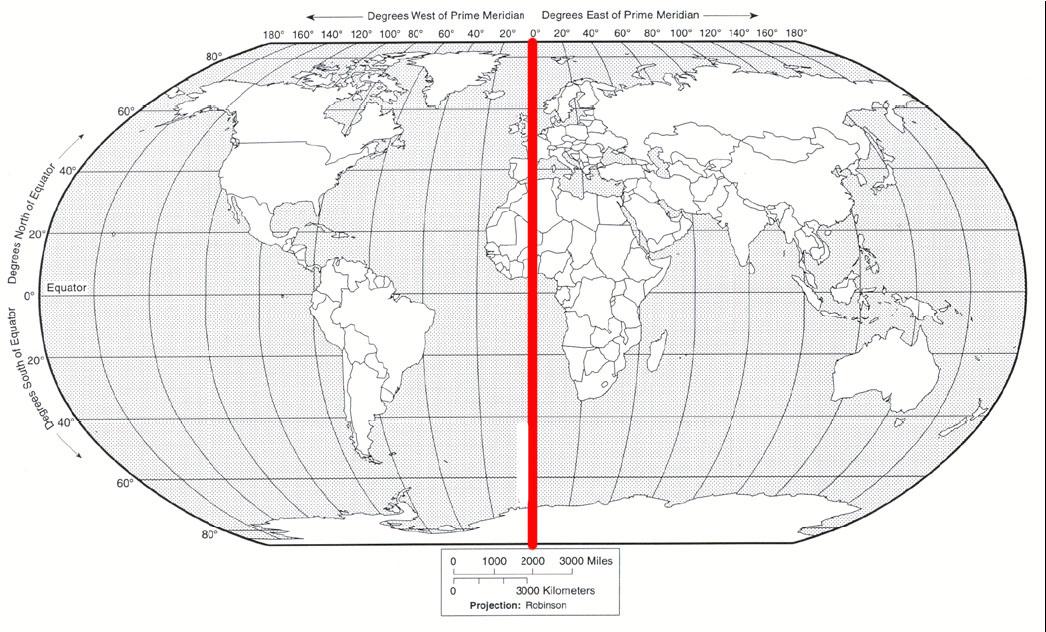
What is the name of the line at zero degrees longitude?
a)
Equator
b)
Prime Meridian
c)
North Pole
d)
South Pole
7.
During which season is the northern hemisphere tilted toward the Sun?
a)
Summer
b)
Fall
c)
Winter
d)
Spring
8.
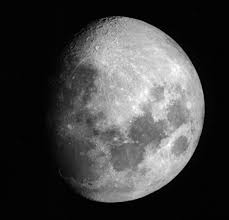
Name the moon phase
a)
waning crescent
b)
waxing crescent
c)
waning gibbous
d)
waxing gibbous
9.
Frank has a paper clip. It has a mass of 9g and a volume of 3cm3. What is its density?
a)
3 g/cm3
b)
1/3 g/cm3
c)
27 g/cm3
d)
39 g/cm3
10.
If this substance takes up 6ml of space, what is its mass?
a)
 6 ml
b)
6 grams
c)
0 grams
d)
4 grams 
11.

Which topographic map matches formation C?

a)

1

b)

2

c)

3

d)

4

12.
The best evidence of Earth’s rotation is provided by the
a)
Foucault pendulum and global warming
b)
Foucault pendulum and Coriolis effect
c)
Moon phases and global warming
d)
Moon phases and Coriolis effect
13.
Which sphere of Earth covers approximately 70%of Earth’s surface?
a)
atmosphere
b)
hydrosphere
c)
lithosphere
d)
asthenosphere
14.
Some of the constellations that are visible to New York State observers at midnight in December are different from the constellations that are visible at midnight in June because
a)
constellations revolve around Earth
b)
constellations rotate on an axis
c)
Earth rotates on its axis
d)
Earth revolves around the Sun
15.

Planets that are closest to the Sun are identified as

a)

low-density jovian planets

b)

low-density terrestrial planets

c)

high-density jovian planets

d)

high-density terrestrial planets

16.

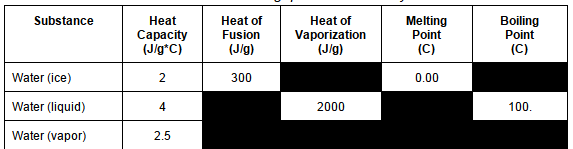
Which process of the water cycle occurs when water absorbs 2260 Joules of heat energy per gram?

a)

melting of ice

b)

condensation of water

c)

evaporating of water

d)

freezing of water

17.

Which list correctly identifies the energy transfer between A, B and C

a)

A- Conduction, B-Convection, C-Ratiation

b)

A- Convection, B- Radiation, C- Conduction

c)

A- Convection, B- Conduction, C- Radiation

d)

A- Conduction, B- Radiation, C- Convection

18.

The diagram below represents the light spectra given off by the same element as observed under two different conditions. Spectrum A was observed when that element was heated in a laboratory. Spectrum B shows the same element as seen in the light from a distant star.

The light spectrum observed from this distant star shows a

a)

red shift, which indicates that the star is moving away from Earth

b)

red shift, which indicates that the star is moving toward the Earth

c)

blue shift, which indicates that the star is moving away from Earth

d)

blue shift, which indicates that the star is moving toward Earth

19.

Equal areas of which surface would absorb the greatest amount of insolation on a sunny day?

a)

light-colored, smooth surface

b)

light-colored, rough surface

c)

dark-colored, smooth surface

d)

dark-colored, rough surface

20.
A Foucault pendulum appears to change its directions of swing because Earth
a)
is tilted on its axis
b)
is spinning on its axis
c)
has a curved surface
d)
has a density of 5.5 g/cm3
21.

The modern heliocentric model of planetary motion states that the planets travel around

a)

the Sun in slightly elliptical orbits

b)

the Sun in circular orbits

c)

Earth is slightly elliptical orbits

d)

Earth in circular orbits

22.
To an observer on Earth, the Sun appears brighter than the star Rigel because the Sun is 
a)
hotter than Rigel
b)
more luminous than Rigel
c)
closer than Rigel
d)
larger than Rigel
23.
El Cuy is a South American city located at 40 degrees south latitude. During which month would the coldest day most likely occur at this location?
a)
May
b)
November
c)
July
d)
January
24.
Evidence supports the idea that increases in carbon dioxide and methane in Earth’s atmosphere are major contributors to global warming. This is based primarily on the fact that carbon dioxide and methane are excellent absorbers of
a)
gamma rays
b)
visible light
c)
infrared radiation
d)
microwaves
25.
What caused the interior of Earth to separate into layers?
a)
a decrease in the rate of rotation of Earth
b)
the gravitational pull on materials of varying densities
c)
variations in heating by the Sun due to Earth’s tilt
d)
collisions with meteors and comets
26.
At which location is the altitude of Polaris approximately 42°?
a)
Niagara Falls
b)
Elmira
c)
Watertown
d)
Massena
27.
At which latitude is the Sun directly overhead on certain days of the year?
a)
23.5° N
b)
66.5° N
c)
42° N
d)
90° N
28.
Which motion causes the constellation Orion to be visible at midnight from New York State in winter but not in summer?
a)
rotation of Earth
b)
rotation of Orion
c)
revolution of Earth
d)
revolution of Orion
29.
In which two temperature zones of the atmosphere does the temperature increase with increasing altitude?
a)
troposphere and stratosphere
b)
troposphere and mesosphere
c)
stratosphere and thermosphere
d)
mesosphere and thermosphere
30.
The layer of our atmosphere in which weather occurs is the
a)
troposphere
b)
stratosphere
c)
mesosphere
d)
exosphere
31.
Which has the largest wavelengths
a)
Radio waves
b)
Micro waves
c)
Ultra violet waves
d)
X-rays
32.
A major piece of evidence supporting the Big Bang Theory and the expansion of the universe is the observation of wavelengths of stars in distant galaxies show a
a)
red shift and are moving away
b)
red shift and moving towards
c)
blue shift and moving away
d)
blue shift and moving towards
33.
If the tilt of Earth’s axis were increased from
23.5° to 30°, summers in New York State would
become
a)
cooler, and winters would become cooler
b)
cooler, and winters would become warmer
c)
warmer, and winters would become cooler
d)
warmer, and winters would become warm
34.
The same side of the Moon always faces Earth because the Moon’s period of revolution
a)
is longer than the Moon’s period of rotation
b)
equals the Moon’s period of rotation
c)
is longer than Earth’s period of rotation
d)
equals Earth’s period of rotation
35.
Land that is along an ocean
a)
geography
b)
continent
c)
coast
d)
region
36.
A substance that pollutes something, especially water or the atmosphere is called
a)
dirt
b)
pollutant
c)
oxygen
d)
precipitant
37.
Liquid water changing slowly into a gas and rising into the atmosphere is called
a)
evaporation
b)
condensation
c)
rain
d)
typhoon
38.

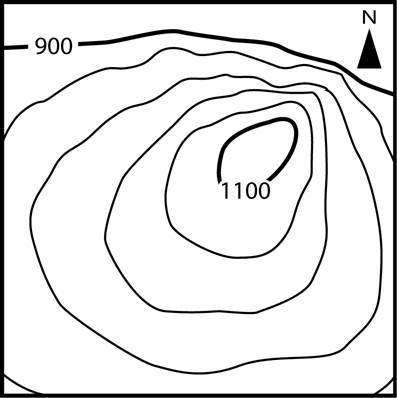
What is the contour interval for this map?

a)

500

b)

100

c)

20

d)

1000

39.

What is the elevation of Point A

a)

1500

b)

900

c)

1000

d)

1200

40.

Which direction is Maple Stream flowing?

a)

North

b)

South

c)

East

d)

West

41.
What do contour lines that are farther apart represent?
a)
waterfall
b)
steep area
c)
gentle slope
d)
river
42.
How many mountain tops does this map have?
a)
one
b)
two
c)
three
d)
four
43.
Provided is a topographic map of a hill with contour lines drawn showing elevation in meters.
The steepest slope on this hill can be found on the side that is facing which direction?
a)
Southwest
b)
Northeast
c)
Northwest
d)
Southeast
44.
What is the highest elevation this hill could possibly have? (might not be labeled)
a)
1040
b)
1060
c)
1079
d)
1009
45.
It is steep on a topographic map where __________.
a)
lines are closest together
b)
a river flows into a lake
c)
contours bend
d)
contours are far apart
46.
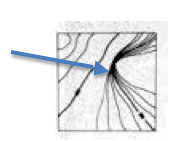
What feature is at the arrow?
a)
volcano
b)
mountain
c)
cliff
d)
river
47.
A mountaineer is planning an expedition. He wants to follow the easiest possible path, which means he needs to find the most gentle slope up the mountain. Which route should the mountaineer choose?
a)
Route A
b)
Route B
c)
 Route C
d)
Route D
48.

What is a possible elevation of location D

a)

50 feet

b)

41 feet

c)

60 feet

d)

91 feet

49.
Which of the following statements best explains why it is warmer at the equator than at the North Pole?
a)
The equator has a larger area than the North Pole.
b)
The equator is closer to the Sun than the North Pole.
c)
The equator receives more direct sunlight than the North Pole.
d)
The equator has more hours of daylight per year than the North Pole.
50.
The Sun appears larger than the others stars because of
a)
its yellow color
b)
its high temperature
c)
its distance from Earth
d)
the greater amount of light it gives off
51.
Which list orders the celestial bodies from closest to farthest from the Earth?
a)
the Sun, Jupiter, the asteroid belt, the Moon
b)
the star Alpha Centauri, the Sun, Mars, the Moon
c)
Saturn, the Moon, the star Alpha Centauri, the asteroid belt
d)
the Moon, the Sun, Neptune, the star Alpha Centauri
52.
How is Earth different from the other planets in the solar system?
a)
It has an atmosphere
b)
It has a solid surface
c)
It has warm temperatures
d)
It has liquid water on its surface
53.
The length of one day on Earth is determined by how long it takes
a)
the Moon to revolve once
b)
the Moon to rotate once
c)
Earth to rotate once
d)
Earth to revolve once
54.
On Earth, a day lasts about 24 hours. On Saturn, a day lasts about 10 hours. Why is a day on Saturn so much shorter than a day on Earth?
a)
The Earth rotates on its axis more slowly than Saturn does.
b)
Saturn is much farther from the Sun than Earth is.
c)
Saturn is much more massive than Earth.
d)
Earth revolves around the Sun more slowly than Saturn does.
55.
Which quality do all the planets in the solar system share?
a)
They all have moons.
b)
They all rotate in 24 hours.
c)
They all have rings.
d)
They all orbit the Sun in about the same plane.
56.
Earth is an average distance of 1.0 AU (astronomical unit) from the Sun, or about 150 million km. If Saturn is an average distance of 9.5 AU from the Sun, what is the approximate distance of Jupiter from the Sun?
a)
0.5 AU
b)
1.5 AU
c)
5 AU
d)
11 AU
57.
Identify the phase of the Moon in the drawing...
a)
Crescent
b)
Gibbous
c)
Full
d)
New
58.
Max saw the new Moon on June 3rd, approximately when would Max see another new Moon?
a)
July 1
b)
June 17
c)
July 17
d)
June 9
59.

Topography is the study of..

a)

Height

b)

Elevation

c)

Temperature

d)

Hills

60.
What is pictured here?
a)
Lines of Latitude
b)
Lines of Longitufe
c)
Prime Meridian
d)
International Date Line
61.
What is this line called?
a)
Prime Meridian
b)
Equator
c)
East Pole 
d)
West Pole
62.
What is the red line called?
a)
Equator
b)
Prime Meridian
c)
East Pole
d)
West Pole
63.
What is pictured here?
a)
Lines of Latitude
b)
Lines of Longitude
c)
Tropic of Cancer
d)
Tropic of Capricorn
64.
What is the line that separates the northern and southern hemispheres?
a)
Prime Meridian
b)
Equator
c)
Greenwich Line
d)
International Dateline
65.
If a scale measures weight, what metric unit is used?
a)
liter
b)
meter 
c)
gram
d)
grandma
66.
Where is Sydney?
a)
35 N, 165 W
b)
35 S, 165 E
c)
35 N, 165 E
d)
35 S, 165 W
67.

The blanket of gases that surrounds the earth’s surface.

a)

Air

b)

Atmosphere

c)

Space

d)

Biosphere

68.

___________ show elevation in a map.

a)

Contour lines

b)

Isograms

c)

Reference lines

d)

Height lines

69.

If you needed to know the distance between your current location and your destination, which part of a map would you use?

a)

Map scale

b)

Legend

c)

Key

d)

Latitude lines

70.

Which point on the map is at 60 degrees N and 60 degrees E?

a)

A

b)

B

c)

C

d)

D

71.
Which group of substances is arranged in order of decreasing specific heat values?
a)
Iron, granite, basalt
b)
Copper, lead, iron
c)
dry air, water vapor, iceOption 3 (optional)
d)
Liquid water, ice, water vapor
72.
Which process is responsible for the greatest loss of energy from Earth’s surface into space on a clear night?
a)
Condensation
b)
Conduction
c)
Radiation
d)
Convection
73.

How long does it take to go from perihelion to aphelion?

a)

6 months

b)

2 months

c)

12 months

d)

8 months

74.
Positions 1, 2, and 3 in the diagram below represent the noon Sun above the horizon on three different days during the year, as viewed from Binghamton, New York. At which position was the noon Sun on January 21, as viewed from Binghamton?
a)
Above position 1
b)
Below position 3
c)
Between position 1 and position 2
d)
Between position 2 and position 3
75.
The diagram below represents the apparent path of the Sun as seen by an observer at 65° N on March 21.
a)
9 a.m.
b)
11 a.m.
c)
3 p.m.
d)
6 p.m.
76.
Equal areas of which surface will absorb the most insolation?
a)
Partially melted snowfield
b)
Blacktop parking lot
c)
White sand beach
d)
Lake surface
77.
Most of which type of electromagnetic radiation is given off by Earth’s surface at night?
a)
gamma rays
b)
ultraviolet light  
c)
visible light
d)
infrared rays
78.
The diagram below represents Earth as viewed from space. Letter A represents the approximate angle of tilt between Earth’s rotational axis and a line (XY) perpendicular to the plane of Earth’s orbit.   What is the value of the angle represented by letter A?
a)
15.0°
b)
23.5°
c)
24.5°
d)
30.0°
79.
Base your answers to questions 42 through 44 on the diagram below and on your knowledge of Earth science. The diagram represents Earth in its orbit around the Sun. Locations A through D represent four positions of Earth in its orbit. Earth is closest to the Sun (perihelion) at position A, and farthest from the Sun (aphelion) at position C. At which position is the gravitational attraction between the Sun and Earth the greatest?
a)
A
b)
B
c)
C
d)
D
80.
Which change in seasons occurs in the Northern Hemisphere at position D?
a)
Winter is ending and spring is beginning.
b)
Spring is ending and summer is beginning.
c)
Summer is ending and fall is beginning.
d)
Fall is ending and winter is beginning.
81.
Base your answers to questions 45 through 47 on the diagram below and on your knowledge of Earth science. The diagram represents the apparent path of the Sun as observed at four locations, A through D, on Earth’s surface on the same date. The present positions of the Sun represent the same time of day at each location. The zenith (the position directly overhead) is shown for an observer at each location. [Diagrams are not drawn to scale.] What is the approximate time of day represented at each location?
a)
6:00 a.m.
b)
9:00 a.m.
c)
3:00 p.m.
d)
6:00 p.m.
82.
During the course of the day, which location had the greatest intensity of insolation at solar noon?
a)
A
b)
B
c)
C
d)
D
83.
Based on the Sun’s apparent path, where is location D?
a)
equator
b)
Tropic of Cancer
c)
Tropic of Capricorn
d)
North Pole
84.
Equal areas of which type of surface will reflect the most insolation?
a)
light gray rooftop Option 1*
b)
dark tropical forest
c)
snow-covered field
d)
black paved road
85.
Which diagram best represents how greenhouse gases in our atmosphere trap heat energy?
a)
1
b)
2
c)
3
d)
4
86.
Base your answers to questions 28 through 30 on the diagrams below and on your knowledge of Earth science. The diagrams, labeled A, B, and C, represent equal-sized portions of the Sun’s rays striking Earth’s surface at 23.5° N latitude at noon at three different times of the year. The angle at which the Sun’s rays hit Earth’s surface and the relative areas of Earth’s surface receiving the rays at the three different angles of insolation are shown. As viewed in sequence from A to B to C, these diagrams represent which months and which change in the intensity of insolation?
a)
December → March → June; and decreasing intensity
b)
December → March → June; and increasing intensity
c)
June → September → December; and decreasing intensity
d)
June → September → December; and increasing intensity
87.
As the angle of the Sun’s rays striking Earth’s surface at noon changes from 90° to 43°, the length of a shadow cast by an object will
a)
Decrease
b)
Increase
c)
Decrease, then increase
d)
Increase, then decrease
88.

The deflection of Earth’s planetary winds is caused by the rotation of the earth, what is this phenomena called?

a)

the coriolis effect

b)

the doppler effect

c)

convection

d)

gravitational pull

89.
The angle the sun's rays strike the earth's surface
a)
Fusion
b)
Insolation
c)
Angle of Insolation
90.
The time and date of the year when day and night are equal length. 
a)
Fusion
b)
Solstice
c)
Equinox
91.
Exposure to the sun's rays
a)
Fusion
b)
Insolation
c)
Fission
92.
The process of joining two or more things together
a)
Fision
b)
Fusion
c)
Isotope
93.
A tide just after a new or full moon when there is the greatest difference between high and low water. 
a)
Neap Tides
b)
Spring Tides
94.
A tide just after the 1st or 3rd quarters of the moon when there is the least difference between high and low water. 
a)
Neap Tides
b)
Spring Tides
95.
This is the path one object travels around another object
a)
orbit
b)
inertia
c)
revolution
d)
rotation
96.
This is one complete trip of one object around another object
a)
insolation
b)
rotation
c)
revolution
d)
gravity
97.
This is the force of attraction between any two objects
a)
inertia
b)
gravity
c)
orbit
d)
revolution
98.

APPROXIMATELY how many Joules of energy are required to change 10 gram of water from 20 C to 90 C?

a)

1400 J

b)

2800 J

c)

210,000 J

d)

1,400,000 J

99.
 How many joules of heat are needed to raise the temperature of 10.0 g of aluminum from 22°C to 55°C, if the specific heat of aluminum is 0.90 J/gx°C?    
a)
297 Joules
b)
0.003 Joules
c)
297 J/gx°C
d)
0.003 J/gx°C
100.
When a  piece of aluminum foil is taken out of the oven and cools from 100° to 50°, What is the change in temperature?
a)
50°
b)
c)
100°
d)
150°
101.
A high specific heat means...
a)
It heats up quickly with energy added
b)
It requires more energy to change temperature