
 Worksheets
Chemistry Unit Test Review
Total questions: 96
Worksheet time: 2hrs 34mins
Matter is anything that has ____________ and _______________.
mass, volume
color, shape
weight, taste
energy, light
2. ____________ is the amount of matter present.
Mass
Volume
Density
Weight
3. ____________ is the amount of space an object takes up.
Volume
Mass
Density
Weight
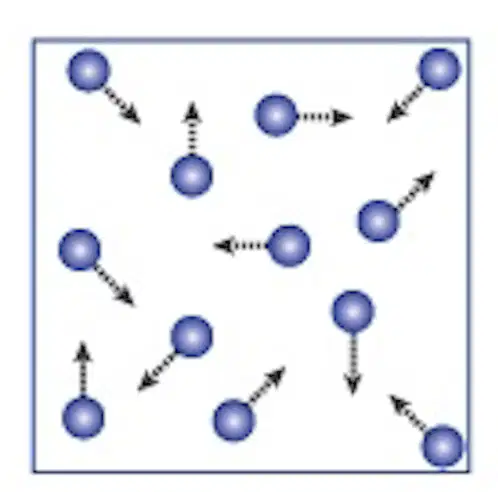
What state of matter is shown in the image?
solid
liquid
gas
plasma
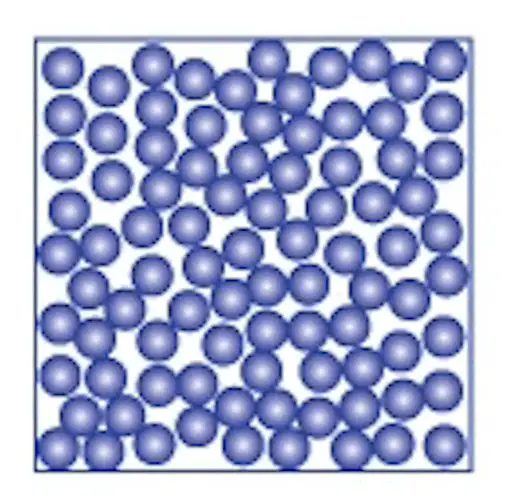
What state of matter is shown in the image?
solid
liquid
gas
plasma
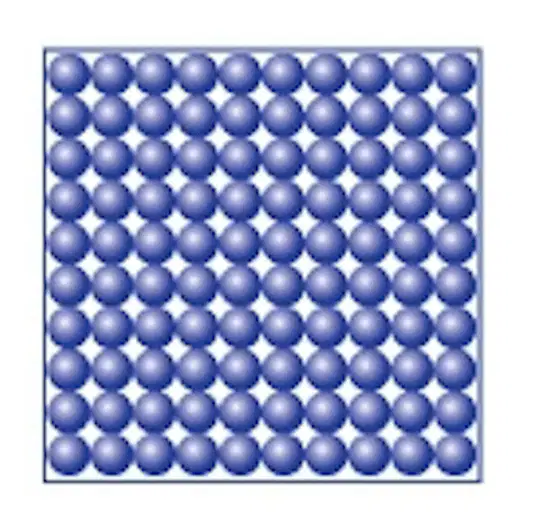
What state of matter is shown in the image?
solid
liquid
gas
plasma
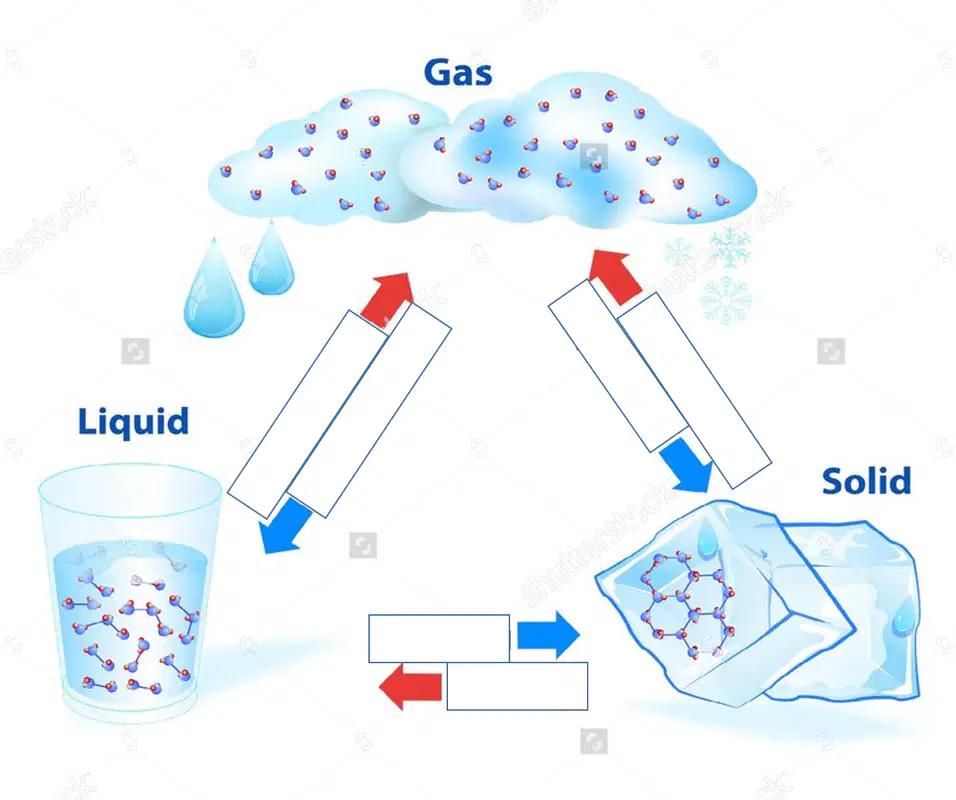
The transition from gas to solid is ____
deposition
freezing
condensation
sublimation
The transition from liquid to gas is ____
vaporization
freezing
condensation
sublimation
Density is the relationship of mass to volume. The equation to calculate density is _________________ .
Density = Mass / Volume
Density = Volume / Mass
Density = Mass x Volume
Density = Mass + Volume
There are __________ meters in 1 kilometer.
1000
100
10
500
There are _________ decimeters in 1 meter.
10
100
1
0.1
There are _________ milligrams in 1 gram.
1000
100
10
500
In 1 hectometer there are _________ meters.
100
10
1000
10000
In 1 centigram there are _______ grams.
0.01
0.1
0.001
1
In 1 decagram there are _______ grams.
10
100
1
0.1
. ________________ properties are things we can observe or measure just by looking at a material. ________________, ________________ and ________________ are all examples of ________________ properties.
Physical; color, shape, texture; physical
Chemical; mass, volume, density; chemical
Magnetic; weight, size, flexibility; magnetic
Thermal; temperature, heat, energy; thermal
11a. ________________ is a physical property that describes a material that is able to be hammered into a thin sheet.
Malleability
Solubility
Conductivity
Density
11b. ________________ is a physical property that describes a material that is able to be stretched into a thin wire.
Ductility
Malleability
Brittleness
Conductivity
c. ________________ is a physical property that describes a material that allows electricity or heat to travel through it.
Conductivity
Density
Malleability
Solubility
d. ________________ and ________________ are two physical properties that describe what a substance looks like.
Color and shape
Mass and volume
Weight and density
Boiling point and melting point
12. ________________ properties describe how a material behaves when it comes in contact with another substance. ________________, ________________ and ________________ are all examples of ________________ properties.
chemical, toxicity, flammability, reactivity, chemical
chemical, conductivity, melting point, boiling point, solidification temperature, chemical
physical, color, texture, reactivity, chemical
chemical, corrosiveness, density, volume, matter
13. ______________ changes change the identity of a substance. ______________ changes DO NOT change the identity of a substance.
Chemical; physical
physical; chemical
shape, size
reactivity, flammability
A(n) ___ is the smallest substance that retains the properties of a given element.
There are two main regions the ______ and the_____.
atom; nucleus, electron cloud
molecule; electron, proton
cell; nucleus, cytoplasm
compound; atom, bond
There are three subatomic particles - ____________________, ________________ and ____________________.
proton, neutron, electron
proton, photon, electron
neutron, positron, electron
proton, neutron, positron
_________ are positively charged particles located in the ________.
Neutrons, nucleus
protons, nucleus
electrons, nucleus
electrons, electron cloud
17. ____________________ are neutral (do not have a charge) particles located in the ____________________.
Neutrons; nucleus
Protons; cytoplasm
Electrons; mitochondria
Ions; cell membrane
18. ____________________ are negatively charged particles located in the ________________________________.
Electrons; electron cloud
Protons; nucleus
Neutrons; electron cloud
Ions; nucleus
The ____________________ force is the weakest force in the atom. The ____________________ is the strongest force in the atom.
gravitational; strong nuclear force
electromagnetic; weak nuclear force
strong nuclear; gravitational force
weak nuclear; electromagnetic force
The ____________________ is the force responsible for the attraction of positively charged protons to the negatively charged electrons.
electromagnetic force
gravitational force
strong nuclear force
weak nuclear force
21. Rows on the Periodic Table are known as _________. These elements have the same number of _____________ electrons.
periods; core
groups; core
columns; valence
families; orbital
Columns on the Periodic Table are known as ________ or __________. These elements share similar ____________ of matter.
groups; families; properties
rows; periods; colors
blocks; sections; weights
lines; chains; numbers
_____ are charged particles.
_______ are positively charged and _______ are negatively charged.
Ions; cations; anions
Atoms; anions; cations
Molecules; cations; anions
Electrons; anions, cations
__________ have more protons than electrons and ____________ have more electrons than protons.
Cations; anions
Anions; cations
Neutrons; protons
Electrons; neutrons
You can predict the type of __________ formed by an element based in its number of ____________________ electrons.
ion; valence
molecule; core
atom; shared
compound; paired
________________ are atoms with the same number of protons, but different numbers of neutrons.
Isotopes
Ions
Molecules
Compounds
The ________________ of an atom is the number of protons and ______________ in the nucleus.
mass number; neutrons
atomic number; electrons
atomic mass; protons
isotope; neutrons
____________________ are atoms of the same element with different numbers of ___________________.
Isotopes; neutrons
Ions; protons
Molecules; electrons
Compounds; nuclei
An atom of ____________________ would have 47 protons.
silver
gold
copper
iron
Carbon is located in period ______ and group ______.
2; 14
3; 15
2; 16
1; 13
______________________ is located in period 1 and group 1.
Hydrogen
Helium
Lithium
Oxygen
Atoms form _________ with other atoms so that they can fill their outermost electron orbital. The outermost electron orbital is called the _________ orbital or shell.
ions; core
isotopes; outer
bonds, core
An atom wants to have ________ valence electrons in its outermost orbital. This is called ___________________.
8; an octet
10; a full valence shell
all of its; total neutrality
7; the halogen rule
Counting atoms is the first step in ____________________ chemical equations.
balancing
writing
naming
predicting
A Chemical Equation is balanced when the number of atoms of each element on the ________________ side is the same as the number of atoms of each element on the ____________________ side.
reactant; product
product; reactant
left; right
right; left
Convert 5.74 liters to milliliters.
5740 milliliters
574 milliliters
57400 milliliters
57.4 milliliters
Convert 65.4 decimeters to meters.
(a)
Convert 2.13 decaliters to liters.
(a)
A solid has a mass of 25g and a volume of 15cm³. What is the density of the solid?
1.67 g/cm³
0.6 g/cm³
3.75 g/cm³
40 g/cm³
A liquid has a mass or 40g and volume of 20mL what is the density of the liquid?
2 g/mL
0.5 g/mL
20 g/mL
4 g/mL
A solid has a mass of 21g and a density of 0.3g/cm³. What is the volume of the solid?
70 cm³
63 cm³
7 cm³
0.07 cm³
A liquid has a density of 0.75g/mL and a volume of 50mL. What is liquid’s mass?
37.5 g
25 g
75 g
0.015 g
Matter is:
Anything that has mass and takes up space.
A type of energy.
A form of light.
A chemical reaction.
Density is:
The amount of mass in a given volume
The amount of energy in a substance
The speed of an object
The temperature of a substance
Density and mass are different because:
Density is the amount of matter in a given volume, while mass is the amount of matter in an object.
Density is measured in kilograms, while mass is measured in grams per cubic centimeter.
Density and mass are the same property of matter.
Density is only found in liquids, while mass is found in solids.
How are physical and chemical properties different?
Physical properties can be observed without changing the substance, while chemical properties describe how a substance changes into a new one.
Physical properties describe how a substance reacts with other substances, while chemical properties can be observed without changing the substance.
Physical and chemical properties are the same.
Physical properties are only found in solids, while chemical properties are only found in liquids.
Which of the following best describes the similarities and differences between physical and chemical changes?
Both involve changes in matter, but only chemical changes result in new substances.
Both result in new substances being formed.
Physical changes are irreversible, while chemical changes are always reversible.
Physical changes involve energy changes, while chemical changes do not.
What are the 5-6 ways you know a chemical change has occurred?
Change in color, formation of a gas, formation of a precipitate, change in temperature, change in odor, production of light
Change in shape, melting, dissolving, freezing, boiling, condensation
Change in size, breaking, tearing, folding, mixing, stretching
Evaporation, sublimation, condensation, filtration, distillation, crystallization
The 2 main regions of the atom are:
nucleus and electron cloud
protons and neutrons
electrons and protons
shells and orbits
What are the three subatomic particles we discussed? Where are each of these particles located within the atom?
Protons, neutrons, and electrons; protons and neutrons are in the nucleus, electrons are outside the nucleus.
Protons, electrons, and photons; all are in the nucleus.
Neutrons, electrons, and positrons; neutrons and electrons are in the nucleus, positrons are outside.
Protons, neutrons, and electrons; all are outside the nucleus.
Some of the properties of the alkali metals are:
They are hard and have high melting points.
They are non-reactive
They are soft and have low melting points.
They are highly reactive
They are non-conductors of electricity.
They are colorless gases at room temperature.
The physical and chemical properties of the noble gases are:
high reactivity and metallic bonding
low reactivity and are colorless, odorless gases
solid at room temperature and highly reactive
form many compounds easily
The physical properties of the transition metals include:
high melting and boiling points, good conductivity, and malleability
low melting points and poor conductivity
brittleness and low density
lack of metallic luster
What should you know about the alkaline earth metals?
They are highly reactive metals found in Group 2 of the periodic table.
They are nonmetals found in Group 18 of the periodic table.
They are transition metals found in the center of the periodic table.
They are noble gases found in Group 1 of the periodic table.
Ions are:
atoms or molecules with a net electric charge due to the loss or gain of electrons
neutral atoms with equal numbers of protons and electrons
particles found only in metals
molecules that cannot conduct electricity
Write the ion notation for a typical ion of magnesium.
Mg2+
Mg2-
Mg+
Mg-
Isotopes are:
atoms with the same number of protons but different number of neutrons
atoms with the same number of neutrons but different number of protons
atoms with different numbers of protons and electrons
atoms with the same number of protons and electrons
Write both isotopic notations for an atom of nitrogen with a mass number of 14.
14N and Nitrogen-14
7N and Nitrogen-7
N-14 and Nitrogen-14
N-7 and Nitrogen-7
An ionic bond is:
A bond formed by the sharing of electrons between atoms.
A bond formed by the transfer of electrons from one atom to another.
A bond formed by the equal sharing of protons between atoms.
A bond formed by the overlapping of atomic orbitals.
A covalent bond is:
A bond formed by the sharing of electrons between atoms.
A bond formed by the transfer of electrons between atoms.
A bond formed by the attraction between oppositely charged ions.
A bond formed by the sharing of protons between atoms.
Pure substances and mixtures can be compared and contrasted based on which of the following characteristics?
Composition and uniformity
Color and shape
Size and weight
Temperature and pressure
Elements and compounds are alike because they are both made of atoms. How are they different?
Elements are made of only one kind of atom, while compounds are made of two or more kinds of atoms.
Elements are made of molecules, while compounds are made of atoms.
Elements can be separated by chemical means, while compounds cannot.
Elements and compounds are both made of multiple types of atoms.
Core electrons are ______, while valence electrons are ______.
found in the outermost shell; found in the inner shells
involved in chemical bonding; not involved in chemical bonding
found in the inner shells; found in the outermost shell
always paired; always unpaired
A Lewis Dot structure is different from a Bohr Model because:
A Lewis Dot structure shows only valence electrons, while a Bohr Model shows all electrons in energy levels.
A Lewis Dot structure shows all electrons, while a Bohr Model shows only valence electrons.
A Lewis Dot structure shows protons and neutrons, while a Bohr Model does not.
A Lewis Dot structure and a Bohr Model show the same information.
Which of the following is Lewis Dot Structure for a neutral atom of Sulfur.
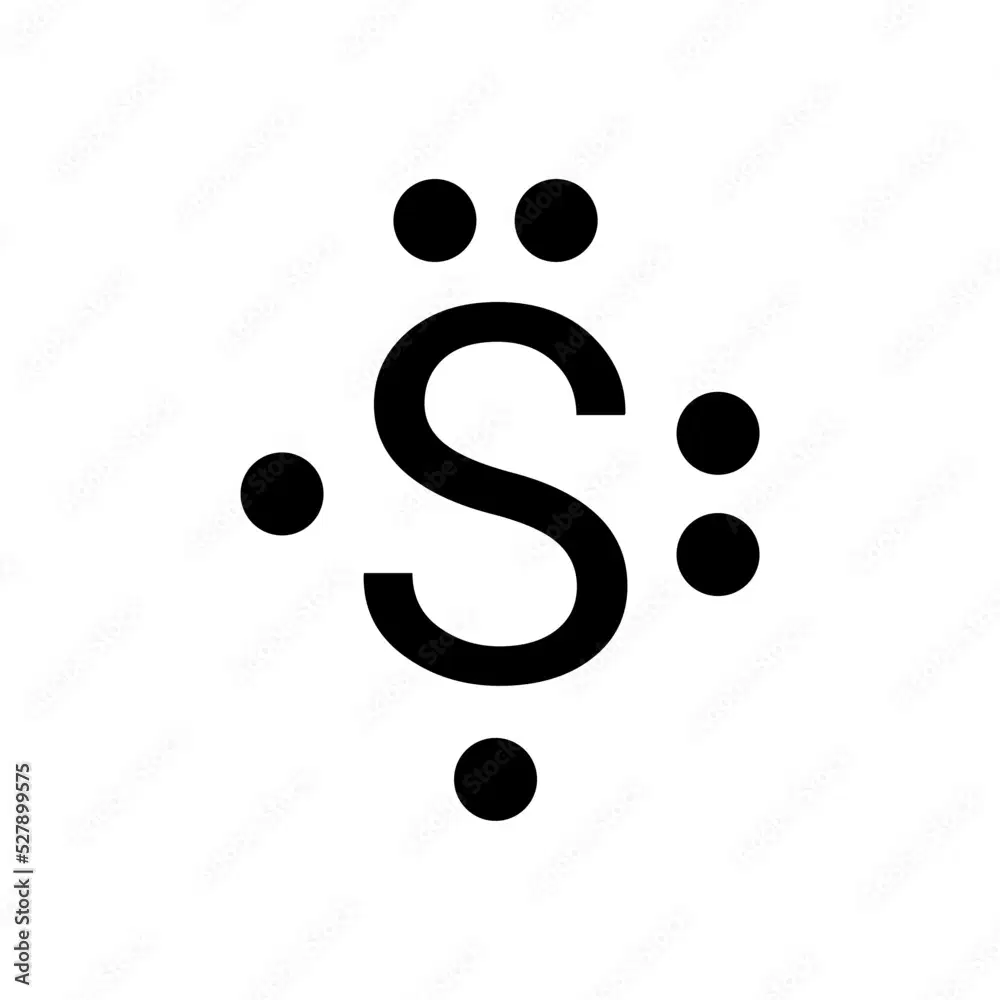
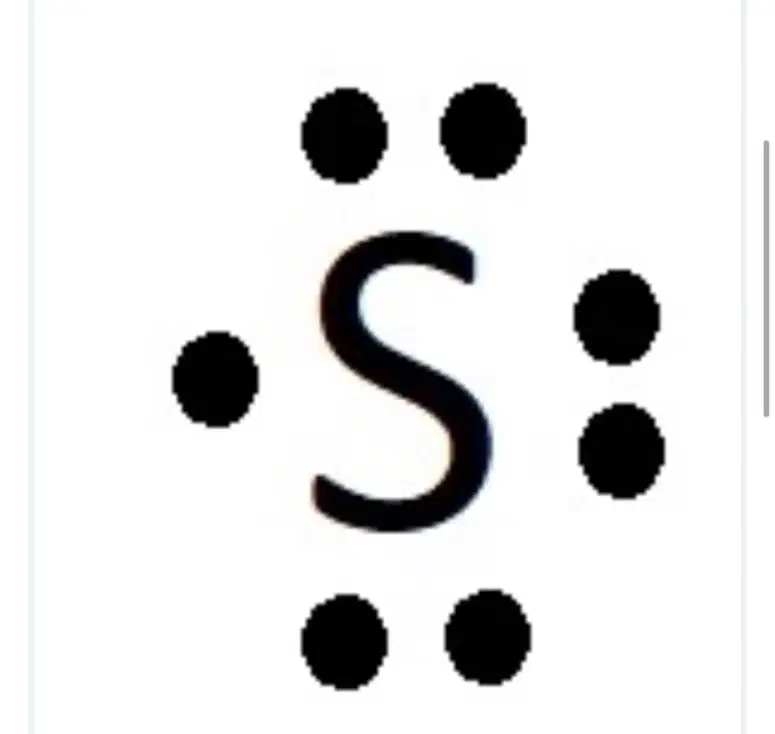
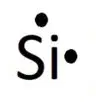
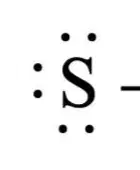
Chlorine and Calcium would form a covalent bond.
True
False
Carbon is in period 2.
True
False
Nitrogen and Oxygen would form a covalent bond.
True
False
Chlorine has 18 protons.
True
False
Sodium has 11 protons.
True
False
Salt water is classified as a solution.
True
False
Compounds are mixtures.
True
False
Protons are located in the nucleus.
True
False
Isotopes are charged particles.
True
False
If two liquids with different densities are poured into a container, the liquid that is denser will float on top of the mixture.
True
False
Use the method learned in class to balance the following chemical equations. _____ N₂ + _____ H₂ → _____ NH₃
1 N₂ + 3 H₂ → 2 NH₃
1 N₂ + 2 H₂ → 2 NH₃
2 N₂ + 3 H₂ → 2 NH₃
1 N₂ + 3 H₂ → 1 NH₃
Use the method learned in class to balance the following chemical equations. ___ Zn + ___ HCl → ___ ZnCl₂ + ___ H₂
1 Zn + 2 HCl → 1 ZnCl₂ + 1 H₂
2 Zn + 2 HCl → 1 ZnCl₂ + 2 H₂
1 Zn + 1 HCl → 1 ZnCl₂ + 2 H₂
2 Zn + 1 HCl → 2 ZnCl₂ + 1 H₂
How many neutrons does an atom of Lithium-7 have?
4
7
3
1
An atom has 6 protons 7 neutrons and 6 electrons. What is the identity of the element?
Carbon-13
Carbon-6
Nitrogen-7
Aluminum-13
An atom of Oxygen has 8 protons 8 Neutrons and 10 electrons. What is the identity of the atom?
Oxygen-16
O2-
O2+
Oxygen-18
What is the identity of an element with the following:
Mass Number = 37,
Protons = 17
Neutrons = 20
electrons = 18
37Cl-
37Rb+
17O
20Ca2-
What is the mass number and charge of an atom of Sodium with 12 neutrons and 10 electrons
mass number = 23
charge = +1
mass number = 12
charge = -10
mass number = 11
charge = -1
mass number = 22
charge = +1
In a covalent bond the bond is created by a(n) _____ of valence electrons.
In an ionic bond the bond between atoms in created by a(n) _____ of valence electrons.
sharing, transfer
absorbing, imbalance
fusion, fission
transfer, sharing
The transition from solid to liquid is ____
Melting
freezing
condensation
sublimation
The transition from solid to gas is ____
vaporization
freezing
condensation
sublimation
The transition from gas to liquid is ____
deposition
freezing
condensation
sublimation
The transition from liquid to solid is ____
vaporization
freezing
condensation
sublimation

