
 Worksheets
Semester Exam
Total questions: 100
Worksheet time: 2hrs 13mins
Name
Class
Date
1.
What is one problem with using a series circuit?
a)
It has a lot of series.
b)
If one goes down, they all go down!
c)
It doesn't work properly.
d)
There are no problems.
2.
What is one benefits of using a parallel circuit?
a)
It gets confusing.
b)
There are no problems.
c)
If one goes down, it does not affect the others.
d)
Porque es para llelio.
3.
What causes lightning?
a)
A similarity in electrical charge.
b)
Electrons flowing through a conductor.
c)
A difference in electrical charge.
d)
Raindrops conducting electricity from the clouds to the ground.
4.
A flow of electrons through a conductor is called:
a)
A river
b)
A spark
c)
An electron flow
d)
A current
5.
In most electrical circuits, the pathway is made of:
a)
Wood
b)
Plastic
c)
Metal
d)
Static
6.
What are the three components of a circuit?
a)
Pathway, Source, and Battery.
b)
Energy source, Conductor, and Receiver.
c)
Battery, Bulb, and Plastic.
d)
Wire, Electron, and Charge.
7.
What are the two poles of a magnet called?
a)
North and South
b)
East and West
c)
Up and Down
d)
Red and Blue
8.

What kind of circuit is this?
a)
Series
b)
Consecutive
c)
Parallel
d)
Training
9.

What kind of circuit is this?
a)
Series
b)
Consecutive
c)
Parallel
d)
Training
10.

What kind of circuit is this?
a)
series
b)
parallel
11.
wood is a _____?
a)
conductor
b)
insulator
12.
A material in which electrons are able to move easily
a)
Circuit
b)
Insulator
c)
Resistance
d)
Conductor
13.
A material in which electrons are not able to move easily
a)
Circuit
b)
Insulator
c)
Resistance
d)
Conductor
14.

Which statement is true?
a)
The light bulb will light up because the circuit is complete.
b)
The light bulb will light up because the circuit is broken.
c)
The light bulb will not light up because the circuit is complete.
d)
The light bulb will not light up because the circuit is broken.
15.

In a parallel circuit if one of the light bulbs burns out the rest _________.
a)
stop the flow of electricity
b)
can still light up
c)
will go out
d)
of the light bulbs burn out also
16.
Which best describes a parallel circuit?
a)
Electricity flows along one pathway.
b)
The flow of electricity comes from one source.
c)
Electricity flows along more than one pathway.
d)
The flow of electricity comes from more than one source.
17.
Which best describes a series circuit?
a)
It has two light bulbs.
b)
The same current flows through both light bulbs.
c)
It uses a single battery.
d)
The current is divided between the light bulbs.
18.

In the following diagram, the lightbulb is:
a)
Pathway
b)
Energy source
c)
The conductor
d)
The energy reciever
19.
An alarm clock draws 0.8 A of current when connected to a 120 V circuit. Calculate the resistance.
a)
150 Ohms
b)
150 Volts
c)
96 Ohms
d)
96 Volts
20.
If a radio produces 13 Ohms of resistance in a 150 Volt circuit what is the amount of current in the circuit?
a)
1950 V
b)
.086 A
c)
11.5 A
d)
975 W
21.
A light bulb has a resistance of 5 ohms and a maximum current of 12 amps how much voltage can be applied before the bulb will break ?
a)
2.4 A
b)
60 V
c)
600V
d)
120 ohms
22.
If an Oven is rated at a current of 15 A and a voltage of 220 V the power rating would be ?
a)
14.66 Ohms
b)
.068 A
c)
1650 W
d)
3,300 W
23.
Shaq runs his diffuser every morning the diffuser uses 75W of power and the current supplied is 2.5A. How many volts are needed to run the diffuser?
a)
30 V
b)
187.5 V
c)
93.75 Ohms
d)
.033 W
24.
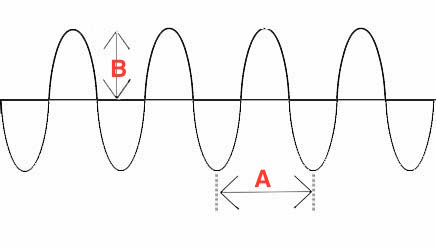
What property of this wave is represented by the letter "A"
a)
amplitude
b)
crest
c)
trough
d)
wavelength
25.
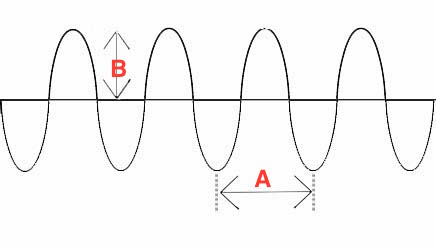
What property of the wave is represented by the letter "B"?
a)
amplitude
b)
crest
c)
trough
d)
wavelength
26.
The highest point on a wave is:
a)
the crest
b)
the trough
c)
the top
d)
the coast
27.
The lowest point on a wave is the:
a)
Amplitude
b)
Crest
c)
Trough
d)
Wavelength
28.
The number of wavelengths that pass a point each per second is:
a)
frequency
b)
period
c)
longitudinal
d)
transverse wave
29.
The type of waves that require medium to pass:
a)
Mechanical Waves
b)
Electromagnetic Waves
30.

Which vocabulary term is used to identify the distance between points C & G?
a)
Amplitude
b)
Crest
c)
Frequency
d)
Wavelength
31.
When the frequency of a wave increases, what happens to the wavelength?
a)
The wavelength is not directly affected by the frequency of a wave.
b)
The wavelength increases.
c)
The wavelength decreases.
d)
More specific information is needed to form a conclusion about the wavelength.
32.
A mechanical wave cannot travel through...
a)
a vacuum(empty space).
b)
water.
c)
air.
d)
glass.
33.
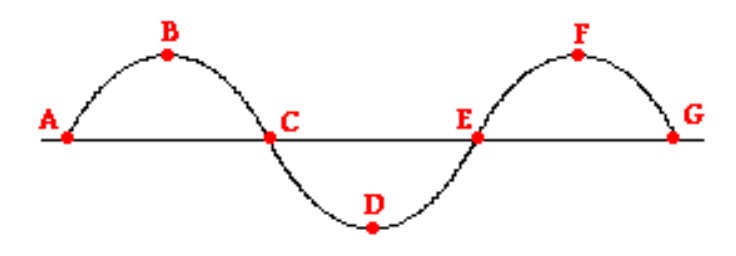
Which letter(s) represent the trough of the wave?
a)
A
b)
B & D
c)
D
d)
C & G
34.
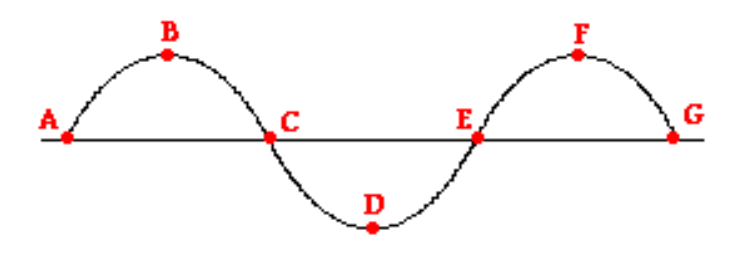
Which letter(s) represent the crest of the wave?
a)
A
b)
B & D
c)
B & F
d)
F
35.
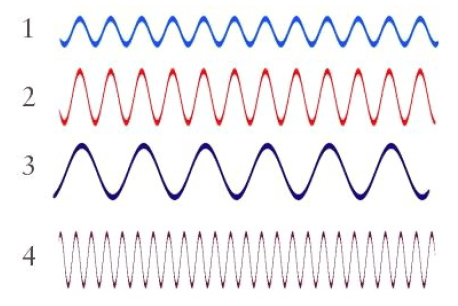
Which wave in the diagram has the greatest frequency?
a)
1
b)
2
c)
3
d)
4
36.
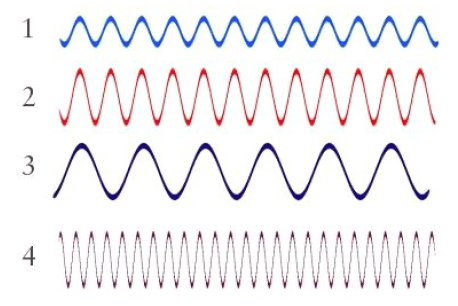
Which wave in the diagram has the greatest wavelength?
a)
1
b)
2
c)
3
d)
4
37.
Which of the following can sound travel through?
a)
solid
b)
liquid
c)
gas
d)
all of the above
38.
crest to crest or trough to trough
a)
crest
b)
trough
c)
amplitude
d)
wavelength
39.
which material does sound travel the fastest?
a)
solid
b)
liquid
c)
gases
40.
When a wave strikes and object and bounces off. (example echo)
a)
medium
b)
refraction
c)
reflection
d)
interference
41.
When a wave bends as it passes through at an angle from one medium to another.(example: pencil in a glass of water-)
a)
medium
b)
refraction
c)
reflection
d)
interference
42.
Energy cannot be created or destroyed in any reaction. This law is known as......
a)
Energy Transfer
b)
Energy Transformation
c)
Conservation of Energy
d)
Gravitational Limits
43.
What two factors determine the amount of potential energy an object has
a)
speed and mass
b)
speed and position
c)
mass and position
d)
temperature and mass
44.
Potential energy that depends on height or position from surface of the Earth is
a)
Gravitational potential energy
b)
Chemical potential energy
c)
Elastic potential energy
d)
Magnetic potential energy
45.
A running refrigerator motor
a)
Kinetic
b)
Potential
46.
A spring in a pinball machine before it is released
a)
Kinetic
b)
Potential
47.
A race-car traveling at its maximum speed
a)
Kinetic
b)
Potential
48.
What two factors affect the strength or force of gravity between two objects
a)
mass and speed
b)
speed and distance
c)
mass and distance
d)
heat and composition
49.
Why is the force of gravity important to the Earth and Moon?
a)
Gravity keeps the Earth in orbit around the Sun and Moon in orbit around the Earth
b)
Gravity keeps the Sun from gaining to much mass
c)
Gravity keeps the Sun in orbit around the Earth and the Earth in orbit around the Moon
d)
Gravity keeps the moon from gaining to much mass
50.
The reason the Moon orbits the Earth, and the Earth orbits the sun (and not the other way around) is:
a)
the Moon has a larger mass than the Earth
b)
the Sun has a smaller mass than the Earth
c)
smaller massed objects in space orbit those with larger masses
d)
the Earth has a longer orbit than the Moon
51.
Predict what would happen to the gravitational pull between the Sun and Earth if the Earth's distance from the Sun increased
a)
the gravitational pull would incre
b)
The gravitational pull would decrease
c)
The gravitational pull would stay the same
52.
You take a trip to a planet that has the exact same mass as Earth, which means your weight
a)
Increases
b)
Decreases
c)
Stays the same
53.
When a tennis ball is dropped to the ground, it does not bounce back to its original height. Why not?
a)
Some of the gravitational PE of the ball has been destroyed during the bounce
b)
Some of the gravitational PE of the ball has been converted to thermal and sound during bounce
c)
Some of the gravitational PE of the ball was converted to elastic PE evident of the compression of the ball
d)
Both B and C are correct
54.
Which is a true statement about elastic potential energy?
a)
Elastic energy is stored in the stretch or compression of the material in which the object is made of.
b)
As elastic energy is released from the object, the object must be able to be restored to its original shape
c)
The more an object is stretched or compressed the more elastic energy is being stored up
d)
all of the above
55.
Which is the following IS NOT an example of energy stored as elastic potential energy?
a)
A stretched rubberband
b)
a bouncing tennis ball
c)
a loose spring
d)
an arrow pulled back in a bow
56.
A baseball hit into the air with a bat. When does the baseball have the greatest elastic potential energy?
a)
one second before it hits the bat
b)
The moment it hits the bat and is compressed
c)
Two seconds after it hits the bat and is in motion
d)
When it reaches its highest point in the air
57.

The picture above shows an aluminum box being pushed into a loading spring. Which of the pictures contains the most elastic potential energy?
a)
Picture 1
b)
Picture 2
c)
Picture 3
d)
Picture 4
58.

The picture below shows an aluminum box hanging from the springs. Which spring length contains the most elastic potential energy?
a)
Length A
b)
Length B
c)
Length C
d)
Length D
59.
There is a car that has a mass of 1300 k/g. The car is currently generating 343,850J of energy. What is the velocity of the car?
a)
23m/s
b)
529m/s
c)
26.99m/s
d)
264.4m/s
60.
An apple has is sitting on a shelve 3m high. The apple has 73.5J of potential energy. What is the mass of the apple?
a)
8.16g
b)
22.48g
c)
.4g
d)
2.5g
61.
You take a trip to the Moon which is much less massive than Earth so your mass
a)
Increases
b)
Decreases
c)
Stays the same
62.
An energy transformation occurs when
a)
one form of energy changes to another form of energy in the same object
b)
the form of energy remains the same type but is moved from one object to another
c)
matter transforms to make energy in nuclear reactions
d)
energy is created or destroyed during a chemical reaction
63.
A truck is traveling at 50 m/s and has a mass of 2010 kg. The truck has kinetic energy. Now calculate it.
a)
62,500J
b)
125,000J
c)
2,512,500J
d)
31,250J
64.
Distance and direction of an object's change in position from a starting point
a)
displacement
b)
distance
c)
motion
d)
reference point
65.
Jermaine runs exactly 2 laps around a 400 meter track. What is the displacement?
a)
800
b)
400
c)
0
d)
200
66.
A change in position or location
a)
Magnetism
b)
Gravity
c)
Position
d)
Movement
67.
How far an object has moved?
a)
displacement
b)
distance
c)
motion
d)
reference point
68.
David walks 3 km north, and then turns east and walks 4 km. What is the distance?
a)
7 km
b)
3 km
c)
4 km
d)
1 km
69.
1. Amy runs 2 miles south, then turns around and runs 3 miles north. What is displacement?
a)
5 miles
b)
1 miles
c)
2 miles
d)
3 miles
70.
Ray runs 30 feet north, 30 feet west, and then 30 feet south. What is the distance?
a)
90 feet
b)
30 feet
c)
60 feet
d)
0 feet
71.
1. Ray runs 30 feet north, 30 feet west, and then 30 feet south. What is the displacement?
a)
30 feet west
b)
90 feet
c)
30 feet south
d)
0 feet
72.
_____ is how fast an object moves in a specific direction.
a)
velocity
b)
speed
c)
displacement
d)
distance
73.
Bill runs 400 meters to Andy's house, turns around, and runs 400 meters back home. What is Bill's distance?
a)
0 meters
b)
400 meters
c)
800 meters
d)
1600 meters
74.
Bill runs 400 meters to Andy's house, turns around, and runs 400 meters back home. What is Bill's displacement?
a)
0 meters
b)
400 meters
c)
800 meters
d)
1600 meters
75.
_____ are measured in units of m/s in Physics.
a)
Speed and velocity
b)
Distance and displacement
c)
Scalars
d)
Vectors
76.

What is the formula to calculate speed?
a)
S = t/d
b)
S = d/t
c)
S = d x t
d)
S = t x d
77.
What is the formula to calculate speed?
a)
S = t/d
b)
S = d/t
c)
S = d x t
d)
S = t x d
78.

What is speed?
a)
how far you go
b)
how much distance is covered over a period of time
c)
how fast you accelerate
d)
the change in the location of a object
79.

A runner races in the 100 meter dash. It takes her 10 seconds to finish. What is her average speed?
a)
10 m/s
b)
1000 m/s
c)
100 seconds
d)
10 seconds
80.

Total distance divided by total time is
a)
average speed
b)
constant speed
c)
instantaneous speed
d)
acceleration
81.

Shona cycles at an average speed of 8km/h. How far has she travelled if she cycles for 4 hours?
a)
55km
b)
32km
c)
43km
d)
32miles
82.

Bob runs from 4:50 pm until 5:20pm at an average speed of 7km/h. How far did he go?
a)
4.5km
b)
2.5km
c)
3.5km
d)
14km
83.

Alan travels 100 km in 5hrs. Find his average speed in km/h
a)
5km/hr
b)
10km/hr
c)
50km/hr
d)
20km/hr
84.

Find speed when distance is 142 km and time is 2 hours.
a)
71km/hr
b)
52km/hr
c)
17km/hr
d)
90km/hr
85.

What does this graph represent?
a)
Constant Speed
b)
Acceleration
c)
Not moving
86.

What is happening at D?
a)
Stationary
b)
Accelerating
c)
Fast steady speed; moving away from the starting position
d)
Slower steady speed; moving away from the starting position
87.

What is happening at E?
a)
Stationary
b)
Accelerating
c)
Fast steady speed; moving away from the starting position
d)
Steady speed; returning to start position
88.

Which runner won the race?
a)
A
b)
B
c)
C
d)
It was a tie
89.

Which runner had a head start?
a)
A
b)
B
c)
C
d)
None of them
90.

According to the graph how far does the person travel in the first 5 seconds?
a)
2 m
b)
10 m
c)
0 m
d)
5 m
91.

What is the person doing from 5 seconds to 10 seconds?
a)
Walking
b)
Running
c)
Standing Still
d)
Walking Fast
92.

What is the average speed of the person during the first 5 seconds?
a)
0 m/s
b)
1 m/s
c)
3 m/s
d)
6 m/s
93.
F=200 N
d=50 m
w=??
d=50 m
w=??
a)
4 J
b)
0.25 J
c)
250 J
d)
10,000 J
94.
A person weighing 600 N gets on an elevator. The elevator lifts the person 6 m in 10 seconds. How much power was used?
a)
360 W
b)
60 W
c)
3600 W
d)
600 W
95.
An engine reaches its top speed from rest in 7.5 s. It is able to perform 250,000 J of work in that time. How much power does this engine have in that time?
a)
0.00003 W
b)
33,333 W
c)
1,875,000 W
d)
1873 W
96.
How much time is needed to produce 720 Joules of work if 90 watts of power is used?
a)
0.125 s
b)
8 s
c)
64800 s
d)
80 s
97.
What is the definition of power?
a)
the amount of work an object does
b)
the rate at which force is applied
c)
the amount of matter in an object
d)
the rate at which work is done
98.
Kyrell pushes a basketball with a force of 32 Newtons. In 4 seconds, he moves the ball 12 meters. How much power did Kyrell demonstrate?
a)
32 Watts
b)
96 Watts
c)
10.67 Watts
d)
1536 Watts
99.
Scott travels north 5 miles and then goes west 3 miles before coming straight back south 2 miles. What is his distance?
a)
10
b)
7
c)
8
d)
6
100.
Which of the following would result in an increase in power?
a)
Decrease the amount of time to do work.
b)
Increase the amount of time to do work.
c)
Decrease the distance moved.
d)
Decrease the amount of work done.
100 %

