wayground logo

Free Printable Worksheets

Font size

S
M
L
XL
Worksheets

APS - Final Exam Practice

Total questions: 100

Worksheet time: 3hrs 50mins

Name
Class
Date
1.

A car driving in a circle at a constant speed of 10 m/s is accelerating. True or False?

a)
True
b)
False
2.
This is a velocity-time graph.  What is the object doing in segment B?
a)
Positive acceleration
b)
Negative acceleration
c)
Constant Velocity
d)
Not moving
3.
Which runner stopped for a rest?
a)
Albert
b)
Bob
c)
Charlie
4.
Which car speeds up before coming to a stop?
a)
1
b)
2
c)
3
d)
4
5.
If a force of 26 N is exerted on two balls, one with a mass of 5 kg and the other with a mass of 8 kg, which ball will have the greater acceleration?  (F=ma)
a)
The one with a mass of 8 kg will have the greatest acceleration.
b)
The one with a mass of 5 kg will have the greatest acceleration.
c)
They will both accelerate at the same rate.
6.
If you exert a net force of 8 N on a 2-kg object, what will its acceleration be?
a)
2 m/s2
b)
4 m/s2
c)
16 m/s2
d)
10 m/s2
7.

The SI unit for force is...

a)

Kilograms

b)

Newtons

c)

Meters per second

d)

Pounds

8.
In order to be ____ forces, their effects must cancel each other out and not cause a change in an object's motion.
a)
balanced
b)
strong
c)
weak
d)
normal
9.
Calculate the net force.
a)
5 N
b)
10 N
c)
45 N
d)
500 N
10.
A 70 kg runner has a velocity of 5 m/s. Her kinetic energy is
a)
875 J
b)
175 J
c)
1750 J
d)
350 J
11.
gravitational potential energy is defined as
a)
the energy an object has due to its height above the ground
b)
the energy an object has due to its motion
c)
the energy a spring has due to its stretch
d)
the chemical energy stored in the molecules of atoms
12.
You drop a 5 kg ball from a height of 2 m. Just before it reaches the ground, what type of energy does it have?
a)
Potential Energy
b)
Kinetic Energy
c)
Nuclear Energy
d)
Chemical Energy
13.
It takes 20 N of force to move a box a distance of 10 m. How much work is done on the box in Joules?
a)
200 J
b)
20.0J
c)
100 J
d)
10 J
14.
A material in which electrons are able to move easily
a)
Circuit
b)
Insulator 
c)
Resistance 
d)
Conductor 
15.
If the current through the battery was 10A in this diagram. What would the current through each bulb be?
a)
10A
b)
5A
c)
20A
d)
0A
16.
If you increase the resistance of a circuit, what happens?
a)
Current decreases
b)
Current increases
c)
Electrons disappear
d)
Bulbs get brighter
17.
The maximum distance that the particles of a wave’s medium vibrate from their rest position
a)
A. frequency
b)
B. wavelength
c)
C. wave speed
d)
D. amplitude
18.
A change in the direction of a wave when the wave finds an obstacle or an edge.
a)
A. refraction
b)
B. reflection
c)
C. standing wave
d)
D. diffraction
19.
The combination of two or more waves that result in a single wave
a)
A. diffraction
b)
B. resonance
c)
C. reflection
d)
D. interference
20.
When the crests of one wave overlap the crests of another wave or waves, this occurs.
a)
A. diffraction
b)
B. destructive interference
c)
C. constructive interference
d)
D. resonant frequencies
21.
A car moved 60 km East and 90 km West. What is the displacement?
a)
30 km West
b)
60 km West
c)
30 km East
d)
150 km
22.
What is the average velocity of a car that moved 60 km in 3 hours?
a)
10 km/h
b)
20 km/h
c)
30 km/h
d)
60 km/h
23.
What is happening at D?
a)
Stationary
b)
Accelerating
c)
Fast steady speed; moving away from the starting position
d)
Slower steady speed; moving away from the starting position
24.
What is happening at A?
a)
Stationary
b)
Accelerating
c)
Slower steady speed; moving away from the starting position
d)
Steady speed; returning to start position
25.
What do we call the  top of a transverse wave?
a)
crest
b)
trough
c)
wavelength
d)
amplitude
26.
a)
A
b)
B
c)
C
d)
D
27.
In red shift, the wavelengths of light become
a)
Bluer
b)
shorter
c)
longer
28.
What star category has the largest stars?
a)
Super giants
b)
White Dwarfs
c)
Giants
d)
Main Sequence
29.
Very hot stars are what color? 
a)
Blue
b)
Yellow
c)
Red
d)
Orange
30.
What is the color of the coolest stars?
a)
blue
b)
Yellow
c)
Red
d)
Orange
31.
All stars fuse hydrogen into heavier elements during the main sequence stage, up to Iron (Fe).
a)
False
b)
True
32.
What is the process that occurs in the core of a star, like the sun, that produces energy?
a)
fission
b)
fusion
c)
decay
d)
convection
33.
What stage of stellar evolution is the sun experiencing at this time?
a)
protostar
b)
main-sequence
c)
giant
d)
white dwarf
34.
What is the sun mostly made out of?
a)
Water
b)
Hydrogen
c)
Helium
d)
ron
35.
What happens during nuclear fusion?
a)
Oxygen is formed
b)
Hydrogen and oxygen join to create water
c)
Hydrogen atoms join to create helium
d)
Solar flares
36.
In the diagram given, what happens as we move to the left?
a)
Stars Get Larger
b)
Stars get Colder
c)
Stars get hotter
37.
The category that contains the most stars is...
a)
Main Sequence
b)
Supergiants
c)
Giants
38.

What is luminosity?

a)

the amount of heat that a star gives off

b)

the color of the star

c)

the amount of energy a star emits

d)

a type of game that you play to build up your brain muscles.

39.

Which stage is this?

a)

Red/Blue Supergiants

b)

Main sequence

c)

White dwarfs

d)

Red Giants

40.

What is this section of stars known as?

a)

Main Sequence

b)

Red Giants

c)

White dwarfs

d)

Blue/Red Supergiants

41.

Which star type is represented by this section of the H-R diagram?

a)

Main Sequence Star

b)

Blue/Red Supergiants

c)

White Dwarfs

d)

Red Dwarfs

42.

Look at the H-R diagram. Which star is

sort of cool, dim (not too much light), and red?

a)

Betelguse

b)

Sirius B

c)

Procyon B

d)

Barnard's star

43.
Solve the problem: Al + O2 --> Al2O3
a)
4Al + 3O2 --> 2Al2O3
b)
2Al + 4O2 --> Al2O3
44.
Solve the problem: Al + S --> Al2S3
a)
Al + 2S --> 2Al2S3
b)
2Al + 3S --> Al2S3
45.
Is the equation balanced?: 2H2O + O2 --> 4MgO + 3Fe
a)
Yes
b)
No
46.
What is a reactant?
a)
The chemical substances that begin the reaction.
b)
What comes from the reaction.
47.
What is a yield?
a)
The arrow in an equation that represents the chemical reaction.
b)
The beginning substances.
48.
Which problem is balanced?
a)
PbO2 + 2H2
b)
So2 + H20 --> H2SO4
c)
2Na + 2H2O --> 2NaOH + H2
49.
What is a coefficient?
a)
The small number on the right of the chemical symbol.
b)
The large number to the left of a formula.
50.
What is a product?
a)

The ending formulas.

b)
The beginning formulas.
51.
In the equation,          2Mg + O2 ---> 2MgO, which are the reactants?
a)
Mg and O
b)
MgO
c)
Mg and MgO
d)
O and MgO
52.
Exothermic reactions...
a)
Absorb energy
b)
Release energy
c)
Release Color
d)
Absorb Color
53.
How many atoms of carbon (C) are in C6H12O6?
a)
3
b)
6
c)
12
d)
24
54.
___________________ are the elements are compounds that leave (are formed in) a chemical
reaction.
a)
Polymers
b)
Bonds
c)
Reactants
d)
Products
55.
Solid magnesium, Mg, reacts with oxygen gas, O2, to form the solid magnesium oxide, MgO. Which equation is a balanced chemical equation for this chemical change? 
a)
2Mg + O2 → 2MgO
b)
Mg + 2O → 2MgO
c)
Mg + O2 → MgO2
d)
Mg + O → MgO
56.
 Which is NOT an example of chemical change?
a)
production of gas.
b)
change in color.
c)
change in size.
d)
transfer of energy.
57.
Chemical reactions that absorb energy are known as ________________________.
a)
Endothermic
b)
Exothermic
c)
Boring
d)
Explosive
58.
3. If the atoms of an object are moving fast, the temperature would be...
a)
High
b)
Low
c)
Unknown
59.
A change in the size, shape, or state of matter.
a)
chemical change
b)
physical change
c)
chemical reaction
d)
electron change
60.
Which of the below elements will most likely form a Covalent Bond? 
a)
K and Cl
b)
H and O
c)
Al and Mg
d)
K and Na
61.
What is the name for LiF?
a)
Lithium Fluoride
b)
Lithium Fluorine
c)
Fluorine Lithide
62.
Name this compound
a)
hydrogen disulfide
b)
dihydrogen sulfate
c)
dihydrogen monosulfide
d)
monohydrogen disulfide
63.
Which of the below elements will most likely form an Ionic Bond
a)
P and O
b)
Cs and O
c)
Li and Mg
d)
Ne and Cl
64.
What elements make an ionic bond?
a)
metal and nonmetal
b)
2 or more nonmetals
c)
metal
d)
none of the above
65.
What elements generally make a covalent bond?
a)
metal and nonmetal
b)
2 or more nonmetals
c)
metal
d)
none of the above
66.
The proper formula for magnesium Chloride
a)
MgCl
b)
Mg2Cl
c)
MgCl2
d)
Mg2Cl2
67.

Name the molecular compound CO

a)

carbon monoxide

b)

monocarbon monoxide

c)

carbide

d)

oxygen carbide

68.
K20 - name?
a)
potassium dioxide
b)
potassium oxide
c)
potassium oxygen
d)
dipotassium dioxide
69.

What is the formula for diphosphorus pentoxide?

a)

P2O5

b)

PO5

c)

P5O2

d)

Po2O5

70.
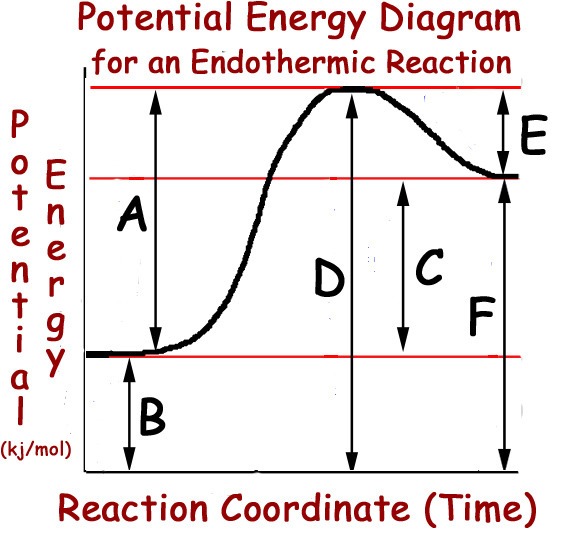
What kind of reaction is this?
a)
Endothermic
b)
Exothermic
c)
Cannot be determined
71.
Is this reaction endothermic or exothermic?
a)
endothermic 
b)
exothermic
72.
Which letter corresponds to the activation energy of the forward reaction?
a)
A
b)
B
c)
C
d)
D
73.
During a phase change, what happens to the temperature?
a)
Increases
b)
Stays the same
c)
Decreases
d)
Could increase or decrease
74.
A measure of the average kinetic energy of the individual particles in an object is called
a)
thermal energy
b)
conduction
c)
convection
d)
temperature
75.
When ice is in the process of melting in a glass of lemonade, the ice is undergoing a change in
a)
Potential energy
b)
Kinetic energy
76.

During a phase change, the __________ of the molecules changes.

a)

KE

b)

PE

c)

temperature

d)

PE and temperature

77.

During a temperature change, the __________ of the molecules changes.

a)

KE

b)

PE

c)

physical state

d)

KE and phase

78.
a)

constant speed

b)

increasing speed

c)

decreasing speed

d)

no speed

79.

Which of the following dot diagrams shows an object that is accelerating

a)

A

b)

B

c)

Neither object is accelerating

d)

You can not tell from the dot diagram

80.

What is the weight of a 20 kg object on Earth?

a)

20 N

b)

10 N

c)

100 N

d)

200 N

81.

If an object weighs 50 N on Earth, then it's mass is

a)

50 kg

b)

500 kg

c)

5 kg

d)

5 g

82.
If the children are each 50 N, what must be the tension of one of the ropes?
a)
100N
b)
50 N
c)
100 lbs
d)
50 lbs
83.

An object slides with a constant velocity. This means that the force of friction must be ______________ applied force that is keeping the object in motion.

a)

greater than

b)

less than

c)

equal to

84.
You drop a 5 kg ball from a height of 2 m. Just before it reaches the ground, what type of energy does it have?
a)
Potential Energy
b)
Kinetic Energy
c)
Nuclear Energy
d)
Chemical Energy
85.

Where is potential energy at its maximum?

a)

a

b)

b

c)

c

d)

d

86.

Where is kinetic energy at its maximum?

a)

a

b)

b

c)

c

d)

d

87.
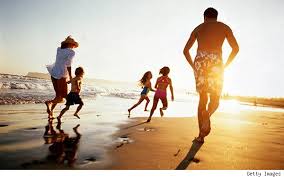
The sun shines down on this family as the play on the beach.
a)
conduction
b)
convection
c)
radiation
88.
What is the definition of CONDUCTION?
a)
When heat is transferred from objects like rays of light or electromagnetically.
b)
a  hot liquid or air that  expands, becomes less dense, and rises or becomes more dense, and sinks.
c)
When heat transfers from objects that are touching.
d)
When heat transfers through the heater or AC in your house.
89.
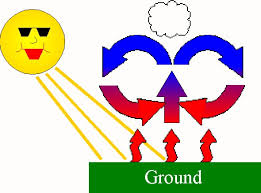
Warm air rises and the cool air sinks demonstrates this type of heat transfer. 
a)
conduction
b)
convection
c)
radiation
d)
Insolation 
90.
Warm air is __________ dense than cold air and rises creating convection currents.
a)
more
b)
less
91.
Two reactions occur that do not obey the Law of Conservation of Mass. The first reaction involves light elements forming heavier ones. The second reaction has heavy elements forming lighter ones. Which statement describes these reactions?
a)
Both reactions may be nuclear fusion
b)
Both reactions may be nuclear fission
c)
The first reaction is nuclear fusion, and the second is nuclear fission
d)
The first reaction is nuclear fission, and the second is nuclear fusion
92.
The half life of iodine-131 is 8.040 days. What percentage of an iodine-131 sample will remain after 40.20 days?
a)
312.5%
b)
31.25%
c)
.3125%
d)
3.125%
93.
Has a mass of 4 and a charge of +2
a)
Alpha
b)
Beta
c)
Gamma
94.
Which type of nuclear radiation is being emitted here?
a)
Alpha
b)
beta
c)
gamma 
d)
none
95.
Which type of nuclear radiation is being emitted here?
a)
alpha
b)
beta
c)
gamma
d)
none
96.
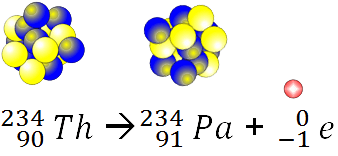
What particle completes this reaction?
a)
alpha particle
b)
beta particle
c)
gamma particle
d)
neutron
97.
Frank has an eraser. It has a mass of 4g, and a volume of 2cm3. What is its density?
a)
8 g/cm3
b)
2 g/cm3
c)
1/2 g/cm3
d)
24 g/cm3
98.
Jack has a rock. The rock has a mass of 14g and a volume of 2cm3. What is the density of the rock?
a)
7 mL
b)
7 g/cm3
c)
28 g/cm3
d)
1/7 g/cm3
99.
What is the volume of Object X?
a)
10.0 cm3
b)
15.0 cm3
c)
20.0 cm3
d)
25.0 cm3
100.
Helium balloons rise on earth because
a)
helium is less dense than air
b)
helium is more dense than air
c)
helium is cooler than air
d)
helium is warmer than air