wayground logo

Free Printable Worksheets

Font size

S
M
L
XL
Worksheets

Second Year Science Summer Assessment

Total questions: 100

Worksheet time: 57mins

Name
Class
Date
1.
The diagram shows the female reproductive system. The part labelled B is called  
a)
sperm 
b)
the egg  
c)
the womb  
d)
the ovary 
2.
In the diagram representing the menstrual cycle shown, when does ovulation take place?
a)
between day 6 and 11
b)
between day 17 and 20
c)
between day 1 and 5
d)
between day 12 and 16
3.
The diagram shows the female reproductive system. The part labelled A is called
a)
 the egg
b)
the womb
c)
the ovary
d)
sperm
4.
Where in their female reproductive system is fertilisation most likely to take place?
a)
fallopian tube
b)
uterus
c)
vagina
d)
 cervix
5.
This usually occurs between days 6 and 12 of the menstrual cycle.
a)
Shedding of the lining of the uterus
b)
An egg is released from the ovaries
c)
The lining of the uterus remains in place in preparation for the possible arrival of an early embryo.
d)
 The lining of the uterus builds up
6.
The diagram shows the female reproductive system during the fertile period of the menstrual cycle. Select what happens in the ovary during this time?
a)
 Implantation occurs.
b)
An egg is released.
c)
A sperm fuses (joins) with an egg.
d)
Fertilisation takes place.
7.
The period during which a girl sexually matures is called
a)
menstrual cycle
b)
puberty
c)
childhood
d)
teens
8.
The diagram shows the female reproductive system during the fertile period of the menstrual cycle. Select what happens to the lining of the uterus during this time?
a)
It breaks down.
b)
The uterus releases an egg.
c)
It gets bigger.
d)
Sperm become implanted in the uterus.
9.
After fertilisation the zygote increases in size and travels down the Fallopian tube to become embedded in the walls of the womb. This process is known as
a)
implantation
b)
ovulation
c)
menstruation
d)
conception
10.

Another name for the neck of the uterus is the

a)

Womb

b)

Vagina

c)

Urethra

d)

Cervix

11.
That fusion of the male and female gamete to form a zygote is known as ? 
a)
fertilisation
b)
menstruation
c)
pollination
d)
 ejaculation
12.
This occurs on days 1 to 5 of the menstrual cycle.
a)
The lining of the uterus remains in place in preparation for the possible arrival of an early embryo.
b)
Shedding of the lining of the uterus
c)
An egg is released from the ovaries
d)
The lining of the uterus builds up
13.
Which subatomic particle has a positive (+) charge?
a)
Neutron
b)
Proton
c)
Electron
14.
Which subatomic particle has a negative (-) charge?
a)
Proton
b)
Electron
c)
Neutron
15.
Which two subatomic particles make up the nucleus of an atom?
a)
Protons and Electrons
b)
Neutrons and Electrons
c)
Electrons and Protons
d)
Protons and Neutrons
16.
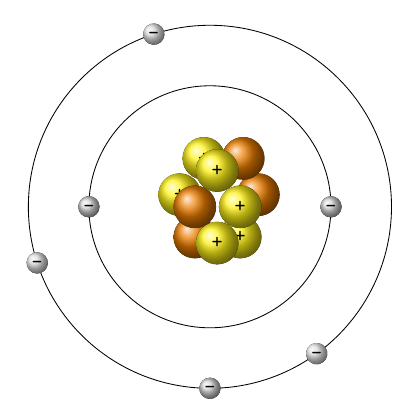
The subatomic particles in green are...
a)
Protons
b)
Neutrons
c)
Electrons
17.
How many electron shells/levels does this atom have?
a)
1
b)
2
c)
3
d)
4
18.
How many protons does this atom have?
a)
3
b)
6
c)
4
d)
2
19.
How many electrons does this picture show?
a)
4
b)
5
c)
6
d)
3
20.
What is shadowed, or hidden, during a lunar eclipse?
a)
Sun
b)
Moon
c)
Earth
d)
Pluto
21.
What is shadowed, or hidden, during a solar eclipse?
a)
Sun
b)
Moon
c)
Earth
d)
Jupiter
22.
During a lunar eclipse, what celestial object is casting a shadow?
a)
Sun
b)
Earth
c)
Moon
d)
Mercury
23.
The darkest part of a shadow is called the ________.
a)
umbra
b)
penumbra
c)
eclipse
d)
dark-dark
24.
Why do we not experience eclipses every month?
a)
You have to be in the right spot
b)
The Moon's orbit is tilted
c)
Moon is smaller than the Sun
d)
Earth's orbit is tilted
25.
What is at the center of the Solar System?
a)
Earth
b)
Moon
c)
Sun
d)
Jupiter
26.
It takes the Earth _______ days to travel all the way around the Sun.
a)
28
b)
100
c)
24
d)
365
27.
It takes the Earth ___ hours to complete a rotation.
a)
12
b)
24
c)
50
d)
365
28.
What is the phase of this moon?
a)
Third Quarter
b)
Waning Crescent
c)
First Quarter
d)
Waning Gibbous
29.
When the moon appears to be "getting smaller", we call this _______________.
a)
Waxing
b)
Waning
c)
Shrinking
d)
Disappearing
30.
At position A, which hemisphere would have summer?
a)
Northern hemisphere
b)
Southern hemisphere
31.
Which type of eclipse is shown in this picture?
a)
Solar Eclipse
b)
Orbit
c)
Lunar Eclipse
d)
Total Eclipse
32.
What moon phase would you see a full moon?
a)
1
b)
3
c)
5
d)
7
33.
What causes day and night on Earth?
a)
the tilt of Earth's axis
b)
Earth's revolution around the sun
c)
the moon
d)
Earth's rotation
34.
Why does Earth have seasons?
a)
because sometimes the Earth is closer to the sun and farther away from the sun
b)
because the temperature of the sun changes
c)
because Earth's axis is tilted
d)
because of Earth's rotation and revolution
35.
How many days does one cycle of lunar phases take?
a)
29.5
b)
365
c)
28-31
d)
7
36.
The universe is expanding!  This means that:
a)
all of the galaxies are spreading out.
b)
the universe must have started from a single point.
c)
the universe is cooling down.
d)
all of the above.
37.
Our theory of the universe was confirmed by the discovery of:
a)
fusion.
b)
cosmic microwave background radiation.
c)
the Andromeda galaxy.
d)
the Doppler effect.
38.
The universe is ____________ years old.
a)
8.13 billion
b)
13.8 billion
c)
1.83 billion
d)
381 million
39.
The Big Bang:
a)
is NOT an explosion in space.
b)
is an expansion OF space.
c)
is our best explanation for the beginning of the universe.
d)
All of the above.
40.
The universe is expanding.  This means that:
a)
Galaxies are getting bigger.
b)
Atoms are getting bigger.
c)
The universe is creating more matter.
d)
The amount of space between galaxies is increasing.
41.
What is an object that does not conduct electricity?
a)
Conductor
b)
Insulator
c)
Circuit
d)
Resistance
42.
Current is the ...
a)
pressure of electricity 
b)
flow of electrons from atom to atom
c)
tendency of a material to resist the flow of electricity.
d)
total power
43.
What is one thing every circuit needs?
a)
insulator
b)
flashlight
c)
power source
d)
switch
44.
Which best describes a parallel circuit?
a)
Electricity flows along one pathway.
b)
The flow of electricity comes from one source. 
c)
Electricity flows along more than one pathway. 
d)
The flow of electricity comes from more than one source. 
45.
Which best describes a series circuit? 
a)
It has two light bulbs. 
b)
The same current flows through both light bulbs. 
c)
It uses a single battery.
d)
The current is divided between the light bulbs. 
46.
What is one problem with using a series circuit? 
a)
It has a lot of series. 
b)
If one goes down, they all go down! 
c)
It doesn't work properly.
d)
There are no problems. 
47.
What is one benefits of using a parallel circuit?  
a)
It gets confusing.
b)
There are no problems.
c)
If one goes down, it does not affect the others. 
d)
Porque es para llelio. 
48.
what is this symbol for?
a)
light bulb
b)
switch
c)
battery
d)
resistor
49.
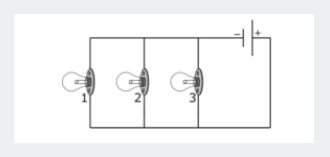
If bulb 1 burns out, what will occur?
a)
bulbs 2 and 3 will go out
b)
bulbs 2 and 3 receive more volts
c)
bulbs 2 and 3 will stay lit
d)
nothing will happen
50.
What will happen if one light bulb is removed from this circuit?
a)
the other bulbs will go out
b)
the other bulbs will get dimmer
c)
the other bulbs will get brighter
d)
the battery will become stronger
51.
What kind of circuit is this?
a)
Series
b)
Consecutive
c)
Parallel
d)
Training
52.
What is velocity?
a)
the quickness of an object
b)
the location of an object
c)
acceleration
d)
speed in a specific direction
53.
How far will a person go if they jog for 2 hours at a speed of 12 km/hr?
a)
6 km
b)
0.5 km
c)
10 km
d)
24 km
54.
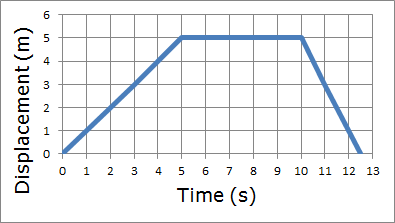
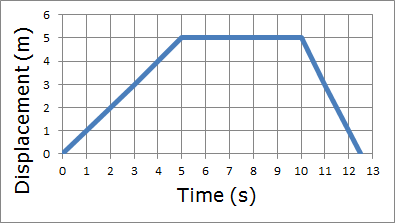
What is the person doing from 5 seconds to 10 seconds?
a)
Walking 
b)
Running
c)
Standing Still 
d)
Walking Fast
55.
According to the graph how far does the person travel in the first 5 seconds?
a)
2 m
b)
10 m
c)
0 m
d)
5 m
56.
Which of the following is the correct equation to solve for time?
a)
T = D/S
b)
T = S/D
c)
T = S x D
d)
T = D x S
57.
Which of the following is a unit for acceleration?
a)
km/s
b)
m/s2
c)
mi/hr
d)
ft
58.
Calculate the average speed (in meter/sec) if a cheetah runs 180 meters in 10 seconds.
a)
198 m/sec
b)
170 m/sec
c)
12 m/sec
d)
18 m/sec
59.
A roller coasters accelerates from an initial velocity of 6.0 m/s to a final velocity of 70 m/s over 4 seconds.  What's the acceleration?
a)
24 m/s2
b)
18 m/s2
c)
16 m/s2
d)
16 m/s
60.
The graph represents
a)
no motion
b)
constant velocity
c)
acceleration
d)
negative acceleration
61.
What is the definition of "weight"?
a)
the force in which gravity pulls on an object
b)
the time it takes to get on a ride 
c)
the amount of matter in an object
d)
the size of an object
62.
what is the weight of 500 g pack of sugar?
a)
5 N
b)
50 N
c)
0.5 N
d)
5000 N
63.
Given the weight is mass x 10, what is the weight of 50 kg person?
a)
60 N
b)
500 N
c)
5 N
d)
40 N
64.
what would happen to the force of gravity on you if you decreased in mass?
a)
the force of gravity would increase
b)
the force of gravity would decrease
c)
the force of gravity would remain the same
d)
your mass does not influence gravity
65.
which of the following tools would you use to measure mass?
a)
spring scale
b)
electronic balance
c)
meter stick
d)
seismograph
66.
Weight is measured in what units?
a)
newtons or pounds
b)
grams or kilograms
c)
milliters
d)
centimeters
67.
What is a PUSH or PULL of an object?
a)
Motion
b)
Force
c)
Friction
d)
Gravity
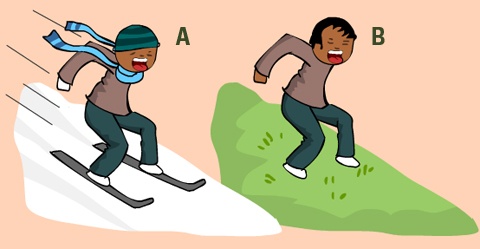
68.
Why is it harder for the boy in Image B to get down the hill?
a)
Motion
b)
Friction
c)
Work
d)
Displacement
69.
What is the standard unit force is measured in?
a)
Newtons
b)
pounds
c)
grams
d)
meters
70.
Force depends on
a)
Force
b)
mass
c)
acceleration
d)
mass and acceleration 
71.
8 N to the left , and 4 N to the right. Find the net force. Is this balanced?
a)
12 N Right;  No
b)
4 N Left;  No
c)
12 N Right;  Yes
d)
4 N Left;  Yes
72.
Which force produces a change in motion?
a)
unbalanced force
b)
balanced force
c)
gravitational force
d)
frictional force
73.

What is organized DNA?

a)

Nucleus

b)

Chromosomes

c)

Gene

d)

Centromeres

74.

What are small stretches of DNA that code for traits?

a)

Nucleus

b)

Chromosomes

c)

Gene

d)

Centromeres

75.
Where is all the genetic information in a cell?
a)
Nucleus
b)
Nucleotides
c)
Chromosomes
d)
Cytoplasm
76.
Which of the following traits is not inherited?
a)
Fur color
b)
Feathers
c)
Hair color
d)
A suntan
77.
Bobby has curly dark hair, blue eyes, and a small mouth.  What are his acquired traits?
a)
curly hair
b)
blue eyes
c)
mouth
d)
plays the drums
78.
How many chromosomes do you get from each parent?
a)
22
b)
23
c)
44
d)
46
79.
The passing of traits from parent to offspring 
a)
Heredity 
b)
Genetics 
c)
Hybrid 
d)
Probability 
80.
What is one advantage of sexual reproduction?
a)
offspring are identical to parents
b)
offspring are resistant to viruses
c)
offspring are born live, rather thna from eggs
d)
offspring inherit a wider variety of genetic information
81.

Number of chromosomes in a human body cell

a)

23

b)

44

c)

46

d)

2

82.
If you are a boy, what percent of your genes did you get from your dad?
a)
25%
b)
50%
c)
75%
d)
100%
83.
What shape is DNA?
a)
Double Helix
b)
Double Trouble
c)
Double Bubble
d)
Double Spiral
84.
Genes come in ______
a)
Pairs 
b)
Trios
c)
Singles
d)
Family Size
85.

Resistance in measured in

a)

Amps

b)

Volts

c)

Ohms

d)

Quarks

86.

Current in measured using a

a)

voltmeter

b)

ammeter

c)

ohmmeter

d)

charger

87.

What force is required to give a car of mass 1000 kg an acceleration of 2 m/s2?

a)

500 N

b)

2000 N

c)

998 N

d)

1000N

88.

Asexual reproduction

a)

involves two parents and the offspring are genetically identical

b)

involves one parent and there is variation in the offspring

c)

involves two parents and there is variation in the offspring

d)

involves one parent and the offspring are genetically identical

89.

Our solar system was formed ________ years after the formation of the universe

a)

9 billion

b)

9 million

c)

9 thousand

d)

90 million

90.

A zygote is formed as a result of

a)

Implantation

b)

Fertilisation

c)

Puberty

d)

Menstruation

91.

Which part of the male reproductive system produces sperm?

a)

The scrotum

b)

The prostate

c)

The testicles

d)

The penis

92.

The diagram shows the male reproductive system. The part labelled c is the

a)

Urethra

b)

Testicles

c)

Penis

d)

Scrotum

93.

The diagram shows the male reproductive system. The part labelled a is the

a)

Urethra

b)

Testicle

c)

Scrotum

d)

Seminal vesicle

94.

Implantation is

a)

The attachment of the embryo to the womb wall

b)

The zygote dividing many times

c)

The fusion of the male and female gamete

d)

The release of an egg from the ovary

95.

What does IVF stand for?

a)

In vitro fertilisation

b)

Insert viable foetus

c)

Internal variable fertilisation

d)

Internal vitro fertilisation

96.

Which of the parents could have fertility problems?

a)

It has to be both of them

b)

It could be either of them

c)

It must be the mother

d)

It must be the father

97.

Fertility problems can arise as a result of

a)

Low sperm count

b)

Absence of ovulation

c)

Sperm deformation

d)

All of the above

98.

The tissue which passes substances from the mother’s blood to the baby’s blood is called the

a)

placenta

b)

umbilical cord

c)

amniotic fluid

d)

afterbirth

99.

The correct order of the 3 stages of birth is

a)

Removal of Placenta, Labour, Birth

b)

Labour, Birth, Removal of Placenta

c)

Birth, Labour, Removal of Placenta

d)

Labour, Removal of Placenta, Birth

100.

An advantage of breastfeeding is

a)

Breast milk has extra nutrients and antibodies in the first few days

b)

Breast milk gives the baby the right balance nutrients

c)

Breast milk passes immunity from mother to baby

d)

All of the above