
 Worksheets
Grade 7 dynamic Earth Quarter 5
Total questions: 95
Worksheet time: 49mins
The presence of the same __________ on several continents supports the hypothesis of continental drift.
fossils
rocks
both fossils and rocks
neither fossils nor rocks
A lack of explanation for continental drift prevented many scientists from accepting that a single supercontinent called ________ once existed.
Glomar
Glossopteris
Pangaea
Wegener
Matching ____________ on different continents are evidence for continental drift.
river systems
rock structures
weather patterns
wind systems
Wegener believed that the continents were assembles as part of a supercontinent about ________ years ago.
250 million
350 million
450 million
550 million
The _____________ hypothesis suggested that continents are in constant motion on the surface of Earth.
continental drift
continental shelf
Pangaea
Gondwana

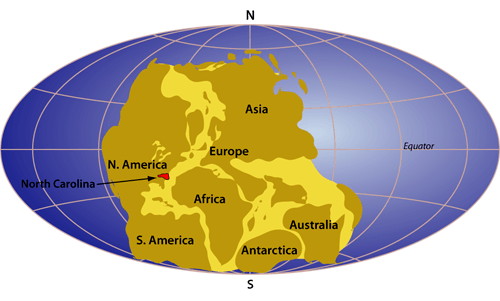
This is a picture of ___________.
Pangaea
Laurasia
Gondwana
Eurasia
Alfred Wegener named his single supercontinent ____________, which means "all Earth" in ancient Greek.
Pandora
Gandowandaland
Pangaea
Percia
The remains or traces of ancient life are called ____________.
bones
remanents
fossils
none of the above

What is one piece of evidence supporting Continental Drift
Volcanoes are erupting all the time.
Tsunamis are created by volcanoes.
The continents fit together like puzzle pieces.
Erosion created the Grand Canyon.
What is a second piece of evidence supporting Continental Drift?
Alfred Wegener was a great thinker and scientist.
Fossils of the Mesosaurus are found on different continents separated by the Atlantic Ocean.
Oceans move earth around.
The wind blows the continents around.
The presence of the same _____ on several continents supports the hypothesis of continental drift.
Fossils
Rocks
Weather
Erosion
Scientists at the time rejected Wegener’s hypothesis of continental drift because he could not explain?
How or why Earth’s continents move.
How animals could be located on other continents
Where Glaciers were
How plant fossils were located around the world
What did Wegener find on several continents that supported his theory of continental drift?
Rocks
Fossils
Both rocks and fossils
Neither
The coastline of South America matches the coastline of
Africa
Asia
Australia
Greenland
Why did scientists reject Wegener's hypothesis?
He could not explain how continents moved
He was German
He could not explain his evidence sufficiently
Simply because they didn't like him
What was the name of Wegener's supercontinent?
Pangaea
Gondwana
Wegener
Mesossaurus
Different continents had matching _______ which provided evidence for continental drift.
river systems
rock structures
weather patterns
wind systems
Which of the following is not a piece of evidence Wegener used to support his theory of continental drift?
Climate
Rocks & Mountains
Fossils
Human remains
How do rocks provide evidence that continents move?
The same rocks are found on two continents that were once joined together.
The rocks were in the same climate.
Certain rocks cannot exist in certain places
Rocks do not provide evidence
How does glacial features and coal deposits support the theory of continental drift?
They do not support the theory
These features cannot exist in their present location
Coal forms in cold places
Glaciers exist near the equator
How can fossils provide evidence that continents move?
Similar fossils found on continents that are now separated by vast oceans suggests that the continents were once joined together
Fossils do not providence evidence
Fossils of plants have been found only on continents that are joined
Fossils of animals have been found only on continents that are joined


What causes the continents to move?
Meteors
Plate tectonics
Ocean waves
Earth's rotation
Most scientists did not believe Alfred Wegener's hypothesis about drifting land masses. Why?
He did not give enough evidence.
They thought his time table was off.
They did not like Alfred.
He could not explain how the land masses moved.
Choose all the evidence Wegener used to support his Continental Drift Hypothesis.
human remains
fossils
mountain ranges
climate evidence
the age of the Earth
Which two continents have the most obvious fit which supports the continental drift theory?
Europe
Africa
Asia
South America
A deep, steep-sided canyon in the ocean floor
trench
seamount
guyot
abyssal plain
the natural and artificial features existing on the ocean floor
seamount
continental shelf
sonar
ocean floor topography
sound waves to detect and determine the location, size, and relative motion of underwater objects
ocean floor topography
sonar
seamount
continental slope
an underwater mountain chain where new ocean floor is formed
mid-ocean ridge
seamount
guyot
abyssal plain
The Mariana __________ is the deepest known place on Earth
Volcanoe
Seamount
Ridge
Trench
In sea-floor spreading, molten material rises from the mantle and erupts
in deep-ocean trenches
along the edges of all the continents
along mid-ocean ridges
at the north and south plate
The process by which the ocean floor sinks beneath an deep-ocean trench and back into the mantle is known as
continental drift
subduction
conduction
convection
The process of ___________ continually adds new crust to the ocean floor along both sides of the mid-ocean ridge.
plate tectonics
seafloor spreading
continental drift
convection

What kind of plate boundary is shown on the picture?
divergent
convergent
transform
trench
The scientist credited with sea-floor spreading is _________
Alfred Wegener, a German scientist
Harry Hess, an American geologist
J.Tuzo Wilson, a Canadian scientist
Kenn Bulaso, a Filipino educator
What 3 kinds of evidence were used to prove that the seafloor spread?
Rock formations, age of rocks, WWII shipwrecks
Age of rocks, magnetic seafloor stripes, WWII ship logs
Rock formations, magnetic seafloor stripes, age of rocks
Process by which new ocean crust forms.
Seafloor spreading
Continental drift
Mid-ocean ridge
Rift
The youngest rocks on the ocean floor are located ____
near continents
at mid ocean ridges
far from mid-ocean ridges
near Asia
What TWO words are the best used to describe how the seafloor spreads
Magma and conveyor belt
Earthquakes and the conveyor belt
Volcanoes and earthquake
Volcanoes and the conveyor belt
What is the rate at which tectonic plates are moving?
Between 1-9mm per year
Between 1-9cm per year
Between 1-9km per year
Between 1-9inches per year
Which of the following best explains the age of oceanic crust and ocean-floor features?
continental drift
crystallization
seafloor spreading
convection
______ is the study of the forms and features of land surfaces.
Tomography
Topography
Geology
None of the above

An ____ is an imaginary line on a map that shows points that have the same age
isochron
isochrome
isomer
isotope
The theory of _____________. explains how new crust is created at mid-ocean ridges.
continental drift
plate tectonics
ocean trenches
seafloor spreading
The theory of_____ states that Earth’s surface is made of rigid slabs of rock, or plates, that move with respect to each other.
Plate tectonics
continental drift
ocean trenches
seafloor spreading
the parts which join up to form the crust are called
plates
tectonics
lithospheres
when 2 plates come close together
divergent boundary
convergent boundary
transform boundary
when 2 plates move apart
convergent boundary
divergent boundary
transform boundary
when 2 plates slip past each other
convergent boundary
divergent boundary
transform boundary
movement of the plates results from
gravity
heat inside earth
mantle convection current
all of the above
subduction occurs as a result of
convergent boundary
divergent boundary
transform boundary
volcanic eruption is a result of
convergent boundary
divergent boundary
transform boundary
rift valley in Africa is a result of
convergent boundary
divergent boundary
transform boundary
The Andes mountains resulted from
convergent boundary
divergent boundary
transform boundary


A sudden shaking of Earth's surface?
Tsunami
Volcano
Earthquake
A mesosaurus walking by
One of the very large sections of hard, solid rock making up Earth's outer layer?
Mantle
Pattern
Inner core
Plate
The place where to plates meet?
Pattern
Plate Boundary
Mantle
Earthquake
Layer of soft, solid rock underneath Earth's surface?
Mantle
Inner core
Crust
Outer core
A large ground-shaking event vertically displaces water sending a very energized wave toward shore?
Volcano
Earthquake
Tsunami
A mesosaurus splashing into the water
The pieces that make up Earth's surface?
Jigsaw puzzle
Pattern
Plate boundary
Tectonic Plates
Occurs when plates crash into or pull away from each other and hot magma from below rises up to the surface in an eruption?
Earthquake
Tsunami
Volcano
Liquid inner core explodes
Occurs when plate boundaries get stuck together, but the plates themselves keep moving?
Earthquakes
Volcano
Tsunami
Tectonic Plates

Which of these boundaries is responsible for creating volcanic arcs?
Continental - Continental Convergence
Oceanic - Continental Convergence
Mid Ocean Ridges
Oceanic - Oceanic Convergence

A boundary that doesn't create or destroy crust is called a:
Transform Boundary
Convergent Boundary
Divergent Boundary
Rift Valley
The bending of rock layers due to stress.
Folding
Anticline
Syncline
A break in the Earth's crust.
Fault
Folding
Folded mountains are formed by ?
Compression
Faults
Mountains that are made of layers of rocks that are folded are....
Uplifted Mountains
Fault-block mountain
Folded Mountain
Plateau

Parallel ridges that form where blocks of crust move up o down along faults.
Uplifted Mountain
Volcanic Mountain
Fault-block Mountain
None of the above
As molten rock and ash erupt onto the Earth´s surface, it hardens. Over time, many eruptions can build huge ________
Volcanic Mountains
Fault-block mountains
Uplifted Mountains
Plateau

