
 Worksheets
TEST: 7th Grade Science 1st Term Review
Total questions: 100
Worksheet time: 1hrs 10mins
Which gas is the most common in our air?
Nitrogen
Hydrogen
Helium
Oxygen
Does high air pressure systems SINK or RISE in the atmosphere?
Sink
Rise
Do LOW air pressure systems SINK or RISE in the atmosphere?
Sink
Rise
Low pressure will usually bring what kind of weather?
clear and dry
cloudy and wet
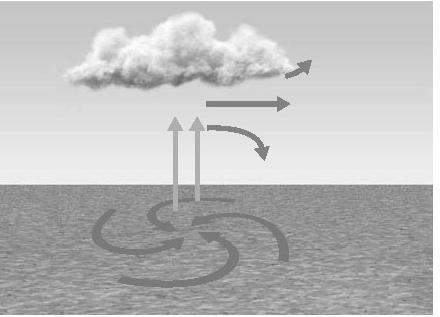
Which type of pressure system is pictured?
high
low
warm
cold
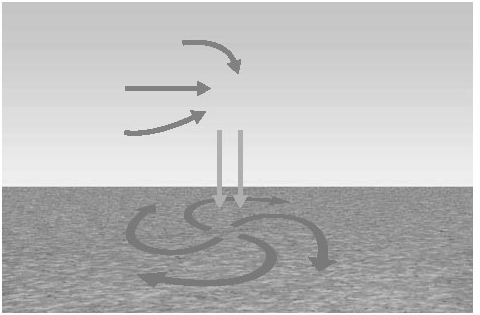
Which type of pressure system is pictured?
high
low
warm
cold

Wind in the Northern hemisphere deflects to the ______________ because of the Coriolis Effect.
right
left
east
west
The Coriolis Effect is caused by
Earth revolving around the sun
Earth rotating on its axis
Differences in surface temperature
Differences is air pressure
Flow of air from land to a body of water is called:
doldrum
chinook
sea breeze
land breeze


These winds occur at a latitude between 0 and 30 degrees.
Trade winds
Westerlies
Easterlies
These winds occur at a latitude between 30 and 60 degrees.
Trade winds
Westerlies
Easterlies
These winds occur at a latitude between 60 and 90 degrees.
Trade winds
Westerlies
Easterlies

Surface currents are mainly formed by and driven by the ______.
Winds
Ocean water is more dense than fresh water at the same temperature due to differences in _________.
Deep Ocean currents are primarily caused by ________.
temperature and salinity
wind
gravity
precipitation

The warm, strong current off the coast of Florida is the ____________.
Gulf Stream
Current

When surface currents meet continents they ___?
Stop moving
Are deflected (change paths)
Continue in the direction they were going

Salt water is ____________ fresh water.
more dense than
less dense than
the same density as

Why is it warmer in Charleston than it is in San Diego even though they are the same distance from the Equator?

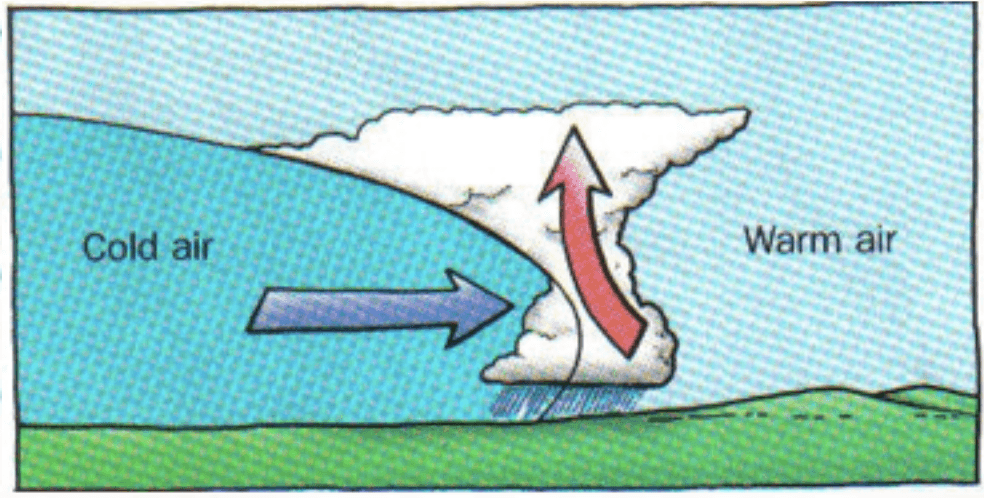
Name that front.
Cold Front
Warm Front
Stationary Front
Occluded Front
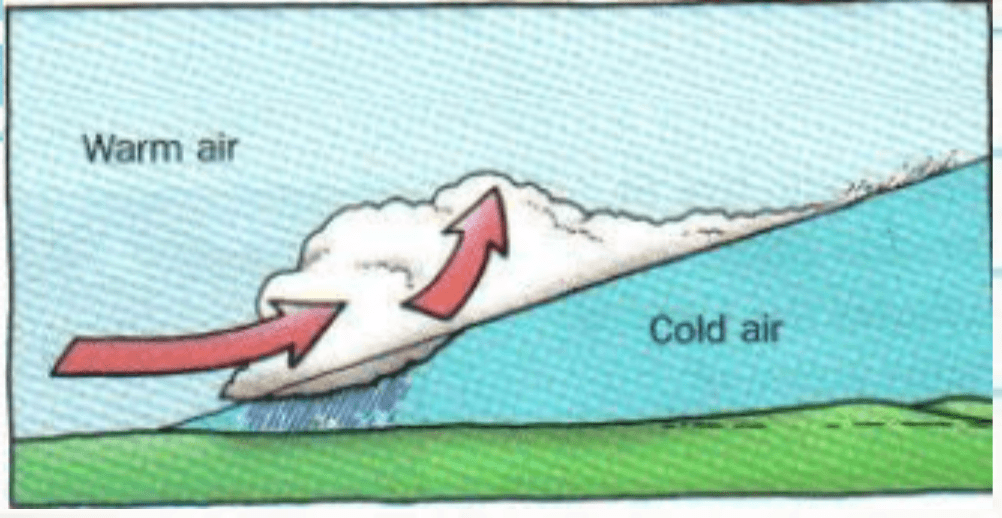
Name that front.
Cold Front
Warm Front
Stationary Front
Occluded Front
What type of weather will you see along a cold front?
Thunderstorms
Sunny skies
Gentle rain
No weather
What kind of weather happens along a Warm Front?
Thunderstroms
Days of Rain!
Nothing
Wind

How does elevation affect the climate of an area?
As elevation increases, air temperature increases.
As elevation increases, air temperature decreases.
As elevation increases, precipitation increases.
As elevation increases, precipitation decreases.

How do ocean currents affect the climate of an area? Choose all that apply.
Cold ocean currents have a cooling effect on nearby land.
Cold ocean currents have a warming effect on nearby land.
Warm ocean currents make nearby land warmer.
Warm ocean currents make nearby land colder.

Distance from a large body of water does not affect the climate of an area.
True
False

Prevailing winds in the United States go from ____ to ______.
east to west
north to south
west to east
south to north
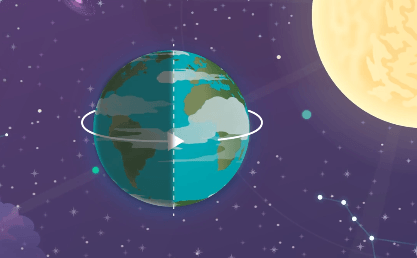
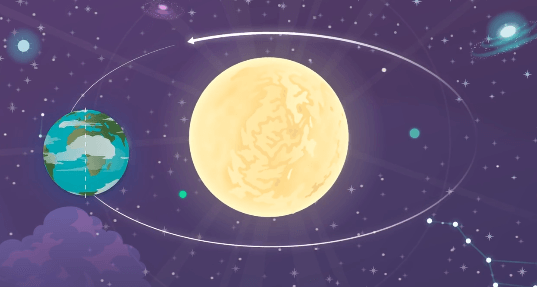


Water vapor leaves a plant in the biosphere and goes into the atmosphere through
transpiration
respiration
precipitation
evaporation
____ happens when liquid turns into a gas on Earth's surface
evaporation
condensation
respiration
transpiration
As a part of the water cycle, water from Earth's surface enters the clouds and finally falls back to the ground in the form of rain. What is the correct sequence of processes water undergoes?
Evaporation, Condensation, Precipitation
Precipitation, Condensation, Evaporation
Condensation, Evaporation, Precipitation
Evaporation, Precipitation, Condensation
Condensation occurs when water vapor_____________.
heats up and becomes liquid water
cools off and becomes liquid water
freezes and becomes ice
rains on the land
What type of organism “fixes” the nitrogen for use by plants?
Humans
Plants
Bacteria
Aliens
Plants absorb ________________________ and release oxygen
Carbon dioxide
Carbon monoxide
Vitamin X
Oxygen
Ammonification...
animals eat the plants and other animals that contain nitrogen and release it through their waste
Bacteria in the soil and lightning in the atmosphere “fix” the nitrogen
Once in the ground, bacteria in the soil also nitrify the nitrogen
plants absorb nitrogen through their roots and return it back to the atmosphere
Organisms that need nitrogen to survive.
only plants
only animals
only bacteria
all living things
How do animals get the nitrogen they need?
From the air they breathe
From the water they drink
From the food they eat
From the sun
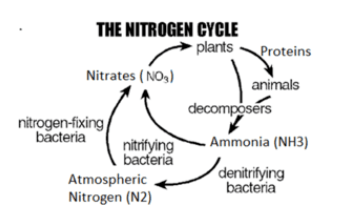
According to this diagram, plants use nitrogen to make _________________________
bacteria
animals
proteins
decomposers
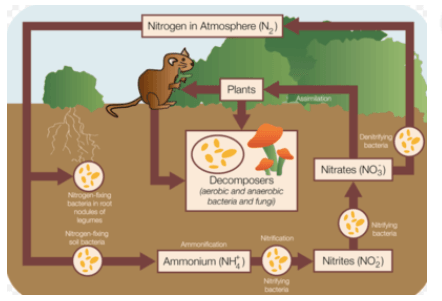
A correct path that nitrogen could take would be
air -> animals -> plants -> bacteria
animals -> air -> bacteria -> plants
bacteria -> air -> plants -> animals
air -> bacteria -> plants -> animals
The process that allows organisms to use nitrogen
assimilation
denitrification
fixation
ammonification
When did climate change (CO2 in the atmosphere) increase significantly?
1800s Industrial Revolution
1600s Industrial Revolution
1800 Crusades
1600 Crusades
What are examples of renewable energy sources?
Solar
Wind
Coal
Gas
What are examples of non-renewable energy sources?
Geothermal
Coal
Oil
Hydro
What types of data have scientists collected related to climate change?
Measuring Earth’s current temperature and CO2
Examining ice/glacier melting
Taking educated guesses
The ice caps are getting bigger/growing
What are some potential consequences of climate change?
The sea levels will rise putting seaside towns and cities at risk of drowning
The sea levels will drop putting seaside towns and cities at risk of drowning
More extreme weather
Animals will be able to adapt to the changes
What are some possible solutions to climate change
Use less energy
Choose renewable energy sources
Plant trees and other plants
Recycle and reuse items
What is the definition of renewable energy sources?
sources of energy that will never go away or be used up
Sources of energy that can go away and be used up
Wind, Solar, Hydro, Geothermal
Coal, Oil, Gas
What is the definition of non-renewable energy sources?
sources of energy that will never go away or be used up
Sources of energy that can go away and be used up
Wind, Solar, Hydro, Geothermal
Coal, Oil, Gas

The graph shows changes in carbon dioxide
(CO2) concentrations and surface temperatures
on Earth from the years 1880 to 2000.
Why do carbon dioxide concentrations and
surface temperatures show the relationship seen
in the graph?
because lower carbon dioxide levels mean more
heat is retained in Earth's atmosphere
because higher carbon dioxide levels mean
more heat is retained in Earth's atmosphere
because lower carbon dioxide levels mean less
heat is retained in Earth's atmosphere
because higher carbon dioxide levels mean less
heat is retained in Earth's atmosphere
The formation of a solid when two liquids combine is called?
Solidification
Freezing
Precipitate
Solubility
The difference between a Physical change and a Chemical change is…
Physical change is only a change to the outside appearance.
Chemical change is when matter is changed into something new.
Atoms are rearranged in chemical changes & not in physical.
All are correct.
Which type of change is most often easily reversed?
Chemical
Physical
Both a physical and chemical change.
Neither a physical or chemical change.

Identify what type of change happening in the picture below...
Chemical Change
Physical Change
Endothermic Reaction
Exothermic Reaction

Identify what type of change happening in the picture below...
Chemical Change
Physical Change
Endothermic Reaction
Exothermic Reaction

Identify what type of change happening in the picture below...
Chemical Reaction
Physical Change
Change in State
Change in appearance only
Which of the following is an example of a physical change?
A glass falling and shattering on the floor.
Baking a birthday cake.
Burning a piece of paper.
Baking soda and vinegar mixing together.
Which is not a clue that could indicate a chemical change has occurred?
Change in color
Change in shape
Release of energy
Formation of an odor
Choose which one is a physical property
Flammability
Solubility
Water Reaction
Magic
Choose the 3 that are physical properties of aluminum foil
Malleable
Luster
Oxidation
High melting point
Which of these statements best describes a chemical property of a substance?
It reacts with an acid to form water
The object has a blue color
The substance has a powdery texture
It has a density of 2.11 g/cm3
Choose whether the following is a physical or chemical property: Malleability
Physical
Chemical
Choose whether the following is a physical or chemical property: Non-flammable
Physical
Chemical
Which option best describes the difference between a physical and chemical property?
There is no difference between a physical and chemical properties?
Physical properties are usually room temperature but chemical properties are very hot
Observing a chemical property results in the creation of a new substance while observing a physical change does not change the substance
The difference between physical and chemical properties are the states of matter
Four substances were tested for pH, lemon juice (pH 2), baking soda (pH 9), bleach (pH 12), and milk (pH 6). Which of the following correctly lists the substances from most basic to acidic?
lemon juice, milk, baking soda, bleach
bleach, baking soda, milk, lemon juice
milk, lemon juice, baking soda, bleach
baking soda, bleach, lemon juice, milk
Which of these is a property of acidic solutions?
they taste sour
they feel slippery
they are in many cleaning products
they taste bitter

The table shows the pH of several solutions. Which solution is the most acidic?
vinegar
milk
water
bleach
Bases are generally ............................ to touch
Hot
Cold
Soapy
Rough
The Substance which turns Blue litmus red is ......................
Basic
Acidic
Neutral
All of these

