wayground logo

Free Printable Worksheets

Font size

S
M
L
XL
Worksheets

Unit 15 Review - Optics and Color

Total questions: 101

Worksheet time: 2hrs 43mins

Name
Class
Date
1.
If you had a Yellow light with a Magenta filter, what color light would you have after the filter.
a)
Red
b)
Blue 
c)
Green
d)
Cyan
2.
A red bird appears red because it REFLECTS what color
a)
Magenta
b)
Red
c)
Cyan
d)
Doesn't reflect any light
3.
This is an example of...
a)
Reflection
b)
Refraction
c)
Polarization
d)
Spectrum
4.
A convex lens is a __________ device.
a)
Convergent
b)
Divergent
c)
Reflective
d)
None of the above
5.
A Concave lens is a __________ device.
a)
Convergent
b)
Divergent
c)
Reflective
d)
None of the above
6.
A Convex mirror is a __________ device.
a)
Convergent
b)
Divergent
c)
Polarizing
d)
None of the above
7.
A Concave mirror is a __________ device.
a)
Convergent
b)
Divergent
c)
Polarizing
d)
None of the above
8.
_____ is a lens that is thicker in the middle.
a)
Convex
b)
Concave
9.
_____ is a lens that is thinner in the middle..
a)
Convex
b)
Concave
10.

During warm days, it is best to wear what color of clothing?

a)

dark blue

b)

red

c)

violet

d)

white

11.

During warm days, why is it wise to wear white?

a)

It absorbs less heat.

b)

It absorbs more heat.

c)

It absorbs more color.

d)

It absorbs more light.

12.

Why does the color black absorb most heat? All of the answers are correct EXCEPT __________.

a)

It is the absence of all colors.

b)

It is the absence of all colors.

c)

It is the presence of all colors.

d)

It is the presence of all colors.

13.

We see a leaf green because all the other colors of light are absorbed. What color is reflected by the leaf?

a)

blue

b)

green

c)

orange

d)

all of the choices

14.
If a candle is placed at 2f in front of a converging lens, the image
a)
will appear at f on the opposite side of the lens
b)
the image will appear at 2f on the opposite side of the lens
c)
the image will appear between f and 2f on the opposite side of the lens
d)
the image will not appear
15.
Concave mirrors will produce...
a)
Real, erect images
b)
Virtual, inverted images
c)
Real, inverted images
d)
no images form
16.
Which type of lens is shown?
a)
Concave
b)
Convex
c)
Reflective
d)
Refracting
17.
A pencil appearing to bend when it is immersed in a glass of water is an example of...
a)
Reflection
b)
Rarefaction
c)
Refraction
d)
Reconstruction
18.

When light passes from one medium to a denser medium _________.

a)

it is bent towards the normal.

b)

it always lies along the normal.

c)

it is unaffected.

d)

it is bent away from the normal.

19.

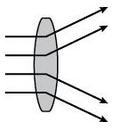
Which lens represents the path light takes through a diverging lens?

a)
b)
c)
d)
20.

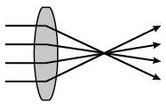
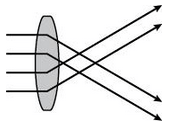
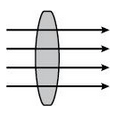
Which figure represents the path light takes through a converging lens?
a)
b)
c)
d)
21.

Which optical device bends light inward?

a)

convex lens

b)

concave lens

c)

plane mirror

d)

convex mirror

22.
True
a)
Cone cells detect light and dark
b)
Rods focus light
c)
Cones detect color
d)
Rods detect color
23.

Which statement is true?

a)

Rods detect light.

b)

Rods detect colour.

c)

Rods are the material which colours the eye.

d)

All of the above

24.
Convex mirrors produce
a)
only virtual images
b)
virtual or real images
c)
only real images
d)
inverted images
25.
When a wave bounces off of a surface, it is
a)
reflecting
b)
refracting
c)
diffracting
d)
all of the above
26.
A plane mirror gives you a 
a)
real image
b)
virtual image
c)
magnified image
d)
inverted image
27.
Where might you find a concave mirror?
a)
car headlights
b)
the corner of a convenience store
c)
inside a microscope
d)
in your eyeball
28.
Where might you find a convex mirror?
a)
car headlights
b)
the corner of a convenience store
c)
inside a microscope
d)
in your eyeball
29.

Where might you find a concave lens?

a)

car headlights

b)

the corner of a convenience store

c)

the peephole in your front door

d)

in your eyeball

30.
Where might you find a convex lens?
a)
car headlights
b)
the corner of a convenience store
c)
inside a microscope
d)
in your eyeball
31.

Images that come from the converging of light waves are

a)

real

b)

virtual

c)

imaginary

d)

magnified

32.
The part of the eye that is covered with rods and cones is the
a)
cornea
b)
iris
c)
vitreous humour
d)
retina
33.
These cells sense color.
a)
rods
b)
cones
c)
irises
d)
humours
34.
These cells sense brightness.
a)
rods
b)
cones
c)
epithelial
d)
humours
35.

The primary colors of pigment in printing are

a)

red, green, indigo

b)

red, green, blue

c)

black, white, yellow

d)

magenta, cyan, yellow

36.

The primary colors of light are

a)

red, green, indigo

b)

red, green, blue

c)

black, white, yellow

d)

magenta, cyan, yellow

37.

Mixing all the primary colors of light in equal amounts results in _________ light.

a)

Black

b)

White

c)

Yellow

d)

Indigo

38.

Mixing all the primary colors of pigment in equal amounts results in _________ pigment.

a)

Black

b)

White

c)

Yellow

d)

Indigo

39.

The job of a lens is

a)

reflection.

b)

refraction.

c)

diffraction.

d)

to tell the number of proton in an atom.

40.

The image in a plane mirror is always ________________

a)

virtual, upright and reduced

b)

virtual, laterally inverted and same size as the object

c)

virtual, vertically inverted and same size as the object

d)

virtual, upright and enlarged

41.

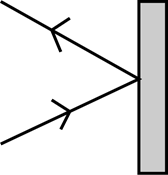
Which point is the angle of incidence ?

a)

A

b)

B

c)

C

d)

D

e)

E

42.

Which is the reflected ray?

a)

A

b)

B

c)

C

d)

D

e)

E

43.

What type of image is created in this picture?

a)

inverted, real

b)

upright, real

c)

inverted, virtual

d)

upright, virtual

44.

What type of image in created in this picture?

a)

inverted, real

b)

inverted, virtual

c)

upright, real

d)

upright, virtual

45.

the image will appear...

a)

magnified

b)

nowhere,because the rays do not meet at a point

c)

virtual

d)

upright

e)

all of the above

46.

The angle of incidence is always the same number as the...

a)

total reflection

b)

half the sum

c)

angle of reflection

d)

the mirrors edge

47.
The Law of Reflection:
The angle of incidence is _________ the angle of reflection
a)
bigger than
b)
the same as
c)
smaller than
48.
Luminous means...
a)
Gives out its own light
b)
Reflects light from other things
49.
If light strikes a mirror at a 50⁰ angle, what angle will it come off of the mirror?
a)
50⁰
b)
70⁰
c)
45⁰
d)
30⁰
50.
Which color absorbs all light?
a)
White
b)
Black
c)
Orange
d)
Green
51.

What type of reflection is shown in the image?

a)

Regular reflection

b)

Diffuse reflection

c)

Total internal reflection

52.

________________ is an imaginary line perpendicular to the surface

a)

Normal line

b)

Incident line

c)

Reflected line

53.
a real image...
a)
is produced by virtual rays and can be projected on a screen
b)
is produced by real rays and cannot be projected on a screen
c)
is produced by virtual images and cannot be projected on a screen
d)
is produced by real rays and can be projected on a screen
54.
A light ray hits a plane surface at 20 degrees. What is the angle between the incident and reflected rays. 
a)
20o
b)
40o
c)
70o
d)
30o
55.
This is an example of a _____________ mirror
a)
Concave
b)
Convex
c)
Plane
d)
Magnifying
56.
What does the word "converging" mean?
a)
to separate
b)
to come together
c)
parallel 
d)
perpendicular
57.
Light has the lowest velocity in which medium?
flint glass n=1.70
barium glass n=1.60
crown glass n=1.523
water n=1.33
diamond n=2.45
a)
diamond
b)
water
c)
flint glass
d)
barium glass
58.
If the angle of incidence of light traveling through air, and then striking water is 30 degrees what is the angle of refraction? (n=1 air, n=1.33 water)
a)
15 degrees
b)
22 degrees
c)
43 degrees
d)
17 degrees
59.
What is the index of refraction of a refractive liquid if the angle of incidence in the air is 35 degrees and the angle of refraction is 14 degrees?
a)
1.33
b)
2.21
c)
2.37
d)
1.72
60.
Glass has a _____________ index of refraction than air.
a)
Equal
b)
Greater
c)
Less
d)
Impossible to say
61.
How does light behave as it enters these mediums?
a)
continue its path as straight line.
b)
bends toward the normal
c)
bends away from the normal
d)
reflects
62.

What happens to light during total internal reflection?

a)

The angle of incidence is greater than the critical angle.

b)

The angle of reflection is the same as the critical angle.

c)

The angle of refraction is less than the critical angle.

d)

The angle of incidence is zero.

63.

Fiber optic cables work because of the principle of _____.

a)

total internal refraction

b)

incomplete internal refraction

c)

total internal reflection

d)

partial internal reflection

64.

When angle of incident (i) equals to critical angle (c) if light is traveled from a denser medium to a less dense medium,

a)

total internal reflection occurs.

b)

angle of refraction is equal to 90 degree.

c)

light is refracted out

d)

light travel in straight line

65.
When light moves from a slower medium to a faster medium at an angle, what is the effect?
a)
The wave is super abnormal
b)
The wave turns away from the normal
c)
The wave turns towards the normal
d)
The wave turns towards the normal
66.
This image is...
a)
Inverted and smaller
b)
inverted and bigger
c)
not inverted and smaller
d)
not inverted and bigger
67.
The illustration shows a light ray striking an object.
In the illustration, the light ray striking the object is-
a)
absorbed
b)
stopped
c)
reflected
d)
refracted
68.
Refraction is the bending of a wave disturbance as it passes from one _________ into another.
a)
glass
b)
medium
c)
area
d)
boundary
69.

a convex lens does what to rays

a)

diverges

b)

converges

c)

implodes

d)

merges

70.

a convex mirror does what to rays

a)

diverges

b)

converges

c)

implodes

d)

merges

71.
The ray of light that strikes a reflecting surface is called ________.
a)
incident ray
b)
reflected ray
c)
normal ray
d)
none of the above
72.
The angle produced as a source of light bounces off a reflecting surface is called ______.
a)
angle of crookedness
b)
angle of reflection
c)
angle of incidence
d)
angle of bounce
73.

Law of reflection states that - The angle of incidence is .................. to the angle of reflection.

a)

equal

b)

double

c)

half

74.
If you had a Yellow light with a Magenta filter, what color light would you have after the filter.
a)
Red
b)
Blue 
c)
Green
d)
Cyan
75.
An image that forms where light seems to come from a point but light rays don't actually meet is a 
a)
virtual image
b)
real image
c)
Inverted Image
d)
Pizza
76.
Convex Mirrors produce...
a)
only virtual images
b)
virtual or real images
c)
only real images
d)
inverted images
77.

A light ray strikes the mirror such that the angle of incidence is 30 degrees. What is the angle between the incident ray and reflected ray?

a)

b)

15°

c)

30°

d)

60°

78.
The point in the middle way between a curved mirror and the center of curvature is the
a)
principle point
b)
focal point
c)
center of curvature
d)
principle axis
79.
Concave lenses, like the ones found in the peepholes of a door, always produce images that are .....
a)
Virtual, upright, smaller
b)
Real, inverted, larger
c)
Real, inverted, smaller
d)
Virtual, upright, larger
80.
Speed of light in a vacuum is
a)
represented by the symbol "c"
b)
3.00 X10⁸ m/s 
c)
both answers are correct
81.
What is the difference between reflection and refraction? 
a)
Both involve light bending through a medium
b)
Reflection is light bouncing off a medium's surface and refraction is light bending through a medium
c)
Reflection is light bending through a medium's surface and refraction is light bouncing off a medium
d)
Refraction is light being absorbed in a medium and reflection is light being bent through a different medium
82.

How does light behave when hitting this shirt?

a)

Yellow is absorbed; all other colors are reflected.

b)

Yellow is reflected; all other colors are absorbed.

c)

All colors are absorbed, but yellow is refracted.

d)

Yellow is scattered and all other colors are absorbed.

83.

How will this object appear when looking at it through a blue filter?

a)

Blue

b)

Green

c)

Black

d)

Orange

84.

Which color(s) does this filter transmit?

a)

No colors are transmitted.

b)

All colors but green

c)

Only green

85.

Which color will transmit through the filter?

a)

Red only

b)

Blue and Violet

c)

Green

d)

All colors

86.

Why won't the red filter allow the other colors to transmit?

a)

Because they reflect off of the filter.

b)

Because only red can transmit through a red filter.

c)

Because red has the longest wavelength.

87.

Which colors make up white light?

a)

Red, Orange, and Yellow

b)

All colors

c)

Reds and Violets

88.

If an object appears black when looking through a green filter, what color would it have to be?

a)

Green

b)

White

c)

red

89.

How would a tomato look under blue light?

a)

The tomato would seem to disappear

b)

The tomato would still appear red

c)

The tomato would appear black

d)

The tomato would appear white

90.
Absorb or Reflect all colors?
a)
Absorb
b)
Reflect
91.

If a green shirt is in a room with only red lights on, will it still look green?

a)

yes, the shirt will appear green

b)

no, the shirt will appear red

c)

no, the shirt will appear black

d)

no, it will look like nothing is there

92.
What are the three secondary colors of light?
a)
Red, Green, Blue
b)
Green, Yellow, Blue
c)
Cyan, Magenta, Yellow
d)
Magenta, Yellow, Black
93.

What will you get if you mix (light)...

a)

White

b)

Cyan

c)

Magenta

d)

Yellow

e)

Black

94.

What will you get if you mix (light)...

a)

White

b)

Cyan

c)

Magenta

d)

Yellow

e)

Black

95.

What will you get if you mix (light)...

a)

White

b)

Cyan

c)

Magenta

d)

Yellow

e)

Black

96.

What will you get if you mix...cyan and Yellow light

a)

White

b)

Blue

c)

Magenta

d)

Red

e)

Black

97.

Additive colors are made of

a)

light

b)

pigment or paint

c)

nothing

98.

Subtractive colors are made of

a)

light

b)

pigment or paint

c)

nothing

99.

Mark the primary colors for additives.

a)

Cyan

b)

Red

c)

Green

d)

Blue

100.

Mark the primary colors for subtractives.

a)

Cyan

b)

Yellow

c)

Green

d)

Magenta

101.

The SECONDARY COLORS of the Subtractive Color Process are:

a)

RGB

b)

CYM

c)

Black

d)

White