
 Worksheets
Physical Science Sem 1 Review
Total questions: 100
Worksheet time: 34mins

The ability to do work or cause change is called ________?
force
work
energy
power




Can energy be destroyed?
no
yes
Which of the following is the correct equation for calculating an object's gravitational potential energy?
PE = mgh
PE = mg / h
PE = mg + h
PE = gh
What is the gravitational potential energy (GPE) of a 1 kilogram book that is 1 meter above the ground?
g = 9.8 m/s2
9.8 Joules
1.0 Joule
0.10 Joule
11.8 m/s2
True or False: The equation for Kinetic energy is KE=1⁄2mv2
True
False
Which object shows an energy transformation from electrical to mechanical?



When you drop a basketball it does not bounce back all the way. This is because some of the mechanical energy is 'lost' when it transforms into which of the following ?
Sound
Chemical
Radiant
Hamster


Observe the diagram. Which statement is true about the kinetic energy of the molecules in the containers?
The molecules are moving faster in Diagram A
The molecules are moving slower in Diagram A
The molecules are moving at the same rate in both diagrams
Phase change going from Liquid to Solid...
Melting
Freezing
Condensation
Sublimation
Phase change going from a Gas to a Liquid...
Sublimation
Deposition
Ionization
Condensation
Phase change going from a Liquid to a Gas...
Vaporization
Deposition
Condensation
Melting
Phase change going from a Solid to a Liquid...
Freezing
Condensation
Melting
Sublimation
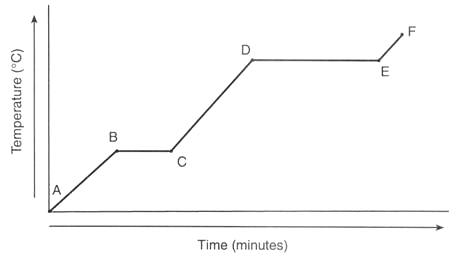
What state/phase is the object likely from points A to B?
Solid
Liquid
Gas
Plasma

Where on the graph are phase changes taking place?
1
2
3
4
5

What do all waves transfer?
Matter
Heat
Electricity
Energy

Which of the following can waves transfer energy through?
solid
liquid
gas
empty space
all of the above

What are the two types of waves?
longitudinal and transverse
sound and light

What is the number of complete waves passing a fixed point in a given amount of time?
Amplitude
Intensity
Wavelength
Frequency

What does #1 represent?
Period
Frequency
Wavelength
Amplitude

What does #2 represent?
Period
Frequency
Wavelength
Amplitude
Review: What is it called when a wave bounces off an object?
Reflection
Refraction
Diffraction

What type of interference is being shown in the picture?
Constructive
Destructive

What type of interference is occurring in the picture?
Constructive
Destructive
What is the Doppler Effect?
A change in frequency due to the relative motion of a wave source and an observer
When a wave overlaps with another wave
When a wave bounces off of another object
When a wave bends due to traveling through a different medium
An ambulance is driving towards you as you stand on the sidewalk. What happens to the pitch of the siren as it comes towards you?
It increases
It decreases
You are standing on the side of the road when a police car races past you with its siren on. After the police car passes you, what happens to the pitch of the siren?
It increases
It decreases
It turns red
Which of the following best explains an electric current?
An electric current is the flow of positive charges in a circuit.
An electric current is the flow of atoms in a circuit.
An electric current is the flow of electrons in a circuit.
An electric current is the flow of neutrons in a circuit.


What is a circuit that only has ONE path for electricity to flow?
series circuit
closed circuit
parallel circuit
light bulb

DC stands for __________ current.
deviating
default
diverging
direct
Magnetism is a force of ____________________________ that occurs between two _____________ objects.
attraction or repulsion, magnetic
external or internal, magnetic
external or repulsion, electronic
attraction or internal, electronic
A permanent magnet is a material that produces a ___________________ field without any ___________________ magnetic field being present.
electronic, internal
magnetic, internal
magnetic, external
electronic, external
Every magnet has both a _________ pole and a __________ pole.
North, South
East, West
Positive, Negative
Positive, South
Certain materials respond to magnetic fields by becoming ______________ themselves. ____________ is one of these materials.
magnetic, Plastic
electronic, Iron
magnetic, Iron
electronic, Plastic
Some objects that normally aren't magnetic can become magnetized when connected to a circuit. Items that are magnetized in this way are called ________.
electromagnets
electrons
electrochromic devices
permanent magnets

The magnetic ____________ around a bar magnet is shown above.
legs
flowers
field
direction
What do we call a device that converts electricity into mechanical movement?
electric charge
electric motor
electric current
electric plasma
What do you call a device that converts mechanical movement into electricity?
electric field
electric motor
electric generator
electric plasma
When will the forces of gravity between two objects be the GREATEST?
when the masses of both objects are small and the objects are far apart
when the masses of both objects are large and the objects are close together
when the masses of both objects are small and the objects are close together
when the masses of both objects are large and the objects are far apart
Which statement about gravity is true?
gravity causes objects to pull towards one another
gravity causes objects to push away from each other
gravity only takes place between planets
the moon doesn't have any gravity
the rate at which speed or velocity changes
acceleration
average speed
motion
reference point

Is this a speed or acceleration graph?
speed
acceleration

What is happening at segment B?
no motion/object at rest
constant speed
acceleration
speed of an object in a particular direction
motion
velocity
speed
acceleration
total distance traveled divided by total time taken to travel that distance
velocity
motion
acceleration
average speed


Which runner stopped for a rest?
Albert
Bob
Charlie
None of them stopped


What is Newton's 2nd Law?
Every action has an equal and opposite reaction
An object at rest stays at rest, an object in motion stays in motion.
F = ma
Friction
A 25 kg bike accelerates at 10 m/s2. What was the force?
250 N
2.5 N
25 N
15 N
Friction is a
non - contact force
contact force
electrostatic force
magnetic force
The factors on which friction depends
nature of the surfaces
how hard the objects are pressed together
both (a) and (b)
none of these
Friction can be increased by making the surface
rough
smooth
does not depend on the nature of surface
none of these
Which of the following statements is true?
Friction pulls objects towards the centre of the earth
Friction primarily affects the objects that contain iron
Friction slows down or stops objects in motion
Friction does not affect objects in motion

________________ is done whenever a force moves an object a distance.
Load
Friction
Force
Work
How can simple machines make work easier?
by decreasing the force needed to complete the task
by increasing the friction between the machine and the object
by adding more work on the object than originally applied
by removing the force of gravity on the object
Simple machines can make work easier by reducing the input force needed to move an object. However, there is a trade off for decreased input. What is the trade off?
The distance the object is moved is increased.
The distance the object is moved is decreased.
The amount of work is increased.
The amount of work is decreased.
Which of the following is NOT one of the things a machine can do?
Changes the amount of force required.
Changes the distance over which the force is exerted.
Changes the direction of the force.
Changes the amount of work done.
What is the formula needed to solve for work?
w = f/d
w = f*d
w = f+d
If you push a cart with a force of 60 N for 2 m, how much work have you done?
120 J
30 J
120 N
30 N
Two people shove on a wall with 100 N of force. The wall does not move. How much work have they done?
100J
100N
0J
0N

