
 Worksheets
Sun, Earth, Moon Review
Total questions: 100
Worksheet time: 3hrs 45mins
Name
Class
Date
1.

When the Northern Hemisphere of Earth is Leaning away from the Sun, What season is the Southern Hemisphere experiencing?
a)
Summer
b)
Winter
c)
Spring
d)
Fall
2.

What season is it in the Northern Hemisphere at letter A?
a)
Winter
b)
Summer
c)
Spring
d)
Fall
3.

In the summer many people enjoy going to the beach. There is a beautiful beach in Argentina, which is located in the Southern Hemisphere. Which diagram shows the position of Earth when it is summer in Argentina?
a)
A
b)
B
c)
C
d)
D
4.

Spinning of the Earth on its axis is called...
a)
rotation
b)
revolution
c)
orbit
5.
What phase of the moon does a solar eclipse occur?
a)
New moon
b)
1st quarter
c)
Full moon
d)
3rd quarter
6.
What moon phases do spring tides occur?
a)
new and full
b)
1st & 3rd quarters
7.
How many days does it take for the moon to complete a full cycle?
a)
27
b)
29.5
c)
28
d)
20
8.
A[n] ___________ tide occurs when the sun, Earth, and the moon are nearly in a line.
a)
spring
b)
high
c)
low
d)
neap
9.

Name this phase of the moon.
a)
waning crescent
b)
waxing crescent
c)
waning gibbous
d)
waxing gibbous
10.

Name this moon phase.
a)
waxing crescent
b)
waxing gibbous
c)
waning gibbous
d)
waning crescent
11.
How often do tides occur in a day?
a)
two high tides and two low tides occur in a day
b)
1 high tide and 1 low tide occur in a day
c)
2 tides occur in a day
d)
the number of tides which occur in a day is never the same
12.
It takes the Earth _______ days to travel all the way around the Sun.
a)
28
b)
100
c)
24
d)
365
13.
When the Earth spins around its own axis one whole time, it is called a ....
a)
Year
b)
Day
c)
Hemisphere
d)
Seasons
14.
The Earth's _______ is an imaginary line that goes from the North Pole to the South Pole.
a)
vernal equinox
b)
axis
c)
solar eclipse
d)
solar flare
15.
Extra high tide caused by the alignment of the sun and the moon
a)
high tide
b)
low tide
c)
neap tide
d)
spring tide
16.
What keeps the Earth in the Solar system?
a)
string
b)
gravity
c)
moon
d)
other planets
17.
When the moon passes between the Earth and Sun, blocking the sunlight.
a)
lunar eclipse
b)
waning moon
c)
solar eclipse
d)
waxing moon
18.
When the moon passes into the Earth's shadow.
a)
solar eclipse
b)
lunar eclipse
c)
waxing moon
d)
waning moon
19.
What is the biggest cause of ocean tides?
a)
sun's gravity
b)
Earth's gravity
c)
moon's gravity
d)
people swimming
20.

a)
waxing gibbous
b)
full moon
c)
new moon
d)
waning gibbous
21.

Which moon is this
a)
First Quarter
b)
Waxing gibbous
c)
Waning gibbous
d)
Third Quarter
22.

4. Look at the diagram. What event does the picture show?
a)
full moon
b)
solar eclipse
c)
lunar eclipse
d)
quarter moon
23.
The phase of the moon that looks like the letter "C" is called a _______.
a)
new moon
b)
half moon
c)
crescent moon
d)
full moon
24.
When the Earth spins on its axis this causes ___________________
a)
all four seasons to happen.
b)
day and night to happen.
c)
the moon to go through phases.
d)
high tides and low tides.
25.

Neap Tide : _____ :: Spring Tide : _____
a)
X and Z; W and Y
b)
X and W; Y and Z
c)
W and Y; X and Z
d)
Y and Z; X and W
26.

Which of the following moon phases would be present during a neap tide?
a)
full moon
b)
gibbous
c)
quarter
d)
new moon
27.

Which of the following is MOST accurately portrayed in the model?
a)
The ratio of the size of the Sun & the Earth
b)
The ratio of the size of the Moon and the Sun
c)
The movement of the Earth around the Sun
d)
The movement of the Moon around the Earth
28.

Between which two points in the diagram above would a WAXING GIBBOUS phase of the moon be visible on Earth?
a)
Between W & X
b)
Between X & Y
c)
Between Y & Z
d)
Between Z & W
29.

Which of the following would be an
accurate picture of the Earth during the
summer time of the Northern Hemisphere?
accurate picture of the Earth during the
summer time of the Northern Hemisphere?
a)
1
b)
2
c)
3
d)
4
30.
What season is it in the Southern
Hemisphere during January?
Hemisphere during January?
a)
Spring
b)
Summer
c)
Fall
d)
Winter
31.

What season is being experienced in the southern hemisphere when the northern hemisphere is tilted away from the sun?
a)
Summer
b)
Fall
c)
Winter
d)
Spring
32.

At which latitude is the sun visible for 24 straight hours in June?
a)
Arctic Circle
b)
Tropic of Cancer
c)
Equator
d)
Tropic of Capricorn
33.
How many days from a first quarter to a new moon?
a)
7
b)
14
c)
21
d)
28
34.
If you accidentally splash chemicals in your eye, which piece of safety equipment should you use?
a)
a fire blanket
b)
an eyewash station
c)
a safety shower
d)
a fire extinguisher
35.
If you break a glass container in the lab, you should _____.
a)
immediately tell the teacher
b)
gather the pieces of glass together
c)
blame your lab partner
d)
wipe up any chemicals that were in the container
36.

The complete trip of structure X around structure Z is called an _____.
a)
rotation
b)
revolution
c)
spiral
d)
spin
37.

The time it takes structure Y to travel once around structure X is known as one _____.
a)
day
b)
month
c)
year
d)
light year
38.
As the moon's shape appears to get smaller, we say that the moon is _.
a)
swelling
b)
waxing
c)
waning
d)
disappearing
39.
Phases of the moon in which the moon appears to be getting larger are referred to as _.
a)
waxing
b)
waning
c)
new
d)
eclipse
40.

What type of eclipse is this?
a)
Solar Eclipse
b)
Lunar Eclipse
41.

What type of eclipse is this?
a)
Solar Eclipse
b)
Lunar Eclipse
42.
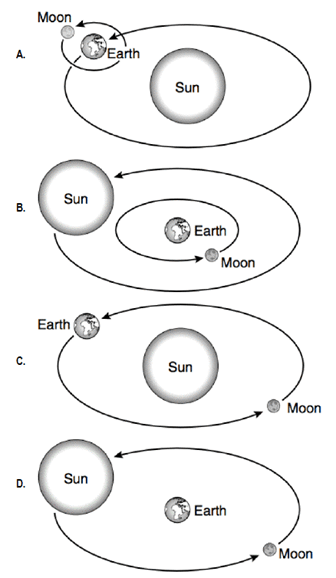
Which of these best shows that the Earth revolves around the sun as the moon revolves around the Earth?
a)
Picture A
b)
Picture B
c)
Picture C
d)
Picture D
43.
Which location on Earth receives the most direct sunlight?
a)
The deserts
b)
The South Pole
c)
The Equator
d)
The Western Hemisphere
44.

A force is a ......
a)
Push
b)
Pull
c)
Push or a Pull
45.
High tides are created on Earth when
a)
electromagnetic waves reverse the direction of ocean currents
b)
water is warmed by the Sun and rises to higher levels
c)
radiation striking the water increases the amount of salt
d)
gravity pulls on the water creating buldges
46.
If the moon and Earth's distance from each other were smaller, what would happen to the tides?
a)
Nothing
b)
higher high tides would occur
c)
we would have more than 2 tides a day
47.

Which days indicate a low tide occurred?
a)
day 8 & 25
b)
day 3 & 17
c)
day 8 & 15
d)
day 15 & 25
48.
Which moon phases are visible when a neap tide occurs?
a)
First Quarter and Full Moon
b)
First Quarter and Last Quarter
c)
Full Moon and New Moon
d)
Last Quarter and new Moon
49.
Which moon phases are visible during a spring tide?
a)
First Quarter and last Quarter
b)
First Quarter and Full Moon
c)
Full Moon and new moon
d)
Last Quarter and new moon
50.
How many times do a high and low tide occur?
a)
1 high and 2 low tides in 48 hours
b)
2 high and 2 low tides in 28 days
c)
1 high tide and 1 low tide in a 7 day period
d)
2 high and 2 low tides in 24 hours
51.
How many electrons can fit into each orbital?
a)
3,3,4
b)
2,8,8
c)
2,3,4
d)
8,2,8
52.
On the Periodic Table, which group number is most reactive?
a)
Group 1
b)
Group 17
c)
Group 18
d)
Group 15
53.

What season is it at position 1 in the Northern Hemisphere?
a)
Summer
b)
Fall
c)
Spring
d)
Winter
54.

During what moon phases do Spring tides occur?
a)
1st Quarter, 2nd Quarter
b)
3rd Quarter, New Moon
c)
Waxing Crescent, Waning Gibbous
d)
New Moon, Full Moon
55.

At position A, what season is it?
a)
Winter
b)
Spring
c)
Fall
d)
Summer
56.

What moon phase is at position 5?
a)
Full Moon
b)
Waxing Crescent
c)
New Moon
d)
1st Quarter
57.

What season is it in the northern hemisphere at position c?
a)
summer
b)
winter
c)
spring
d)
fal
58.

What moon phase is occurring at number 7?
a)
1st Quarter
b)
2nd Quarter
c)
4th quarter
d)
3rd Quarter
59.

What moon phase is occurring at number 4?
a)
Waxing Crescent
b)
Waning gibbous
c)
Waxing Gibbous
d)
New Moon
60.

How often does the Moon orbit the Earth in one year?
a)
12
b)
13
c)
28
d)
365
61.

Which phase of the moon occurs when you cannot see any reflection of the sun on the moon?
a)
Full Moon
b)
Waning Crescent
c)
Waxing Gibbous
d)
New Moon
62.
What is shadowed, or hidden, during a solar eclipse?
a)
Sun
b)
Moon
c)
Earth
d)
Jupiter
63.
What is shadowed, or hidden, during a lunar eclipse?
a)
Sun
b)
Moon
c)
Earth
d)
Pluto
64.
Why do we not experience eclipses every month?
a)
You have to be in the right spot
b)
The Moon's orbit is tilted
c)
Moon is smaller than the Sun
d)
Earth's orbit is tilted
65.

What year did humans land on the moon?
a)
1950
b)
1969
c)
1977
d)
200
66.

Who was the first man on the moon?
a)
Neil Armstrong
b)
Buzz Aldrin
c)
Michael Collins
d)
Tom Hanks
67.
This is when the earth has 2 full moons in 1 calendar month.
a)
Blue Moon
b)
Corn Moon
c)
Twin Moon
d)
Equinox
68.

Which position marks the autumnal equinox, the start of fall in the northern hemisphere?
a)
A
b)
B
c)
C
d)
D
69.

In which position is the northern hemisphere experiencing winter?
a)
A
b)
B
c)
C
d)
D
70.

If you are seeing a new moon, how long has it been since you saw the full moon?
a)
About 1 week
b)
About 2 weeks
c)
About 3 weeks
d)
About 4 weeks
71.
An equinox occurs when
a)
neither hemisphere is tilted toward or away from the sun.
b)
the Northern Hemisphere is tilted away from the sun.
c)
the Northern Hemisphere is tilted toward the sun.
d)
Earth's axis is parallel to the sun's rays.
72.
When the Northern Hemisphere experiences the shortest daytime and the longest night time it is the
a)
summer solstice.
b)
winter solstice.
c)
fall equinox.
d)
spring equinox.
73.
Why is it generally warmer near the equator than it is near the poles?
a)
the equator receives more direct sunlight
b)
the poles receive more direct sunlight
c)
the equator is closer to the sun
d)
the poles are closer to the sun
74.
The term equinox means....
a)
equal amount of day light and equal amount of night
b)
Equal amount of winter and summer
c)
Equal amounts of hot dogs for everyone
d)
The longest day of the year
75.
The first day of spring is also known as what?
a)
the winter solstice
b)
the summer solstice
c)
the vernal equinox
d)
the autumnal equinox
76.
The shortest day of the year falls on which?
a)
The summer solstice
b)
The winter solstice
c)
The autumnal equinox
d)
The vernal equinox
77.
What has the greatest affect on tides?
a)
moon
b)
sun
c)
temperature
d)
time of year
78.
When the sun's light is blocked by the moon and makes a shadow on earth, this is called a...
a)
lunar eclipse
b)
solar eclipse
79.
When the moon passes behind the Earth into the shadow, this is called a...
a)
lunar eclipse
b)
solar eclipse
80.
The tide caused when the sun and moon's gravitational pulls cancel each other out.
a)
high tide
b)
low tide
c)
spring tide
d)
neap tide
81.
Tide with the smallest difference between high and low tides.
a)
neap tide
b)
spring tide
82.
Equinoxes occur in...
a)
summer/winter
b)
spring/fall
83.
Solstices occur in...
a)
spring/fall
b)
summer/winter
84.
Began a new era of astronomy when he concluded that the Sun was the center of the universe.
a)
Aristotle
b)
Isaac Newton
c)
Claudius Ptolemy
d)
Nicolaus Copernicus
85.
What is the line called that separates the light side from the dark side?
a)
Shadow Line
b)
Light Edge
c)
Tetrahedron
d)
Terminator
86.

What type of tides would this arrangement of earth-moon-sun create?
a)
neap tide
b)
spring tide
c)
new moon tide
d)
full moon tide
87.

What type of tide would this arrangement of earth-moon-sun create?
a)
full moon tide
b)
new moon tide
c)
neap tide
d)
spring tide
88.
We only see one side of the Moon from Earth because.....
a)
it spins once per month and goes around us once per month.
b)
it doesn't spin at all.
c)
the Moon's rotation is from top to bottom.
d)
the moon is flat.
89.
What gets wet while it dries?
a)
Towel
b)
Pool
c)
Broom
d)
Shirt
90.
A measure of the pull of gravity and this changes on the moon
a)
Mass
b)
Weight
c)
Density
d)
Volume
91.
The boiling temperature of water is ______ degrees Celsius no matter what size container the water is in.
a)
32
b)
100
c)
0
d)
200
92.
Mushrooms and earthworms are examples of ___________
a)
Decomposers
b)
Consumers
c)
Producers
d)
Food Chain
93.
About how much of the Earth's surface is cover with water?
a)
25%
b)
50%
c)
75%
d)
100%
94.
Which of the following is an example of a physical change?
a)
Baking
b)
Mixture
c)
Reflected
d)
Freezing
95.
This has a changing shape and volume
a)
Solid
b)
Liquid
c)
Gas
d)
Density
96.
This has a definite shape and volume
a)
Solid
b)
Liquid
c)
Gas
d)
Density
97.
Substances with greater density
a)
Float
b)
Sink
c)
Fly
d)
Flip
98.
Giraffes have __________ stomachs.
a)
1
b)
2
c)
3
d)
4
99.
A gorilla can live for
a)
10-15 years
b)
5-10 years
c)
40-50 years
d)
70-80 years
100.
What is the most popular breed of dog?
a)
Bloodhound
b)
Labrador
c)
Greyhound
d)
Boxer
100 %

