
 Worksheets
Earth Science Online Power Session
Total questions: 100
Worksheet time: 2hrs 33mins
Name
Class
Date
1.

The point from which an earthquake originates is called the -
a)
focus
b)
epicenter
c)
fault line
d)
shockwave
2.
Cyanite (Al2SiO5), quartz (SiO2), and leucite (KAlSi2O6) may be grouped together because they all contain -
a)
aluminum
b)
carbon
c)
potassium
d)
silicon
3.
The folding and faulting found in the rocks of the Blue Ridge Mountains of Virginia were created by -
a)
collisions of continental plates
b)
wave action of prehistoric oceans
c)
the Coriolis effect
d)
heating and cooling of the prehistoric atmosphere
4.

What does the ozone layer do?
a)
absorb ultraviolet radiation
b)
cause pollution
c)
increase biological activity
d)
nothing
5.

In which of these general areas would you expect volcanoes to occur?
a)
Areas with limestone formations and water flowing underground
b)
Near areas of tectonic plate subduction such as the Pacific’s Ring of Fire
c)
Near continental-continental boundaries where mountain-building occurs
d)
At all kinds of tectonic plate boundaries
6.

The diagram above shows the changes to a land surface caused by a river flowing through the area for many years. Which process caused the changes to the surface?
a)
Condensation
b)
Erosion
c)
Evaporation
d)
Pollution
7.

Layer A probably formed in an ocean. Which of these is the best clue that layer A formed in an ocean?
a)
The thickness of the layer
b)
The type of fossils in the layer
c)
The position of the layer
d)
The density of the layer
8.

Granite is a hard material and forms from cooling magma. Granite is a type of —
a)
lava stone
b)
igneous rock
c)
volcanic dust
d)
sedimentary rock
9.

When comparing fossil A to fossil B, which is most likely correct?
a)
Fossil B is older
b)
Fossil B is larger
c)
Only fossil B is metamorphic
d)
Only fossil B was once an organism
10.

Which of these animals is most likely to form a fossil?
a)
F
b)
G
c)
H
d)
J
11.
A Virginia natural resource important to the state’s economy, as well as a primary source of energy, is —
a)
oil
b)
steel
c)
coal
d)
limestone
12.

180 degrees longitude -halfway around the earth from the prime meridian
a)
Compass rose
b)
Prime Meridian
c)
International date line
d)
Equator
13.

Which planet is Mercury?
a)
1
b)
2
c)
3
d)
4
14.

The picture shows an experiment determining how temperature affects the rate of evaporation of water. The experiment was conducted three times each by a different group of students. Which is the independent variable in the experiment?
a)
the amount of water
b)
the size of the beakers
c)
the temperature of the water
d)
the number of trials conducted
15.
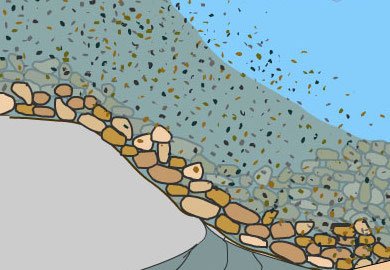
The process by which sediments settle out of water or wind
a)
deposition
b)
cementation
c)
weathering
d)
erosion
16.
After a full moon, the moon starts to become less illuminated. What do we call this?
a)
Waxing
b)
Power outage
c)
Waning
d)
Apocalypse
17.
During the winter in the northern hemisphere, the northern hemisphere is tilted in what direction?
a)
toward the sun
b)
away from the sun
c)
the earth is straight up and down
d)
there is no tilt
18.
How does igneous rock form from metamorphic rock?
a)
weathering and erosion
b)
Compacting and concreting
c)
heat and pressure
d)
melting and cooling
19.
The four agents of erosion are water, _____, ice, and gravity. What goes in the blank?
a)
Bacteria
b)
Volcanoes
c)
Sunlight
d)
Wind
20.

The canyon shown in the picture was most likely formed by -
a)
a volcano
b)
high winds
c)
earthquakes
d)
running water
21.
The bends in a stream are called
a)
oxbow lakes
b)
aquifers
c)
meanders
d)
erosion
22.

Which type of front is shown?
a)
An occluded front forms.
b)
An cold front forms.
c)
An stationary front forms.
d)
An warm front forms.
23.
As warm, moist air moves into a region, barometric pressure readings in the region will generally
a)
fluctuate
b)
remain the same
c)
decrease
d)
increase
24.
A rain gauge measures what?
a)
Air pressure
b)
Wind speed
wind speed
wind speed
c)
Amount of rain fall
d)
Wind direction
25.

What type of mechanical weathering is depicted in this picture?
a)
Exfoliation
b)
Organic
c)
Ice Wedging
d)
Abrasion
26.
Boundaries that spit apart are called ________ boundaries.
a)
transform
b)
hot spot
c)
divergent
d)
convergent
27.

What is the name of plate B?
a)
Eurasian
b)
North American
c)
South American
d)
Indo-Australian
28.

What type of plate boundary is shown in the picture?
a)
convergent
b)
divergent
c)
transform
29.

The picture gives a description of what type of rock?
a)
Sedimentary
b)
Igeneous
c)
Metamorphic
d)
Lava
30.

The picture gives a description of what type of rock?
a)
Sedimentary
b)
Igneous
c)
Lava/maga
d)
Sediment
31.

Rock X is produced by "cooling". What type of rock is Rock X?
a)
Sedimentary Rock
b)
Metamorphic Rock
c)
Sediment
d)
Igneous Rock
32.
Which layer of the earth is the thinnest?
a)
Mantle
b)
Inner Core
c)
Outer Core
d)
Crust
33.

_________, the supercontinent, existed over 200 million years ago.
a)
Pancakes
b)
Continents
c)
Pangea
d)
Skrat
34.

Fossils can be found in which type of rock?
a)
Igneous
b)
Sedimentary
c)
Metamorphic
35.
What does it mean to recycle?
a)
To use only once
b)
To reuse
c)
To throw away
d)
To save
36.
The moon appears to change shape because of _____.
a)
the Moon's revolution around Earth
b)
the seasons of the year
c)
the movement of stars in they sky
d)
Earth's rotation on its axis
37.

What is the unit of measurement used to measure the distance of galaxies or stars?
a)
light year
b)
centimeter
c)
millimeter
d)
grams
38.

What type of Moon?
a)
Full Moon
b)
Waxing Gibbous
c)
New Moon
d)
Waning Gibbous
39.

a)
LAYER 1
b)
LAYER 3
c)
LAYER 4
d)
LAYER 6
40.

a)
A
b)
B
c)
C
d)
D
41.
Suppose you found a material in which 50% of the original radioactive atoms were still present. If the half-life of an atom is 60 years, how old is the material?
a)
30 years old
b)
60 years old
c)
120 years old
d)
180 years old
42.

What happens to pressure as you go deeper into the ocean?
a)
increases
b)
decreases
c)
stays the same
d)
doubles
43.
What is the most abundant salt in the sea?
a)
calcium chloride
b)
potassium chloride
c)
magnesium chloride
d)
sodium chloride
44.
Where is MOST of the Earth's water located?
a)
oceans
b)
rivers
c)
lakes
d)
glaciers
45.

What is the deepest part of the ocean?
a)
a rift zone
b)
an abyssal plain
c)
a seamount
d)
an oceanic trench
46.

Which letter is the Abyssal Plain?
a)
B
b)
C
c)
D
d)
E
47.
Which of the following is the smallest?
a)
The Milky Way Galaxy
b)
A red giant star
c)
The moon
d)
Jupiter
48.

The weather map below shows isobars labeled in millibars. Points A, B, C, and D are locations on Earth’s surface. Which location is probably experiencing the highest wind speeds?
a)
A
b)
B
c)
C
d)
D
49.
Compared to the oceanic crust, the continental crust is
a)
more dense and more mafic
b)
more dense and more felsic
c)
less dense and more mafic
d)
less dense and more felsic
50.

Which sequence best describes the geologic history, from oldest to youngest, that occurred at this site?
a)
deposition of F, D, C, B → intrusion of E → uplift and erosion → deposition of A
b)
intrusion of E → deposition of F, D, C, B → uplift and erosion → deposition of A
c)
deposition of F, D, C, B, A → uplift and erosion → intrusion of E
d)
deposition of F, D, C, B, A → intrusion of E → uplift and erosion
51.
The passage of the Moon into Earth's shadow causes a
a)
Solar eclipse
b)
Lunar eclipse
c)
Full Moon
d)
New Moon
52.
A red shift in the light from very distant galaxies suggests that the universe is
a)
Contracting
b)
Fixed and stationary
c)
Moving Randomly
d)
Expanding
53.

The map below shows a portion of Earth’s system of latitude and longitude and five surface locations labeled A, B, C, D, and X. It is solar noon at location X. At which location will solar noon next occur?
a)
A
b)
B
c)
C
d)
D
54.

The diagram below represents three bedrock outcrops. The layers have not been overturned. Letters A through E identify different rock layers. Fossils found in the rock layers are shown. Which fossil could be classified as an index fossil?
a)
Shell
b)
Rod
c)
Snail
d)
Wave
55.
Which process generates the energy that is released by stars?
a)
nuclear fusion
b)
thermal conduction
c)
convection currents
d)
radioactive decay
56.
Which ocean current has the greatest warming influence on the climate of the Outer Banks of North
Carolina?
Carolina?
a)
Gulf Stream Current
b)
North Atlantic Current
c)
Labrador Current
d)
Canary Current
57.

What type of craft is shown?
a)
Shuttle
b)
Rocket
c)
Space plane
d)
Rover
58.
How does earth’s location affect its temperature when compared with Mars or Mercury?
a)
Earth is warmer than Mars but cooler than Mercury.
b)
Earth is cooler than either Mars or Mercury due to its location.
c)
Mercury is covered by ice because it is farther from the sun than other planets are.
d)
Earth has water in the gas state because it is closer to the sun than Mars or Mercury.
59.
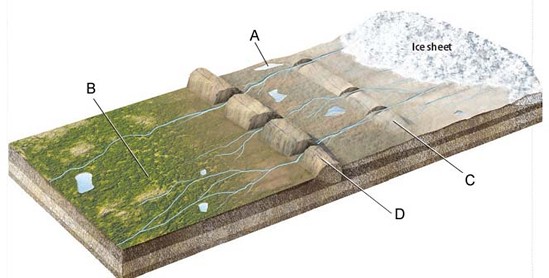
What glacial features are indicated by the labels C and D on the figure?
a)
moraines
b)
outwash plains
c)
kettle lakes
d)
ice sheets
60.
Which is one of the three most common elements in Earth's crust?
a)
Calcium
b)
Sodium
c)
Silicon
d)
Quartz
61.
What is the oldest province?
a)
Coastal Plain
b)
Piedmont
c)
Blue Ridge
d)
Appalachian Plateau
62.

Karst topography includes underground caverns. Where in VA would this landscape be found?
a)
Piedmont
b)
Coastal Plain
c)
Valley and Ridge
d)
Blue Ridge
63.

What type of rock is common in the Valley and Ridge region and is the rock needed to create Karst topography because it can be dissolved by the weak acid of Carbon Dioxide dissolved in water
a)
Sandstone
b)
Granite
c)
Basalt
d)
Limestone
64.

What are the two main elements (gases) that make up the Sun?
a)
Carbon and Helium
b)
Iron and Hydrogen
c)
Hydrogen and Helium
d)
Carbon and Hydrogen
65.
If an object has a density of .6 g/mL and you put it into water, will it sink or float?
a)
sink
b)
float
66.

I have two objects with the same volume but different masses. Which object will be more dense?
a)
The object with less weight.
b)
The object with more weight.
c)
The object with more mass.
d)
The object with less mass.
67.
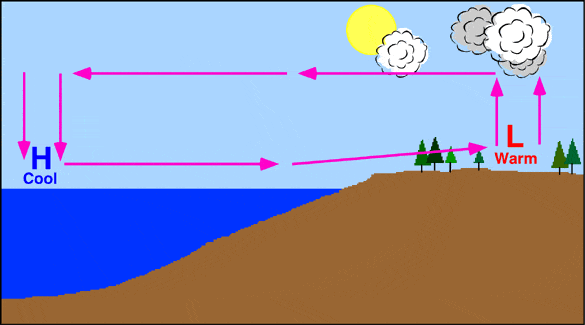
Is this a land or a sea breeze?
a)
land breeze
b)
sea breeze
68.
Water is _______ than land during the day, causing a sea breeze.
a)
hotter
b)
larger
c)
cooler
d)
warmer
69.
Which organism first appeared in the Mesozoic?
a)
Trilobites
b)
Dinosaurs
c)
Cyanobacteria
d)
Humans
70.
To determine the most accurate and precise age of Earth's oldest rocks, geologists would use __________________.
a)
absolute dating
b)
index fossils
c)
relative dating
d)
superpositi
71.

Our solar system is located inside a galaxy called the _____________.
a)
Local Group
b)
Milky Way
c)
Andromeda
d)
Constellation
72.

Which is an example of a Main Sequence star?
a)
Betelgeuse
b)
our Sun
c)
Sirius B
d)
Polaris
73.
Which of the following planets is Earths sister planet?
a)
Venus
b)
Neptune
c)
Mars
d)
Mercury
74.
What planet is eighth in the Solar System?
a)
Uranus
b)
Jupiter
c)
Neptune
d)
Mars
75.
A rocky body that strikes Earth's surface?
a)
Comet
b)
Meteor
c)
Meteoroid
d)
Meteorite
76.
What is a constellation?
a)
A planet
b)
A myth
c)
A group of stars that form a recognizable pattern
d)
Another word for a comet
77.
What do we call the distance from the Earth to the Sun?
a)
A light year
b)
An Astronomical Unit
c)
Miss Best
d)
A satellite
78.
What is the difference between a gibbous moon and a crescent moon?
a)
The gibbous shows more than half of the bright side of the moon.
b)
The crescent shows more than half of the bright side of the moon.
c)
The gibbous shows less than half of the bright side of the moon.
79.
Which way does the moon revolve?
a)
clockwise
b)
counter clockwise
c)
some times it changes direction
d)
it doesn't revolve
80.

Where is the moon in relation to the Earth and the sun in picture B?
a)
The moon is at a right angle to the Earth and the sun.
b)
The moon is on the opposite side of the Earth from the sun.
c)
The moon is on the same side of the Earth as the sun.
81.
When are tides highest?
a)
during the moon's first quarter phase
b)
during the moon's third quarter phase
c)
when the sun, Earth and the moon are nearly in a line
d)
when the moon is at a right angle to the sun
82.

During a SOLAR eclipse, which celestial body is blocked?
a)
The Earth
b)
The Moon
c)
The Sun
d)
Comets
83.
A ______ telescope uses a mirror to focus light onto a small area.
a)
reflecting
b)
refracting
c)
radio
d)
spectrum
84.
Rocks are classified according to ____
a)
how hard they are
b)
where they are formed
c)
how they are formed
d)
their color
85.
Most minerals do not split apart evenly. Instead, they have a characteristic type of
a)
cleavage
b)
fracture
c)
crystal
d)
luster
86.

If you saw the definition stating that something was naturally occuring, inorganic, solid, has chemical composition and has crystal structure you would say that that definition defines which of the following?
a)
Mineral
b)
Crystal
c)
Rock
d)
none of th above
87.

Looking at the appearance of these rocks which are coarse grained, glassy, and airy, which type of rock are you looking at?
a)
Metamorphic
b)
Sedimentary
c)
Clastic
d)
Igneous
88.

This image represents what process?
a)
Meta formation
b)
The rock agrigation
c)
Metamorphism
d)
The rock cycle
89.

This grainy Sedimentary rock is called what?
a)
Talk
b)
Sulphur
c)
Sandstone
d)
Graphite
90.

This layered Metamorphic rock is called what?
a)
Slate
b)
Sulphur
c)
Gneiss
d)
Rhyolite
91.

This yellow mineral with a strong odor is called what?
a)
Slate
b)
Graphite
c)
Gneiss
d)
Sulphur
92.
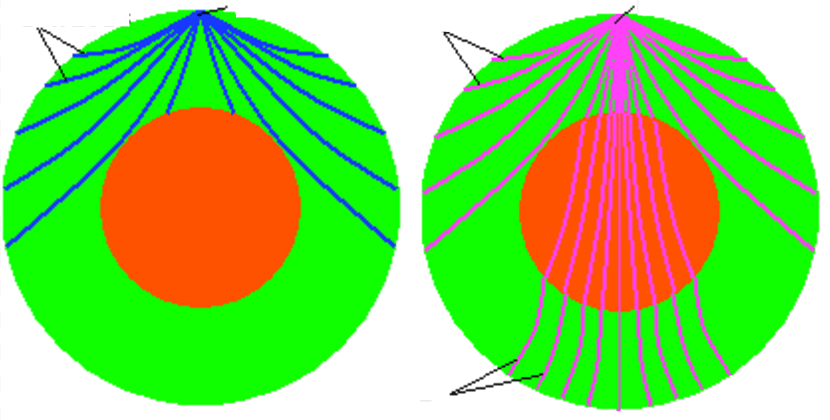
What type of wave are the BLUE waves? (orange circle is the core)
a)
P-waves
b)
S-waves
c)
Love waves
d)
Raleigh waves
93.

Where is the epicenter for this earthquake located based on triangulation?
a)
A
b)
B
c)
C
d)
D
94.
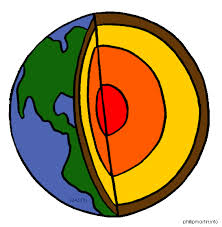
Which layer is made up of iron and nickel?
a)
Crust
b)
Mantle
c)
Inner Core
d)
Lithosphere
95.
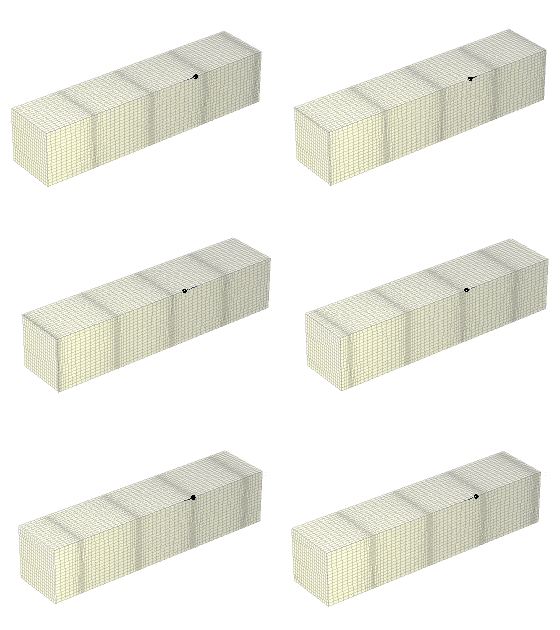
Which body wave is pictured?
a)
P-Wave
b)
S-Wave
c)
Rayleigh Wave
d)
Love Wave
96.

The curving of air to the right in the Northern hemisphere is caused by ___________ and is called the _________ effect.
a)
Earth's rotation...Coriolis
b)
Earth's revolution...Coriolis
c)
Earth's rotation...Doppler
d)
Earth's revolution...Doppler
97.
Which global winds have the greatest impact on the weather in the US?
a)
trade winds
b)
prevailing westerlies
c)
doldrums
d)
polar easterlies
98.
About how much of the atmosphere contains nitrogen?
a)
1%
b)
78%
c)
21%
d)
97%
99.
Where is the ozone layer, which absorbs UV radiation, located in our atmosphere?
a)
stratosphere
b)
thermosphere
c)
mesosphere
d)
troposphere
100.

Who is the person credited with developing the theory of continental drift?
a)
Harry Hess
b)
Alfredo Sauce
c)
Alfred Wegener
d)
Alfred the Butler
100 %

