wayground logo

Free Printable Worksheets

Font size

S
M
L
XL
Worksheets

Astronomy 1303 Chapter 2

Total questions: 100

Worksheet time: 2hrs 49mins

Name
Class
Date
1.
We can see constellations change positions throughout the night because
a)
Earth moves around the Sun
b)
Earth is rotates on its axis
c)
Stars move in different motions
d)
Earth is tilted
2.
Which number most likely shows the position of the Sun at noon? 
a)
1
b)
2
c)
3
d)
4
3.
On this day, the daylight and nighttime hours are equal.  This occurs in September.
a)
Autumnal Equinox
b)
Summer Solstice
c)
Vernal Equinox
d)
Winter Solstice
4.

Which line represents the path of the sun during Winter for a location in New York State?

a)

A

b)

B

c)

C

5.

Look at the diagram. Path B shows the path of the sun during which season?

a)

Autumn/Spring

b)

Summer

c)

Winter

6.
Look at the picture.  Would the sun be low or high in the sky in the afternoon picture?
a)
The sun would be highest.
b)
You would not be able to see the sun at all.
c)
The sun would be low in the sky.
d)
The sun has nothing to do with shadows.
7.
Each of the two days of the year when neither hemisphere is tilted toward or away from the sun is called a(n) ? 
a)
winter solstice
b)
summer solstice
c)
rotation
d)
equinox
8.
Which motion occurs at a rate of approximately
one degree per day?
a)
the Moon revolving around Earth
b)
 the Moon rotating on its axis
c)
Earth revolving around the Sun
d)
Earth rotating on its axis
9.
If the tilt of Earth’s axis were increased from
23.5° to 30°, summers in New York State would
become
a)
cooler, and winters would become cooler
b)
cooler, and winters would become warmer
c)
warmer, and winters would become cooler
d)
warmer, and winters would become warm
10.
During the month of January, at which location
in New York State is the Sun lowest in the sky at
solar noon?
a)
Massena
b)
Niagara Falls
c)
Utica
d)
New York City
11.
What is the name of the star closest to the Celestial North Pole?
a)
Rigel
b)
Vega
c)
Polaris
d)
Orion
12.
Where on the Earth is the Sun at Zenith at noon on the winter solstice?
a)
Tropic of Cancer
b)
Tropic of Capricorn
c)
Equator
d)
no where on the Earth
13.
At position D in the Northern hemisphere it would be _____.
a)
Summer
b)
Winter
c)
Spring
d)
Fall
14.
Object spinning on its axis. 
a)
revolution
b)
rotation
15.
Object orbiting another object. 
a)
revolution 
b)
rotation
16.
What are the reasons for the seasons?
a)
Earth's tilt and rotation.
b)
Earth's rotation and revolution.
c)
Earth's tilt and revolution.
d)
Earth's tilt and resolution
17.
A model of the universe in which Earth is at the center of the revolving planets and stars. This includes the sun revolving around the Earth. This model is no longer supported.
a)
Geocentric
b)
Heliocentric
18.
The Foucault Pendulum is evidence that Earth is
a)
Revolving counterclockwise
b)
Rotating Counterclockwise
c)
Rotating clockwise
d)
Revolving clockwise
19.
The daily motions of the Moon, Sun and stars are due to the Earth's
a)
Revolution
b)
Geocentrism
c)
Tilt on the axis
d)
Rotation
20.
Every 45° of longitudinal change is equal to how many hours of a time difference
a)
1
b)
2
c)
3
d)
4
21.
If you could locate Polaris and walked in its direction, you'd be walking due
a)
North
b)
East
c)
South
d)
West
22.
In the summer many people enjoy going to the beach. There is a beautiful beach in Argentina, which is located in the Southern Hemisphere. Which diagram shows the position of Earth when it is summer in Argentina?
a)
A
b)
B
c)
C
d)
D
23.
When the hours of daylight and darkness are equal everywhere on Earth, the following occurs
a)
solstice
b)
summer
c)
eclipse
d)
equinox
24.
What season are we currently in?
a)
summer
b)
fall
c)
winter
d)
spring
25.
This image shows the:
a)
Geocentric Solar System
b)
Heliocentric Solar System
26.
Which of these best shows that the Earth revolves around the sun as the moon revolves around the Earth?
a)
Picture A
b)
Picture B
c)
Picture C
d)
Picture D
27.
When the Northern Hemisphere of Earth is Leaning away from the Sun, What season is the Southern Hemisphere experiencing?
a)
Summer
b)
Winter
c)
Spring
d)
Fall
28.
What day of the year does the northern hemisphere have the longest daylight hours?
a)
winter solstice
b)
summer solstice
c)
fall equinox
d)
spring equinox
29.
The sun appears to move across the sky each day.  What causes this?
a)
the spinning of the Earth's axis
b)
The path of the sun around the Earth
c)
the production the nuclear energy around the sun
d)
the tilt of the Earth on its axis
30.
Which diagram best represents the tilt of Earth’s axis relative to the sun in December?
a)
1
b)
2
c)
3
d)
4
31.
Which diagram best represents the tilt of Earth’s axis relative to the sun in Northern Hemisphere's summer?
a)
1
b)
2
c)
3
d)
4
32.
What is in the center of the Heliocentric Model?
a)
Sun
b)
Comet 
c)
Jupiter
d)
Earth
33.
Circumpolar Constellations rotate around which celestial object?
a)
The Sun
b)
Polaris
c)
The Ecliptic
d)
The moon
34.
The term equinox means....
a)
equal amount of day light and equal amount of night
b)
Equal amount of winter and summer
c)
Equal amounts of hot dogs for everyone
d)
The longest day of the year
35.
What do June 21 and December 21 have in common?
a)
equinox dates
b)
the moon is full
c)
solstice dates
d)
the cold fronts blow in
36.
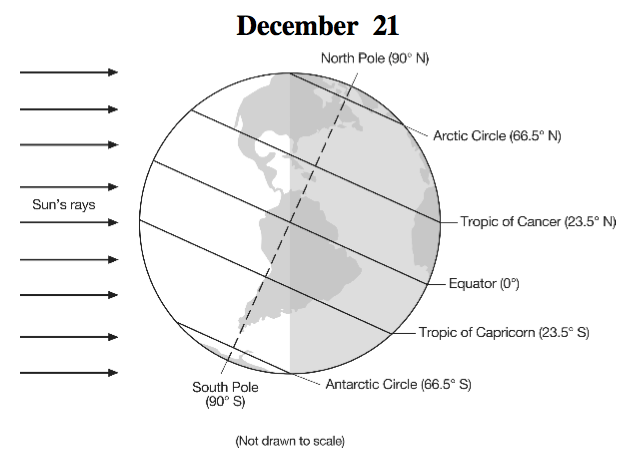
What Latitude experiences direct Sun Rays on December 21st?
a)
23.5°N Tropic of Cancer
b)
0° (Equator)
c)
23.5° S Tropic of Capricorn
d)
66.5° S Antarctic Circle
37.
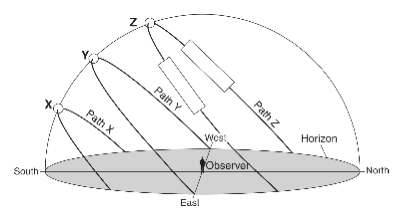
State the day in New York represented by Sun's Path Z.
a)
September 23
b)
December 21
c)
March 20
d)
June 21
38.
Which point represents the sun at solar noon on the Winter Solstice?
a)
X
b)
Y
c)
Z
39.
In which direction does the sun rise on the Summer solstice? 
a)
North of East
b)
due East
c)
South of East
d)
South
40.
Which position of the sun would the observer have the longest shadow? 
a)
X
b)
Y
c)
Z
41.
What location receives the direct rays on March 21?
a)
The Tropic of Cancer (23.5 degrees North)
b)
The Tropic of Capricorn (23.5 degrees South)
c)
The Equator (0 degrees)
d)
The Arctic Circle (66.5 degrees North)
42.
The Northern Hemisphere gets __________ sunlight in the winter, which leads to _________ temperatures.
a)
less direct, hotter
b)
less direct, colder
c)
more direct, hotter
d)
more direct, colder
43.
Earth's orbit brings the planet closest to the sun in ............
a)
February
b)
August
c)
July
d)
January
44.
In December, people in the ......... hemisphere receive the most direct sunlight
a)
Northern
b)
Southern
c)
Eastern
d)
Western
45.
If the axis of the earth was straight there would be:
a)
0 seasons
b)
2 seasons
c)
4 seasons
d)
8 seasons
46.
Where will your shadow point on solar noon of any day?
a)
due South
b)
South East
c)
due North
d)
North West
47.
Highest Path of the sun for NY state is
a)
A. The Equinoxes
b)
B. The Winter Solstice
c)
C. The Summer Solstice
48.
How many degrees will the sun appear to move across the sky in 4 hours? 
a)
15 degrees
b)
30 degrees
c)
45 degrees
d)
60 degrees
49.
Which location will receive the greatest intensity of insolation on Sept 22nd?
a)
Tropic of Cancer
b)
Tropic of Capricorn
c)
Equator 
d)
North Pole
50.
Which location will receive the greatest duration of insolation on Dec 21st? 
a)
New York
b)
North pole
c)
Equator
d)
South Pole
51.
During the time exposure of the photograph, the stars appear to have moved through an arc of 120 degrees. How many hours did this time exposure take?
a)
5h
b)
8h
c)
12h
d)
15h
52.
Which season has the least amount of daylight in the Northern Hemisphere?
a)
Winter
b)
Spring
c)
Summer 
d)
Fall
53.
The Coriolis effect
provides evidence of Earth’s:
a)
Revolution
b)
Rotation
c)
Tilted axis
d)
Elliptical Orbit
54.
What happens when the hemisphere in which you live tilts away from the sun?
a)
It is summer.
b)
It is spring.
c)
It is winter.
d)
It is fall.
55.
What day of the year does NY have the longest duration of insolation?
a)
winter solstice
b)
summer solstice
c)
fall equinox
d)
spring equinox
56.
Which celestial object is shown in the photograph near the center of the star trails?
a)
The Sun
b)
Polaris
c)
Sirius
d)
The Moon
57.
In June, there are fewer hours of daylight and less direct sunlight in the...
a)
Southern Hemisphere  
b)
Northern Hemisphere 
c)
Western Hemisphere 
d)
Eastern Hemisphere 
58.
During which N.Hemisphere season is Earth closest to the sun? 
a)
winter 
b)
spring
c)
summer
d)
fall
59.
At which time would your shadow be the shortest?
a)
7:00 am
b)
7:00 pm
c)
around 12:00 pm
d)
3:30 pm
60.
When is your shadow the longest?
a)
noon
b)
sunrise and sunset
c)
9 am
d)
midnight
61.
Why are summers in NY warmer than winter days in NY?
a)
Earth is closer to the sun in NY's summer
b)
greater duration and angle of insolation in summer
c)
The N. Hemisphere is tilted away from the sun in summer.
d)
The angle of insolation is lower in the summer.
62.
The movement of most celestial objects is:
a)
Unpredictable and cyclic
b)
Random
c)
Predictable and cyclic
63.
Which of the following best describes one day on Earth? The time it takes the...
a)
Earth to revolve around the Sun.
b)
Moon to rotate on its axis.
c)
the tides to move from high to low.
d)
the Earth to rotate once on its axis.
64.
The Coriolis effect causes objects in the Northern Hemisphere to curve to the _______, and objects in the southern hemisphere to curve_________.
a)
left, right
b)
north, south
c)
right, left
d)
east, west
65.
On which day of the year would the intensity of insolation at Kingston, New York, most likely be greatest?
a)
March 21
b)
June 21
c)
September 21
d)
December 21
66.
Locations in the Northern Hemisphere are warmest in summer because sunlight in summer is
a)
least intense and of shortest duration
b)
least intense and of longest duration
c)
most intense and of shortest duration
d)
most intense and of longest duration
67.
In New York State, the risk of sunburn is greatest between 11 a.m. and 3 p.m. on summer days because
a)
The air temperature is hot
b)
The angle of insolation is high
c)
Earth's surface reflects most of the sunlight
d)
The Sun is closest to the Earth
68.
State the day represented by Sun's Path Y.
a)
September 1st
b)
December 21st
c)
March 21st
d)
June 21st
69.
What time of the day is represented by the location of the Sun on the diagram?
a)
6 AM
b)
9 AM
c)
12 PM
d)
6 PM
70.
On which date will the sun take this path across the sky? 
a)
Summer solstice
b)
Winter solstice
c)
August 31st 
d)
Equinoxes
71.
What Latitude experiences direct Sun Rays on December 21st?
a)
23.5°N
b)
0° (Equator)
c)
23.5° S
d)
66.5° S
72.
At ____ the length of a shadow is the shortest.
a)
8am
b)
5pm
c)
midday (noon)
d)
midnight
73.
On which day of the year will the north pole receive 24 hours of daylight? 
a)
June 21st
b)
Sept 22nd
c)
March 21st
d)
December 21st
74.
The earth's rate of rotation is...
a)
1 degree per day
b)
15 degrees per hour
c)
15 degrees per day
d)
365 days per year
75.
The vertical ray of the sun hits 23.5N latitude on what day of the year?
a)
Sept 21
b)
Dec 21
c)
Mar 21
d)
June 21
76.
When is the Sun directly overhead at noon in New York State?
a)
never
b)
September 21/March 21
c)
June 21
d)
Dec 21
77.
What happens to the length of your shadow from sunrise to sunset?
a)
increases only
b)
decreases only
c)
decreases, then increases
d)
increases, then decreases
78.
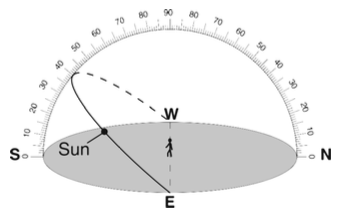
The model below represents the apparent path of the Sun across the sky on March 21 as seen by an observer on Earth. What latitude is the observer located?
a)
b)
23.5°N
c)
23.5°S
d)
40°N
79.
The diagram represents the apparent path of the Sun as observed at four locations, A through D, on Earth's surface on the same date.Based on the Sun's apparent path, where is location D?
a)
Equator
b)
Tropic of Cancer
c)
Tropic of Capricorn
d)
North Pole
80.
What day of the year will you have the longest shadow?
a)
Summer solstice
b)
Spring Equinox
c)
Fall Equinox
d)
Winter Solstice
81.

Base your answer to the following question on the diagram below to the left, which shows the tilt of Earth on its axis in relation to the Sun on one particular day. Points A through E are locations on Earth’s surface. Point D is located in Virginia. The dashed line represents Earth’s axis.

On this day, which location has the greatest number of hours of daylight?

a)

E

b)

B

c)

C

d)

D

82.

In New York State, the number of hours of daylight each day increases continuously from...

a)

March 1 to May 1

b)

June 1 to August 1

c)

September 1 to November

d)

ecember 1 to February 1

83.

The diagrams below represent the constellations seen by an observer in New York State while looking toward the southern horizon at midnight on July 9 and January 8.

Which motion is mainly responsible for the difference in the constellations visible at midnight on these two dates?

a)

The Sun orbits Earth

b)

Earth orbits the Sun

c)

The stars in the constellations orbit Earth

d)

Earth orbits the stars in the constellations

84.

How many degrees per hour does the Sun appear to move across the sky?

a)

41 degrees

b)

23.5 degrees

c)

90 degrees

d)

15 degrees

85.

What time is at position 3?

a)

12 p.m. (noon)

b)

9 a.m.

c)

3 p.m.

d)

6 p.m.

86.

On which day do observers in New York State experience the greatest duration of insolation?

a)

March 21

b)

June 21

c)

September 23

d)

December 21

87.

Which date is represented by the diagram?

a)

March 21

b)

June 21

c)

September 21

d)

December 21

88.

What time is at position 1?

a)

12 p.m. (noon)

b)

9 a.m.

c)

3 p.m.

d)

6 a.m.

89.

What time is at position 1?

a)

12 p.m. (noon)

b)

9 a.m.

c)

3 p.m.

d)

6 a.m.

90.

What season is represented at point B?

a)

Winter

b)

Spring

c)

Summer

d)

Fall

91.

Which date is represented by the diagram?

a)

March 21

b)

June 21

c)

September 21

d)

December 21

92.
The diagram below shows the altitude of the Sun at solar noon on March 21, as seen by anobserver at 42° N latitude.
Compared to the altitude of the Sun observed at solar noon on March 21, the altitude of the Sun observed at solar noon on June 21 will be
a)
15° higher in the sky
b)
23.5° higher in the sky
c)
42° higher in the sky
d)
48° higher in the sky
93.
The cartoon characters below are watching the Sun set.
Toward which general direction are the characters looking?
a)
North
b)
South 
c)
East
d)
West
94.
The diagram below shows the noontime shadow cast by a vertical post located in New York State.
Which letter indicates a location west of the post?
a)
A
b)
B
c)
C
d)
D
95.
The diagram below shows the apparent path of the Sun as viewed by an observer at a certain Earth location on March 21.At which latitude is the observer located?
a)
the Equator (0°)
b)
23.5 degrees N
c)
66.5 degrees N
d)
90 degrees N
96.
The tilt of the Earth on its axis is a cause of the Earth’s
a)
uniform daylight hours
b)
changing length of day and night
c)
24-hour day
d)
365 1/4-day year
97.
The diagram represents the apparent daily path of the sun across the sky in the Northern Hemisphere on the dates indicated.At noon on which date would the observer cast the longest shadow?
a)
June 21
b)
September 23
c)
March 21
d)
December 21
98.
Based on observations made in the Northern Hemisphere, which statement is the best supporting evidence that the Earth rotates on its axis?
a)
The stars appear to follow daily circular paths around Polaris.
b)
The apparent solar diameter varies throughout the year.
c)
The length of the daylight period varies throughout the year.
d)
The seasons (spring, summer, fall, and winter) repeat in a cyclic pattern.
99.
Base your answer on diagram below, which represents the Sun’s apparent paths and the solar noon positions for an observer at 42° N latitude on December 21, September 23, and June 21.In which direction will sunrise occur on June 21?
a)
north of due west 
b)
north of due east 
c)
south of due east
d)
south of due west
100.
The Coriolis effect is a result of Earth's
a)
tilt
b)
orbital shape
c)
revolution
d)
rotation