
 Worksheets
Review quiz 100
Total questions: 100
Worksheet time: 1hrs 25mins
Name
Class
Date
1.
Behavioral changes of individuals of a species that allow for better survival. (Acquired traits)
a)
Variation
b)
Adaptation
c)
Behavior
d)
Environment
2.
When every organism of a species has died.
a)
Evolution
b)
Natural Selection
c)
Extinction
d)
Artificial Selection
3.
Where the better adapted organisms survive to pass traits along to offspring.
a)
Evolution
b)
Natural Selection
c)
Extinction
d)
Artifical Selection
4.
What is the advantage of having different shaped beaks?
a)
To look different from other species.
b)
To be able to eat the food readily available in the environment.
c)
To protect itself against predators.
d)
To protect itself against prey.
5.
Why are advantageous traits more likely to be passed onto offspring?
a)
Because they are more likely to survive and reproduce.
b)
Because they come from dominant alleles.
c)
Because they come from recessive alleles.
d)
Because the trait is an acquired phenotype.
6.
What word describes a trait that helps an organism survive in its environment?
a)
natural selection
b)
mutation
c)
camouflage
d)
adaptation
7.
All mutations and adaptations usually lead to what process?
a)
selective breeding
b)
behavioral
c)
natural selection
d)
genetic engineering
8.
Why do frogs and other organism reproduce so many eggs or offspring?
a)
so that their babies can have friends to play with
b)
the more offspring the more likely the offspring will survive
c)
the more offspring the less likely offspring will survive
d)
the more offspring the less competition
9.
Which organisms are most likely to survive?
a)
the best adapted
b)
the fastest
c)
the strongest
d)
the most domesticated (tamed)
10.
Do organisms "decide" to evolve and change?
a)
Yes, they know they need to change to survive
b)
No, they change because of natural selection
11.
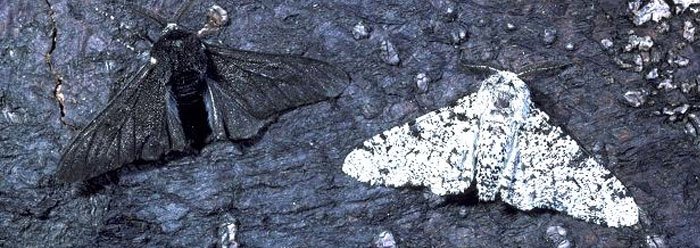
The trees these moths used to live on were white, but have been covered in soot from coal factories. Which moth will be more successful in this environment?
a)
Dark moth
b)
Light moth
c)
Both will be equally successful
d)
Neither will be successful
12.

Since the 1800s humans have stopped burning coal, and the trees have returned to their original color. Which moth will be more successful in this environment?
a)
Dark moth
b)
Light moth
c)
Both will be equally successful
d)
Neither will be successful
13.
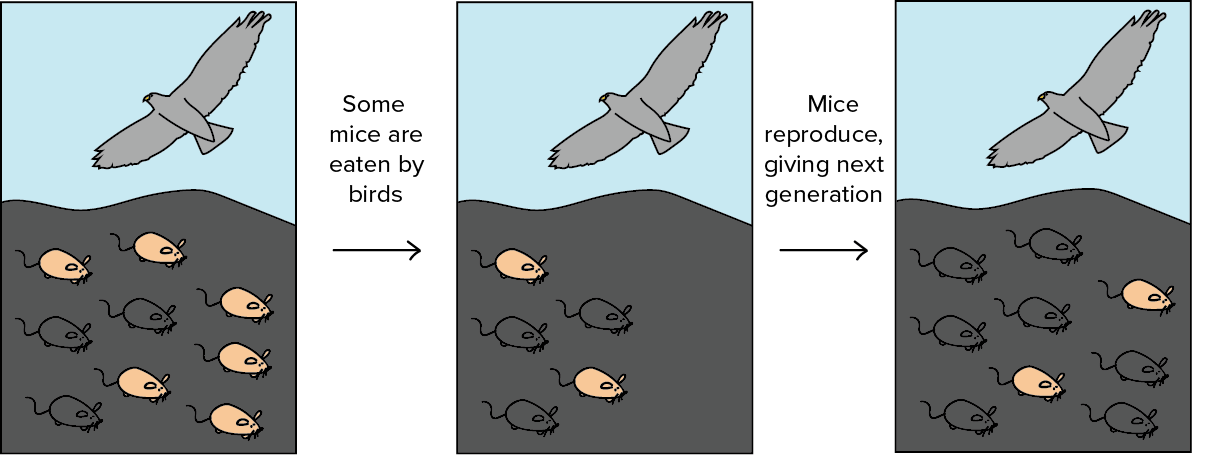
Why is the mouse population changing over time?
a)
The light mice can reproduce more successfully than the dark mice
b)
The hawks eat more dark mice than light mice because the dark mice taste better
c)
The hawks eat more light mice than dark mice because they can see the light mice more easily
d)
The hawks eat more dark mice than light mice because they can see the dark mice more easily
14.
Which term describes a group of the same species that live in the same area?
a)
Population
b)
Community
c)
Biome
d)
Ecosystem
15.
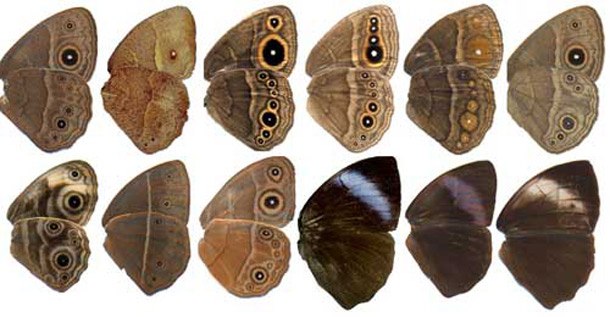
These moths are all the same species. The differences between their wings is an example of ________________
a)
Natural Selection
b)
Variation
c)
Homeostasis
d)
Extinction
16.
Which organism has an advantage in its environment?
a)
The fastest
b)
The strongest
c)
The best adapted
d)
The most tamed
17.

This species of squirrel has been separated by the Grand Canyon. Which term best describes the differences between them?
a)
Variation
b)
Extinction
c)
Population
d)
Overpopulation
18.
Artificial selection is also known as surivial of the fittest.
a)
True
b)
False
19.
Natural selection is when ____________ decides who survives and who doesn't
a)
nature
b)
humans
c)
animals
d)
years
20.
When every organism of a species has died.
a)
Evolution
b)
Natural Selection
c)
Extinction
d)
Artificial Selection
21.
If and then statements are usually the structure of a
a)
hypothesis
b)
conclusion
c)
Theory
d)
law
22.
According to superposition, the fossils found in the lower layer of rocks are ________ than those found at higher layer
a)
older
b)
Same age
c)
Younger
d)
tougher
23.
Comparing one rock to another rock to determine the age is considered to be called
a)
Absolute age
b)
Relative age
c)
Actual age
d)
Predicted age
24.
An object in motion will remain in motion unless another force is applied to that object is considered a
a)
theory
b)
law
c)
hypothesis
d)
Conclusion
25.
Evolution is a
a)
law
b)
theory
c)
hypothesis
d)
conclusion
26.
What is an example of quantitative observations?
a)
red roses
b)
twenty four feet
c)
white fur
d)
selective breeding
27.
A dog can be trained to alert a human if the telephone is ringing
a)
hypothesis
b)
theory
c)
law
d)
conclusion
28.
Do organisms "decide" to evolve and change?
a)
Yes, they know they need to change to survive
b)
No, they change because of natural selection
29.
This is a period of deep sleep that occurs in some animals when outside temperatures are cold: ______
a)
hibernation
b)
migration
30.
Polar bears have compact ears, a small tail, and thick fur to keep themselves warm. Are these examples of physical (structural) or behavioural adaptations?
a)
Physical
b)
Behavioural
31.
What is a PUSH or PULL of an object?
a)
Motion
b)
Force
c)
Friction
d)
Gravity
32.
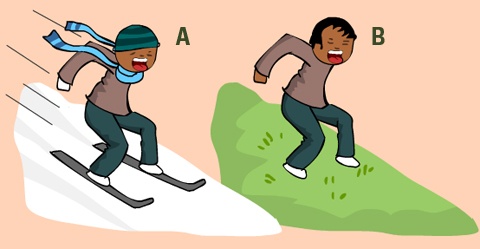
Why is it harder for the boy in Image B to get down the hill?
a)
Motion
b)
Friction
c)
Work
d)
Displacement
33.
Which force produces a change in motion?
a)
unbalanced force
b)
balanced force
c)
gravitational force
d)
frictional force
34.
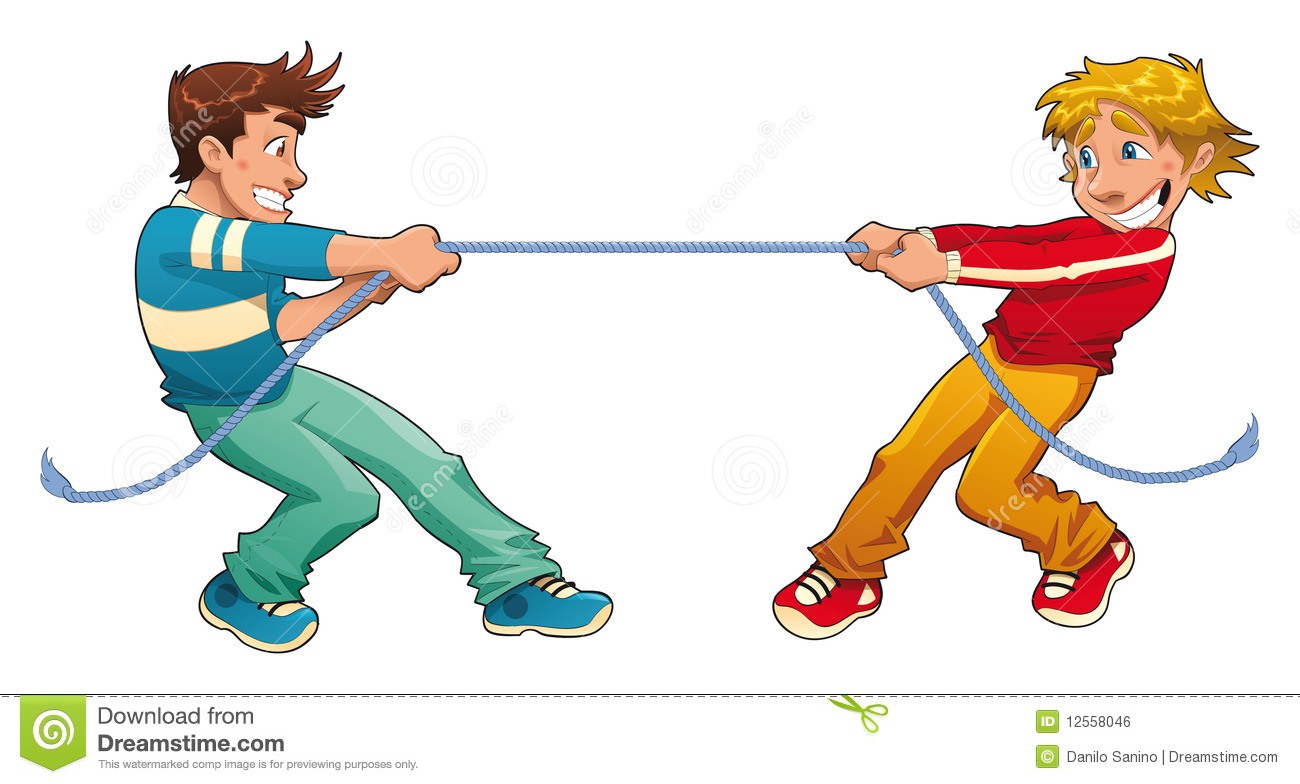
If these boys are pulling with the same amount of force. What will happen?
a)
The boy in blue will win.
b)
They will not move at all.
c)
The boy in red will win.
d)
Both will fall down.
35.
_______________ is how fast an object changes over time.
a)
speed
b)
velocity
c)
momentum
d)
acceleration
36.
What is the formula for force?
a)
F=M/A
b)
F=A/M
c)
F=M*A
d)
F=M*F
37.
What happens when two forces act in the same direction?
a)
They cancel each other out.
b)
The stronger one prevails.
c)
Their strengths are added.
d)
Their sum divided by the two is the total force.
38.
Any time the forces are unbalanced, an object will remain at rest. True or false?
a)
true
b)
false
39.
Objects that are changing their speed or their direction
a)
force
b)
energy
c)
acceleration
d)
friction
40.
a force that causes a change in motion of an object
a)
friction
b)
balanced force
c)
unbalanced force
d)
force
41.
the capacity for vigorous activity; available power
a)
friction
b)
motion
c)
force
d)
energy
42.
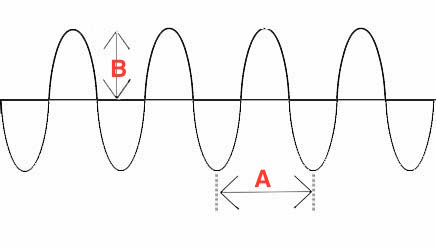
What property of this wave is represented by the letter "A"
a)
amplitude
b)
crest
c)
trough
d)
wavelength
43.
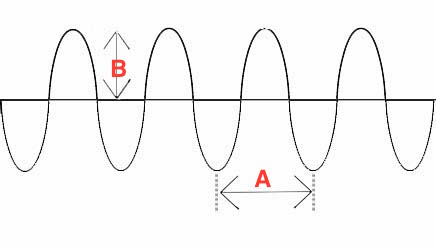
What property of the wave is represented by the letter "B"?
a)
amplitude
b)
crest
c)
trough
d)
wavelength
44.
The highest point on a wave is:
a)
the crest
b)
the trough
c)
the top
d)
the coast
45.
The lowest point on a wave is the:
a)
Amplitude
b)
Crest
c)
Trough
d)
Wavelength
46.
The number of wavelengths that pass a point each per second is:
a)
frequency
b)
period
c)
longitudinal
d)
transverse wave
47.

Which vocabulary term is used to identify the distance between points C & G?
a)
Amplitude
b)
Crest
c)
Frequency
d)
Wavelength
48.
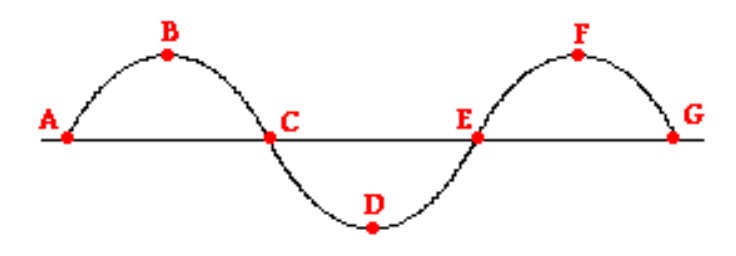
Which letter(s) represent the trough of the wave?
a)
A
b)
B & D
c)
D
d)
C & G
49.
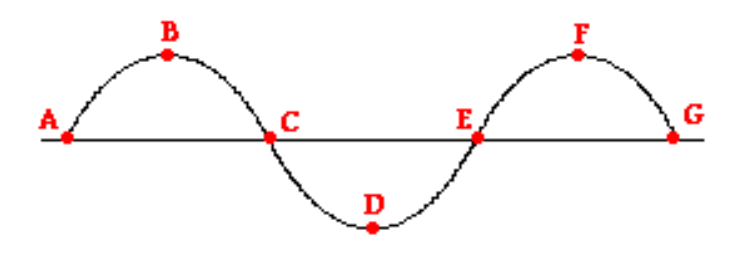
Which letter(s) represent the crest of the wave?
a)
A
b)
B & D
c)
B & F
d)
F
50.
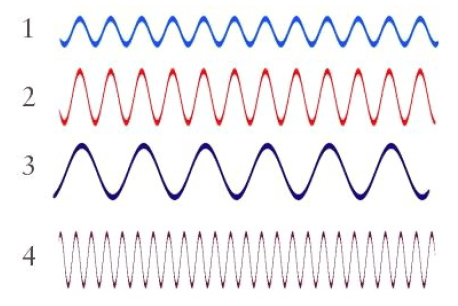
Which wave in the diagram has the greatest frequency?
a)
1
b)
2
c)
3
d)
4
51.
The order of the planets is:
a)
Mars,Venus,Earth,
Mercury,Saturn
Jupiter, Uranus, Neptune
Mercury,Saturn
Jupiter, Uranus, Neptune
b)
Earth,Venus,Mars
Jupiter, Neptune,
Mercury,Saturn,
Uranus
Jupiter, Neptune,
Mercury,Saturn,
Uranus
c)
Mercury,Venus,Earth
Mars,Jupiter,
Saturn,Uranus
Neptune
Mars,Jupiter,
Saturn,Uranus
Neptune
52.
Planets that are closer to the sun
a)
take more time to orbit
b)
take less time to orbit
53.

Which planet is the largest?
a)
Jupiter
b)
Saturn
c)
Uranus
d)
Neptune
54.
Which planet is fifth from the sun?
a)
Saturn
b)
Jupiter
c)
Mars
d)
Earth
55.
The spinning of an object on its axis is called______
a)
orbit
b)
rotation
c)
revolution
d)
tide
56.
Day and night is caused by the _____________ of earth on its axis.
a)
revolution
b)
orbit
c)
rotation
57.

When the Northern Hemisphere of Earth is Leaning away from the Sun, What season is the Southern Hemisphere experiencing?
a)
Summer
b)
Winter
c)
Spring
d)
Fall
58.
How long does it take the Earth to make one REVOLUTION around the Sun?
a)
12 hours
b)
24 hours
c)
365 days
d)
29.5 days
59.
About how many days does it take to moon to go through a complete cycle?
a)
7 days
b)
365 days
c)
29 days
d)
20 days
60.

When the visible (lit) portion of the moon is increasing, the moon is:
a)
waning
b)
full
c)
waxing
d)
new
61.

When the Earth is between the moon and sun, it is most likely a:
a)
new moon
b)
full moon
c)
waxing crescent
d)
waxing gibbous
62.

Approximately how much time passes between the new moon and full moon?
a)
one month
b)
two weeks
c)
3 days
d)
24 hours
63.
What causes the moon's phases
a)
Where you are standing on Earth
b)
the amt of sunlight reflected onto the moon from the sun
c)
The tilt of Earth
d)
how fast the moon is moving
64.

How long does it take the moon to complete an orbit around Earth?
a)
23 days
b)
29 days (1 month)
c)
2 weeks (half a month)
d)
365 days (a year)
65.
Why do we always see the same side of the moon from Earth?
a)
because the phases change
b)
because it rotates and revolves at the same rate
c)
because half of the moon always receives sunlight
d)
The moon changes positions
66.
What part of the moon do we see from Earth?
a)
all of it
b)
the same side
c)
none of it
d)
only one quarter
67.
As the moon's shape appears to get smaller, we say that the moon is _.
a)
swelling
b)
waxing
c)
waning
d)
disappearing
68.
The moon seems to change shape from day to day in a cycle that lasts about a month as it goes through _.
a)
revolutions
b)
phases
c)
rotations
d)
eclipses
69.
Which moon phase is when you can't see the moon at all?
a)
Waning crescent
b)
Full moon
c)
Waxing gibbous
d)
New moon
70.
The cycle of the moon lasts about a _.
a)
day
b)
year
c)
week
d)
month
71.
Which of the following words describe the phases of the moon?
a)
none, quarter, half, three quarters, full
b)
new, crescent, quarter, gibbous, full
c)
dark, light, half, quarter, blue
d)
first quarter, second quarter, third quarter, fourth quarter
72.
The Earth's axis is tilted _____ degrees.
a)
23.5
b)
25.3
c)
30.2
d)
24
73.

At position A, which hemisphere would have summer?
a)
Northern hemisphere
b)
Southern hemisphere
74.

What happens when the area in which you live tilts away from the sun?
a)
It is summer.
b)
It is spring.
c)
It is winter.
d)
It is fall.
75.
The term equinox means....
a)
equal amount of day light and equal amount of night
b)
Equal amount of winter and summer
c)
Equal amounts of hot dogs for everyone
d)
The longest day of the year
76.
What do June 21 and December 21 have in common?
a)
equinox dates
b)
the moon is full
c)
solstice dates
d)
the cold fronts blow in
77.
What is the longest day of the year?
a)
winter solstice
b)
summer solstice
c)
fall equinox
d)
spring equinox
78.
Why do we experience the changing of the season on the earth?
a)
distance from the sun
b)
rotation of the earth
c)
change in solar output
d)
tilt of the earth's axix
79.

Why is the Equator warmest?
a)
Because it is closest to the sun.
b)
Because it receives the most direct sunlight
c)
Because no clouds form here.
d)
Because it is far from the sun
80.

Which season is taking place in the Southern Hemisphere in Position 1?
a)
Winter
b)
Spring
c)
Summer
d)
Fall
81.

Which season is taking place in the Northern Hemisphere in Position 1?
a)
Winter
b)
Spring
c)
Summer
d)
Fall
82.

Which season is taking place in the Northern Hemisphere in Position 4?
a)
Winter
b)
Spring
c)
Summer
d)
Fall
83.

Why do globes lean sideways?
a)
To allow them to spin easier.
b)
To demonstrate the tilt of Earth's axis.
c)
To demonstrate the effects of gravity.
d)
To demonstrate day and night.
84.

What happens when the area in which you live tilts away from the sun?
a)
It is summer.
b)
It is spring.
c)
It is winter.
d)
It is fall.
85.

What season is it in the Southern Hemisphere when it is fall in the Northern Hemisphere?
a)
winter
b)
spring
c)
summer
d)
fall
86.
In the Northern Hemisphere, on which day will you receive the most daylight?
a)
September 21
b)
December 21
c)
March 21
d)
June 21
87.
Behavioral changes of individuals of a species that allow for better survival. (Acquired traits)
a)
Variation
b)
Adaptation
c)
Behavior
d)
Environment
88.
When every organism of a species has died.
a)
Evolution
b)
Natural Selection
c)
Extinction
d)
Artificial Selection
89.
What is the advantage of having different shaped beaks?
a)
To look different from other species.
b)
To be able to eat the food readily available in the environment.
c)
To protect itself against predators.
d)
To protect itself against prey.
90.
Why are advantageous traits more likely to be passed onto offspring?
a)
Because they are more likely to survive and reproduce.
b)
Because they come from dominant alleles.
c)
Because they come from recessive alleles.
d)
Because the trait is an acquired phenotype.
91.
Where the better adapted organisms survive to pass traits along to offspring.
a)
Evolution
b)
Natural Selection
c)
Extinction
d)
Artifical Selection
92.
The outermost solid layer of the Earth is called the
a)
mantle
b)
outer core
c)
inner core
d)
crust
93.
This layer of the Earth is found between the core and the crust.
a)
mantle
b)
outer core
c)
inner core
d)
crust
94.
The layer that lies beneath the mantle and surrounds the inner core.
a)
mantle
b)
outer core
c)
inner core
d)
crust
95.
Is a layer of week of soft mantle that is made of rock that flows slowly. Tectonic plates move on top of this layer.
a)
Inner Core
b)
Asthensophere
c)
Lithosphere
d)
Outer Core
96.
This is the outermost, rigid layer of the Earth, made up of two parts, is divided into pieces call tectonic plates.
a)
Inner Core
b)
Asthensophere
c)
Lithosphere
d)
Outer Core
97.

Identify the letter in the diagram. Identify letter A
a)
Lithosphere
b)
Asthenosphere
c)
Mantle
d)
Outer Core
98.
Identify the letter in the diagram. Identify letter G
a)
Crust
b)
Convection Current
c)
Inner Core
d)
Outer Core
99.
Supporting Evidence: fossils, continent shape, landforms
a)
Continental Drift
b)
Seafloor Spreading
c)
Plate Tectonics
100.
The name for the actual lithospheric plates
a)
Tectonic Plates
b)
Plate Tectonics
c)
Pangaea
d)
Continental Drift
100 %

