
 Worksheets
Protozoans
Total questions: 35
Worksheet time: 20mins
Name
Class
Date
1.
What do all protozoans have in common?
a)
Their cells have nuclei
b)
They can make their own food through photosynthesis
c)
They live in saltwater environments
d)
They are multicellular
2.
What might happen if a protozoan was missing its flagellum?
a)
It wouldn't be able to digest food
b)
It wouldn't be able to move
c)
It wouldn't be able to reproduce
d)
It wouldn't be able to breathe
3.
Where might a parasitic protozoan live?
a)
In a pig's intestines
b)
All of these!
c)
On the surface of a pond
d)
In the mud of a riverbank
4.
What can you infer about protozoans from the fact they are single-celled organisms?
a)
They are probably unable to make humans sick
b)
They probably have no DNA in their cells
c)
They are probably poorly adapted to their environments
d)
They probably can't be seen without a microscope
5.
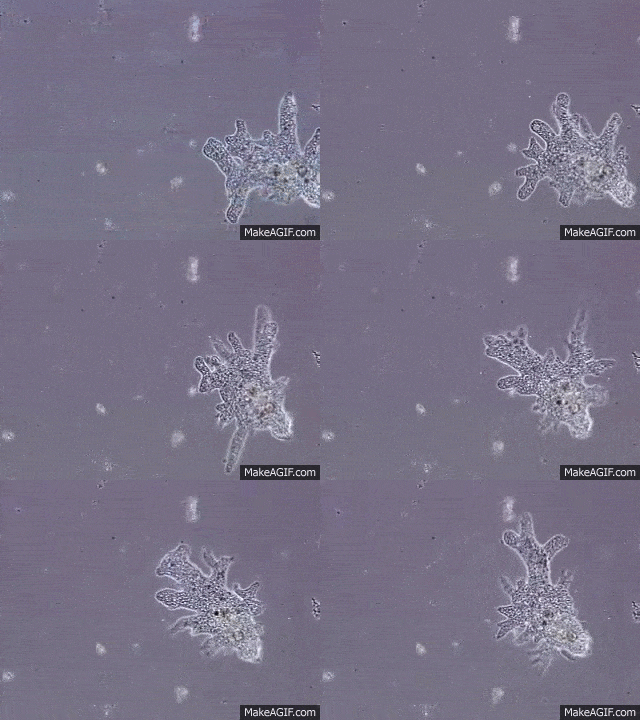
How does an amoeba move?
a)
It uses cilia
b)
It uses flagellum
c)
It uses pseudopods
d)
It cannot move
6.
What is the name of the hair-like structures on some protozoans that are used for movement?
a)
tentacles
b)
trichocysts
c)
Flagella
d)
Cilia
7.
Which of the following move using a whip-like structure?
a)
amoeba
b)
ciliate
c)
flagellate
d)
sporozoan
8.

Which protozoan is this?
a)
Amoeba
b)
Euglena
c)
Water mold
d)
Paramecium
9.

Which protozoan can photosynthesize?
a)
Amoeba
b)
Paramecium
c)
Plasmodium
d)
Euglena
10.
How do paramecium move?
a)
Cilia
b)
Flagella
c)
pseudopods
11.
a pseudopod is a(n) __________.
a)
extra nucleus for reproduction
b)
false foot for locomotion
c)
whip-like extension for locomotion
d)
second stage of protozoan life cycle
12.
What is a common way that pathogenic protozoa are transmitted?
a)
eating undercooked food
b)
fecal-oral contact
c)
airborne
d)
sexual contact
13.
Which protozoan is an STD / STI?
a)
Trypanosoma
b)
Toxoplasma
c)
Entamoeba histolytica
d)
Trichomonas
14.
Which old kingdom has ancestral member that gave rise to the Protozoa?
a)
Monera
b)
Plantae
c)
Fungi
d)
Protista
15.
Which is a NOT a method of transmission of pathogenic protozoa?
a)
breathing air
b)
drinking contaminated water
c)
contact with infected feces
d)
insect vectors
16.
Which of these is common in dogs and cats who drink contaminated water?
a)
Giardia
b)
Trypanosoma
c)
Plasmodium
d)
Trichomonas
17.

What type of protozoan is this?
a)
heliozoans
b)
radiolarians
c)
foraminiferans
d)
rhizopodans
18.

What phylum of protozoa contains members that can cause toxic blooms or have bioluminescence?
a)
Phylum Amoebozoa
b)
Phylum Euglenida
c)
Phylum Dinozoa
d)
Phylum Ciliophora
19.
Which genus of protozoa will prey on Paramecium?
a)
Gymnodinium
b)
Didinium
c)
Cryptosporidium
d)
Plasmodium
20.
Mosquitos are the vectors for
a)
Toxoplasma
b)
Cryptosporidium
c)
Plasmodium
d)
Giardia
21.
Which group does not have a structure for movement?
a)
Sarcodines
b)
Ciliates
c)
Flagellates
d)
Sporozoans
22.
Which pathogenic protozoan can affect pregnant females and cause stillbirth, miscarriage, or congenital disabilities in the fetus?
a)
Plasmodium
b)
Giardia
c)
Isopora
d)
Toxoplasma
23.
The layer that gives support to protozoans that is similar to a cytoskeleton is called the
a)
endoplasm
b)
pellicle
c)
cytopharynx
d)
egestion vacuole
24.
What is the function of the contractile vacuole?
a)
remove waste
b)
digest and transport food
c)
remove excess water
d)
mitosis
25.
Which of these is NOT a asexual reproductive method seen in protozoans?
a)
binary fission
b)
budding
c)
multiple fission
d)
conjugation
26.
Which group of protozoans has a test?
a)
Sarcodines
b)
Flagellates
c)
Ciliates
d)
Sporozoans
27.
Which of these protozoan groups has an apical complex used for penetrating host cells?
a)
Sarcodines
b)
Flagellates
c)
Ciliates
d)
Sporozoans
28.
Which of these structures is composed of protein threads and used for protection when discharged by the pellicle?
a)
trichocysts
b)
cytopharynx
c)
tentacles
d)
flagella
29.
Flagellates have dimorphic nuclei. The function of the macronucleus is
a)
daily metabolic activity
b)
contains DNA
30.
Marine ciliates that are sessile (attached to rocks) and have tentacles to sting prey are called
a)
didinium
b)
dinoflagellates
c)
suctorians
d)
giardia
31.

These protozoans are called
a)
foraminiferans
b)
radiolarians
c)
paramecium
d)
plasmodium
32.

This protozoan is a(n)
a)
radiolarian
b)
heliozoan
c)
amoeba
d)
Trypanosoma
33.

Giardia causes symptoms in what body system of mammal hosts?
a)
circulatory
b)
respiratory
c)
digestive
d)
skeletal
34.
Babesia causes symptoms in what body system of mammal hosts?
a)
circulatory
b)
respiratory
c)
digestive
d)
skeletal
35.
Which protozoan can resist chlorination and cause widespread illness in children, the elderly, and in HIV patients if it gets into water supply?
a)
Toxoplasma
b)
Cryptosporidium
c)
Plasmodium
d)
Trypanosoma
100 %

