
 Worksheets
DCA #1 Review
Total questions: 52
Worksheet time: 1hrs 23mins
Name
Class
Date
1.

This Founding Father was an ambassador to Spain and France during the American Revolution and the 1st Chief of the Supreme Court
a)
John Jay
b)
Benjamin Franklin
c)
John Adams
d)
James Madison
2.

This Founding Father is also known as the "Father of the Constitution" and wrote the Bill of Rights (1st 10 Amendments).
a)
Thomas Jefferson
b)
George Washington
c)
James Madison
d)
Andrew Hamilton
3.

Between 1865 and 1900 the U.S. government increased the number of people moving West through
a)
Providing price supports for farm products
b)
Offering low-interest loans to businesses
c)
Free coinage of silver
d)
granting land to railroads companies
4.

The direct election of Senators was adopted through which Amendment?
a)
16th
b)
17th
c)
18th
d)
19th
5.

Acquiring territories such as Hawaii were taken by the U.S. Government in order to
a)
gain overseas markets and raw materials
b)
begin the policy of Manifest Destiny
c)
establish military alliances with other nations
d)
Support isolationist forces in Congress
6.

Which event caused the immediate entry of the U.S. into WWI in 1917?
a)
League of Nations requested help
b)
U.S.S. Maine was blown up in Havana Harbor
c)
Nazi tyranny threatened Western democracy
d)
German submarine warfare on American ships
7.

The Homestead Act and the Transcontinental Railroad are both examples of the U.S. commitment to
a)
Conservation of Natural Resources
b)
Reconstruction
c)
Racial Equality
d)
Manifest Destiny
8.
Farmers in the 1870's and 1880's had a hard time making a profit off their goods because:
a)
Railroad companies charged high rates for transporting farm products
b)
Prices of agricultural products were increasing
c)
Farm labor was inionized
d)
Agricultural output was declining rapidly
9.

During the progressive Era, Progressive reformers wanted to fix which problem from industrialism
a)
Lack of capital for railroad expansion
b)
Unfair taxes on the wealthy
c)
Use of child labor in the workplace
d)
Restrictions on the use of natural resources
10.

Sears, J.C. Penny and Montgomery Ward are all examples of this type of business created at the end of the 1800's:
a)
Boutique
b)
Specialty Store
c)
Shopping Mall
d)
Department Store
11.

How did immigration change in America in the late 19th century?
a)
increase in the number of immigrants from Eastern and Southern Europe
b)
Most immigrants were political refugees
c)
Fewer immigrants arrived
d)
Most immigrants settled in rural, farm areas
12.

Alexis de Tocqueville spoke about the ability for citizens to meet in public "freely for all purposes." Which value does this refer to?
a)
Egalitarianism
b)
Laissez-Faire
c)
Populism
d)
Liberty
13.

During the first few years of WWI, what was Wilson/America's stance on getting involved?
a)
Create an alliance with the Allied Powers
b)
Create an alliance with the Central Powers
c)
Create a new alliance with Mexico
d)
Remain neutral/isolationism
14.

Why did the United States get involved in WWI?
a)
Zimmerman Telegram
b)
Unrestricted submarine warfare on American ships
c)
Economic interests
d)
All of the above
15.

Why did the Irish immigrate to America in large numbers
a)
Poverty
b)
Potato famine
c)
Political oppresion
d)
All of the above
16.
A sensationalist reporting in which writers often exaggerated stories to attract readers.
a)
De Lome Letter
b)
Journalism
c)
Yellow Journalism
d)
Isolationism
17.
The doctrine that a country should stay out of foreign affairs.
a)
Imperialism
b)
Isolationism
c)
Nationalism
d)
Militarism
18.
1898- This was written by the Spanish ambassador and it was published in the newspapers. It outraged Americans because it called President McKinley weak.
a)
Yellow Journalism
b)
USS Maine
c)
De Lome Letter
d)
Imperialism
19.
1898- It lasted only 4 months. This was the end of Spain's colonial empire and the emergence of the US as a world power,
a)
Sinking of the USS Maine
b)
Boxer Rebellion
c)
Dollar Diplomacy
d)
Spanish American War
20.
1903- The 48mile international waterway allows ships to pass between the Atlantic and Pacific Ocean, saving about 8,000 miles. ¨Expansion of World trade.
a)
Platt Amendment
b)
Monroe Doctrine
c)
Boxer Rebellion
d)
Panama Canal
21.
What amendment provided suffrage for women (1920)?
a)
16th
b)
17th
c)
18th
d)
19th
22.
What anti-monopoly law made all "combinations, contracts, and conspiracies" that restrained free trade illegal (1890)?
a)
Interstate Commerce Act
b)
Sherman Antitrust Act
c)
Clayton Antitrust Act
d)
Keller-Cefauver Act
23.
Who was the person who founded the settlement house (Hull House) for the Assimilation and Americanization of the immigrant poor?
a)
Elixabeth Cady Stanton
b)
Jane Addams
c)
Susan B. Anthony
d)
Belle Starr
24.
Who advocated for African Americans to take on menial jobs & blue collar jobs and earn the respect of white America with hard work ?
a)
WEB Du Bois
b)
Marcus Garvey
c)
Booker T. Washington
d)
Nat Turner
25.
Which Progressive President used Big Stick Diplomacy and was known as a Trust buster?
a)
Teddy Roosevelt
b)
Taft
c)
Woodrow Wilson
d)
Franklin D Roosevelt
26.

Whose book, the Jungle, caused the Pure Food and Drug Act and the Meat Inspection Act to be passed?
a)
Upton Sinclair
b)
Lincoln Steffens
c)
Ida Tarbell
d)
Jacob Riis
27.
Key Reforms of the Progressive Era
· Initiative
· Referendum
· Recall
· Direct Primary
· 17th Amendment
How did the reforms listed above impact America?
· Initiative
· Referendum
· Recall
· Direct Primary
· 17th Amendment
How did the reforms listed above impact America?
a)
A system of separate schools for new immigrants
b)
They gave citizens a greater voice in the democratic process of government
c)
More sources of revenue and taxes in state governments.
d)
They successfully brought economic relief to the urban working class
28.

Writers that dig up and expose the bad things going on in society
a)
Suffragists
b)
Muckrakers
c)
Students
d)
Yellow Journalists
29.

The founder of the NAACP who encouraged African Americans to fight to end segregation
a)
Booker T. Washington
b)
George Washington Carver
c)
W.E.B. Dubois
d)
Upton Sinclair
30.

Banned people from making (manufacture), transportation, drinking (consumption) or selling (distribution) of alcohol
a)
17th Amendment
b)
18th Amendment
c)
19th Amendment
d)
21st Amendment
31.

This was created to allow women to vote nationally
a)
17th Amendment
b)
18th Amendment
c)
19th Amendment
d)
21st Amendment
32.

The founder of the Tuskegee Institute and head of the African Americans community. Believed in vocational training to get a "slice of the economy".
a)
Booker T. Washington
b)
George Washington Carver
c)
W.E.B Dubois
d)
Upton Sinclair
33.
The Progressive Era tried to fix the problems of ________________
a)
The Civil War
b)
Reconstruction
c)
The Great Depression
d)
The Gilded Age
34.

Images such as this illustrate the position that many US companies were —
a)
requiring vocational training programs for children
b)
employing children as a source of cheap labor
c)
seeking government regulation of child labor
d)
providing safe working conditions for child laborers
35.
The Farmer's Alliance and the Grange, both founded during the Gilded Age, stood for additional government regulation of trade and creating the conditions for more political power and economic well being for farmers (as compared to industrialists). What 1890s group was founded, supporting these ideas, and attacking the Gold Standard?
a)
Progressives
b)
Free Soil Party
c)
IWW
d)
Populists
36.
What was a city government marked by corruption, bribery, and Kickbacks (common during the Gilded Age) called?
a)
credit mobilier
b)
political machine
c)
corrected democracy
d)
electoral politics
37.
Described as a time marked by gross income inequality and corrupt practices by corporations and abuse of workers, the term "Gilded Age" was coined by what writer?
a)
Upton Sinclair
b)
Andrew Carnegie
c)
Mark Twian
d)
Henry George
38.
Who gave the "Cross of Gold" speech?
a)
Willaim McKinley
b)
William Henry Harrison
c)
Marcus Hannah
d)
William Jennings Bryan
39.
Dawes Act
a)
Sioux Indians massacred here
b)
Indians are assimilated by this
c)
Indians are killed by this
d)
Indians are moved on Trail of Tears
40.
During the Gilded age, workers came together to work for better pay, working conditions, and less hours. Leaders such as Samuel Gompers help led many of this workers in....
a)
Philanthropy
b)
Labor Unions
c)
Political Bosses
d)
Credit Unions
41.

Which event sparked World War I?
a)
the German-French dispute over Alsace-Lorraine
b)
Russia’s quest for a warm water port
c)
assassination of the heir to the Austro-Hungarian throne
d)
sinking of the Lusitania
42.

Which of the following was not a main cause of WWI?
a)
Militarism
b)
Imperialism
c)
Alliances
d)
Progressivism
43.

What is the policy of building up armed forces in aggressive preparedness for war?
a)
Militarism
b)
Nationalism
c)
Imperialism
d)
Alliances
44.

During WWI, most battles were fought on the Western Front. Near what country was it located?
a)
England
b)
France
c)
Italy
d)
Russia
45.

Because of the Treaty of Versailles …
a)
Germany had to give up 1 million square miles of land
b)
Germany had to pay war reparations to the Allies
c)
Germany’s government was reconstructed.
d)
ALL OF THE ANSWERS ARE CORRECT
46.
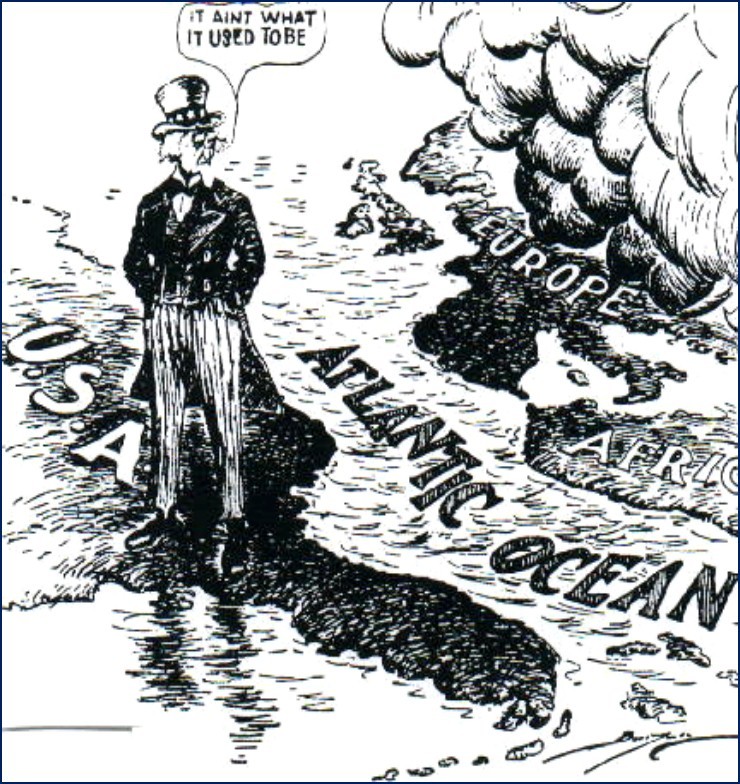
When a country is neutral it:
a)
makes an official alliance with another country
b)
sends troops to battle when a war begins
c)
does not take either side in a war and stays out of it
d)
declares war and joins the fight
47.

President Wilson's fourteen points
a)
initiated U.S. involvement in World War I
b)
laid out his goals for peace
c)
ended World War I
d)
called for Germany to accept blame for the war
48.

What were the U.S. forces that was led by General John Pershing, who fought with the Allies in Europe during WW1?
a)
American Battle Forces
b)
American Expeditionary Forces
c)
German Forces
49.

What act when 21 to 30 men had to register with the government in order to be randomly selected for military service in 1917?
a)
Lend-Lease Act
b)
Selective Draft Act
c)
Selective Service Act
50.

made it a crime for any person to convey information intended to interfere with the U.S. armed forces prosecution of the war effort or to promote the success of the country’s enemies.
a)
17th Amendment
b)
Espionage Act of 1917
c)
The US Constitution
d)
Wilson's 14 Points
51.

was a major part of the final Allied offensive of World War I that stretched along the entire Western Front. It was fought from September 26, 1918, until the Armistice of 11 November 1918, a total of 47 days.
a)
Battle of the Argonne Forest
b)
Battle of the Bulge
c)
Gulf War
d)
Battle of Berlin
52.

Is a United States Supreme Court case concerning enforcement of the Espionage Act of 1917 during World War I.
a)
Plessey vs Furgeson
b)
Brown vs. The Board of Education
c)
Schenck v. United States
d)
Texas vs. Johnson
100 %

