
NEW
Font size
S
M
L
XL
 Worksheets
Periodic table
Total questions: 25
Worksheet time: 12mins
Name
Class
Date
1.
Fluorine, chlorine, bromine, iodine, and astatine make up Group 17, the halogens. Why are these elements grouped together?
a)
They are all very reactive nonmetals with similar chemical properties.
b)
They are all nonreactive gases with similar physical properties.
c)
Their atoms all have eight electrons in their outer energy levels.
d)
They all have the same atomic number.
2.
Which of the following best describes the properties of metals?
a)
hard, brittle, and nonconductive
b)
liquid, dark, and conductive
c)
shiny, malleable, and conductive
d)
soft, oily, and very reactive
3.
How are the elements in the periodic table arranged?
a)
by their atomic mass
b)
by their chemical symbol
c)
by their chemical name
d)
by their atomic number
4.
What does the number of electrons in the outer level indicate about the element?
a)
how reactive the element is
b)
how malleable the element is
c)
how brittle the element is
d)
how ductile the element is
5.
vertical columns in the periodic table are _________ of elements with similar properties.
a)
groups
b)
periods
6.
_______ are horizontal rows of elements that contain increasing numbers of protons and electrons.
a)
groups
b)
periods
7.

According to its location on the periodic table, sodium (Na) can be described as
a)
an alkaline-earth metal.
b)
a transition metal.
c)
an alkali metal.
d)
a metalloid.
8.

What does the 1.00794 stand for?
a)
Hydrogen
b)
atomic number
c)
atomic mass
d)
atomic explosion
9.

The yellow atoms are called
a)
metals
b)
nonmetals
c)
metalloids
d)
noble gases
10.

The atoms along the staircase are called
a)
metals
b)
nonmetals
c)
metalloids
d)
noble gases
11.
What does Li mean?
a)
Lanthanum
b)
Lawrencium
c)
Lutetium
d)
Lithium
12.
An isotope is the same element with a different number of...? (4.3)
a)
Protons
b)
Neutrons
c)
Electrons
13.

what does the 6 represent?
a)
Atomic mass
b)
atomic number
c)
chemical symbol
d)
element name
14.

What does Pt represent/show ?
a)
Element name
b)
Element chemical symbol
c)
Atomic mass
d)
Pure substance
15.

What would the word platinum be described as being on the element card
a)
Period
b)
Element chemical symbol
c)
Element name
d)
Atomic number
16.
True/False The properties of an element can be predicted from its location in the Periodic Table.
a)
True
b)
False
17.
Elements in Group 2 have
a)
Two energy levels
b)
Two valence electrons
c)
Two compounds
d)
Two electrons
18.
The noble gases have how many valence electrons?
a)
1
b)
2
c)
7
d)
8
19.

Beryllium is in group number______.
a)
Group 2
b)
Group 3
c)
Group 4
d)
Group 7
20.

The period for Bromine is ___________.
a)
3
b)
2
c)
4
21.
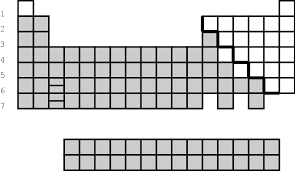
The colored part of the periodic table is.....
a)
nonmetals
b)
metals
c)
metalloids
d)
gases
22.

What happens to the atomic number of elements as you move left to right, up to down on the periodic table?
a)
The atomic number stays the same
b)
The atomic number decreases
c)
The atomic number decreases then increases
d)
Th atomic number increases
23.
What are the horizontal row in the periodic table called?
a)
periods
b)
family
c)
column
d)
group
24.
How many elements are there?
a)
103
b)
113
c)
118
d)
121
25.
High conductivity, solid at room temperature, and shiny
a)
Metals
b)
Nonmetals
Reset

