
 Worksheets
SPICY-1.3- 1.5 Q-Inertia, Gravity, Phases, Eclipses and Tide
Total questions: 46
Worksheet time: 32mins
Name
Class
Date
1.

This force attracts all objects towards each other.
a)
Newton
b)
gravity
c)
weight
d)
path
2.
The law of universal gravitation is credited to whom?
a)
Einstein
b)
Beckett
c)
Rose
d)
Newton
3.

The amount of matter in an object is what?
a)
pressure
b)
weight
c)
mass
d)
neutrinos
4.
The force of gravity on an object is called what?
a)
weight
b)
mass
c)
pressure
d)
ping
5.

This is a push or pull in any direction.
a)
shove
b)
force
c)
motion
d)
distance
6.

What is the tendency of an object to resist a change in motion?
a)
coffee
b)
motion
c)
inertia
d)
gravity
7.
What two main factors keep a planet in motion?
a)
mass and size
b)
weight and mass
c)
force and motion
d)
gravity and inertia
8.
Force of gravity is directly proportional to
a)
Mass
b)
Weight
c)
Distance
d)
Time
9.
Force of gravity is inversely proportional to
a)
Mass
b)
Weight
c)
Distance
d)
Time
10.
As distance between two objects increase, the pull of gravity
a)
Increases
b)
Decreases
c)
Stays the same
11.

Where would you have to travel to reduce your weight but not lose any mass?
a)
The moon
b)
The Sun
c)
Jupiter
d)
Saturn
12.
Two factors affecting the magnitude(strength) of the force of gravity between 2 objects are...
a)
mass and distance
b)
mass and matter
c)
distance and weight
d)
weight and mass
13.

Which of the following will change with different gravitational forces?
a)
mass
b)
amount of matter in an object
c)
weight
d)
kilograms
14.

Which of the following will not change in different gravitational fields?
a)
weight
b)
force
c)
mass
d)
pounds
15.

The strength of the force of gravity between two objects depends on _____ factors
a)
The masses of objects and the gravitational pull
b)
The mass of the planet and the mass of the object
c)
The masses of objects and the distance between them
d)
All of the above
16.
The weight of an object_______as it moves away from the center of Earth
a)
increases
b)
stays the same
c)
triples
d)
decreases
17.

Which has greater mass?
a)
the apples
b)
the oranges
c)
neither
18.
On which celestial object (object in space) would your mass be the greatest?
a)
Earth
b)
Jupiter
c)
Sun
d)
Your mass doesn't change on different celestial objects
19.

Why do all of the planets orbit the sun rather than Earth?
a)
the sun has more mass
b)
the sun is a star
c)
the Earth is heavier
d)
the sun is in the middle of the milky way
20.
How many days does it take for the moon to complete a full cycle?
a)
29
b)
29.5
c)
28
d)
28.52
21.
How many high tides and low tides are there each day?
a)
1 & 1
b)
2 & 2
c)
1 & 2
d)
2 & 1
22.
What moon phases do spring tides occur?
a)
new and full
b)
1st & 3rd quarters
23.
What moon phases do neap tides occur?
a)
new and full
b)
1st & 3rd quarters
24.
When the moon blocks the Earth from the sun what occurs?
a)
Lunar Eclipse
b)
Solar Eclipse
25.

Which tide is seen here?
a)
Neap Tide
b)
Spring Tide
26.

Which tide is seen here?
a)
Neap Tide
b)
Spring Tide
27.
Neap tides have what kind of tides?
a)
Strong, extreme tides
b)
Weak tides
c)
Average tides
28.
Spring tides have what kind of tides?
a)
Strong, extreme tides with the greatest difference between high and low tide
b)
Weak tides with the least amount of difference between high and low tides
c)
Average tides
29.

What is it called when there is a little bit of light on the left side of the moon and light is decreasing?
a)
Waxing crescent
b)
Waxing gibbous
c)
Waning gibbous
d)
waning crescent
30.

What is it called when there is a little bit of light on the right side of the moon and light is increasing?
a)
Waxing crescent
b)
Waxing gibbous
c)
Waning gibbous
d)
Waning cresent
31.

What is it called when more than half of the moon is lit on the right side and light is increasing?
a)
Waxing crescent
b)
Waxing gibbous
c)
Waning gibbous
d)
Waning crescent
32.

What is it called when more than half of the moon is lit on the left side and light is decreasing?
a)
Waxing crescent
b)
Waxing gibbous
c)
Waning gibbous
d)
Waning cresent
33.
What is it called when the light of the moon is decreasing?
a)
waxing
b)
waning
34.
What is it called when the light of the moon is increasing?
a)
waxing
b)
waning
35.
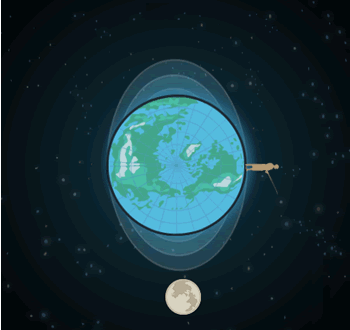
In the diagram below, the observer is experiencing a _______ low tide. What is the most likely position of the Sun? (Note: Shading has been removed from the diagram so it cannot be used to determine the Sun's position.)
a)
A. neap, To the left of the image.
b)
B. neap, To the right of the image.
c)
C. spring, Above the image.
d)
D. All positions are equally likely.
36.
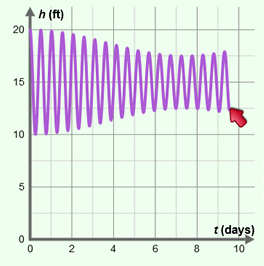
What type of tide is occuring at 0 days AND during what phase of the moon?
a)
spring, new
b)
neap, 1st quarter
c)
spring, 3rd quarter
d)
neap, full
37.
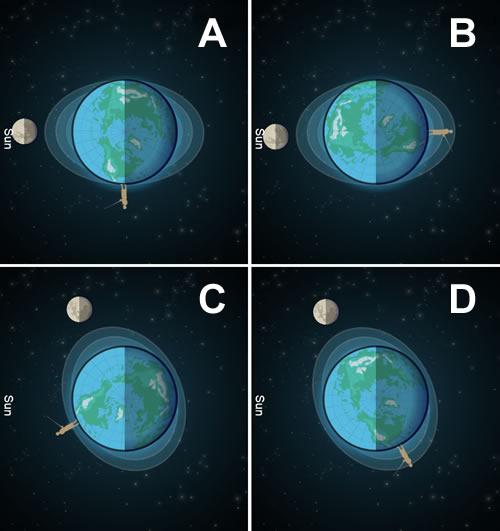
Which diagram shows the observer standing at a daily high tide during spring tide?
a)
A
b)
B
c)
C
d)
D
38.
Which diagram shows the observer standing at a daily low tide during neap tide?
a)
A
b)
B
c)
C
d)
D
39.

Which diagram shows a third quarter moon?
a)
F
b)
G
c)
H
d)
J
40.

This picture is an example of
a)
Solar Eclipse
b)
Lunar Eclipse
c)
Solar Ellipse
d)
New Moon
41.

This picture is an example of
a)
Solar Eclipse
b)
Lunar Eclipse
c)
New Moon
d)
Constellation
42.

What is the central, darker part of a shadow called?
a)
the umbra
b)
the penumbra
43.

The tidal range on November 8 was approximately
a)
11 m
b)
2 m
c)
13 m
d)
15 m
44.

In the diagram, the current moon phase is shown. Which image shows the moon phases that will be seen immediately before and after the current moon phase?
a)
Image A
b)
Image B
c)
Image C
d)
Image D
45.

If the sun, moon, and Earth are lined up, what does this diagram represent?
a)
full moon
b)
new moon
c)
lunar eclipse
d)
solar eclipse
46.

If these three bodies are lined up with each other, what would this diagram represent and what shadow would create a total eclipse?
a)
full moon, umbra
b)
new moon, penumbra
c)
lunar eclipse, penumbra
d)
solar eclipse, umbra
100 %

