
 Worksheets
Nuclear Reactions
Total questions: 10
Worksheet time: 30mins
Name
Class
Date
1.

Identify elements A and B and the process, C, in the illustration below.
a)
Deuterium, Tritium, Nuclear Fusion
b)
Deuterium, Tritium, Nuclear Fission
c)
Tritium, Hydrogen, Nuclear Fusion
d)
Deuterium, Hydrogen, Nuclear Fission
2.
Two reactions occur that do not obey the Law of Conservation of Mass. The first reaction involves light elements forming heavier ones. The second reaction has heavy elements forming lighter ones. Which statement describes these reactions?
a)
Both reactions may be nuclear fusion
b)
Both reactions may be nuclear fission
c)
The first reaction is nuclear fusion, and the second is nuclear fission
d)
The first reaction is nuclear fission, and the second is nuclear fusion
3.
A nuclear fission reaction occurs when a uranium-235 atom is bombarded with a neutron. This reaction is used to produce energy in a nuclear power plant. Why is it not possible to carry out a nuclear fusion reaction in a nuclear reactor?
a)
A fusion reaction releases harmful rays
b)
A fusion reaction is difficult to control
c)
A fusion reaction requires extremely low temperature and pressure
d)
A fusion reaction requires extremely high temperature and pressure
4.
In nuclear fusion, two positively charged nuclei must touch and bind together. This requires that the nuclei approach each other at.....
a)
low temperatures and low velocity
b)
low temperatures and high velocity
c)
high temperatures and high velocity
d)
high temperatures and low velocity
5.
Which of the following statements BEST describes nuclear fission?
a)
Nuclear fission inside stars can absorb or release energy
b)
Nuclear fission causes the reaction inside an atomic bomb
c)
Nuclear fission is usually present in endothermic reactions
d)
Nuclear fission cannot be used to produce power in nuclear energy plants
6.
Which of the following statements BEST describes nuclear fusion?
a)
Nuclear fusion is a common source of energy
b)
Nuclear fusion usually requires freezing temperatures
c)
Nuclear fusion usually requires a high-temperature environment
d)
Nuclear fusion releases a small amount of energy compared to most
chemical reactions
7.
The half life of iodine-131 is 8.040 days. What percentage of an iodine-131 sample will remain after 40.20 days?
a)
312.5%
b)
31.25%
c)
.3125%
d)
3.125%
8.
Has a mass of 4 and a charge of +2
a)
Alpha
b)
Beta
c)
Gamma
9.
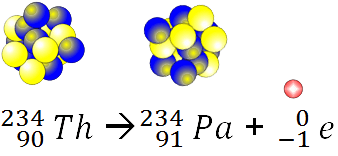
Which type of nuclear radiation is being emitted here?
a)
Alpha
b)
beta
c)
gamma
d)
none
10.

Has the symbol
a)
Alpha
b)
Beta
c)
Gamma
100 %

