
 Worksheets
Cells: The Basic Unit of Life
Total questions: 50
Worksheet time: 42mins
Name
Class
Date
1.
A web of proteins in the cytoplasm that keeps a cell's membrane from collapsing
a)
Cell Wall
b)
Cytoskeleton
c)
ER
d)
Lysosomes
2.

Which organelle is only found in a plant cell?
a)
nucleus
b)
chloroplast
c)
mitochondria
d)
cell membrane
3.

The Golgi apparatus _____.
a)
packages cell products for export
b)
eliminates waste
c)
stores DNA
d)
makes energy
4.

This organelle creates chemical energy.
a)
Nucleus
b)
Ribosome
c)
Mitochondria
d)
ER
5.

This guy first saw cells of cork through a microscope....and Newton hated his guts.
a)
Anton van Leeuwenhoek
b)
Robert Hooke
c)
Charles Schwann
d)
Mr. Messmann
6.

Where is DNA stored in a cell?
a)
Lysosomes
b)
Golgi Complex
c)
Ribosomes
d)
Nucleus
7.

What is the fluid inside a cell called?
a)
Endoplasimic Reticulum
b)
Orange Juice
c)
Water
d)
Cytoplasm
8.

Which of these is NOT a part of the Cell Theory?
a)
All cells are independent.
b)
Cells are the basic unit of living things.
c)
All living things are one or more cells.
d)
Cells come from cells.
9.

This organelle helps plants keep their rigid structure.
a)
Cell wall
b)
Cell membrane
c)
Chloroplast
d)
Nucleus
10.

This organelle turns the light energy into a simple sugar.
a)
Mitochondria
b)
ER
c)
Chloroplast
d)
Nucleus
11.

This organelle transports materials throughout the cell through a system of folded membranes.
a)
ER
b)
Ribosomes
c)
FedEx
d)
Golgi Complex
12.
This organelle eliminates waste and worn-out organelles
a)
Nucleus
b)
ER
c)
Vacuole
d)
Lysosome
13.

This organelle makes proteins.
a)
Cell membrane
b)
Nucleus
c)
Ribosome
d)
ER
14.

Plant and animal cells are identical.
a)
True
b)
False
15.

The chloroplast _____.
a)
uses sugar to make energy
b)
eliminates waste products from the cell
c)
uses light energy to make sugar (glucose)
d)
manufactures proteins for cell export
16.
You are made up of...
a)
eukaryotic cells
b)
prokaryotic cells
c)
plant cells
d)
bacterial cells
17.
A large fluid-filled vesicle located in the cytoplasm of a plant cell; stores water, enzymes, and waste; keeps toxic wastes away from the rest of the cell.
a)
Lysosome
b)
Vacuole
c)
Flagella
d)
Centrioles
18.
All cells are produced ____________.
a)
from nothing
b)
from other cells
19.
The first part of the Cell Theory states: "What happens in Cell Theory, stay in Cell Theory."
a)
True
b)
False
20.
When observing cells, which of the following optical tools is most appropriate?
a)
Hand lens
b)
Telescope
c)
Petri dish
d)
Microscope
21.
There are three parts to the cell theory. Which is NOT one of those parts?
a)
All organisms are composed of one or more cells.
b)
The cell is the basic unit of structure and organization in organisms.
c)
Cells spontaneously arise from carbon and nutrients carried in the bloodstream.
d)
All cells come from pre-existing cells.
22.
"All animals are made of cells". This fact was discovered by...
a)
Matthias Schleiden
b)
Theodor Schwann
c)
Robert Hooke
d)
Rudolf Virchow
23.
Who looked at cork and named the cell?
a)
Robert Hooke
b)
Van Leeuwenhoek
c)
Robert Brown
d)
Francesco Redi
24.

Identify this structure that surrounds the entire cell.
a)
cell wall
b)
cell membrane
c)
sap vacuole
d)
cytoplasm
25.

Identify this structure that is green and makes food the plant cell.
a)
cytoplasm
b)
cell wall
c)
chloroplast
d)
cell membrane
26.
A group of the same type of cells that work together for a purpose are called -
a)
a tissue
b)
an organ
c)
an organ system
d)
an unicellular organism
27.
A group of tissues working together is -
a)
an organ
b)
an organ system
c)
a prokaryote
d)
a cell
28.
The levels of organization from the simplest to the most complex are
a)
Cells, tissues, organs, organ systems, organism
b)
Organisms, organs, tissues, cells, organ systems
c)
Cells, organs, organ systems, tissues, organism
d)
Tissues, cells, organs, organism
29.

A group of organs working together to perform a life function for a multicellular organism would be called a(n)
a)
organ system
b)
organism
c)
tissue
d)
organ
30.
Which statement is correct?
a)
Tissues are composed of cells that have the same function
b)
Tissues that have the same function form organ systems
c)
Cells that have the same function form an organ
d)
Organisms are composed of tissues that have the same function
31.
Which statement is correct?
a)
Tissues are composed of cells that have the same function
b)
Tissues that have the same function form organ systems
c)
Cells that have the same function form an organ
d)
Organisms are composed of tissues that have the same function
32.
Twenty years after M.J Schleiden and Theodore Schwann published separate conclusions on the cell theory, Rudolf Virchow proposed that -
a)
cells form only from pre-existing cells
b)
bacteria can form in a sterile broth
c)
all cells can trace their ancestry back to ancient times
d)
cells are the building blocks of life
33.
Which correctly matches the scientists to their contribution to cell theory?
a)
Hooke - discovered and named the "cell"
Schleiden - stated all plants are composed of cells
Leeuwenhoek - discovered "animalcules" in pond water
Schleiden - stated all plants are composed of cells
Leeuwenhoek - discovered "animalcules" in pond water
b)
Hooke - discovered "animalcules" in pond water,
Schwann - stated all animals are composed of cells
Virchow - all cells come from pre-existing cells
Schwann - stated all animals are composed of cells
Virchow - all cells come from pre-existing cells
c)
Leeuwenhoek - discovered "animalcules" in pond water
Schleiden - stated all animals are composed of cells
Schwann - stated all plants are composed of cells
Schleiden - stated all animals are composed of cells
Schwann - stated all plants are composed of cells
d)
Schleiden - all cells come from pre-existing cells
Schwann - all plants are composed of cellsj
Virchow - all plants are composed of cells
Schwann - all plants are composed of cellsj
Virchow - all plants are composed of cells
34.

What free-floating substance is "C" pointing to in the cytoplasm?
a)
Flagellum
b)
Cell Wall
c)
DNA
d)
Nucleus
35.
Hooke and Leeuwenhoek helped with the discovery of cells as well as...
a)
helped discover mushrooms
b)
aided in the discovery of plasma
c)
nothing, they were ineffective scientists
d)
Aided in the development of the microscope
36.
When Leeuwenhoek looked at pond scum, he found little organisms that he called "animalcules." What are these known as today?
a)
Tiny fish
b)
Protists
c)
Large Bacteria
d)
Nothing, just dirt
37.
Ribosomes can be found in the membranes of what organelle?
a)
Cell Wall
b)
Nucleus
c)
Vesicles
d)
ER
38.
Which of the following is NOT a kind of active transport?
a)
Endocytosis
b)
Exocytosis
c)
Osmosis
39.
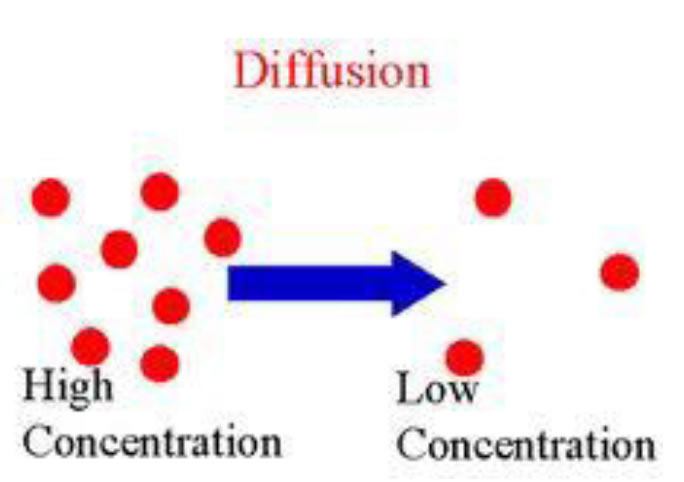
What is this image depicting?
a)
Passive Transport
b)
Active Transport
40.

What is this image depicting?
a)
Passive Transport
b)
Active Transport
41.
Low to High
a)
Passive Transport
b)
Active Transport
42.
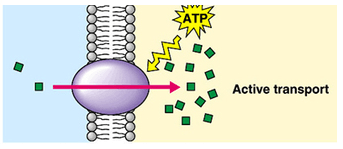
What is this image depicting?
a)
Passive Transport
b)
Active Transport
43.

The picture is an example of _________________.
a)
isotonic
b)
diffusion
c)
osmosis
44.
When both inside and outside of a cell have the same amount of water it is said that the cell has reached a state of ___________.
a)
osmosis
b)
equilibrium
c)
diffusion
45.
What does selectively or semi-permeable mean?
a)
The cell controls what passes in and out of the cell
b)
Nothing gets through
c)
The cell lets only large substances through
46.
What is Osmosis?
a)
equal concentration
b)
diffusion of water through a selectively-permeable membrane
c)
high to low concentration
d)
non-polar tail
47.
TRUE or FALSE: It requires energy for particles to move from an area of high concentration to an area of low concentration
a)
True
b)
False
48.
What happens when your muscle cells run out of oxygen?
a)
The muscle cell die
b)
Short-Term paralysis
c)
Long term paralysis
d)
Fermentation supplies energy
49.
TRUE or FALSE: Photosynthesis happens in the chloroplasts & cellular respiration happens in the mitochondria
a)
True
b)
False
50.
What are the required ingredients or reactants for photosynthesis?
a)
Light energy, water, and glucose
b)
ATP, water & carbon dioxide
c)
Light energy, water, and carbon dioxide
d)
Nothing, it create energy from thin air through the use of magic
100 %

