
 Worksheets
Moon Phases
Total questions: 112
Worksheet time: 4hrs 53mins
Name
Class
Date
1.

The Moon ________ around the Earth.
a)
moves parallel
b)
rotates
c)
moves perpendicular
d)
revolves
2.

What moon phase is at position 1?
a)
new moon
b)
waxing gibbous
c)
waning gibbous
d)
waning crescent
3.

What moon phase is at position 6?
a)
waxing crescent
b)
waxing gibbous
c)
waning gibbous
d)
waning crescent
4.

What moon phase is at position 5?
a)
waxing crescent
b)
waxing gibbous
c)
full moon
d)
waning crescent
5.

What moon phase is at position 3?
a)
waxing crescent
b)
1st quarter
c)
3rd quarter
d)
waning crescent
6.

What moon phase is at position 7?
a)
1st quarter
b)
3rd quarter
c)
waning gibbous
d)
waning crescent
7.

What moon phase is at position 8?
a)
waxing crescent
b)
waxing gibbous
c)
waning gibbous
d)
waning crescent
8.

What moon phase is at position 4?
a)
waxing crescent
b)
waxing gibbous
c)
waning gibbous
d)
waning crescent
9.

What moon phase is at position 2?
a)
waxing crescent
b)
waxing gibbous
c)
waning gibbous
d)
waning crescent
10.

Name the moon phase
a)
waning crescent
b)
waxing crescent
c)
waning gibbous
d)
waxing gibbous
11.

Name the moon phase
a)
waning crescent
b)
waxing crescent
c)
waning gibbous
d)
waxing gibbous
12.

Name the moon phase
a)
waning crescent
b)
waxing crescent
c)
waning gibbous
d)
waxing gibbous
13.

Name the moon phase
a)
waning crescent
b)
waxing crescent
c)
waning gibbous
d)
waxing gibbous
14.

Name the moon phase
a)
waning crescent
b)
waxing crescent
c)
waning gibbous
d)
waxing gibbous
15.

Name the moon phase
a)
First Quarter
b)
Last Quarter
c)
New Moon
d)
Full Moon
16.

Name the moon phase
a)
First Quarter
b)
Last Quarter
c)
New Moon
d)
Full Moon
17.

Name the moon phase
a)
First Quarter
b)
Last Quarter
c)
New Moon
d)
Full Moon
18.

Name the moon phase
a)
First Quarter
b)
Last Quarter or (third quarter)
c)
New Moon
d)
Full Moon
19.
How much of the moon is always lit?
a)
can't tell
b)
always changes
c)
half
d)
3/4
20.

Name the moon phase that would come AFTER this moon.
a)
waning crescent
b)
waxing crescent
c)
waning gibbous
d)
waxing gibbous
21.

What moon phase came right BEFORE this one?
a)
First Quarter
b)
Last Quarter
c)
New Moon
d)
Full Moon
22.
Is a moon that is waxing growing in size?
a)
yes
b)
no
c)
I don't know
d)
no
23.
Is a waning moon getting smaller in size?
a)
yes
b)
no
c)
let me think...
24.
When does a lunar eclipse happen?
a)
I do not know
b)
when there is a shadow of the Earth on the moon
c)
It is a phase of the moon
25.
How long is the moons complete phase?
a)
29.5 days
b)
30 days
c)
45 days
d)
I don't know
26.
How many phases does the moon have?
a)
7 phases
b)
5 phases
c)
I do not know
d)
8 phases
27.
Is the moon Earth's natural sattllie?
a)
no
b)
Yes
c)
I don't know
28.

What happens when the area in which you live tilts away from the sun?
a)
It is summer.
b)
It is spring.
c)
It is winter.
d)
It is fall.
29.

Why does the area around the equator stay the same temperature all year?
a)
The equator rotates slower than the poles.
b)
The equator remains the same distance from the sun.
c)
The equator always receives direct sunlight.
d)
The equator has 18 hour days.
30.
What are the reasons for the seasons?
a)
Earth's tilt and rotation.
b)
Earth's rotation and revolution.
c)
Earth's tilt and revolution.
d)
Earth's tilt and resolution
31.
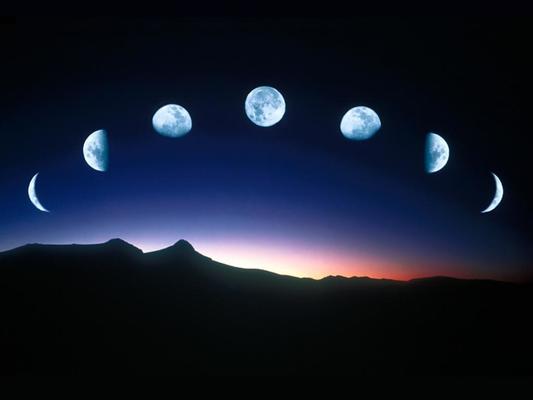
When the moon waxes, it ________.
a)
goes from a new moon to a full moon
b)
seems to get bigger in size
c)
goes from a full moon back to a new moon
d)
A and B only
32.

When the moon wanes, it ________.
a)
goes from a new moon to a full moon
b)
goes from a full moon back to a new moon
c)
seems to get smaller in size
d)
B and C only
33.

What is the correct order of the first five phases of the moon?
a)
full, crescent, quarter, gibbous, new
b)
new, crescent, gibbous, quarter, full
c)
new, crescent, quarter, gibbous, full
d)
full, quarter, gibbous, crescent, new
34.
The curved path of a celestial object or spacecraft around a star, planet, or moon, especially a periodic elliptical revolution?
a)
planet
b)
rotation
c)
orbit
d)
tide
35.
The moon at any time after new moon and before full moon, so called because its illuminated area is increasing.
a)
waning phases
b)
waxing phases
36.

What is true of a new moon?
a)
The moon appears invisible.
b)
You can see about half the moon.
c)
The moon looks like a pizza pie.
d)
It involves teenage vampires
37.

When only a small part of the moon is visible, it is probably in what phase?
a)
waxing or waning crescent
b)
first quarter
c)
new moon phase
d)
waxing or waning gibbous phase
38.

When the visible (lit) portion of the moon is increasing, the moon is:
a)
waning
b)
full
c)
waxing
d)
new
39.

When the Earth is between the moon and sun, it is most likely a:
a)
new moon
b)
full moon
c)
waxing crescent
d)
waxing gibbous
40.

Approximately how much time passes between the new moon and full moon?
a)
one month
b)
two weeks
c)
3 days
d)
24 hours�
41.
Changes in the moon's appearance are
a)
phases
b)
eclipses
c)
stages
d)
cycle
42.
What causes the moon's phases
a)
Where you are standing on Earth
b)
the amt of sunlight reflected onto the moon from the sun
c)
The tilt of Earth
d)
how fast the moon is rotating
43.
Why do we always see the same side of the moon from Earth?
a)
because the phases change
b)
because it rotates and revolves at the same rate
c)
because half of the moon always receives sunlight
d)
The moon changes positions�
44.

The Moon orbits Earth in a ________________ direction
a)
clockwise
b)
counterclockwise
c)
upwards
d)
downwards
45.
Define Waxing
a)
Part of the moon that is lit appears to be growing from the right
b)
Completely illuminated
c)
dark side is facing earth
d)
Part of the moon that is lit appears to be shrinking from the left
46.
Define Waning
a)
Moon appears to be gradually increasing and lit on the right
b)
Moon is completely illuminated�
c)
Moon appears to be gradually decreasing and lit on the left
d)
More than half illuminated�
47.
Define Full Moon
a)
None of moon is visible
b)
Half moon phase is visible
c)
Complete moon face is visible
d)
Less Than half of moon is visible
48.
Define New Moon
a)
None of moon is visible from Earth
b)
All of moon visible from Earth
c)
Moon is 1/2 visible from Earth
d)
Moon is more than Half Visible from Earth
49.
Define Quarter Moon
a)
None of the moon is visible
b)
Less than Half the moon is visible
c)
More than half of moon is visible
d)
Half of the moon is visible
50.
The 1st Quarter moon is lit on the:
a)
Left Side
b)
Right Side
51.
T/F The moon can be seen from Earth because it reflects the sun's light
a)
TRUE
b)
FALSE
52.
T/F When the moon is waxing, the part that is lit by the sun is getting larger on the right side
a)
TRUE
b)
FALSE
53.
The 3rd quarter (or Last quarter) moon is:
a)
waning
b)
waxing
54.
A[n] ______________ tide occurs when the sun is at right angles to the line between Earth and the moon.
a)
high
b)
neap
c)
low
d)
spring
55.
Differences in the moon's and sun's pull on different sides of the Earth cause _________.
a)
gravity
b)
lunar phases
c)
tides
d)
dabbing
56.
A[n] ___________ tide occurs when the sun, Earth, and the moon are nearly in a line.
a)
spring
b)
high
c)
low
d)
neap
57.
The bulge of water on the side of the Earth closest to the moon produces ___________.
a)
high tide
b)
low tide
c)
neap tide
d)
spring tide
58.
Tides are the cycle of rising and falling ocean water that repeats automatically every
a)
24 hours
b)
12.5 hours
c)
25 hours
d)
6.25 hours
59.
Tides are caused mainly by the differences in how much gravity from the moon and the sun pulls on different parts of the Earth.
a)
True
b)
False
60.
Changes in the positions of Earth, the moon, and the sun affect the height of high tides during a month.
a)
True
b)
False
61.

Tides are caused by
a)
strong winds that blow over ocean waters.
b)
the interaction of Earth, the moon and the sun.
c)
the shifting of the plates on the ocean floor.
d)
variations in the salinity of ocean water
62.

What do we call a tide that has a large tidal range?
a)
gravity
b)
wind
c)
spring
d)
neap
63.
What do we call the tides with a small tidal range that happen when the sun and moon are at right angles to each other?
a)
Neap Tide
b)
Spring Tide
c)
Larger Change
d)
Smaller Change
64.
In general, tides occur...
a)
each hour
b)
2 times a day
c)
each month
d)
twice a month
65.

What type of tides would this arrangement of Earth-Moon-Sun create?
a)
neap tide
b)
spring tide
c)
new moon tide
d)
full moon tide
66.

What type of tide would this arrangement of Earth-Moon-Sun create?
a)
full moon tide
b)
new moon tide
c)
neap tide
d)
spring tide
67.
What causes tides?
a)
gravity
b)
wind
c)
spring
d)
neap
68.

Which body has the greater effect on Earth's tides?
a)
Sun
b)
Saturn
c)
Moon
d)
Venus
69.
If tides alternate from high to low and there are two of each type of tide a day, about how many hours will generally be between each different tide?
a)
2 hours
b)
6 hours
c)
12 hours
d)
24 hours
70.
The Sun has much more mass than the Moon yet the Moon has a much greater effect on Earth's tides. Why?
a)
The Sun is much closer
b)
The Sun is much farther away
c)
The Sun is too hot for tides
d)
The Dark Side of the Moon is too dark
71.

What is a difference between spring and neap tides?
a)
Spring tides occur when the earth and sun are IN LINE with the new or full moon.
b)
Spring tides occur when moon in 3rd or 1st quarter phases
c)
Spring tides are LOWER than neap tides
d)
Spring tides occur in Spring and neap tides can occur in any season
72.
When the moon is at full moon or new moon, what type of tide will we experience?
a)
rip tide
b)
spring tide
c)
neap tide
d)
breaker tide
73.
Spring tides and neap tides occur in patterns governed by the
a)
phases of the moon
b)
seasons (fall, winter, etc.)
c)
surface currents
d)
deep sea currents
74.

On what day did the highest high tide occur?
a)
Friday
b)
Monday
c)
Thursday
d)
Saturday
75.

On what day was there the largest tidal range?
a)
Friday
b)
Monday
c)
Saturday
d)
Thursday
76.

Just after midnight on Thursday will the tide be...
a)
rising
b)
springing
c)
neaping
d)
falling
77.
What does the rotation of the earth cause us to experience?
a)
seasons
b)
year
c)
day & night
d)
eclipse
78.
What is the longest day of the year?
a)
winter solstice
b)
summer solstice
c)
fall equinox
d)
spring equinox
79.
Equinox means -
a)
Equal light
b)
Longest day
c)
Shortest day
d)
Tilt
80.
Earth's axis is tilted at -
a)
23.5 degrees
b)
33.5 degrees
c)
28 degrees
d)
90 degrees
81.
When the Northern Hemisphere learns toward the sun, daylight is -
a)
shorter
b)
longer
c)
equal
82.
When the Northern Hemisphere leans toward the sun, the northern part gets -
a)
more sunlight
b)
less sunlight
c)
to be winter
d)
cooler
83.
If its ____ in the Northern hemisphere, then its summer in the Southern hemisphere.
a)
spring
b)
summer
c)
fall
d)
winter
84.

What season is letter A in the northern hemisphere?
a)
Winter
b)
Summer
c)
Spring
d)
Fall
85.
Which particle contributes the negative charge to the atom?
a)
proton
b)
electron
c)
neutron
d)
nucleus
86.
Which particle does not contribute mass to the atom?
a)
Proton
b)
Neutron
c)
Electron
d)
Nucleus
87.

What element has 3 p+?
a)
nitrogen
b)
lithium
c)
beryllium
d)
carbon
88.
The three main subatomic particles are electrons, protons and ____________.
a)
photons
b)
neurons
c)
neutrons
d)
quarks
89.
What is the electrical charge of a proton?
a)
1+
b)
1-
c)
neutral
d)
2-
90.
What is atomic number?
a)
Number of protons in an atoms
b)
Number of neutrons in an atom
c)
Mass of an atom
d)
Charge on an atom
91.
Which subatomic particles are found in the nucleus of an atom?
a)
Protons and Electrons
b)
Protons and Neutrons
c)
Neutrons and Electrons
d)
Protons, Neutrons and Electrons
92.
What electrical charge does an electron have?
a)
+1
b)
0
c)
-1
d)
+2
93.
The total number of protons and neutrons in an atom is called the...
a)
Atomic number
b)
Proton number
c)
Mass number
d)
Weight number
94.
Subatomic particle that determines the identity of the atom
a)
proton
b)
nucleus
c)
electron
d)
neutron
95.
True or false: as you move along the spectrum, left to right, the wavelengths decrease in size (get smaller)
a)
true
b)
false
96.
A wave with a large wavelength will have a ______ frequency and _____ energy
a)
high, low
b)
high, high
c)
low, high
d)
low, low
97.
Select the correct order of waves on the EMS
a)
Radio, Micro, Infra, Visible, Ultra, X-ray, Gamma
b)
Gamma, X-ray, Ultra, Vis, Infra, Micro, Radio
c)
Vis, Micro, Infra, Ultra, X-ray, Gamma, Radio
d)
Micro, Radio, Vis, Infra, Ultra, X-ray, Gamma
98.
Which has the LONGEST wavelength and, therefore, the lowest frequency/energy
a)
Gamma Rays
b)
Radio Waves
c)
Visible Light
d)
Infrared rays
99.
Which has the SHORTEST wavelength and, therefore, the highest frequency/most energy
a)
Radio waves
b)
Ultraviolet Rays
c)
Gamma Rays
d)
X-rays
100.
Which section of the spectrum is the ONLY one we can see?
a)
X-rays
b)
Visible Light
c)
Gamma Rays
d)
Ultraviolet Rays
101.
Which part of the electromagnetic spectrum has high enough energy to cause damage to eyes and skin, and sometimes even cancer?
a)
Infrared Rays
b)
Radio Waves
c)
Microwaves
d)
Ultraviolet Rays
102.
Put the visible light colors in order from longest wavelength to shortest wavelength
a)
Violet, Indigo, Blue, Green, Orange, Yellow, Red
b)
Red, Yellow, Green, Orange, Violet, Blue, Indigo
c)
Red, Orange, Yellow, Green, Blue, Indigo, Violet
103.
Which of the following electromagnetic waves is given off as heat?
a)
Radio Waves
b)
Infrared Rays
c)
Visible Light
d)
Gamma Rays
104.
The sun and everything that revolves around it.
a)
solar system
b)
galaxy
c)
universe
d)
rotation
105.
What is the main element in a stars composition?
a)
Hydrogen
b)
Helium
c)
Lithium
d)
Heavy Elements
106.
The color of the star tells us its
a)
composition
b)
Temperature
c)
Luminosity
d)
Mass
107.
The hottest color star is
a)
Blue
b)
White
c)
Yellow
d)
Red
108.
Our star is a
a)
yellow/ large star
b)
yellow/ small star
c)
yellow/ medium star
109.
What do we use to classify the temperature, brightness, and size of stars?
a)
Color
b)
The star's shape
c)
H-R Diagram
110.

What is the name of the largest stars?
a)
Protostars
b)
Supergiants
c)
Red Giants
d)
Dwarf Stars
111.

What is the name of the gas/dust clouds that form stars?
a)
Nebulas
b)
Protostars
c)
Supernova
d)
Neutron Star
112.

What is the name of the explosion at the death of a massive star?
a)
Supergiant
b)
Supernova
c)
Black Hole
d)
Nebula
100 %

