
 Worksheets
100 questions
Total questions: 109
Worksheet time: 2hrs 50mins
Name
Class
Date
1.
Which of the following energy transformations occur when a lamp that is plugged into a wall socket is functioning correctly?
a)
Chemical to light
b)
Electrical to chemical
c)
Electrical to light
d)
Chemical to electrical
2.
Which of the following shows an energy transformation from chemical energy to electrical to light energy?
a)
A bolt of lightning lights the night sky.
b)
A candle glows brightly in the dark.
c)
A fire in a fireplace lights up a room.
d)
A battery causes a flashlight to shine.
3.
What energy transformations take place when a battery-operated radio is in use?
a)
Electrical to chemical to light
b)
Sound to chemical to mechanical
c)
Chemical to electrical to sound
d)
Light to electrical to thermal
4.
People get energy from the food that they eat and transform that energy as they move. Which energy transformations occur as a student rapidly rubs the palms of his hands together?
a)
mechanical to thermal to electrical
b)
chemical to mechanical to thermal
c)
mechanical to chemical to sound
d)
chemical to sound to electrical
5.
Which of the following devices transforms electrical energy into mechanical energy?
a)
An e-reader
b)
a fan
c)
a manual pencil sharpener
d)
ipod
6.
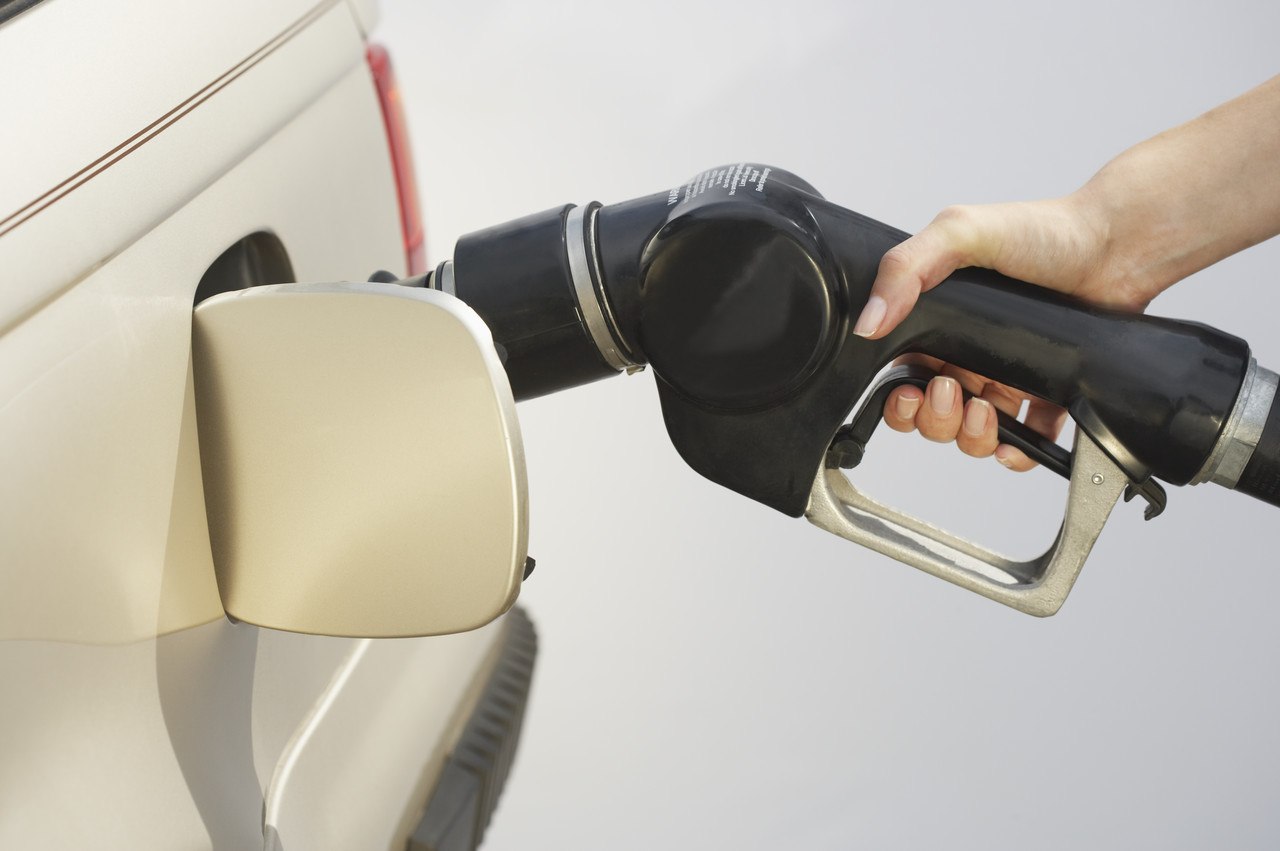
Which energy conversion is taking place when you put gasoline in a car?
a)
thermal -> electrical
b)
mechanical -> electrical
c)
chemical -> mechanical
d)
mechanical -> electromagnetic
7.
Which energy conversion is taking place when you put gasoline in a car?
a)
thermal -> electrical
b)
mechanical -> electrical
c)
chemical -> mechanical
d)
mechanical -> electromagnetic
8.

what type of energy is stored in a battery?
a)
electrical
b)
chemical
c)
thermal
d)
mechanical
9.

Electrical Energy is transferred to _____ Energy.
a)
Thermal
b)
Solar
c)
Electrical
d)
None
10.
Which energy transformation occurs in a toaster?
a)
chemical to electric
b)
electric to thermal
c)
kinetic to chemical
d)
thermal to potential
11.

A battery converts what type of energy to another?
a)
sound to kinetic
b)
light to heat
c)
mechanical to electrical
d)
chemical to electrical
12.
The type of plate boundary where two plates come together is a .....
a)
Convergent Boundary
b)
Divergent Boundary
c)
Transform Boundary
d)
Plate Boundary
13.
Which of the following causes Earth's tectonic plates to move?
a)
Energy from the Sun
b)
Magnetic Pole Reversal
c)
Convection currents in the mantle
d)
Faults in Mountain Ranges
14.
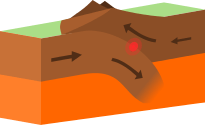
What type of plate boundary is this?
a)
Plate
b)
Divergent
c)
Convergent
d)
Transform
15.

What type of event will occur at this boundary?
a)
Earthquake
b)
Volcano Eruption
c)
Tornado
d)
Mountain Building
16.
A divergent boundary occurs when plates ....
a)
Pull apart
b)
Come together
c)
Slide past each other
d)
subducting
17.
The main purpose of the ____________ system is to break food particles into pieces that can be used.
a)
circulatory
b)
respiratory
c)
digestive
d)
skeletal
18.
What is responsible for delivering oxygen and removing carbon dioxide from the body?
a)
cell nucleus
b)
excretory system
c)
nervous tissue
d)
respiratory system
19.
The __________ system directs the body to inner and outer changes.
a)
digestive
b)
circulatory
c)
nervous
d)
skeletal
20.
The __________ is the main organ of the nervous system.
a)
heart
b)
lungs
c)
brain
d)
skin
21.
___________ are the building blocks of life.
a)
cells
b)
legos
c)
blocks
d)
blood
22.
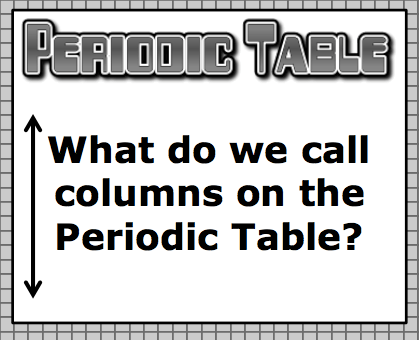
a)
Periods
b)
Groups
23.
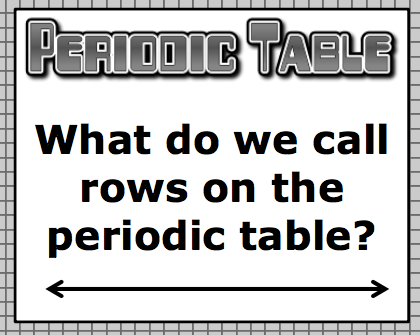
a)
Periods
b)
Groups
24.

a)
energy levels
b)
valence electrons
c)
protons
d)
neutrons
25.
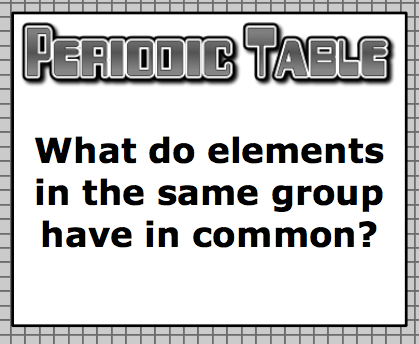
a)
energy levels
b)
valence electrons
c)
protons
d)
neutrons
26.
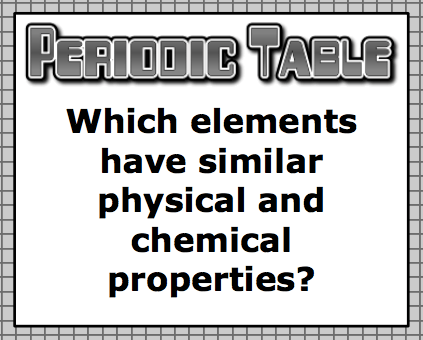
a)
Same group
b)
Same period
27.

True or False. In this Food Web Pyramid Which type of consumer gets only 10% of the energy stored in plants?
a)
Herbivore
b)
Carnivore
c)
Omnivore
d)
Secondary Consumer
28.
Which is a producer?
a)
deer
b)
tall grass
c)
lion
d)
worm
29.
A third-level consumer has to be which type?
a)
Carnivore.
b)
Decomposer.
c)
Producer.
d)
Herbivore.
30.
A consumer is a __________.
a)
heterotroph
b)
autotroph
c)
omnitroph
d)
consumotroph
31.
A producer is a(n)____________.
a)
heterotroph
b)
autotroph
c)
omnitroph
d)
consumotroph
32.
____________ is the ability to cause change.
a)
Energy
b)
Force
c)
Friction
d)
Motion
33.
____________ is the ability to cause change.
a)
Energy
b)
Force
c)
Friction
d)
Motion
34.
Energy due to motion is ____________ energy.
a)
Potential
b)
Energy
c)
Kinetic
d)
Friction
35.
The faster an object moves, the ________ kinetic energy it has.
a)
more
b)
less
c)
none of the above
d)
all of the above
36.
__________ is stored energy.
a)
Potential
b)
Kinetic
c)
None of the above
d)
All of the above
37.
Gravitational potential energy depends on the ________ and ________ of the object.
a)
Height and mass
b)
Friction and movement
c)
Mass and Movement
d)
Height and Friction
38.

What is the name of this element?
a)
Helium
b)
Hydrogen
c)
Argon
d)
Silver
39.

What element is represented in this Bohr Model?
a)
Carbon
b)
Hydrogen
c)
Aluminum
d)
Lithium
40.

What is the name of this element?
a)
Lithium
b)
Boron
c)
Carbon
d)
Neon
41.

What is the name of this element?
a)
Beryllium
b)
Boron
c)
Barium
d)
Bromine
42.
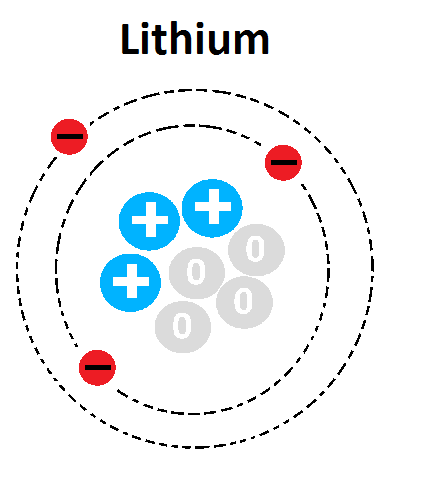
What is the mass number of this atom?
a)
1
b)
3
c)
4
d)
7
43.
A[n] ______________ tide occurs when the sun is at right angles to the line between Earth and the moon.
a)
high
b)
neap
c)
low
d)
spring
44.
A[n] ___________ tide occurs when the sun, Earth, and the moon are nearly in a line.
a)
spring
b)
high
c)
low
d)
neap
45.
A neap tide is a tide with the greatest difference between low and high tides
a)
true
b)
false
46.
What do we call a tide that has largest range; highest high and lowest low?
a)
gravity
b)
wind
c)
spring
d)
neap
47.
In general, tides occur...
a)
each hour
b)
2 times a day
c)
each month
d)
twice a month
48.
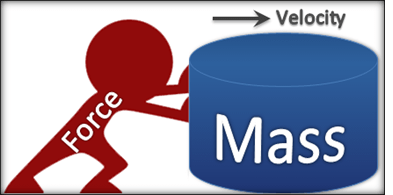
a)
1st
b)
2nd
c)
3rd
49.
What law is best described by inertia?
a)
1st
b)
2nd
c)
3rd
50.

a)
1st
b)
2nd
c)
3rd
51.

a)
1st
b)
2nd
c)
3rd
52.

a)
1st
b)
2nd
c)
3rd
53.
This is an example of ___________ environments. They include rolling hills, snow- capped mountains, swampy lowlands, high plateaus and forests.
a)
physical
b)
human
c)
modify
d)
unintended
54.
These are things that people do to meet their needs and to enjoy and celebrate life. These are examples of __________ activities. Physical environment influences these activities.
a)
shelter
b)
transportation
c)
human
d)
physical
55.
Which of these are NOT examples of human needs?
a)
shelter
b)
food
c)
recreation
d)
topography
56.
Which of these are NOT examples of physical environments?
a)
soil
b)
climate
c)
plant life
d)
transportation
57.
These are examples of ___________________ of the environment:
Greater Highway Construction
Genetic Modification of Foods
Spraying Pesticides
Drilling for Oil in the Seas and Oceans
Building New Cities
Greater Highway Construction
Genetic Modification of Foods
Spraying Pesticides
Drilling for Oil in the Seas and Oceans
Building New Cities
a)
unintended consequences
b)
modifications of the environment
c)
intended consequences
d)
urbainization
58.
How many elements are in C6H12O6?
a)
1
b)
2
c)
3
d)
4
59.
How many atoms of carbon (C) are in C6H12O6?
a)
3
b)
6
c)
12
d)
24
60.
Element or compound?
H2O
H2O
a)
element
b)
compound
61.
Element or compound?
O2
O2
a)
Element
b)
Compound
62.
Which of the following is a compound?
a)
Co
b)
O2
c)
C
d)
CO2
63.
This organelle creates the energy for the cell
a)
mitochondria
b)
cell membrane
c)
ribosome
d)
endoplasmic reticulum
64.
The ____________ regulates what enters and leaves the cell.
a)
mitochondria
b)
cell membrane
c)
golgi bodies
d)
cytoplasm
65.
The _________ holds the dna for the cell
a)
vacuole
b)
smooth ER
c)
rough ER
d)
nucleus
66.
What creates the protein for the cell?
a)
Cytoplasm
b)
Nucleus
c)
Golgi bodies
d)
Ribosomes
67.
Jelly-like material that makes up most of the cell
a)
cytoskeleton
b)
cytoplasm
c)
cyclops
d)
cytoliquid
68.
When a rock breaks down?
a)
Weathering
b)
Erosion
c)
Depositon
69.
When water moves from one place to another
a)
Weathering
b)
Erosion
c)
Deposition
70.
When sand has built up next to a curb.
a)
Weathering
b)
Erosion
c)
Deposition
71.
When a crack has formed in a rock
a)
Weathering
b)
Erosion
c)
Deposition
72.
When mud roles down a hill
a)
Weathering
b)
Erosion
c)
Deposition
73.
What is speed?
a)
how far you go
b)
how much distance is covered over a period of time
c)
how fast you accelerate
d)
the change in the location of a object
74.
What is the formula to calculate speed?
a)
Speed = time/distance
b)
Speed = distance/time
c)
Speed = distance x time
d)
Speed = time x distance
75.

A Drake races in the 100 meter dash. It takes him 10 seconds to finish. What is his average speed?
a)
10 m/s
b)
1000 m/s
c)
100 seconds
d)
10 seconds
76.
What two measurements are necessary for calculating speed?
a)
Mass and time
b)
Temperature and mass
c)
Mass and distance
d)
Distance and time
77.
Which of the following is a unit for acceleration?
a)
km/s
b)
m/s2
c)
mi/hr
d)
ft
78.
If there are two forces going in the same direction how would you find the net force?
a)
Subtract
b)
Add
c)
Neither
d)
Multiply
79.
Find the net force: 15 N to the right, and another 15 newtons to the right.
a)
0 N Right
b)
0 N Left
c)
30 N Left
d)
30 N Right
80.
8 N to the left , and 4 N to the right. Find the net force. Is this balanced
a)
12 N Right No
b)
4 N Left No
c)
12 N Right Yes
d)
4 N Left Yes
81.
What is force?
a)
A push exerted on an object
b)
A push or pull exerted on an object
c)
A pull exerted on an object
d)
Nothing
82.
With unbalanced forces, the object will move in the direction of the _______ force.
a)
larger
b)
smaller
c)
equal
83.
In a chemical equation, is it true that -
a)
the reactant side and product side can have different numbers of atoms for each element
b)
there can be different elements on the reactant side and the product side
c)
an element or compound must be accompanied by a phase change
d)
the coefficients indicate the number of molecules of each reactant used and the number of molecules of each product made
84.
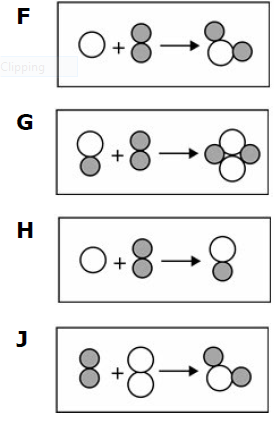
Which of the following models best demonstrates a balanced chemical equation?
a)
F
b)
G
c)
H
d)
J
85.
The formula below represents the most common carbohydrate known as glucose. Which information can be determined from the chemical formula?
C6H12O6
C6H12O6
a)
The structural arrangement of the atoms in a glucose molecule
b)
The color of a glucose molecule
c)
The size of a glucose molecule
d)
The number of atoms of each element in a glucose molecule
86.

For an investigation a student poured a blue solution of CuSO4 into a beaker. The student placed a shiny, silver-colored strip of zinc metal in the solution and observed the changes.
The student inferred that a chemical reaction occurred. What evidence supports this inference?
The student inferred that a chemical reaction occurred. What evidence supports this inference?
a)
A dark solid formed on the zinc metal.
b)
The zinc metal remained silver-colored and shiny
The zinc metal remained silver-colored and shiny
c)
The CuSO4 solution turned blue when the zinc metal was added.
d)
None of these
87.

Which of the following equations demonstrates an actual chemical reaction that forms a new substance?
a)
A
b)
B
c)
C
d)
D
88.
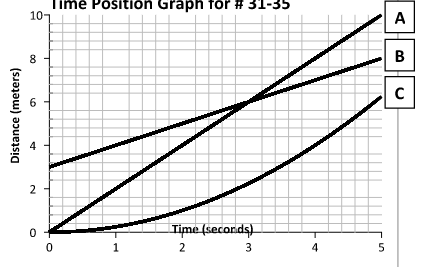
Which runner had a head start?
a)
A
b)
B
c)
C
89.

What is this graph showing?
a)
Constant Speed
b)
Acceleration (speeding up)
c)
Deceleration (slowing down)
d)
No motion
90.

What is happening between 4 and 5 seconds?
a)
The object is slowing down in a negative direction.
b)
The object is slowing down in a positive direction.
c)
The object is slowing down in a negative direction.
d)
The object is speeding up in a negative direction.
91.
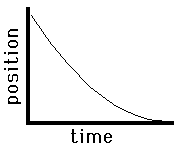
Describe the motion
a)
Slow to fast; Negative direction
b)
Fast to slow; Negative direction
c)
Fast to slow; Positive direction
d)
Slow to fast; Positive direction
92.

What is this object doing?
a)
speeding up
b)
slowing down
c)
not moving
d)
moving at a constant velocity
93.
A bar of copper has a mass of 216g and a volume of 24cm3. What is the density of copper?
a)
9g/cm3
b)
.11g/cm3
c)
5184g/cm3
d)
322mL
94.
What is the density of a plastic ball that has a volume of 6cm3 and a mass of 12g?
a)
2g/cm3
b)
.5g/cm3
c)
72g/cm3
d)
4mL
95.
What is the unit of measurement for mass?
a)
mL
b)
cm3
c)
g
d)
g/cm3
96.
The volume of a candy bar is 55cm3. The mass of the candy bar is 70g. What is the density of the candy bar?
a)
2.3g/cm3
b)
.8g/cm3
c)
3850g/cm3
d)
1.3g/cm3
97.
To calculate density you would use the following equation
a)
D = M/V
b)
M = D x V
c)
V = M/ D
d)
NONE OF THESE
98.

Is this equation balanced?
a)
yes
b)
no
c)
Not enough information
99.

Is this equation balanced?
a)
yes
b)
no
c)
Not enough information
100.
Is the equation balanced?: 2H2O + O2 --> 4MgO + 3Fe
a)
Yes
b)
No
101.
Balance this equation
_Al +_HCl --> _H2 +_AlCl3
_Al +_HCl --> _H2 +_AlCl3
a)
2, 6, 3, 2
b)
it is already balanced
c)
4, 12, 3, 4
d)
2, 1, 4, 5
102.
Balance this equation-
__P4 + __O2 --> __P2O3
__P4 + __O2 --> __P2O3
a)
it is already balanced
b)
2, 1, 3
c)
1, 2, 3
d)
1, 3, 2
103.
Balance this equation.
_CH4 + _O2 --> _CO2 + _H2O
_CH4 + _O2 --> _CO2 + _H2O
a)
1,2,1,1
b)
2,1,2,1
c)
1,2,1,2
d)
0,2,0,2
104.
Balance this equation.
_CH4 + _O2 --> _CO2 + _H2O
_CH4 + _O2 --> _CO2 + _H2O
a)
1,2,1,1
b)
2,1,2,1
c)
1,2,1,2
d)
0,2,0,2
105.
Balance this equation.
_CF4 + _Br2 -- _CBr4 + _F2
_CF4 + _Br2 -- _CBr4 + _F2
a)
2,1,2,1
b)
1,2,2,1
c)
1,2,1,2
d)
2,2,2,2
106.
Balance this equation.
_CF4 + _Br2 -- _CBr4 + _F2
_CF4 + _Br2 -- _CBr4 + _F2
a)
2,1,2,1
b)
1,2,2,1
c)
1,2,1,2
d)
2,2,2,2
107.
Balance this equation
_N2 + _H2 --> _NH3
_N2 + _H2 --> _NH3
a)
1,2,3
b)
1,3,2
c)
1,1,2
d)
2,1,1
108.
Balance this equation.
_Mg + _Cl2 --> _MgCl2
_Mg + _Cl2 --> _MgCl2
a)
1, 2,1
b)
already balanced
c)
2,1,1
d)
1,1,2
109.
Balance this equation.
_SnO2 +_H2-->_Sn +_H2O
_SnO2 +_H2-->_Sn +_H2O
a)
1,1,2,1
b)
1,2,1,1
c)
1,2,1,2
d)
1,2,2,1
100 %

