
 Worksheets
Water as a Resource Quiz
Total questions: 107
Worksheet time: 1hrs 2mins
A renewable resource is a natural resource that is replaced over...
A long period of time.
Eons
A short period of time
Decades
Water can exist in three different states of matter: liquid, solid and (a) .
(a) is the use of water to grow crops and farm land.

The choropleth map uses colour to show the amounts of rainfall in Australia. The places with the highest rainfall are coloured what?
purple
blue
green
yellow

The state that receives the LEAST annual rainfall is:
Perth
Western Australia
South Australia
New South Wales
Precipitation can come in many forms, for example:
Rain, snow and dust.
Rain, hail and snow.
Rocks, hail and snow.
Air, water and wind.
How much of the earth's surface water is salt?
67.5%
77.5%
87.5%
97.5%
Examples of potential water resources include?
Ice and lakes
Ice and glaciers
Water vapour and rivers
Rivers and lakes
Potential water resource is water that
Is easily and immediately available
usable immediately, but could be used when it has undergone some kind of change.
How many people have no access to clean water?
300 million
400 million
Over 600 million
500 million
Which continent has the least amount the population using improved drinking water?
Africa
North America
Australia
Europe

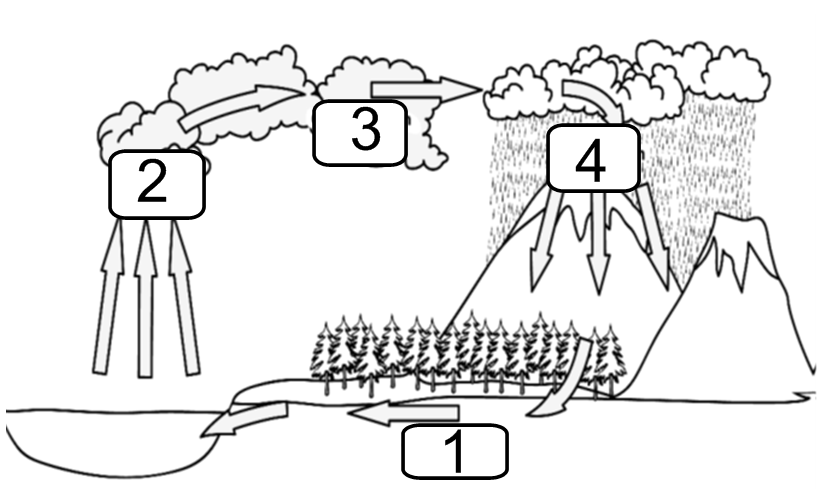
The image above represents:
Evaporations
Water Picture
Water cycle
Cycle of the seasons

The heat of the sun warms up the water in rivers , lakes , oceans and other water bodies . This water turns into water vapour . This process is called (a) .

Water vapour is light , so it rises up (just like a gas balloon).As it moves up ,it comes in contact with cool air and changes into tiny droplets of water. This is called
(a) .

When the clouds become too heavy , they fall as _____________.
dew
rain
groundwater
smoke
_ is the process by which water is removed from the atmosphere.
(a)

In nature there is a continuous cycle in which water keeps changing its from . This is called (a) .
What are the 3 states of water?
Gas
Liquid
Solid
What is the process by which water is changed into water vapour?
Condensation
Precipitation
Evaporation
Transpiration
What is the process by which water absorbed by plants passes into the atmosphere from the plant surface, mainly from the leaves?
Transpiration
Precipitation
Infiltration
Evaporation
Green plants need water for.....
photography.
absorption.
photosynthesis.
synthesis.
Approximately what % of the earth is covered in water?
60%
75%
100%
5%
Most fresh water is found in
oceans
glaciers
lakes
Water from rivers can be used for
drinking
watering plants for food
Both drinking and watering plants
70% of the Earth is made of
Saltwater oceans
Freshwater oceans
Saltwater seas
What is a Natural Resource
Something is made by humans
Something from the Earth that we use
Something from the Earth that we do not need
What is the Water Cycle?
Water goes around and around inside a huge trough, over and over, until it evaporates.
Water in Chicago is pumped through pipelines to other cities farther from the Great Lakes, which in turn send leftover water to really dry places, like Arizona. The leftover water is returned in tanker trucks to Chicago.
Water in lakes, rivers, and oceans evaporates and becomes water vapor in the sky (clouds). The water vapor comes down to Earth in the form of precipitation, and ends up in streams and lakes and oceans.
Water in the Earth's crust, deep underground, turns into steam because of heat from the Earth's core. This steam rises through rock layers until it erupts in the form of geysers.
Which of these is a way people have damaged the water supply?
Waste from factories and runoff from toxic chemicals used on lawns and farm fields has polluted rivers, lakes, oceans, and groundwater.
Chemicals such as pesticides and fertilizers seep into wells that hold drinking water, poisoning the water and causing deadly diseases.
Some of the fuels we burn release poisonous gases into the atmosphere. These gases combine with water vapor in the air to create toxic acids. These acids then fall to Earth as a deadly mixture called acid rain.
All of these are true.

True or false?
Condensation is when a liquid becomes a gas.



Which of the following is NOT part of The Water Cycle?
Evaporation
Condensation
Participation
Rainfall
Which Australian State has the highest percentage of annual rainfall?
(a)
Which is not an element of BOLTSS?
Landscape
Title
Scale
Border
Water stored under Earth's surface
recharge zone
aquifer
river system
ground water
water table
Which of the following statements helps to explain why fresh water is a limited resource?
Most of Earth's water is salt water.
About 71% of Earth's surface is covered by water.
Most of Earth's freshwater is not liquid water usable by humans
Most major cities are built along waterways.
The three major global uses of fresh water are
manufacturing goods, wastewater disposal, and irrigation.
drinking, bathing, and growing crops.
drinking, manufacturing goods, and generating power.
residential, agricultural, and industrial uses.
As a part of the water cycle, water from Earth's surface enters the clouds and finally falls back to the ground in the form of rain. What is the correct sequence of processes water undergoes?
Evaporation, Condensation, Precipitation
Precipitation, Condensation, Evaporation
Condensation, Evaporation, Precipitation
Evaporation, Precipitation, Condensation
What is precipitation?
Sweat from our bodies on hot days
Warm rain but not cold snow or sleet
Gas that we use in furnaces or ovens
Any form of water that falls from the sky
Condensation occurs when water vapor_____________.
heats up and becomes liquid water
cools off and becomes liquid water
freezes and becomes ice
rains on the land
The process when plants release water vapor from their leaves is called _____________.
precipitation
evaporation
transpiration
condensation

What step of the water cycle does this picture show?
Condensation
Runoff
Precipitation
Evaporation
When water changes from a liquid to a solid it is known as...
melting.
condensation.
freezing.
evaporation.
In which area would the rate of evaporation be the lowest?
Over the ocean
Over the mountains
Over the rainforest
Over the desert
Water running off the land surface
Evaporation
Sublimation
Transpiration
Run-off
When clouds get too heavy and water falls back to earth in the form of rain, snow, hail or other forms.
Precipitation
Evaporation
Percolation
Transpiration

What is a well?
a place that has a lot of grass
a hole drilled into the ground to pump water
a place where water in stored underground
Which of the following is an effect of an oil spill?
Many plants and animals die.
The fishing industry improves.
Plant life increases.
The oil cleans the beaches.

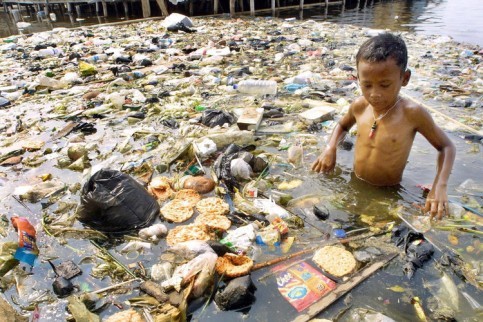
What is water pollution?
Water that comes from a mountain spring.
Water that has been contaminated by waste or other forms of pollution.
Clean and healthy water.
Which of the following is not a "natural" cause of water pollution?
Animal waste.
Floods.
Oil spills.
Volcanoes.
Reasons causing water shortages are...
Over population.
Deforestation.
Pollution.
There are no water shortages.

Proper and careful use of water, avoiding it's wastage, and maintaining the amount of water in its different sources, is called...
Wasting water.
Polluting water.
Water conservation.

Examples of ocean litter are...
Plastic bags.
Fishing equipment.
Soda cans.
Seaweed.

Which of these is a method for conserving fresh water?
Leaving the water running while brushing your teeth.
Taking a long shower or bath.
Wasting water.
Using water wisely and saving it where you can.

Water pollution occurs when:
Harmful substances enter a water supply
Industries dispose of waste safely and correctly.
Industries cut costs with waste disposal.
None of the above.

We can prevent water pollution by:
Reduce the use of plastic.
Properly dispose of chemicals.
Clean up after your animals.
All of the above
Earth is known as ______ planet.
Blue
Green
Red
None

Examples of marine debris are:F
Plastic bags
Coral reefs
Fishing equipment
Soda cans
Who does water pollution impact?
Shrek and his swamp
my water inside of my Fiji water bottle ಠ╭╮ಠ
Only us people
Everything on the planet
Animals only
3 things water pollution causes:
Death of animals
Habitat destroyed
Humans sick
Lung damage
We can prevent water pollution by:
Reduce the use of plastic.
Properly dispose of chemicals.
Clean up after your animals.
All of the above
How does plastic end up reaching and entering the ocean from land?
Littering in towns and cities
Dumpsites near waterways and oceans
People littering on beaches
All of the above
What happens to plastic waste?
Sinks to the bottom and gets buried under the sand
It never fully goes away, it just breaks into little pieces
Dissolves and decomposes in the water
It is dumped in the ocean for fish to eat
another way to talk about water pollution is to talk about water ______
quantity
speed
quality
all of these options
What percentage of the earth's fresh water is easily accessible on the surface?
0.3%
3%
13%
33%
Which of the water sources listed below involves a form of hard engineering?
Natural lake
Water conservation
Reservoir and dam
Aquifer
Identify the common sectors that use water.
Industrial
Coastal
Agricultural
Political
Domestic
Low Income Countries use a higher proportion of water on...
...agriculture
...domestic
...industry
High Income Countries use a higher proportion of water on...
...agriculture
...domestic
...industry
Which option would be the most appropriate solution for a high income country?
Spill over ponds
Desalination plants
Terracing
Sediment trapping
Which option would be the most appropriate solution for a low income country?
Reservoir and dam
Improving infrastructure such as pipes and treatment
Water conservation and storage
Desalination plants
True or False: Only 1% of the water on earth is suitable for human consumption
True
False
What is the term used to describe a lack of water?
Scarcity
Flood
Pollution
Humidity
What is physical water scarcity?
When there is not enough rainfall and water available for all people and the environment.
When there is not enough infrastructure to get water where it needs to go.
When people don't have water pipes, dams or wells to provide them with water.
When there is too much rainfall and it causes flooding.
What is economic water scarcity?
When there is not enough infrastructure to get water where it needs to go, usually due to lack of finances
When there is not enough rainfall, so countries lose money from their economy
When there is too much rainfall, and floods cause economic issues
When water flows away from an area too quickly for people to be able to use it
Australia regularly experiences drought. Despite there being dams on rivers to help with irrigation and saving water for towns, when there is a drought not enough rain falls, and dam levels dip. At these times water restrictions are often put in place to try and save water. This is an example of:
Physical water scarcity
Economic water scarcity
La Nina
The water cycle
Factors affecting water availability
Climate
Pollution
Geology
All of these
98% Of our Fresh water comes from
Ground Water sources
Surface water sources
Oceans
Reservoir
Factors affecting Evaporation
Temperature
Humidity
Wind
All of the above
Chemical formula of water
H2O2
H2O
OH3
HO
Does bushfire affect Water Quality?
False
True
What is the process of removing salt from ocean water
Desalination
Scarcity
Irrigation
Allocation
How do farmers attempt to bring water to their fields?
building dams
stealing it
using irrigation
desalination
Irrigation is......
contamination of water
a supply of water to land or crops
process of taking salt out of seawater
farmers who focus on growing enough food for themselves
Why is fresh water a limited resource?
It isn't because it is a renewable resource
97% of water is in the oceans and too salty to drink.
Only 2.5% is drinkable and is stored in icecaps, rivers, and lakes.
The most efficient way of irrigation is _______
Sprinkler irrigation
Surface irrigation
Drip system
Canal Alignment

Most of our drinkable water is found where?
ponds
ocean
groundwater
pool

What are the two main problems with water?
overuse and pollution
frozen and too salty to drink
too many fish and pollution
color and taste

