
NEW
Font size
S
M
L
XL
 Worksheets
Q2 S2 Climate, Convection, and Review
Total questions: 30
Worksheet time: 15mins
Name
Class
Date
1.

How is climate different from weather?
a)
Climate is immediate weather conditions.
b)
Climate averages over a long period of time.
c)
Climate involves daily forecasts.
d)
Climate reports on one storm at a time.
2.

What makes global winds curve rather than move straight north to south?
a)
Air pressure changes
b)
Temperature differences
c)
Earth’s rotation
d)
Rise in latitude
3.

What is the source of energy that drives Earth’s winds?
a)
The sun
b)
The Earth’s movement
c)
Earth’s gravity
d)
Lunar gravity
4.

What leads to the formation of Earth’s convection and climate regions?
a)
The rotation of the Earth
b)
Differences in heating of Earth’s surfaces
c)
High pressure at the poles
d)
Both A and B
5.

Which global wind system has the greatest effect on weather patterns in the United States?
a)
Doldrums
b)
Easterlies
c)
Westerlies
d)
Trade winds
6.

Convection currents in the atmosphere form what 3 convection regions?
a)
Westerlies, desert, and polar
b)
Polar, temperate, and tropical
c)
Tropical, rainforest, temperate
d)
Temperate, coastal plain, Gulf Stream
7.

What happens to solar energy as it enters Earth’s atmosphere?
a)
All is absorbed by Earth’s surfaces.
b)
All is reflected back into space.
c)
Some is absorbed by surfaces and some reflected.
d)
Most is absorbed by ice at the poles.
8.

Different wind patterns that travel long distances and impact large areas of the planet are called --------.
a)
Surface ocean currents
b)
Local winds
c)
Global winds
d)
Sea breezes
9.

Land areas with lower elevation experience ______________ average temperatures than those areas at higher elevations.
a)
Higher
b)
Colder
c)
Lower
d)
Cooler
10.
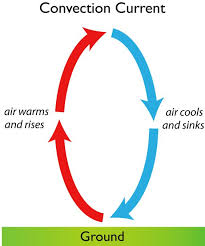
Convection currents involve warm air _________ and cooler air __________.
a)
Sinking, rising
b)
Rising, sinking
c)
Staying in place, rising
d)
Sinking, staying in place
11.

According to the results of the uneven heating lab, which surface reflects the most radiant energy?
a)
sand
b)
soil
c)
water
d)
air
12.

The equator receives more ____________________ than the northern and southern poles.
a)
Solar (radiant) energy
b)
Chemical energy
c)
Potential energy
d)
Presents from a jolly bearded man
13.

The topography of land can impact the way _____________________ move.
a)
air masses
b)
glaciers
c)
lakes
d)
convection currents
14.

The Gulf Stream ocean current brings what type of air to the eastern United States?
a)
warm, dry air
b)
cold, moist air
c)
warm, moist air
d)
cold, dry air
15.

The further an area is from the equator the ____________ its average temperature.
a)
hotter
b)
lower
c)
higher
d)
warmer
16.

A hot air balloon rises when the air inside the balloon is heated. This is an example of-
a)
Radiation
b)
Conduction
c)
Convection
d)
Temperature
17.

Which of these examples is heat transfer by conduction?
a)
Sand warming in the sun
b)
Eggs cooking in a frying pan
c)
A hot air balloon rising
d)
Cooking food in a microwave
18.

Global winds have a prevailing wind direction due to the convection region in which they form. This means weather systems in the United States usually move ______________________________________.
a)
from east to northeast.
b)
from north to south.
c)
from the west from the east.
d)
from the southwest to the south.
19.

Which of the following is heat transfer by radiation?
a)
Cooking carrots in hot water
b)
Pressing a shirt with an iron
c)
A hot sidewalk on a summer day
d)
A hot air balloon rising
20.

Which of the following is heat transfer by convection?
a)
Warm air rising and cooler air sinking
b)
Warming land with sunlight
c)
Cooking food in a microwave
d)
Pressing a shirt with an iron
21.

Earth’s surfaces gains heat energy through which method of heat transfer?
a)
Radiation
b)
Conduction
c)
Convection
d)
Temperature
22.

Heat energy moves from areas of __________temperatures to areas of ____________temperatures.
a)
Warmer, cooler
b)
Warmer, warmer
c)
Cooler, cooler
d)
Cooler, warmer
23.

As the child swings from left to right, at which point will the maximum kinetic energy be reached?
a)
1
b)
2
c)
3
d)
4
24.

What device is made of coils of wire with an electrical current passing through it in order to generate a magnetic field?
a)
electromagnet
b)
circuit protector
c)
electron magnet
d)
magnetic circuit
25.

Which device uses mechanical energy to produce electrical energy in power plants?
a)
battery
b)
electric motor
c)
magnet
d)
generator
26.

In the electric motor, the energy transformation begins as ----
a)
electrical and becomes chemical.
b)
mechanical and becomes electrical.
c)
electrical and becomes mechanical.
d)
mechanical and becomes chemical.
27.

What two forces are required for generators and electric motors to work?
a)
magnetism and thermal
b)
electricity and thermal
c)
electricity and magnetism
d)
magnetism and radiant
28.

What force does a magnetic field apply without actually touching the object?
a)
a push or pull
b)
gravity
c)
friction
d)
pressure
29.

The global winds that form in the Polar Convection Region are called ___________________________
a)
Doldrums
b)
Easterlies
c)
Westerlies
d)
Trade winds
30.

Which statement is true about the way land and water heat and cool?
a)
Water heats and cools faster than land.
b)
Land heats and cools much slower than water.
c)
Water heats and cools much slower than land.
d)
Water and land heat and cool in the same manner.
Reset

