
 Worksheets
AP Bio Ch 4 Review
Total questions: 15
Worksheet time: 15mins
Name
Class
Date
1.
The element present in all organic molecules is
a)
Nitrogen
b)
Phosphorus
c)
Hydrogen
d)
Carbon
2.
How many electron pairs does carbon share in order to complete its valence shell?
a)
1
b)
3
c)
4
d)
8
3.
Which of the following statements correctly describes cis-trans isomers?
a)
They have the same chemical properties
b)
They have an asymmetrical carbon that makes them mirror images
c)
They have different molecular formulas
d)
They have variations in arrangement around a double bond
4.

Thalidomide and L-dopa, shown below, are examples of pharmaceutical drugs that occur as enantiomers, or molecules that
a)
are cis-trans isomers
b)
are mirror images of one another
c)
are mirror images of one another and have the same biological activity
d)
have identical three-dimensional shapes
5.

Which of the structures shown is an impossible covalently bonded molecule?
a)
A
b)
B
c)
C
d)
D
6.
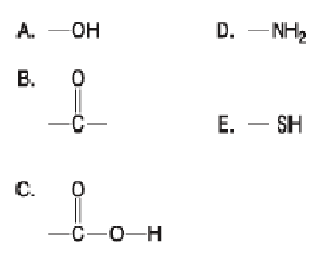
Which of the groups shown above is a carbonyl functional group?
a)
A
b)
B
c)
C
d)
D
7.

Which molecule shown above has a carbonyl functional group in the form of a ketone?
a)
A
b)
B
c)
C
d)
D
8.

Which molecule shown above has a carbonyl functional group in the form of an aldehyde?
a)
A
b)
B
c)
C
d)
D
9.
Organic chemistry is currently defined as
a)
The study of compounds made only by living cells
b)
The study of hydrocarbons
c)
The study of carbon compounds
d)
The study of vital forces
10.

Identify the asymmetric carbon in this molecule
a)
A
b)
B
c)
C
d)
D
11.
Which functional group has the molecular formula of CH3?
a)
Methyl
b)
Amino
c)
Hydroxy
d)
Carbonyl
12.
Which property is most closely associated with the hydroxyl functional group?
a)
Polar
b)
Nonpolar
c)
Basic
d)
Acidic
13.
Which is NOT a way functional groups may affect a molecule?
a)
Serve as a recognizable tag on biological molecules
b)
Affect the molecule's shape
c)
Be directly involved in chemical reactions
d)
Decrease the solubility of the molecule in water
14.
Which functional groups can act as acids?
a)
Ketone and amino
b)
Carbonyl and carboxyl
c)
Carboxyl and phosphate
d)
Hydroxyl and aldehyde
15.

What type of isomer is shown?
a)
Structrual isomers
b)
Cis-trans isomers
c)
Enantiomers
d)
They're not isomers, its the same structure
100 %

