wayground logo

Free Printable Worksheets

Font size

S
M
L
XL
Worksheets

CLASSIFICATION UNIT TEST REVIEW

Total questions: 71

Worksheet time: 54mins

Name
Class
Date
1.
A wolf's scientific name is Canis rufus. Which genus does it belong to?
a)
Canis
b)
rufus
c)
wolf
d)
animal
2.
Which of the following is an example of binomial nomenclature?
a)
Moon Jelly
b)
Jelly fish
c)
Chrysaora fuscescens
d)
Cnidarian
3.
The taxon (group) with the largest amount of organisms grouped together is
a)
species
b)
phylum
c)
genus
d)
domain
4.
Which of the following is NOT true when comparing scientific names and common names?
a)
Scientific names vary from place to place.
b)
Common names vary from place to place.
c)
Scientific names are in Latin.
d)
There can be multiple common names for one organism.
5.
The science of classifying and naming organisms is ______________.
a)
evolution
b)
taxonomy
c)
grouping
d)
scientific names
6.
Smallest taxonomic group with many similar characteristics...
a)
domain
b)
kingdom
c)
species
d)
class
7.
If two organisms are in the same phylum, they must also be in the same
a)
class
b)
species
c)
family
d)
kingdom
8.
The 7 levels of classification, from most broad to most specific are ...
a)
Genus, Family, Order, Class, Phylum, Kingdom, Species
b)
Species, Kingdom, Genus, Phylum, Family, Class, Order
c)
Kingdom, Phylum, Class, Order, Family, Genus, Species
d)
Order, Kingdom, Species, Domain, Phylum, Family, Class, Genus
9.
The scientific name for an organism is made from the:
a)
class and family name
b)
genus and species name
c)
domain and kingdom name
d)
kingdom and phylum name
10.
Who first proposed binomial nomenclature as a way of classifying organisms?
a)
Carolus Linnaeus
b)
Aristotle
c)
Charles Darwin
d)
Louis Pasteur
11.
Members of this kingdom are multicellular and autotrophic
a)
Plantae
b)
Animalia
c)
Protista
d)
Fungi
12.
Members of this kingdom are multicellular and autotrophic
a)
Plantae
b)
Animalia
c)
Protista
d)
Fungi
13.
Which 2 organisms would be able to reproduce  and produce fertile offspring?
a)
2 organisms in the same class
b)
2 organisms in the same family
c)
2 organisms in the same genus
d)
2 organisms in the same species
14.
Term given to describe the 2 name naming system is:
a)
dichotmous key
b)
binomial nomenclature
c)
2 scientific names
d)
binomial key
15.
What is the correct way of writing our scientific name?
a)
homosapiens
b)
homo sapiens
c)
Homo Sapiens
d)
Homo sapiens
16.
An organism whose cell contains a nucleus
a)
Prokaryote
b)
Eukaryote
17.
Which is NOT a domain?
a)
Eukarya
b)
Archae
c)
Bacteria
d)
Plantae
18.
How many kingdoms are there?
a)
1
b)
6
c)
3
d)
13
19.
Scientific names are written in ________
a)
Telugu 
b)
French
c)
Tamil
d)
Latin
20.
When using a dichotomous key to identify organisms, what do we look at?
a)
physical features
b)
weather patterns
c)
environment
d)
diet
21.
Organisms that are classified as autotrophic are able to-
a)
be seen with the human eye
b)
move
c)
reproduce
d)
make their own food
22.
What are the three domains?
a)
Archaea, Bacteria, and Eubacteria
b)
Archaea, Protists, and Eubacteria
c)
Archaea, Bacteria, and Eukarya
d)
Archaea, Fungi, Animalia
23.
What's the difference between a prokaryotic cell and a eukaryotic cell?
a)
Eukaryotic cells have a nucleus.
b)
Prokaryotic cells do not have a nucleus.
c)
Both the above are true.
d)
None of the above are true.
24.
All organisms are composed of
a)
A. a nucleus
b)
B. at east one cell
c)
C. many cells
25.
Which is true of organisms classified under Kingdom Animalia?
a)
A. They are unicellular prokaryotes.
b)
B. They are multicellular heterotrophs.
c)
C. They are unicellular eukaryotes.
d)
D. They are unicellular autotrophs.
26.
Which organisms are closely related?
a)
Equus ceballas (horse) & Equus burchellii (zebra)
b)
Cyanea artica (jellyfish) & Asterias rubens (sea star)
c)
Naja naja (cobra) & Crotalus atrox (rattlesnake)
d)
Alligator mississippiensis (alligator) & Crocodylus porosus (crocodile)
27.
A tool used by a taxonomist to identify an unknown organism is known as a __________.
a)
dichotomous key
b)
binomial nomenclature
c)
scientific name
d)
binomial key
28.
Which kingdom is autotrophic AND has a cell wall?
a)
Bacteria
b)
Fungi
c)
Plantae
d)
Protista
29.
Which kingdom do humans belong to?
a)
Plantae
b)
Fungi
c)
Animalia
d)
Protista
30.
Cladograms are constructed by grouping organisms together based on their____________ characteristics.
a)
shared
b)
different
c)
similar
d)
opposite
31.
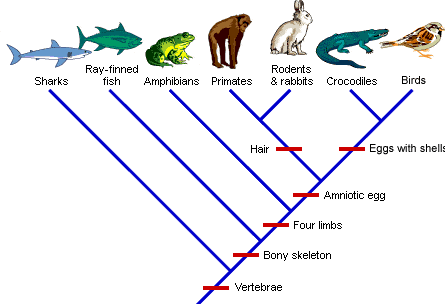
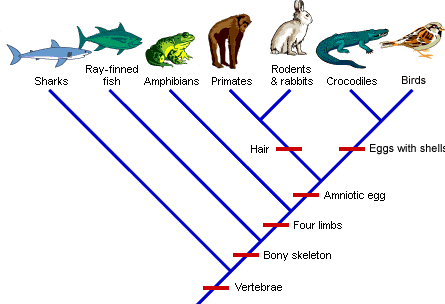
According to this cladogram, sharks are MOST closely related to which organism? 
a)
Amphibians
b)
Ray finned fish
c)
Crocodiles
d)
Birds
32.
Which two orgainsms have hair? 
a)
Sharks & Ray Finned Fish
b)
Primates & Rodents
c)
Birds & Crocodiles
d)
Rabbits & Birds
33.
According to this cladogram, birds are LEAST related to: 
a)
Amphibians
b)
Sharks
c)
Ray Finned Fish
d)
Crocodiles
34.
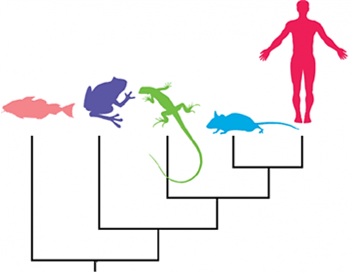
On the cladogram, which organism is the closest relative of the human?
a)
Frog
b)
Hare
c)
Caiman
d)
Parrot
35.
Which trait do only humans have, according to the cladogram?
a)
jaws
b)
mammary glands & hair
c)
terrestrial during all life stages
d)
bipedal & opposable thumbs
36.
What is the most specific level of classification?
a)
Family
b)
Domain
c)
Species
d)
Carolus Linnaeus
37.
Which trait do only humans have, according to the cladogram?
a)
jaws
b)
mammary glands & hair
c)
terrestrial during all life stages
d)
bipedal & opposable thumbs
38.

According to this phylogenetic tree, which creature is the least related out of all pictured?

a)

Fish

b)

Frog

c)

Salamander

d)

Human

39.

What is the name for the "trait" shown on these tree, such as "egg shells" and "four limbs"?

a)

Derived characteristics

b)

Trait nodes

c)

Branching elements

d)

Harmonious changes

40.

According to this tree, which of these animal phyla are most closely related?

a)

Arthropoda & Mollusca

b)

Arthropoda & Chordata

c)

Chordata & Mollusca

41.

What domain... includes eukaryotes?

a)

Bacteria

b)

Archaea

c)

Eukarya

42.

What domain... includes unicellular prokaryotes that can survive in harsh conditions?

a)

Bacteria

b)

Archaea

c)

Eukarya

43.

What Kingdom... Reproduces Asexually, are Multicellular Eukaryotes, and are Heterotrophs?

a)

Protista

b)

Fungi

c)

Plantae

d)

Animalia

44.

What Kingdom... Includes Yeast as an example and are found almost everywhere on land?

a)

Protista

b)

Fungi

c)

Plantae

d)

Animalia

45.

What Kingdom... are Multicellular Eukaryotes, Heterotrophs, and live in diverse environments all over earth?

a)

Protista

b)

Fungi

c)

Plantae

d)

Animalia

46.

Which Kingdom... consists of organisms that are Multicellular Eukaryotes and Autotrophs?

a)

Protista

b)

Fungi

c)

Plantae

d)

Animalia

47.

What Kingdom... Provides food for most Heterotrophs on land?

a)

Protista

b)

Fungi

c)

Plantae

d)

Animalia

48.

Which Kingdom... consists of organisms that are both Autotrophs and Heterotrophs, and consists of both Multicellular and Unicellular organisms?

a)

Protista

b)

Fungi

c)

Plantae

d)

Animalia

49.

What domain... includes the Kingdoms Protista, Fungi, Plantae, and Animalia?

a)

Bacteria

b)

Archaea

c)

Eukarya

50.

What Kingdom... Includes Mushrooms and Yeast as an example?

a)

Protista

b)

Fungi

c)

Plantae

d)

Animalia

51.

Which Kingdom... Can NOT have a cell wall present?

a)

Protista

b)

Fungi

c)

Plantae

d)

Animalia

52.

Which Kingdoms... Can reproduce sexually? More than one correct answer - select all that apply!

a)

Protista

b)

Fungi

c)

Plantae

d)

Animalia

53.

Which Domain... Are Eubacteria in?

a)

Bacteria

b)

Archaea

c)

Eukarya

54.

Prokaryotes...

a)

...Are multicellular organisms who lack a nucleus

b)

...Are unicellular organisms who lack a nucleus

c)

...Are unicellular organisms who have a nucleus

d)

...Are multicellular organisms who have a nucleus

55.
What is one of the major advantages of using the modern classification system is?
a)
A.The characteristic behaviors of all organisms become apparent
b)
A.The evolutionary relationships between organisms become apparent
c)
A.The biochemical similarities between the kingdoms become apparent
d)
A.The metabolic similarities between the members of a phylum become apparent
56.
According to a modern classification system, which of the following sequences of groups is arranged in correct descending order?
a)
Kingdom, genus, phylum, species
b)
Kingdom, phylum, genus, species
c)
Phylum, genus, species, kingdom
d)
Phylum, kingdom, species, genus
57.
Organism X appeared on Earth much earlier than organism Y. Many scientists believe that organism X appeared between 3 and 4 billion years ago. Organism Y appeared approximately 1 billion years ago.
 
    Which row on the chart most likely describes organisms X and Y?  
a)
Row 1
b)
Row 2
c)
Row 3
d)
Row 4
58.
Based on their analysis of the differences of amino acid sequences of one kind of protein, scientists prepared the evolutionary tree below.          
According to this diagram, the DNA of which pair of organisms would show the
greatest similarity?
a)
Snake and tuna
b)
Turtle and rabbit
c)
Horse and donkey
d)
Penguin and turtle
59.
The Florida Panther was once considered to be a subspecies of cougars and given a special trinomial taxonomy of Puma concolor coryi.  Current scientists however, have studied the Florida Panther and removed the subspecies classification to only Puma concolor.  Which of the following would most likely explain why the classification of the Florida Panther changed?
a)
New genetic evidence suggests a much closer relationship between the Florida Panther and other cougars.
b)
Findings have shown a large difference in basic cell structure between the Florida Panther and other cougars.
c)
Shared features between the Florida Panther and other cougars were also found in newly discovered organisms in the world.
d)
Trinomial naming conventions are no longer used by scientists because only the genus and species are important in taxomony.
60.
Two organisms, Paramecium caudatum and Paramecium aurelia, were observed in a drop of pond water on a slide. Which of the following is true of these two organisms?
a)
They are members of the same genus and species.
b)
They are members of different species and different genus.
c)
They are members of the same genus but different species.
d)
They are members of the same species but different genus.
61.
The table below shows the common and scientific names of five vertebrates.
 
  Which two vertebrates are most closely related?
a)
A and
b)
A and D
c)
B and E
d)
C and D
62.
In addition to the six kingdoms that all organisms are divided into, many scientists also recognize three domains.  These domains are divided by five characteristics:  cell type, the presence of cell walls, body type, nutrition, and genetics.  What is the main division of the way nutrition is gathered?
a)
Autotrophs versus heterotrophs 
b)
Motile versus non-motile
c)
Prokaryotic versus eukaryotic
d)
Unicellular versus multicellular
63.
If the organism is a mushroom.  Which of the following would best be used to classify this organism into the domain Eukarya?
a)
It has autotrophic abilities.
b)
It is heterotrophic by nature.
c)
It has membrane-bound organelles.
d)
It has the ability to live in extreme environments
64.
Which of the following lists the three domains accepted by most scientists?  
a)
Bacteria, Protista, and Eukarya
b)
Bacteria, Fungi, and Protista   
c)
Eukarya, Archaea, and Bacteria
d)
Archaea, Prokaryote, and Eukaryote
65.
Upon examining samples of water and mud from a nearby river, you come across an unidentified organism.  The organism is unicellular and autotrophic.  In addition, you can identify a membrane-bound nucleus in the cells.  To what kingdom does it belong?
a)
Animalia
b)
Fungi 
c)
Plantae
d)
Protista
66.
What do the members of the Protista kingdom have in common with the members of the Plant, Animal, and Fungi kingdoms?
a)
A backbone 
b)
A cell wall
c)
A root system
d)
A true nucleus
67.
Some characteristics of a recently discovered organism are listed in the following table. Based on the given characteristics, this organism would be classified in which    kingdom?  
a)
Animalia
b)
Fungi
c)
Plantae
d)
Protista
68.
A cladogram shows how different organisms share common characteristics.  The cladogram below compares some trait between selected organisms. Which of the following traits would organism X most likely have?  
a)
Claws 
b)
Fur
c)
Jaws
d)
Opposable thumb
69.
1Eukaryotes are classified into four kingdoms according to certain characteristics. The diagram below shows some characteristics of the four kingdoms. Which of these kingdoms is the plant kingdom?
a)
Kingdom 1 
b)
Kingdom 2 
c)
Kingdom 3 
d)
Kingdom 4 
70.
A student discovers an arachnid with a segmented abdomen, long legs, and a tail with no stinger. The student uses the dichotomous key below to identify it. Which arachnid has the student found?
a)
Whip Scorpion
b)
Wind Scorpion
c)
Daddy long legs
d)
Scorpion
71.
A dichotomous key for trees is provided. Hikers found a tree that has large brown cones and single sharp needles. What species of tree have the hikers found?
a)
Juniper
b)
Pine
c)
Spruce
d)
Fir