
 Worksheets
HBS Midterm Review
Total questions: 95
Worksheet time: 2hrs 57mins
Name
Class
Date
1.
The elbow is ___________ to the shoulder.
a)
proximal
b)
distal
c)
superior
d)
atp
anterior
anterior
2.
The shoulder is ______________ to the chest.
a)
Anterior
b)
Posterior
c)
Medial
d)
Lateral
3.
The knee is _______________ to the foot
a)
superior
b)
inferior
c)
distal
d)
caudal
4.
Which term relates to the back?
a)
anterior
b)
superior
c)
ventral
d)
dorsal
5.
The skin is _________________ to the bones
a)
superior
b)
deep
c)
superficial
d)
medial
6.
The hand is ___________ to the head
a)
Superior
b)
Superficial
c)
Distal
d)
Inferior
7.
Axillary is located at the
a)
head
b)
armpit
c)
foot
d)
sternum
8.
Brachial is located at the
a)
biceps
b)
shoulder
c)
leg
d)
jaw
9.
Buccal is located at the
a)
nose
b)
butt
c)
mouth
d)
throat
10.
Abdominal is located at the
a)
belly
b)
spine
c)
forearm
d)
chest
11.
Popliteal is located at the
a)
arm
b)
back of knee
c)
front of knee
d)
leg
12.
Patellar is located at the
a)
leg
b)
hip
c)
knee
d)
ankle
13.
Digital refers to the
a)
wrists
b)
knees
c)
hands
d)
teeth
14.
The skull, vertebra, and sternum all refer to which skeleton?
a)
axial
b)
skeletal
15.
Connective tissue in which fat is stored; has the cells distended by droplets of fat
a)
Adipose tissue
b)
Agarose tissue
c)
Peritumium
d)
Muscle Tissue
16.
Bones of the limbs and limb girdles that are attached to the axial skeleton
a)
Axial Skeleton
b)
Appendicular Skeleton
c)
Appendage Skeleton
d)
Superior Skeleton
17.
Animal tissue that functions mainly to bind and support other tissue; has a sparse population of cells scattered through an extracellular matrix
a)
Muscle Tissue
b)
Bone Tissue
c)
Blood Tissue
d)
Connective Tissue
18.
Sheets of tightly packed cells that line organs and body cavities
a)
Muscle Tissue
b)
Epithelial Tissue
c)
Adipose Tissue
d)
Connective Tissue
19.
The branch of physical anthropology in which anthropological data, criteria, and techniques are used to determine the sex, age, genetic population, or parentage of skeletal or biological materials in questions of civil or criminal law
a)
Anthropological Morphology
b)
Forensic Cytology
c)
Anthropological Geneology
d)
Forensic Anthropology
20.
The longest bone of the upper arm or forelimb extending from the shoulder to the elbow
a)
Humerus
b)
Tibia
c)
Fibula
d)
Femur
21.
The inner and usually larger of the two bones of the leg between the knee and ankle that articulates above with the femur and below with the talus; also called�shinbone
a)
Fibula
b)
Femur
c)
Tibia
d)
Humerus
22.
An integrated group of cells with a common structure and function
a)
Organ group
b)
System
c)
Cell Group
d)
Tissue
23.
The measurement and analysis of unique physical or behavioral characteristics (as fingerprint or voice patterns) especially as a means of verifying personal identity.
a)
Biomorphology
b)
Biodynamics
c)
Biometrics
d)
BioMeasurement
24.
The separation of nucleic acids or proteins, on the basis of their size and electrical charge, by measuring their rate of movement through an electrical field in a gel.
a)
Gel Electrolysis
b)
Gel Electromagnetism
c)
Gel Bath
d)
Gel electrophoresis
25.
A degradative enzyme that recognizes specific nucleotide sequences and cuts up DNA.
a)
Restriction enzyme
b)
Induction Enzyme
c)
Control Enzyme
d)
Reduction Enzyme
26.
Differences in DNA sequence on homologous chromosomes that can result in different patterns of restriction fragment lengths (DNA segments resulting from treatment with restriction enzymes).
a)
Restriction fragment lethal polymorphism (RFLP)
b)
Reduction fragment length polymorphism (RFLP)
c)
Restriction fragment length polymorphisms (RFLPs)
d)
Restriction fragment leg polymorphism (RFLP)
27.
What bones can be used to measure height
a)
Femur
b)
Radius
c)
Humerus
d)
All of the above
28.
Which bones are commonly used to identify gender?
a)
Skull and pelvis
b)
Pelvis and humerus
c)
Tibia and Femur
d)
Skull and femur
29.
Formulas for height change depending on age, race and gender
a)
True
b)
False
30.
In humans of african ancestry, the nasal index is
a)
Smaller than those of Asian and European ancestry
b)
Larger than those of Asian and European ancestry
31.
The younger the individual, the ______ cartilage they have.
a)
More
b)
Less
32.
a signal molecule that transmits nerve impulses across synapses
a)
neuron
b)
neurotransmitter
c)
nerve
d)
action potential
33.
nerve impulse
a)
action potential
b)
resting potential
c)
membrane potential
d)
synapse
34.
part of a neuron that receives information from other neurons
a)
axon
b)
dendrites
c)
myelin sheath
d)
synapse
35.
a junction at which a neuron meets another cell
a)
axon
b)
dendrites
c)
myelin sheath
d)
synapse
36.

What number(s) on the graph represents the Resting Potential?
a)
1 and 2
b)
1 and 5
c)
2 and 3
d)
3 and 4
37.

What number on the graph represents the Threshold?
a)
1
b)
3
c)
4
d)
6
38.

Label the Neuron-What does the letter "H" represent?
a)
Schwann Cell
b)
Axon
c)
Axon Terminal
d)
Dendrite
39.

Label the Neuron-What does the letter "G"
represent?
represent?
a)
Axon Terminal
b)
Node of Ranvier
c)
Nucleus
d)
Myelin Sheath
40.

Label the Neuron-What does the letter "C" represent?
a)
Cell Body
b)
Dendrite
c)
Axon Terminal
d)
Myelin Sheath
41.

Label the Neuron-What does the letter "B" represent?
a)
Myelin Sheath
b)
Schwann Cell
c)
Cell Body
d)
Nucleus
42.

Label the Neuron-What does the letter "A" represent?
a)
Axon
b)
Dendrite
c)
Axon Terminal
d)
Cell Body
43.

What number on the graph represents the Depolarization phase?
a)
1
b)
2
c)
3
d)
4
44.

What number on the graph represents the Hyperpolarization phase?
a)
1
b)
2
c)
3
d)
4
45.
What is the insulating membrane that surrounds parts of the axon that helps to protect & propagate action potential?
a)
Axon
b)
Dendrites
c)
Node of Ranvier
d)
Myelin Sheath
46.
These carry signals from tissues and organs to the brain and spinal cord
a)
Sensory Neurons
b)
Motor Neurons
c)
Efferent Neurons
d)
Glial Cells
47.
These connect Sensory and Motor Neurons to each other and are located in the brain and spinal cord
a)
Sensory Neurons
b)
Motor Neurons
c)
Interneurons
d)
Afferent Neurons
48.
These store and release neurotransmitters into the synapse
a)
Dendrites
b)
Axon
c)
Axon Terminals
d)
Nodes of Ranvier
49.
When a neuron is depolarized, what are the first channels to open?
a)
Sodium
b)
Potassium
c)
Calcium
d)
ACTH
50.
What happens at the peak of the action potential?
a)
sodium channels open and potassium channels close
b)
sodium channels close and potassium channels open
c)
all channels open
d)
the sodium potassium pump restores cell back to resting potential
51.

What is being identified with the arrows?
a)
calcium channels
b)
neurotransmitters
c)
receptors
d)
vesicles
52.

What is being identified with the arrows?
a)
calcium channels
b)
neurotransmitters
c)
receptors
d)
vesicles
53.

Which part of the actions at the synapse is identified in the diagram?
a)
Calcium entering
b)
Reuptake of neurotransmitters
c)
Release of neurotransmitters
d)
Neurotransmitter binding to receptors
54.
The ______ helps coordinate and fine‑tune movement and balance.
a)
medulla
b)
cerebrum
c)
cerebellum
55.
The frontal lobe controls
a)
memory, behavior, thinking
b)
memory, thinking, movement
c)
language, thinking, memory
d)
movement, thinking, and memory
56.
The temporal lobe controls
a)
learning, memory, thinking
b)
learning, feelings, and hearing
c)
language, feelings and hearing
d)
learning, behavior, and feelings
57.
The parietal lobe controls
a)
sense of touch, and language
b)
language, feelings, and memory
c)
sense of touch and balance
d)
sense of touch, and movement
58.
The occipital lobe controls
a)
vision and touch
b)
vision and hearing
c)
vision
d)
vision and balance
59.

Letter C
a)
Midbrain
b)
Pons
c)
Corpus collusum
d)
Medulla Oblongata
60.

Letter E
a)
Hypothalamus
b)
Thalamus
c)
midbrain
d)
medulla oblongata
61.

Letter F
a)
Thalamus
b)
Hypothalamus
c)
Cerebellum
d)
Midbrain
62.

Letter G
a)
Thalamus
b)
Hypothalamus
c)
Pituitary Gland
d)
Midbrain
63.

Letter H
a)
Pituitary gland
b)
hypothalamus
c)
thalamus
d)
midbrain
64.

Letter J
a)
pons
b)
medulla oblongata
c)
midbrain
d)
cerebellum
65.

Letter K
a)
pons
b)
medulla oblongata
c)
cerebellum
d)
midbrain
66.
The amygdala, the hypothalamus and the hippocampus are a part of
a)
limbic system
b)
cerebral cortex
c)
hindbrain
d)
forebrain
67.
the large intestine is also known as:
a)
colon
b)
pancreas
c)
mouth
d)
food
68.

what is this
a)
pancrease
b)
stomach
c)
colon
d)
liver
69.

what is this called ?
a)
stomach
b)
esophagus
c)
liver
d)
heart
70.
what produces bile
a)
liver
b)
gallbladder
c)
stomach
d)
pancreas
71.

what is this
a)
mouth
b)
colon
c)
stomach
d)
liver
72.
tiny fingerlike projections in the small intestine that absorb nutrients into the bloodstream
a)
Gall Bladder
b)
Villi
c)
Rugae
d)
Pancreas
73.
This structure is where most of the chemical digestion takes place:
a)
esophagus
b)
small intestine
c)
anus
d)
large intestine
74.
This structure absorbs water back in the body.
a)
stomach
b)
small intestine
c)
esophagus
d)
large intestine
75.
Produces bile which break down fats
a)
Mouth
b)
Liver
c)
Gallbladder
d)
Large Intestine
76.
In the _______ water and minerals are absorbed and waste material is stored.
a)
small intestine
b)
large intestine
c)
stomach
d)
mouth
77.
After the large intestine, what comes next?
a)
Rectum
b)
Toilet
c)
none
78.
Any substance that is acted upon by an enzyme is called a(n)?
a)
Coenzyme
b)
Substrate
c)
Vitamin
d)
Polypeptide
79.
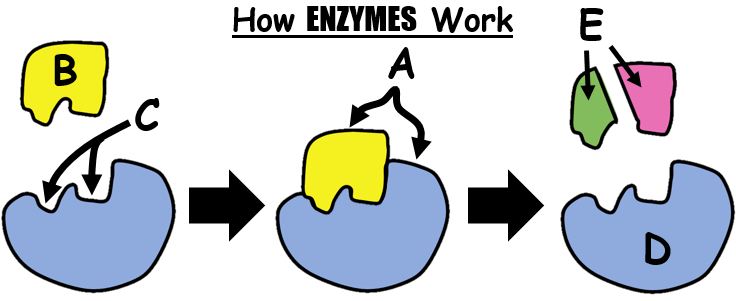
In the diagram, what is letter A?
a)
product
b)
substrate
c)
enzyme-substrate complex
d)
active site
80.
Enzymes are...
a)
nucleic acids
b)
proteins
c)
lipids
d)
carbohydrates
81.
An enzyme speeds up a chemical reaction in the cell but can only be used once. True or False?
a)
true
b)
false
82.
What happens when enzymes are heated to a high temperature?
a)
The enzymes die.
b)
The shapes of the enzyme are altered or denatured
c)
The enzymes' amino acid sequence changes.
d)
The enzymes remain the same
83.
Which of these is most likely an enzyme?
a)
Sucrose
b)
Galactose
c)
Fructose
d)
Amylase
84.
The pH at which an enzyme is most efficient is called the _________ pH of an enzyme.
a)
neutral
b)
optimum
c)
minimum
d)
experimental
85.

The current model of enzyme action is referred to as the...
a)
Induced Fit Model
b)
Lock & Key Model
c)
Singer-Nicolson Model
d)
Davson-Danielli Model
86.
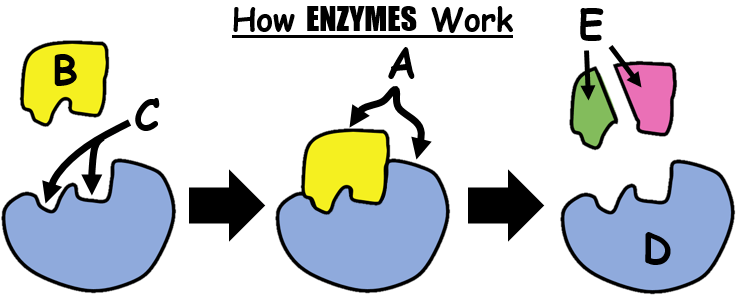
Letter D...
a)
active site
b)
enzyme
c)
substrate
d)
products
87.
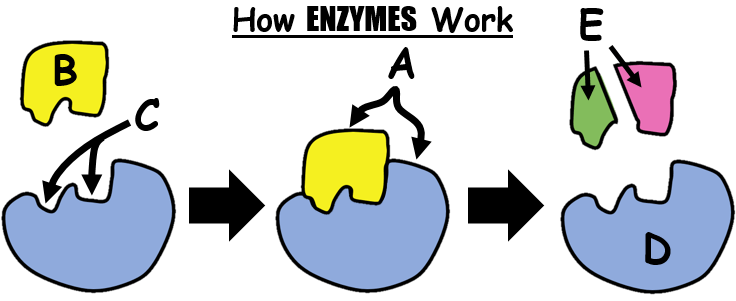
Letter B...
a)
active site
b)
enzyme
c)
substrate
d)
products
88.
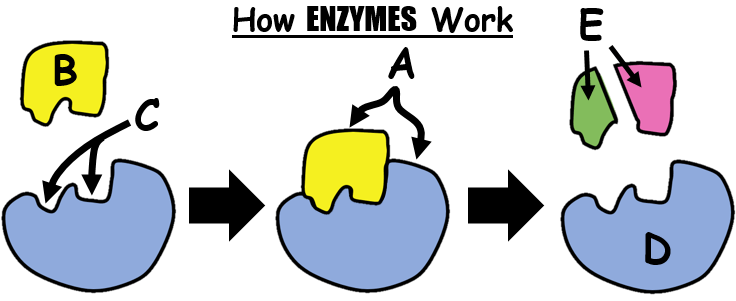
Letter C...
a)
active site
b)
enzymes
c)
substrate
d)
products
89.
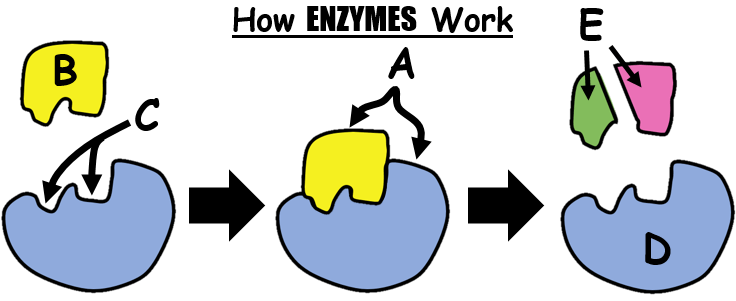
Letter E...
a)
active site
b)
enzyme
c)
substrate
d)
products
90.
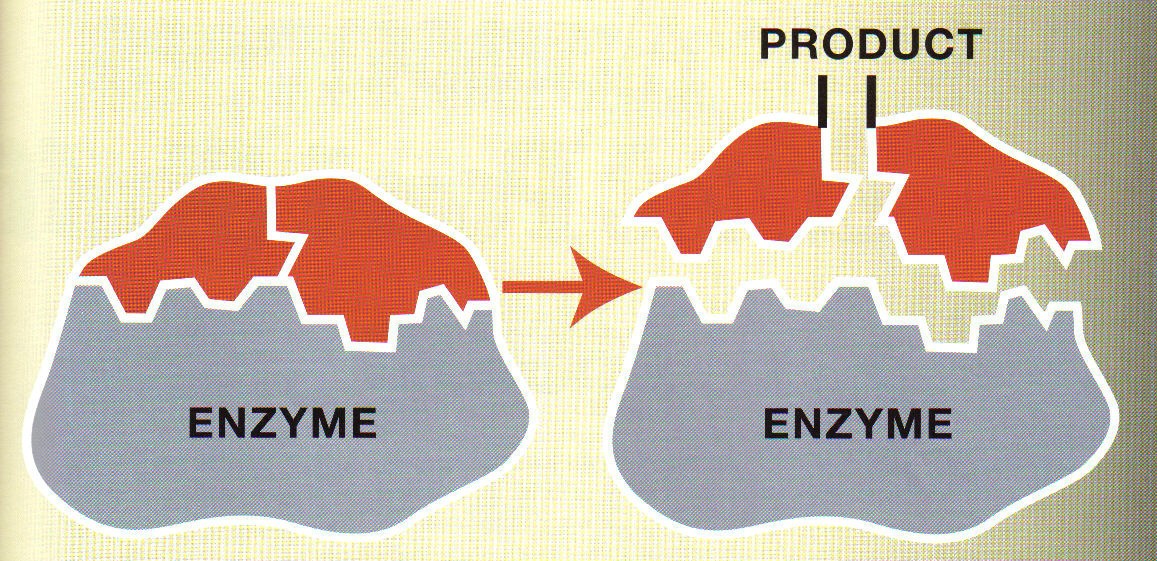
Organic molecules that temporarily bind to enzymes and enhance an enzyme's ability are called:
a)
CoFactors
b)
CoEnzymes
c)
Allosteric Inhibitors
d)
Allosteric Activators
91.
Cells can produce over one thousand different enzymes at a time. Enzymes are critical to the metabolism of these cells, but why are so many different enzymes needed?
a)
Cells are completely unable to control what enzymes
they produce
they produce
b)
The variety of enzymes prevents their actions from being inhibited.
c)
The active site of an enzyme can only bind to a specific substrate.
d)
The products of a reaction are always converted into new enzymes.
92.
Every enzyme has a optimal temperature and pH. True or False?
a)
True
b)
False
93.
Energy is released from ATP when
a)
a phosphate group is added
b)
adenine bonds to ribose
c)
ATP is exposed to sunlight
d)
a phosphate group is removed
95.
Energy is released from ATP when
a)
a phosphate group is added
b)
adenine bonds to ribose
c)
ATP is exposed to sunlight
d)
a phosphate group is removed
95.
Energy is released from ATP when
a)
a phosphate group is added
b)
adenine bonds to ribose
c)
ATP is exposed to sunlight
d)
a phosphate group is removed
100 %

