
 Worksheets
Unit 4 review
Total questions: 98
Worksheet time: 49mins
Which of the following is a characteristic of Angus cattle?
Red with white face, docile
Black, polled, high carcass quality
Light gray to black, resistant to heat
White to light straw color, larger in stature
What is a common trait of Hereford cattle?
Black and white color pattern
Red with white face, good foragers
No set color pattern, large frame
Light gray to black, loose dewlap
Which breed of cattle is known for being the largest framed dairy breed and highest quantity milk producer?
Charolais
Brahman
Holstein
Simmental
What is a phenotypic trait used to categorize food animal breeds?
Diet preferences
Color and/or color patterns
Breeding habits
Lifespan
Which cattle breed originates from India and is known for its heat tolerance?
Angus
Hereford
Brahman
Simmental
Which dairy breed is known for its cream to light fawn color and high butterfat content in milk?
Ayrshire
Jersey
Brown Swiss
Guernsey
What characteristic is associated with the American Landrace pig breed?
Red, drooped ears
Black with white belt
White, long body, big loped forward ears
White, erect ears
Which sheep breed is raised for both wool and meat?
Suffolk
Rambouillet
Dorset
Merino
What is a notable feature of the Hampshire pig breed?
Red, drooped ears
Black with white belt, erect ears
White, long body, big loped forward ears
White, erect ears
Which sheep breed is popular for wool production?
Suffolk
Hampshire
Rambouillet
Dorper
Which of the following is a popular dairy goat breed?
Boer
Nubian
Kiko
Spanish
Which chicken breed is known for laying white eggs?
Rhode Island Red
Cornish Mix
White Leghorn
Jersey Giant
What is a key factor in selecting meat goat breeds?
Egg production
Milk yield
Structural correctness
Plumage color
Which turkey breed is most popular in America?
Broad Breasted Bronze
Broad Breasted White
Jersey Giant
Kosher King
Which organization recognizes 155 breeds of dogs categorized into seven groups?
United States Department of Agriculture (USDA)
American Kennel Club (AKC)
World Canine Organization (WCO)
International Dog Federation (IDF)
What is the primary purpose of breeding Sporting dogs?
To be small and require little space
For hunting and regular exercise
To control the movement of other animals
For pulling sleds and heavy work
Which breed group is known for strong scent abilities and good stamina?
Toy
Hounds
Terriers
Non-Sporting
What is a characteristic of Toy dogs?
Large and intelligent
Small in size, do not require a lot of space
Bred for hunting vermin
Good for training exercises
Which cat breed is known for having 34 recognized color patterns with tabby being the most common?
Maine Coon
Persian
American Shorthair
Siamese
Which cat breed is known for having exceptionally large and heavy bodies with blue eyes?
Siamese
Ragdoll
Abyssinian
Manx
What is a distinctive feature of the Siamese cat's appearance?
Short hair coat
Equilateral triangle head shape
Black-colored nose
Unique color markings
Which rabbit breed is known for having a unique three-layer coat structure of wool?
Californian
Dutch
Angora
Mini Rex
What is a characteristic of the English Spot rabbit?
Over 20 recognized colors
Unique chain of markings
Short hair coat
White blaze on the forehead
What is a common trait of intact male animals?
Less muscular overall
More muscular overall
Longer fur
Smaller size
Which of the following characteristics is true for castrated males?
Typically larger in stature and grow faster than females
Slower-growing and have less muscle overall than intact males
Larger body structure than immature females
More feminine head than immature males
What is a mature female goat called?
Ewe
Doe
Bitch
Queen
In poultry, what is the term for an immature castrated male?
Rooster
Capon
Pullet
Hen
Which species has the term "Barrow" for an immature castrated male?
Cattle
Swine
Poultry
Sheep
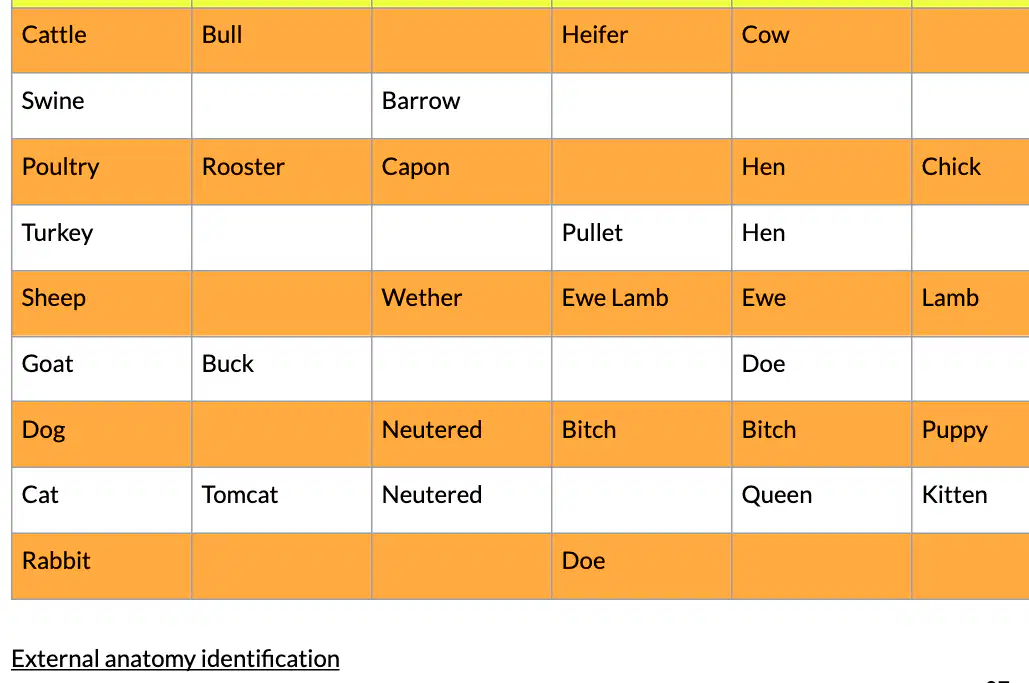
What is the term for a newborn cat?
Kitten
Chick
Lamb
Puppy
What is the muscled portion of the animal between the loin and tail called?
Round
Rump
Loin
Brisket
Which part of the animal is described as the muscled portion along the backbone?
Shoulder
Loin
Flank
Poll
Where is the switch located on an animal?
Top of the head
Bottom of the tail
Between the front legs
Side of the tailhead
What is the function of the hock in an animal's anatomy?
Muscled portion of the rear leg
Tarsal joint halfway up the hind limb
Side section between the belly and top
Area encircling the body behind the front legs
Which part of the animal is known as the pelvic region?
Flank
Brisket
Heart girth
Pin bones
What part of the animal is referred to as the "ham"?
Rear leg of the animal
Muscled portion along the backbone
Part of the animal between the loin and tail
Underside of the animal
Where is the "loin" located on an animal?
Between the neck and ribs
Along the backbone
Between the loin and tail
Side section between the belly and top
What is the "jowl" area of an animal?
Chin area
Underside of the animal
Rear leg of the animal
Tarsal joint halfway up the hind limb
Which part of the animal is the "pastern"?
Part of the leg between the fetlock and hoof
Muscled portion between the neck and ribs
Side section between the belly and top
Large joint halfway up the hind limb
What is the "hock" in animal anatomy?
Tarsal joint halfway up the hind limb
Rear leg of the animal
Muscled portion along the backbone
Part of the animal between the loin and tail
What is the red structure on top of a bird's head called?
Wattle
Beak
Comb
Eye ring
Which part of a bird is described as fleshy structures on the head just below the beak?
Ear lobe
Wattles
Vent
Shank
What is the pointed structure on the front of a bird's head?
Comb
Beak
Eye ring
Hock
Where is the vent located on a bird?
On top of the head
At the back of the bird
Below the beak
Between the neck and tail
What is the area between the breast and vent of a bird called?
Back
Shank
Abdomen
Ear lobe
What is the fleshy side of the face below the eye called?
Dewlap
Cheek
Muzzle
Flank
Which part of an animal is a loose fold of skin under the chin, most prominent in female rabbits?
Elbow
Guard hairs
Dewlap
Whiskers
What is the upper joint of the front leg just below the shoulder known as?
Elbow
Hock
Stifle
Rump
Where is the pelvic region of an animal located?
Flank
Foot pad
Shoulder
Nose pad
What is the projecting jaw that contains the nose and mouth called?
Muzzle
Nose pad
Whiskers
Guard hairs
Which part of an animal is the tip of the nose that may be sensitive and useful for investigating objects?
Muzzle
Nose pad
Whiskers
Hock
What is the upper rounded part of the hindquarter called?
Rump
Stifle
Elbow
Flank
What are long projecting hairs or bristles growing near the mouth known as?
Guard hairs
Whiskers
Dewlap
Cheek
What is the transparent layer covering the eye that serves as the eyelid for snakes called?
Fins
Gills
Scales
Brille
Which structure enables a fish to move through the water by being supported with bone or cartilage rods?
Scutes
Fins
Gills
Scales
What is the major organ of the respiratory system of fish that allows them to breathe without lungs?
Scales
Brille
Gills
Scutes
What are the extensions of the epidermal layer of skin that have been modified to provide protection?
Scales
Fins
Gills
Brille
What are the epidermal scales found on turtles called?
Brille
Scutes
Fins
Gills
Select the correct drawing that shows a fish/amphibian/reptile with all external anatomy labeled.
A drawing and labeling of a fish
A drawing and labeling of a bird
A drawing and labeling of a mammal
A drawing and labeling of an insect
What does the term "confirmation" refer to in animal selection criteria?
The color of the animal's coat
The physical arrangement of bone and body tissue
The animal's age and weight
The animal's feeding habits
Which of the following is important for carrying offspring and yield in animals?
Muscle distribution
Breed character
Body capacity
Finish
What is typically analyzed from the side view of an animal?
Frame size
Breed character
Body capacity
Balance
What does "finish" refer to in the context of animal selection?
The animal's speed
The amount of fat the animal has
The animal's color pattern
The animal's height
In animal selection, what does "balance" mean?
The animal's ability to stand on one leg
The even distribution of body parts in an attractive manner
The animal's weight compared to its height
The animal's speed and agility
What is the average weight of market hogs?
270 pounds
1300 pounds
125 pounds
75 pounds
Which of the following is NOT a criterion for selecting companion animals?
Pets
Recreation
Entertainment
Processed products
What does the Breeding Soundness Exam (BSE) assess?
Weight gain
Fertility
Body composition
Feeding requirements
Which part of the BSE involves using a microscope to determine sperm movement?
Physical examination
Scrotal circumference measurement
Sperm motility
Sperm morphology
What is the purpose of Expected Progeny Differences (EPD) in the cattle industry?
To measure average daily gain
To assess fertility
To compare animals within a breed based on genetic potential
To evaluate body composition
What does the acronym "WW" stand for in the context of animal selection?
Birth Weight
Fertility
Weaning Weight
Weight Watch
Which of the following is NOT a reason to cull animals or prevent future offspring?
Reproductive efficiency
Age
Color of fur
Genetics
According to the USDA, what do grades for food animals indicate?
Sanitation
Quality
Size
Color
Which of the following is a factor in determining beef quality grades?
Color of the animal
Age or maturity of the animal
Speed of growth
Height of the animal
What is marbling in the context of beef quality?
The color of the meat
The dispersal of fat within the lean meat
The size of the meat cut
The age of the animal
What are the USDA Quality Grades for beef cattle?
Prime, Choice, Select, Standard, Commercial, Utility, Cutter, Canner
Prime, Choice, Select, Standard, Commercial, Utility, Cutter, Premium
Prime, Choice, Select, Standard, Commercial, Utility, Premium, Canner
Prime, Choice, Select, Standard, Commercial, Premium, Cutter, Canner
What is the typical meat color for fresh pork sold in supermarkets with a Quality Grade of Acceptable?
Reddish-pink
Bright red
Dark brown
Pale white
Which factor is NOT used to determine pork yield grades?
Loin Eye Area (LEA)
Hot Carcass Weight (HCW)
Fat Depth/Cover over the Ribeye
Bone Density
What is the relationship between dressing percentage and the value of an animal?
Higher dressing percentage increases the animal's value
Higher dressing percentage decreases the animal's value
Dressing percentage has no effect on the animal's value
Dressing percentage only affects the animal's weight
What is one of the selection criteria for cows in beef cattle?
High fertility rates
Low fertility rates
High birth weight calves
Low milk production
Which trait is important for selecting bulls in beef cattle?
Structurally correct feet and legs
Low birth weight calves
High milk production
Quiet disposition
What is a desirable trait for feeder cattle?
High average daily gain
Low average daily gain
High birth weight
Excessive milk production
What is a characteristic of replacement heifers?
Structurally correct with sound feet and legs
High birth weight
Low fertility rates
Excessive milk production
What is one management decision that accurate records help dairy producers make?
Culling the least profitable cows
Increasing birth weight
Reducing milk production
Increasing calving difficulty
What is the purpose of a pedigree in animal selection?
To measure daily feed costs
To identify members of maternal and paternal lines
To assess reproductive efficiency
To evaluate physical soundness
Which of the following is a criterion for selecting market animals?
High tail setting
Medium height, long- and wide-bodied
Low feed per pound of gain rate
Conception rate
What does reproductive history in animal records include?
Pounds of total milk produced
Conception rate, days open, calving interval
Somatic cell score
Sloping shoulder
Which characteristic is important for breeding animals in terms of physical soundness?
High feed costs
Sloping shoulder, strong pastern
Somatic cell score
Medium height
What is a feature of well-attached udders in animal selection?
Held above the hocks
Low feed per pound of gain rate
High tail setting
Clean over loin edge
What is the ideal backfat measurement for a hog at the 10th rib?
0.5 inch
0.8 inch
1.0 inch
1.2 inch
Which of the following is a criterion for selecting broilers for meat production?
Egg size
Desirable feathering
Color of the beak
Length of the tail
In what order does bleaching occur in layers as they lay more eggs?
Beak, vent, eye ring, ear lobe
Vent, eye ring, ear lobe, beak
Eye ring, vent, beak, ear lobe
Ear lobe, beak, vent, eye ring
What is a sign of freedom from defects in broilers?
Thick feathers
Crooked toes
Swollen hocks
Absence of bruises on the breast
What are the characteristics of high-production birds in terms of conformation?
Small body capacity, rigid abdomen
Large body capacity, soft and flexible abdomen
Narrow pubic bones, rough shanks
Bright eyes, dark eyelids
Which health protocol is important for selecting companion animals?
Regular exercise
Vaccination schedule
Grooming routine
Training sessions
What should be avoided in the skin or fur of companion animals?
Bright colors
Dermatitis, mange, or matting
Soft texture
Short length
Which of the following is a genetic disorder to be aware of in sire and dam selection?
Obesity
Congenital heart anomalies
Overactivity
High energy levels
What type of notes are used to identify an animal's unique traits during evaluation?
Behavioral notes
Identification (ID) notes
Health notes
Feeding notes
What is the purpose of comparative or pair notes in animal judging?
To describe individual animal features
To compare traits between animals in each pair
To list the heaviest animals
To determine the species of each animal
How should the length of oral reasons be when explaining a class's placing?
Less than 1 minute
Less than 2 minutes
Less than 3 minutes
Less than 4 minutes

