wayground logo

Free Printable Worksheets

Font size

S
M
L
XL
Worksheets

APES Final Review

Total questions: 100

Worksheet time: 3600secs

Name
Class
Date
1.

What did Thomas Malthus predict?

a)

That human population would exceed 10 billion

b)

That human population would outgrow food supply

c)

That the impact per person would increase as a country industrialized

d)

That war famine and disease would result from population growth

2.

Which of the following exemplifies soft path energy policy?

a)

many power plants feeding into the grid

b)

using a variety of energy sources

c)

producing and distributing electricity locally

d)

meeting the peak demand of energy use

e)

working to increase concentration and lower peak demand

3.

What are the most populous countries, in order from largest to smallest?

a)

China, US, India

b)

India, China, Nigeria

c)

China, India, US

d)

China, India, Nigeria

4.

Which of the following are forms of indirect solar energy?

a)

coal

b)

wind

c)

geothermal

d)

nuclear

e)

tidal

5.

Which phase of the demographic transition model is exemplified by low death rates, high birth rates, and rapidly growing population?

a)

Post-industrial

b)

Industrial

c)

Transitional

d)

Pre-industrial

6.

Which energy source is most widely used in the US?

a)

Coal

b)

Oil

c)

Natural Gas

d)

Nuclear

7.

What is the most effective and least controversial way to lower birth rates?

a)

enact a "One Child" policy

b)

provide education and economic opportunities for women.

c)

teach abstinence only in public schools

d)

reduce funding for healthcare facilities that provide family planning

e)

improve pre-natal care to reduce infant mortality

8.

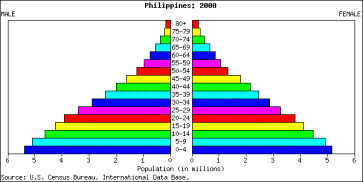
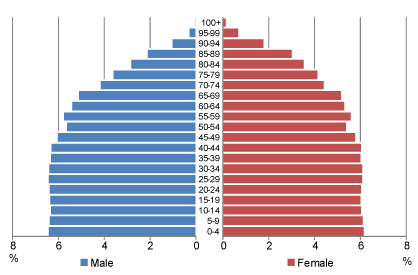
Check all of the following statements that can be made about this image.

a)

pyramid A is most likely in a developing county.

b)

pyramid B has a high age dependency ratio

c)

pyramid A represent a country with a larger population.

d)

pyramid A has a high youth dependency

9.

Agricultural runoff from fertilizers used on farms is considered

a)

point source pollution

b)

non point source pollution

c)

a primary pollutant

d)

a mobile source

10.

Which of the following are primary air pollutants?

a)

O3

b)

SO2

c)

PM 2.5

d)

H2SO4

e)

radon

11.

A low DO may be attributed to

a)

a low BOD

b)

a high BOD

c)

warm water

d)

high riffle

e)

cold water

12.

Which of these criteria pollutants leads to the formation of two major secondary pollutants?

a)

CO

b)

CO2

c)

NOx

d)

Pb

e)

SOx

13.

Limestone injection and flu gas scrubbing are effective pollution control measures for

a)

PM 2.5

b)

PM 10

c)

CO

d)

SOx

e)

O3

14.

The Replacement Fertility Rate is lower in MDC's because in MDC's

a)

infant mortality is higher

b)

less babies are being born

c)

more babies are being born

d)

infant mortality is lower

15.

Isotopes have the same number of _____, but a different number of __________.

a)

protons; neutrons

b)

protons, electrons

c)

electrons, neutrons

d)

protons; bosons

16.

Choose the secondary consumer in the following food chain

a)

phytoplankton

b)

zooplankton

c)

Whale Shark

d)

Bacteria

17.

Click all of the autotrophs

a)

trees

b)

humans

c)

cyanobacteria

d)

moss

18.

If 50,000 kJ of energy is available to the primary producers in an ecosystem, how much will be available to the tertiary consumers?

a)

5,000 kJ

b)

500 kJ

c)

50 kJ

d)

5 kJ

19.

As you burn firewood, the energy stored in the firewood goes from a highly ordered state to a less ordered state. Which law does this demonstrate?

a)

The 1st Law of Thermodynamics

b)

The 2nd Law of Thermodynamics

c)

Newton's 2nd Law

d)

Pascal's Wager

20.

What type of plate boundary is this?

a)

Convergent

b)

Divergent

c)

Transform

d)

Strike/Slip

21.

Which of the following are possible consequences of convergent plate boundaries?

a)

Glaciers

b)

Trenches

c)

Rift Valleys

d)

Mountains

22.

Atoms that emit radiation as they decay into more stable atoms:

a)

Radioactive bosons

b)

Radioisotopes

c)

Gravitons

d)

Higgs particles

23.

The majority of the atmosphere is made of which gas?

a)

Nitrogen

b)

Oxygen

c)

Carbon dioxide

d)

Water Vapor

24.

Which of the following is correctly paired?

a)

Troposphere - Where the Ozone layer is located

b)

Stratosphere - Where most of our weather is lcoated

c)

Where most meteors burn up - Mesosphere

d)

None of the above are correctly paired

25.

Which is associated with thermal inversions?

a)

a layer of cool air forms beneath a layer of warmer air

b)

Reduces atmospheric particulate health hazards

c)

Occurs more often in rural areas

d)

All of the above are associated with thermal inversions

26.

Weather systems rotate and tend to move diagonally, rather than moving directly north-south. This is because:

a)

The Earth is rotating

b)

The Coriolis Effect

c)

The Earth's equator is spinning faster than the poles

d)

All of the above

27.

Enabled citizens to sue parties violating air quality standards, provided funds for pollution control research, and imposed limits on emissions

a)

Clean Air Act of 1970

b)

Clean Air Act of 1990

c)

The Kyoto Protocol

d)

The Paris Climate Agreement

28.

Identify a negative economic effects of acid deposition

a)

Erodes stone buildings and gravestones

b)

Soil chemistry is altered and can kill microorganism life

c)

Nutrients such as calcium and magnsium are leached from the soil

d)

runoff can enter waterways and kill wildlife

29.

The Montreal Protocol of 1987 banned _______ to help solve _____

a)

Nitrogenous runoff; oceanic dead zones

b)

Carbon emissions; climate change

c)

CFC emissions, the ozone hole

d)

Aerosol emissions; global cooling

30.

Systems that remove some of the gases and/or particulates from factory exhaust

a)

Generators

b)

Skimmers

c)

Turbines

d)

Scrubbers

31.

Which of the following is a secondary pollutant?

a)

Carbon monoxide

b)

Sulfur trioxide

c)

Soot

d)

None of the above

32.

Which of the following water cycle process are connected to surface water on the Earth?

I. ground water flow

II. surface water runoff

III. evaporation

a)

I only

b)

I and II only

c)

II and III only

d)

I, II, and III

33.

Which of the following is a non-point source of water pollution?

a)

Effluent from a sewage treatment plant

b)

BP refiner in Indiana discharging ammonia in a river.

c)

Runoff of pesticides from regional farms into the Illinois River.

d)

Hot water discharges from a nuclear power plant.

34.

What is the health risks could be connected to eating some fish from lakes or the ocean?

a)

They may be invasive species that impact native fish species populations.

b)

The Omega-3 fatty acids found in some fish can have a negative impact on cardiovascular health.

c)

If they are high on the food chain they may contain high levels of mercury or PCB's.

d)

They may have been exposed to inorganic nutrients from fertilizers.

35.

Which of the following are not a water treatment procedures used to disinfect and kill harmful bacteria?

a)

Distillation

b)

Chlorine

c)

UV rays

d)

Ozone

e)

Desalination

36.

Which law sets standards limiting pollutants for community's water supplies?

a)

Clean Water Act (CWA)

b)

Safe Drinking Water Act (SDWA)

c)

National Environmental Policy Act (NEPA)

d)

Resource Conservation and Recovery Act (RCRA)

37.

What is it called when a persistent pollutant (like mercury or PCBs) builds up in the tissues of an organism as they continue to eat something that contains the pollutant?

a)

Negative Feedback Loop

b)

Biomagnification

c)

Tragedy of the Commons

d)

Bioaccumulation

e)

Positive Feedback Loop

38.
Strategies used to clean up oil spills include all of the following EXCEPT:
a)
Floating booms and boats to skim floating oil toward collectors
b)
Skimmers to absorb oil from the water
c)
Addition of limestone to neutralize the acidic water
d)
Chemical dispersants that break up the oil and help it to sink.
39.

The pollution of waterways creating conditions in which productivity is decreased and gills of bottom dwelling organisms are clogged is due to

a)

erosion and sedimentation

b)

runoff and flooding

c)

herbicides and eutrophication

d)

mining and acid deposition

40.
What do we call the land area that supplies water to a river system?
a)
runoff
b)
recharge
c)
watershed
d)
valley
41.

Which is a type of wastewater?

I. Sewage water from toilets

II. Water from showering and bathing

III. Water from washing clothes

a)

I only

b)

II only

c)

III only

d)

I and II

e)

I, II, and III

42.

Which pollutant is most likely to be released into groundwater supplies without human intervention?

a)

Phosphates

b)

Lead

c)

Arsenic

d)

Mercury

43.

Which is NOT a criteria pollutant?

a)

Sulfur dioxide

b)

Lead

c)

Carbon dioxide

d)

Particulate matter

e)

Tropospheric ozone

44.

A secondary pollutant

a)

forms in the stratosphere.

b)

is transformed by sunlight or water.

c)

cannot be directly tracked.

d)

does not directly harm humans.

e)

forms primarily from incomplete combustion.

45.

Which is a source of sulfur dioxide found in nature?

a)

Forest fires

b)

Lightning strikes

c)

Plant emissions

d)

Volcanoes

e)

Soil

46.

Carbon monoxide

a)

increases lung cancer rates.

b)

leads to the formation of photochemical smog.

c)

is most problematic in rural areas

d)

does not directly cause deaths.

e)

is produced by incomplete combustion.

47.

Thermal inversions

a)

increase the rate of smog formation.

b)

trap high concentrations of pollution at ground level.

c)

result in increased levels of acid deposition.

d)

are caused by high levels of precipitation.

e)

reduce the negative effects of VOCs.

48.

Acid deposition forms as a result of

a)

nitrogen oxides and photochemical smog.

b)

carbon monoxide and VOCs.

c)

sulfur dioxide and VOCs.

d)

nitrogen oxides and sulfur dioxide.

e)

carbon monoxide and photochemical smog.

49.

Which pollution control method was proposed by an amendment of the Clean Air Act?

a)

Allowing tolls to limit the use of automobiles

b)

A market for sulfur emissions

c)

The regulation of radon emissions

d)

The use of catalytic converters

e)

Chemicals developed to prevent the formation of ozone.

50.

The formation of ozone begins when an 02 molecule is split by

a)

UV-A radiation.

b)

UV-B radiation.

c)

UV-C radiation.

d)

UV-A or UV-B radiation.

e)

UV-B or UV-C radiation.

51.

Which outdoor air pollutant is also a significant indoor air pollutant?

a)

Sulfur dioxide

b)

Nitrogen oxides

c)

Carbon monoxide

d)

Lead

e)

Ozone

52.

The primary source of radon is

a)

electronics.

b)

indoor fires.

c)

household chemical fumes.

d)

rocks and soils.

e)

construction materials

53.
The beneficial ozone is ____ and the dangerous ozone is ____.
a)
O3, CFC
b)
Stratospheric, tropospheric
c)
Tropospheric, stratospheric
d)
O2, O3
54.
Which element accumulates in the environment due to use of fertilizers?
a)
oxygen
b)
hydrogen
c)
nitrogen
d)
carbon
55.
Which is true of urban sprawl?
a)
it occurred in the 1800s
b)
it lasted 20 years in the 1990s
c)
it began in 1950 and continues until today
d)
it began in the 1990s and continues to today
56.
The large scale removal of trees by cutting or burning is called _______________.
a)
urbanization
b)
deforestation
c)
desertification
d)
overpopulation
57.
What are some bad things attributed to population growth?
a)
autism & genetic diseases
b)
religious conflict
c)
low wages & unemployment
d)
burning fossil fuels & increased CO2 production
58.
Which is not a Global Common
a)
Seas
b)
Air
c)
Genetically Modified Plants
d)
Minerals 
59.
This fire burns undergrowth and leaf litter. It kills seedling and small trees. It can protect the forest from pathogens. 
a)
Crown
b)
Ground
c)
Surface
60.
Which of the following type of tree harvesting is the most detrimental to the environment?
a)
Strip Cutting
b)
Selective Cutting
c)
Clear Cutting 
d)
Partial Harvest
61.
Growing more than one crop in a field, especially in alternating rows. 
a)
Alley Cropping
b)
PolyCulture
c)
Interplanting
d)
Intercropping
62.
A hectare (ha) is an area equal to a square that is 100 meters on each side. If the plot of land is 300 m x 300 m, how many hectares is the plot?
a)
9
b)
90
c)
900
d)
9000
63.
The largest area of old -growth forest in the world is located in 
a)
the United States
b)
Russia
c)
Costa Rica
d)
Mexico
64.
Which of the following leads to a decrease in birthrates among women?
a)
Higher Education
b)
High Infant Mortality Rate
c)
No Prenatal Care
d)
No contraceptives
65.
Birthrate remains high, death rate begins to fall, total population increasing
a)
Stage 1 Demographic Transition
b)
Stage 2 Demographic Transition
c)
Stage 3 Demographic Transition
d)
Stage 4 Demographic Transition
66.
All of the following are density independent factors EXCEPT
a)
Limited food
b)
Earthquakes
c)
Hurricanes
d)
Torandoes
67.
The measure of the quality of life is also known as the
a)
Total Fertility Rate
b)
Replacement Level Fertility
c)
Infant Mortality Rate
d)
Birth Rate
68.
All of the following are characteristics of R selected species except
a)
No prenatal care
b)
Short Lifespan
c)
Early reproductive age
d)
Few Offspring
69.
The number of individuals an environment can support is known as the
a)
Total Fertility Rate
b)
Exponential Growth
c)
Limiting Factor
d)
Carrying Capacity
70.
A small community started out with 10 people in year 1.  During year 1 they had 10 births and 5 deaths.  What was this community's growth rate for year 1?
a)
50 %
b)
5 %
c)
75 %
d)
1.5 %
71.
According to the population pyramid of this country, its population is most likely...
a)
growing slowly.
b)
growing rapidly.
c)
decreasing.
d)
not changing.
72.
What kind of growth is this country experiencing?
a)
Exponential Growth
b)
Stable Growth
c)
Declining Growth
73.
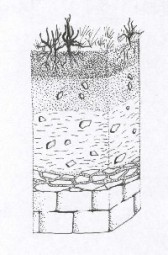
Which of the following is NOT one of the three layers of soil?
a)
topsoil
b)
undersoil
c)
subsoil
d)
bedrock
74.
_______ is the type of soil used most often with plants. It is a mixture of clay, sand, and silt.
a)
loam
b)
humus
c)
mud
d)
dirt
75.
Humus is.....
a)
the dead parts of plants and animals in soil.
b)
A food we eat with pretzels.
c)
The tiny particles inside of soil
d)
The roots that come off of a plant and live in soil.
76.
What is a soil problem all farmers face?
a)
soil hardening
b)
soil erosion
c)
soil spoiling
d)
soil pollution
77.
Layers of soil are also known as:
a)
Soil Profiles
b)
Soil Horizons
c)
Soil sheets
d)
Soil cores
78.
Which layer is the bottom of the soil profile?
a)
C - Partially Weathered Parent Material
b)
D - Separated rock
c)
R - Bedrock
d)
A - Topsoil
79.
Place the following layers in order from top to bottom: bedrock, topsoil, subsoil, organic, parent material.
a)
Organic, Topsoil, Subsoil, Parent Material, Bedrock
b)
Organic, Topsoil, Parent Material, Subsoil, Bedrock
c)
Topsoil, Organic, Subsoil, Parent Material, Bedrock
d)
Topsoil, Organic, Parent Material, Subsoil, Bedrock
80.
What type of growth model is this?
a)
exponential growth model
b)
logistic growth model
c)
Type I curve
d)
Type III curve
81.
relationship in which two species live closely together
a)
resource
b)
mutualism
c)
succession
d)
symbiosis
82.
largest number of individuals of a population that the environment can support  
a)
carrying capacity
b)
primary succession 
c)
denitrification
d)
mutualism
83.
the species that starts life in primary succession
a)
pioneer species 
b)
succession 
c)
nitrogen fixation
d)
cellular respiration 
84.
symbiotic relationship in which one organisms benefits and the other organism is not affected
a)
invasive (non-native) species
b)
mutualism 
c)
nitrogen fixation
d)
commensalism
85.
An environmental factor such as predation, disease, and competition that depends on the number of members in a population per unit
a)
dispersion
b)
density- independent factor
c)
density- dependent factor
d)
population growth rate
86.
population numbers get too large for the environment to support it and growth slows
a)
Exponential growth
b)
Logistic growth
c)
Natality
d)
Emigration
87.
What factor describes when populations increase because animals are moving into a population?
a)
Emigration
b)
Limiting Factors
c)
Immigration
d)
Exponential Growth
88.
The graph of logistic growth can be described as...
a)
S-shaped
b)
J-shaped
c)
W-shaped
d)
U-shaped
89.
Which statement best explains how natural selection occurs?
a)
when adaptations help an organism reproduce and survive.
b)
when organisms are geographically isolated.
c)
when an organism’s offspring grow vestigial structures.
d)
when characteristics from the parent organism are inherited.
90.
How is secondary succession different from primary succession?
a)
Secondary succession occurs after a disturbance in an area that was previously uninhabited.
b)
Secondary succession occurs after a disturbance in an area in which the soil has remained intact.
91.
What does this picture represent?
a)
species diversity
b)
ecosystem diversity 
c)
genetic diversity
d)
biodiversity
92.
Which of the following describes the importance of biodiversity to an ecosystem?
a)
a. People like to be able to see all the different plants and animals
b)
b. If there aren�t all the different species, there will be resources that aren�t being used
c)
c. Biodiversity is not as important as many people think
d)
d. Biodiversity can help minimize the effects of losing a species.
93.
Which human activity would be most destructive to the biodiversity of the biosphere?
a)
a. The burning of wood and coal in rural areas
b)
b. The release of species of freshwater trout in lakes
c)
c. The removal of plants from the food webs they support
d)
d. The removal of erosion barriers from forest boundaries
94.
What affect will continued rise in global temperature most likely have on worldwide biodiversity?
a)
a. It will have no effect as there is plenty of time for organisms to adapt
b)
b. It will increase due to warmer temperatures
c)
c. It will increase due to greater plant production from more CO2
d)
d. It will decrease due to massive habitat destruction
95.
Why are invasive species such a problem in their new ecosystem?
a)
a. The new ecosystem isn�t adapted to their presence
b)
b. The new ecosystem is probably weaker than the native one
c)
c. They have mutations making them more adapted to the new ecosystem
d)
d. They cause mutations in the native species
96.
In what way are humans most impacting the biodiversity of ecosystems around the world?
a)
a. We are putting too many organisms in zoos or keeping them as pets
b)
b. We are increasing biodiversity by breeding new species
c)
c. We are destroying the habitats of a large number of species
d)
d. Recreational hunting
97.
One characteristic feature of tundra is that only the surface thaws in the summer and refreezes in the winter, leaving a layer of permanently frozen subsoil.  This characteristic is known as
a)
glaciation
b)
permafrost
c)
crystallization
d)
soilfrost
98.
Programs that breed animals in captivity then release them to the wild are called...
a)
Kidnapping
b)
Breeding Buildings
c)
Captive Breeding Programs
d)
Catch and Release Programs
99.
Biologists put extra effort into protecting these because they have many species living in them.
a)
Cities
b)
Biodiversity Hotspots
c)
Farms
d)
Conservation stations
100.
The species that plays the biggest role in the habitat is?
a)
Smaller species
b)
Larger species 
c)
Keystone Species
d)
Evolving species