wayground logo

Free Printable Worksheets

Font size

S
M
L
XL
Worksheets

Smitty's Biology STAAR Review

Total questions: 100

Worksheet time: 1hrs 15mins

Name
Class
Date
1.
Members of which kingdom live in unusual conditions such as deep ocean trenches or volcanoes?
a)
Eubacteria
b)
Protista
c)
Fungi
d)
Archaebacteria
2.
What reactants are there in cellular respiration?
a)
Water and Glucose
b)
Oxygen and Glucose
c)
Carbon Dioxide and Water
d)
Glucose  and Carbon Dioxide
3.
 A cell must divide to produce a group of cells that can form a tissue.  Which process is responsible for this division?
a)
Meiosis
b)
Homeostasis
c)
Cell Cycle
d)
Mitosis
4.
How do enzymes function?
a)
They increase the activation energy
b)
They increase the reaction rate
c)
They decrease the reaction rate
d)
They decrease the substrate binding complex
5.
What are the two major organ systems that work to defend the body from injury?
a)
Immune and Endocrine
b)
Integumentary and Nervous
c)
Excretory and Immune
d)
Integumentary and Immune
6.
Normal-
AGA-TTC-ATA-GCG
Mutant-
AGA-TTC-AAT-AGC-G
What is the type of mutation that has occurred?
a)
deletion frameshift
b)
insertion frameshift
c)
substitution
d)
nonsense
7.
Viruses are pathogens that can infect and destroy cells.  What process are these viruses carrying out when they destroy the cells they infect?
a)
Cell Cycle
b)
Lytic Cycle 
c)
Lysogenic Cycle
d)
Replication Cycle
8.
What determines the code, or information, of a DNA molecule?
a)
the shape (structure) of the nitrogen bases
b)
the order (sequence) of the nitrogen bases
c)
the color of the nitrogen bases
d)
the frequency (number) of nitrogen bases
9.
Which of the following increases an organism's chance for survival?
a)
Genetic Drift
b)
Genetic Variation
c)
Asexual Reproduction
d)
Frameshift Mutations
10.
Which of the following is NOT a role of bacteria that live in human bodies?
a)
digesting food
b)
competing for space with disease-causing bacteria
c)
making vitamins
d)
fixing nitrogen
11.
What is the science of describing, classifying, and naming living things?
a)
Dichotomous Key
b)
Taxonomy
c)
Genus and Species
d)
Domain and Kingdom
12.
A group of different species that live together and interact in an environment are called a/an ________.
a)
community
b)
habitat
c)
population
d)
ecosystem
13.

the term that means change over time is:

a)

gene flow

b)

natural selection

c)

Darwin

d)

evolution

14.

the way nature allows certain animals with certain traits to continue the growing population of species.

a)

evolution

b)

natural selection

c)

fossil record

d)

artificial selection

15.
In osmosis the water moves from____________ to __________.
a)
high to low
b)
low to high
16.
Does passive transport require energy?
a)
Yes
b)
No
17.
What happens during cytokinesis?
a)
DNA replicates
b)
Cytoplasm divides
c)
Spindle fibers appear
d)
Nothing
18.
The rabbit in this food web would be considered a:
a)
Decomposer
b)
Producer
c)
Secondary Consumer
d)
Primary Consumer
19.
What are the two major organ systems that work to defend the body from injury?
a)
Immune and Endocrine
b)
Integumentary and Nervous
c)
Excretory and Immune
d)
Integumentary and Immune
20.
6CO2 + 6H20 + light energy    -> C6H12O6 + 6O2
In this chemcial equation, the highlight red is called the ______. 
a)
product
b)
reactant
c)
yields
d)
production
21.
What is the basis for all variation among organisms?
a)
Mutation
b)
Genetic Drift
c)
Migration
d)
Inbreeding
22.
The powerhouse of the cell is the...It converts energy from food into energy the cell can use
a)
Mitochondrion
b)
Golgi body
c)
Nucleus
d)
Ribosomes
23.

Which sequence depicts the Central Dogma of Biology?

a)

DNA → mRNA → amino acids → proteins

b)

DNA → amino acids → mRNA → proteins

c)

DNA → mRNA → proteins → amino acids

d)

DNA → proteins → amino acids → mRNA

24.

Which is the most closely related to the bumble bee, Bombus pennsylvanicus?

a)

Ammophila procera

b)

Melissodes bimaculata

c)

Bombus bimaculatus

d)

Ceratina calcerata

25.

A cross section of rock layers is shown below. Which fossil is found in the oldest layer?

a)

dinosaur

b)

fish

c)

shell

d)

leaf

26.
Osmosis is the movement of _____ across a membrane.
a)
food
b)
energy
c)
oxygen
d)
water
27.

Any variation that can help a species survive in a given environment is called...

a)

an adaptation

b)

a characteristic

c)

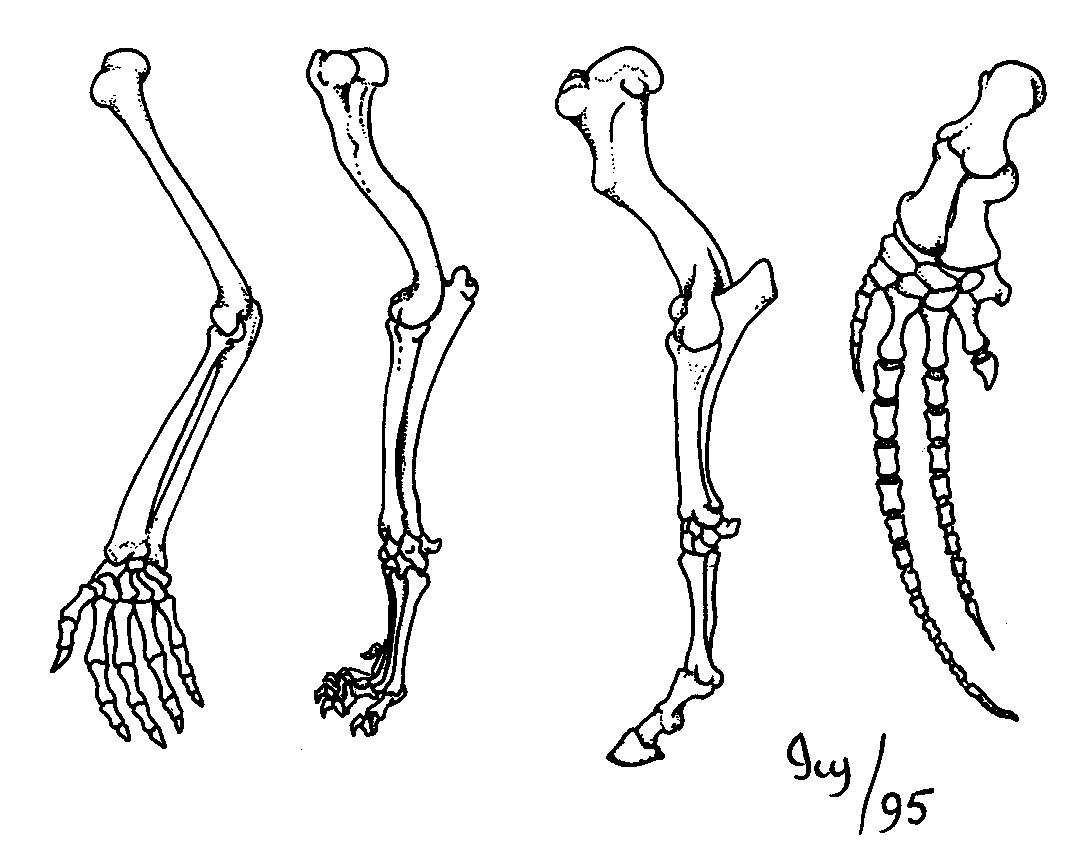
a homologous structure

d)

a vestigial structure

28.
The ability to survive and reproduce.
a)
Adaptation
b)
Trait
c)
Fitness
d)
Variation
29.
Polar bears swim across large expanses of ocean while hunting for seals, their main source of food. The bears use the ice as resting spots during long swims. However, the sea ice is rapidly melting as a result of global warming. Which statement describes what MOST LIKELY will happen as global warming continues?
a)
Polar bear and seal populations will decrease
b)
Polar bear population will decrease and seal population increase
c)
Polar bear population will increase and seal population will decrease
d)
Polar bear populations will decrease, seal populations will not change
30.
According to the cladogram, which organism is most distantly related to the human?
a)
crayfish
b)
rat
c)
perch
d)
frog
31.
Structures with the same parts have different functions; suggests that organisms share a common ancestry
a)
vestigial structures
b)
homologous structures
c)
adaptive radiation
d)
fossil
32.
An organism that needs to eat other organisms to obtain energy is known as a:
a)
Autotroph
b)
Producer
c)
Consumer
d)
Mutualist
33.
Consumer that eats plants
a)
heterotroph
b)
herbivore
c)
producer
d)
community
34.
What does a food web represent?
a)
All connections of energy flow throughout all organisms in a habitat.
b)
The specific ways that mutualism is carried out.
c)
A single pathway or energy flow between organisms. 
d)
How carnivores get their food. 
35.
relationship in which two species live closely together
a)
resource
b)
mutualism
c)
succession
d)
symbiosis
36.
In this Food Web Pyramid Which type of consumer gets only 10% of the energy stored in plants?
a)
Herbivore
b)
Carnivore
c)
Omnivore
d)
Secondary Consumer
37.
What is the term for each step in the transfer of energy and matter within a biological community?
a)
energy path
b)
food web
c)
trophic level
d)
food pyramid
38.
The amount of energy that usually transfers from one trophic level to the next...
a)
10%
b)
20%
c)
80%
d)
50%
39.
The nonliving aspects of an ecosystem.
a)
Abiotic factors
b)
Biotic factors
40.
The living portions of the ecosystem.
a)
Biotic factors
b)
Abiotic factors
41.
A graphic illustration that shows each trophic level and the amount of useable energy contained within.
a)
Food chain
b)
Food web
c)
Energy Pyramid
d)
All of these
42.
A collection of organisms that make up a community as well as all of the nonliving aspects of the environment.
a)
Population
b)
Community
c)
Habitat
d)
Ecosystem
43.
As you move upward, from level to level, in an energy pyramid, energy _____.
a)
increases
b)
decreases
c)
stays the same
d)
increases exponentially
44.
What are the Abiotic factors in this image? 
a)
water, sunlight, dirt, air
b)
birds and plants
c)
birds, water, dirt
d)
plants, water
45.
At what stage does this population reach it's carrying capacity on the Demographic Transition Model
a)
1
b)
2
c)
3
d)
4
46.
Bacteria which convert nitrogen gas into bio-available forms of nitrogen, such as ammonia and nitrate, are known as _____
a)
De-nitrification bacteria 
b)
Nitrogen fixing bacteria
c)
Oxidizers
d)
Buffers
47.
Which of these is not a characteristic share by all living things
a)
Growth and Development
b)
Reproduction
c)
Movement
d)
Homeostatis 
48.
Fungi are a  ________
a)
Autotrophs
b)
Heterotroopers
c)
Decomposers
d)
Primary Consumers
49.
An individual belonging to a specific species
a)
Biotic
b)
Community
c)
Organism
d)
Reptile
50.

What is the correct order for this food chain?

a)

Owl, Mouse, Grasshopper, Grass

b)

Grass, Mouse, Owl, Grasshopper

c)

Grass, Owl, Grasshopper, Mouse

d)

Grass, Grasshopper, Mouse, Owl

51.

What is the hawk in the food web?

a)

Producer

b)

Primary consumer

c)

Secondary consumer

d)

Tertiary consumer

52.

Which of these is an aquatic biome?

a)

Savanna

b)

Tropical Rainforest

c)

Marine

d)

Tundra

53.

Volcano erupting would be an example of what type of succession?

a)

Primary

b)

Secondary

c)

Tertiary

54.
What does every food chain start with? (Even if it's not drawn or written there!)
a)
producers
b)
sun
c)
consumer
d)
decomposers
55.

What is the biggest function of the respiratory system?

a)

to pump blood

b)

to help us digest food

c)

to take in oxygen and release carbon dioxide

d)

to help us fight disease and infection

56.

Which of the following statements describes the function of the heart?

a)

The heart produces white and red blood cells.

b)

The heart controls the nervous system.

c)

The heart makes oxygen and carbon dioxide.

d)

The heart pumps blood throughout the body.

57.

Which two body systems are primarily responsible for gas exchange between the body and the environment?

a)

skeletal and muscular

b)

circulatory and respiratory

c)

circulatory and digestive

d)

respiratory and excretory

58.

Which is not an important organ in the excretory system?

a)

Bladder

b)

Large Intestine

c)

Esophagus

d)

Kidneys

59.

How do the skeletal and circulatory systems work together?

a)

The skeletal system produces red blood cells for the circulatory system.

b)

The skeletal system works with the circulatory system to help break down and digest food.

c)

The skeletal system provides structure for the muscles.

d)

The skeletal system protects the lungs and brain.

60.

How does the immune system depend on the circulatory system in order to function?

a)

The circulatory system produces antibodies used by the immune system.

b)

The circulatory system sends bacteria and viruses to the immune system.

c)

The circulatory system transports immune system cells throughout the body.

d)

The circulatory system protects the immune system from diseases.

61.

Which two systems work together to remove wastes?

a)

digestive and excretory

b)

respiratory and skeletal

c)

skeletal and circulatory

d)

digestive and respiratory

62.
Which gas is removed from the atmosphere during photosynthesis?
a)
hydrogen
b)
oxygen
c)
nitrogen
d)
carbon dioxide
63.
Which statement about photosynthesis is correct?
a)
Plants get the energy they need for photosynthesis from water.
b)
Plants get the energy they need for photosynthesis from soil.
c)
Plants get the energy they need for photosynthesis from sunlight.
d)
Plants do not require energy to perform photosynthesis.
64.
The main source of energy for all life comes from ____.
a)
the Earth
b)
the moon
c)
the sun
d)
the food we eat/make
65.
Which sentence correctly describes photosynthesis. (assume there is enough sunlight)
a)
CO2 and water combine and make O2 and glucose
b)
O2 and water combine to make glucose and CO2
c)
O2 and CO2 combine to make water and glucose
d)
CO2 and glucose combine to make O2 and water
66.
What characteristic sets heterotrophs apart from autotrophs?
a)
Heterotrophs can be classified only as mammals.
b)
Heterotrophs use energy from the sun to make their own food.
c)
Heterotrophs obtain food from consuming other living or once-living things.
d)
Heterotrophs obtain food through the process of photosynthesis.
67.
What is the organelle that contains the chlorophyll used in photosynthesis ?
a)
mitochondria
b)
ribosome
c)
chloroplast
d)
nucleus
68.
What is the "waste" gas (product) produced during photosynthesis?
a)
oxygen
b)
nitrogen
c)
helium
d)
hydrogen
69.
What is the end product of photosynthesis ?
a)
carbon dioxide
b)
water
c)
glucose
d)
methane
70.
What is the pigment molecule that absorbs the sunlight ?
a)
hemoglobin
b)
chlorophyll
c)
ATP
d)
ethyl alcohol
71.
Which of the following is the correct equation for PHOTOSYNTHESIS?
a)
CO+ light + H2O --> O+ glucose
b)
CO+ glucose + H2O --> O+ light
c)
O2 + light + H2O --> CO+ glucose
d)
CO+ O2 + H2O --> Light+ glucose
72.
What is the correct equation for cellular respiration?
a)
6O2 + C6H12O6 -> 6CO2 + 6H2O + Energy
b)
6O2 + C6H12O6 + Energy -> 6CO2 + 6H2O
c)
6CO2 + 6H2O -> 6O2 + C6H12O6 + Energy
d)
6CO2 + 6H2O + Energy -> 6O2 + C6H12O6
73.
In which way are photosynthesis and cellular respiration different?
a)
Cellular respiration stores ATP, while photosynthesis releases ATP.
b)
Cellular respiration produces oxygen, while photosynthesis uses oxygen.
c)
Photosynthesis releases energy, while cellular respiration stores energy.
d)
Photosynthesis uses carbon dioxide, while cellular respiration produces carbon dioxide.
74.

Which organism go through cellular respiration?

a)

animals

b)

plants

c)

both animals and plants

d)

none

75.

Cellular Respiration occurs in what cell organelle?

a)

chloroplast

b)

cytoplasm

c)

mitochondria

d)

animal

76.
What do viruses need to reproduce?
a)
they need genetic material
b)
They need a host cell
c)
They need  bacteria
d)
They need insulin
77.
Reasons that viruses are considered to be nonliving is because
a)
They are not cellular
b)
They cannot reproduce on their own
c)
They cannot make proteins
d)
all of the above
78.
A(n) _____ is a virus that enters a bacterial cell.
a)
endospore
b)
decomposer
c)
plasmid
d)
bacteriophage
79.
When a virus invades a living cell, its _______
takes over the cell's functions.
a)
outer coat
b)
genetic material
c)
core
d)
cytoplasm
80.
Antibiotics kill viruses
a)
True
b)
False
81.
Viruses are cells. 
a)
True 
b)
False
82.
Which of the following occurs after a virus attaches to a host cell in the viral reproduction process?
a)
The host cell dies
b)
The virus dies
c)
The virus inserts its genetic information into the host cell
d)
copies of the virus are immediately released from the host
83.
How could you describe the size of a virus?
a)
Smaller than bacteria
b)
Larger than a parasite
c)
About the size of a dime
d)
Smaller than a proton
84.
The smallest and simpliest forms of life are called
a)
bacteria
b)
virus
c)
fungi
d)
protozoa
85.
What type of reproduction makes offspring that are similar, but not identical, to parents?
a)
asexual reproduction
b)
sexual reproduction
c)
autotrophic
d)
heterotrophic
86.
Which level of classification includes organisms of the same type that are able to breed?
a)
species
b)
genus
c)
kingdom
d)
family
87.
What is taxonomy?
a)
the study of how dead animals are stuffed
b)
the study of classification
c)
the study of giving money to the government
88.
Which of the following describes a protist?
a)
mostly one celled organism with a nucleus
b)
mostly one celled organism without a nucleus
c)
organism that can make its own food
d)
organism that cannot make its own food
89.
What is binomial nomenclature?
a)
A two name naming system
b)
A two headed turtle
c)
A two grouped system to classify
d)
A two lensed microscope
90.
What taxa are in a scientific name?
a)
Genus and Kingdom
b)
Species and Family 
c)
Species and Class
d)
Genus and Species
91.
Which taxa has more organisms, family or phylum?
a)
phylum
b)
family
c)
they are equal
d)
not enough information to answer
92.
What do plants and fungi have in common?
a)
They are both autotrophic
b)
They are both unicellular
c)
They both have cell walls
d)
They both are prokaryotes 
93.
What statement would NOT be good for a dichotomous key?
a)
The organism has 1 dorsal fin
b)
The organism is ugly
c)
The organism has leaves in groups of three
d)
The organism has 6 legs
94.

The 3 domains are Eukarya, Archaea, and

a)

Fungi

b)

Plantae

c)

Animalia

d)

Bacteria

95.

The 4 eukaryote kingdoms are Animals, Plants, Fungi, and

a)

Bacteria

b)

Archaea

c)

Humans

d)

Protists

96.

All living things are made of

a)

cells

b)

prokaryotes

c)

autotrophs

d)

heterotrophs

97.

Which of these is a fungus?

a)

bacteria

b)

mushroom

c)

algae

d)

seaweed

98.

A heterotroph

a)

cannot make its own food.

b)

is able to make its food.

99.

What is the correct order of classification?family

a)

kingdom, domain, phylum, class, order, family, genus, species

b)

domain, kingdom, phylum, class, order, family, genus, species

c)

domain, phylum, class, order, kingdom, family, genus, species

d)

species, genus, family, phylum, order, class, domain, kingdom

100.

What is the proper way to write a scientific name?

a)

Symbion pandora

b)

Symbion Pandora

c)

symbion Pandora

d)

symbion pandora