wayground logo

Free Printable Worksheets

Font size

S
M
L
XL
Worksheets

Review units 1-6

Total questions: 101

Worksheet time: 1hrs 15mins

Name
Class
Date
1.
What is a water molecule composed of?
a)
1 Hydrogen atom and 2 Oxygen atoms
b)
2 Hydrogen atoms and 1 Oxygen atom
c)
3 Oxygen atoms
d)
2 Helium atoms and 1 Oxygen atom
2.
What property of water allows it to be such a versatile solvent that it is often called the "universal solvent?"
a)
Purity
b)
Polarity and high surface tension
c)
High heat capacity
d)
Expansion upon freezing
3.
Large bodies of water do not quickly fluctuate in temperature. Why?
a)
Water is a solvent.
b)
Water has a high heat capacity.
c)
Water acts as a buffer.
d)
Water is non-polar.
4.
Why can water have no net charge but have slight charges in different parts of the molecule?
a)
The oxygen end is slightly negative and the hydrogen end is slightly positive
b)
The hydrogen end is slightly negative and the oxygen end is slightly positive
c)
The hydrogen and oxygen ends change in polarity
d)
Because it is hydrophobic
5.
What process does a multi-cellular organism use to replace its damaged body cells?
a)
mitosis
b)
meiosis
c)
replication
d)
transcription
6.
Which of these lists presents the stages of the cell cycle in the correct order?
a)
interphase, mitosis, cytokinesis
b)
cytokinesis, mitosis, interphase
c)
mitosis, interphase, cytokinesis
d)
interphase, cytokinesis, mitosis
7.
Matt uses a microscope to look at slides of plant cells.  He sees a cell with two nuclei that have visible chromosomes. In which stage of cell division is this cell?
a)
anaphase
b)
prophase
c)
telophase
d)
interphase
8.
Identify the stage.
a)
interphase
b)
metaphase
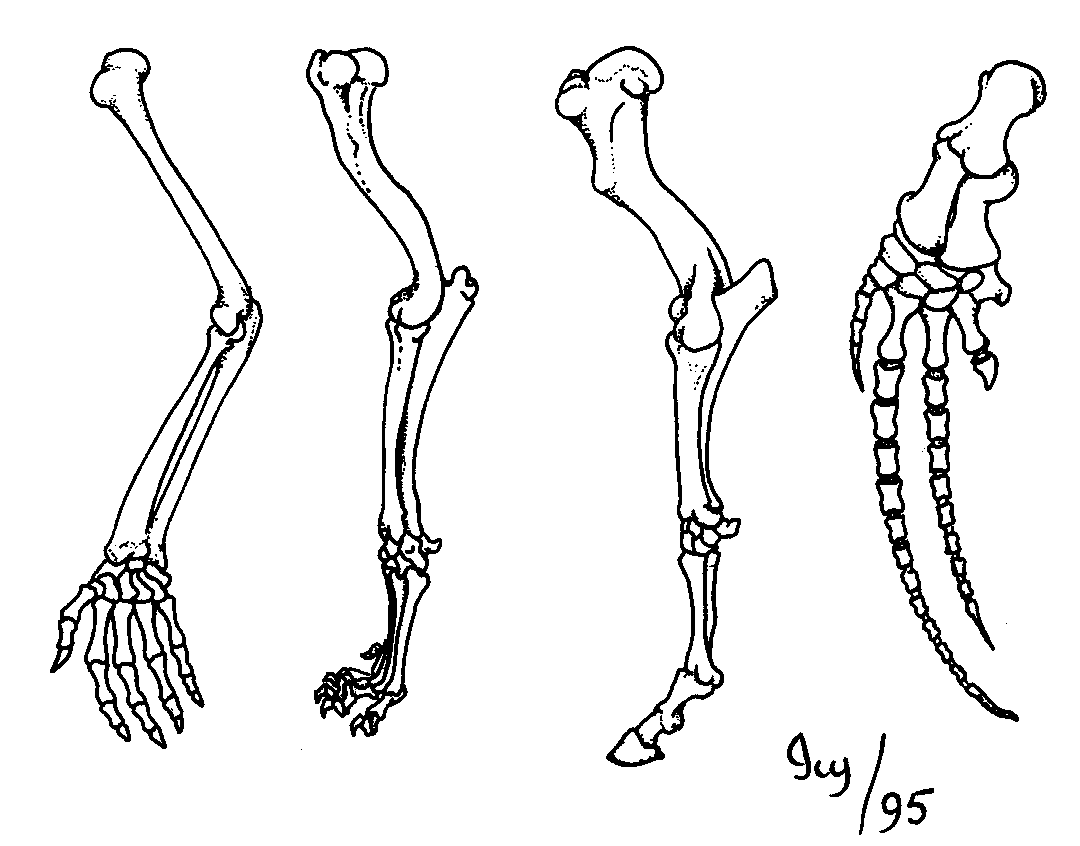
c)
anaphase
d)
telophase
9.
Identify the stage of mitosis.
a)
interphase
b)
prophase
c)
metaphase
d)
anaphase
10.
Identify the stage of mitosis.
a)
interphase
b)
prophase
c)
anaphase
d)
cytokinesis
11.
Identify the stage of mitosis. 
a)
interphase
b)
prophase
c)
anaphase
d)
cytokinesis
12.

Water diffusing through a semipermeable membrane is called

a)

diffusion

b)

endocytosis

c)

osmosis

d)

exocytosis

13.

_____ occurs when a cell engulfs large food particles.

a)

osmosis

b)

endocytosis

c)

exocytosis

d)

diffusion

14.

The cell membrane is built of a double layer of_____

a)

proteins

b)

carbohydrates

c)

water

d)

lipids

15.

Facilitated diffusion moves large molecules through ______

a)

double helix

b)

cell membrane

c)

proteins channels

16.

The _____ controls the materials the move into and out of a cell.

a)

vacuole

b)

cell wall

c)

mitochondria

d)

cell membrane

17.

The _____ use energy to pick up specific molecules and carry them across the cell membrane

a)

transport proteins

b)

epithelial

c)

lipids

d)

oxygen

18.

A nerve cell uses energy to pump sodium out of its cytoplasm into a sodium-rich environment

a)

diffusion

b)

facilitated diffusion

c)

osmosis

d)

active transport

19.

Water moves out of the skin cells of a person swimming in a freshwater pond.

a)

diffusion

b)

facilitated diffusion

c)

osmosis

d)

active transport

20.
The mitochondria is responsible for ...
a)
photosynthesis
b)
anaerobic respiration
c)
aerobic respiration
d)
fermentation
21.
What is one of the reactants of cellular respiration?
a)
energy
b)
glucose
c)
carbon dioxide
d)
water
22.
All living things do which of the following?
a)
Chemosynthesis
b)
Respiration
c)
photosynthesis
d)
all of the answers
23.
Aerobic respiration is different from anaerobic respiration in that aerobic respiration needs...
a)
chlorophyll
b)
carbon dioxide
c)
glucose
d)
oxygen
24.
How many ATP are produced in aerobic respiration?
a)
2
b)
33
c)
4
d)
36
25.
In which way are photosynthesis and cellular respiration different?
a)
Cellular respiration stores ATP, while photosynthesis releases ATP.
b)
Cellular respiration produces oxygen, while photosynthesis uses oxygen.
c)
Photosynthesis releases energy, while cellular respiration stores energy.
d)
Photosynthesis used carbon dioxide, while cellular respiration produces carbon dioxide.
26.
What is the correct equation for cellular respiration?
a)
6O2 + C6H12O6 -> 6CO2 + 6H2O + Energy
b)
6O2 + C6H12O6 + Energy -> 6CO2 + 6H2O
c)
6CO2 + 6H2O -> 6O2 + C6H12O6 + Energy
d)
6CO2 + 6H2O + Energy -> 6O2 + C6H12O6
27.
Where does the Krebs Cycle take place?
a)
mitochondria
b)
chloroplast
c)
cytoplasm
d)
nucleus
28.
Anaerobic respiration.....
a)
doesn't require CO2
b)
requires CO2
c)
doesn't require oxygen
d)
requires oxygen
29.
What is the waste energy from respiration given off as?
a)
Heat
b)
Light
c)
Sound
d)
Kinetic
30.
Which organism pictured must absorb carbon dioxide to survive?
a)
bird
b)
rabbit
c)
insect
d)
tree
31.
Enzymes are
a)
nucleic acids
b)
proteins
c)
lipids
d)
carbohydrates
32.
Which of the following binds to the active site of an enzyme? 
a)
substrate
b)
product
c)
codon
d)
none of the above
33.
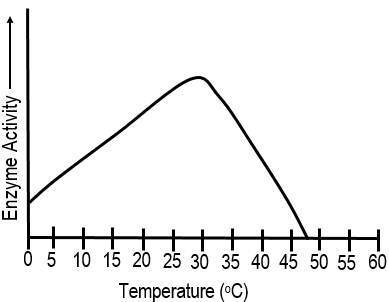
Based on the graph, what temperature does this enzyme work best? 
a)
15 C
b)
40 C
c)
30 C
34.
What is the function of an enzyme?
a)
enzymes break themselves into small pieces
b)
they slow down chemical reactions
c)
they speed up chemical reactions
d)
enzymes combine products to form reactants 
35.
What happens when enzymes are heated to a high temperature?
a)
The enzymes die.
b)
The shapes of the enzyme are altered or denatured
c)
The enzymes' amino acid sequence changes.
d)
The enzymes remain the same
36.
Which of these is NOT true?
a)
Enzymes can denature (change shape) when the temperature gets too high.
b)
Enzymes can only be used once in a chemical reaction. 
c)
Extreme pH can denature enzymes.
d)
Enzymes speed up chemical reactions. 
37.
Letter D...
a)
active site
b)
enzyme
c)
substrate
d)
products
38.
Letter B...
a)
active site
b)
enzyme
c)
substrate
d)
products
39.
Letter C...
a)
active site
b)
enzymes
c)
substrate
d)
products
40.
Letter E...
a)
active site
b)
enzyme
c)
substrate
d)
products
41.
Which of these enzymes breaks down the sugar in milk?  
a)
lactose
b)
lactase
c)
Fructose
d)
Amylase
42.
Enzymes are composed of which of the following monomers? 
a)
amino acids
b)
carbohydrates
c)
nucleotides
d)
monosaccharides
43.
Which sequence of complementary DNA bases would pair with this partial strand
ATG TGA CAG?
a)
ATG TGA CAG
b)
TAC ACT GTC
c)
GTA AGT GAC
d)
CAT TCA CTG
44.
Which of the following best describes a DNA molecule?
a)
double helix
b)
contains ribose
c)
made of amino acids
d)
contains uracil
45.
What determines the code, or information, of a DNA molecule?
a)
the shape (structure) of the nitrogen bases
b)
the order (sequence) of the nitrogen bases
c)
the color of the nitrogen bases
d)
the frequency (number) of nitrogen bases
46.
Which 2 molecules form the sides (backbone) of the DNA ladder?
a)
deoxyribose sugar and adenine
b)
deoxyribose sugar and a hydrogen bond
c)
deoxyribose sugar and the nucleus
d)
deoxyribose sugar and phosphate
47.
The two strands of nitrogenous bases in DNA are joined by which type of bond?
a)
polar bonds
b)
ionic bonds
c)
covalent bonds
d)
hydrogen bonds
48.

A process in which DNA has the unique ability to make an exact copy of itself.

a)

Replication

b)

Translation

c)

Transcription

d)

Protein Synthesis

49.
What are the three components of a nucleotide?
a)
sugar, hydrogen, nitrogen base
b)
sugar, oxygen, nitrogen base
c)
sugar, phosphate, nitrogen base
d)
sugar, phosphate, protein
50.
Who was given credit for determining the shape of DNA? 
a)
Avery
b)
Watson and Darwin
c)
Watson and Crick
d)
Franklin and Crick
51.
Identify #2.
a)
nitrogen base
b)
phosphate group
c)
deoxyribose sugar
d)
nucleotide
52.
RNA contains the sugar
a)
ribose
b)
deoxyribose
c)
glucose
d)
lactose
53.

What is the order for Protein Synthesis?

a)

Transcription -> Translation -> Protein

b)

Translation - > Transcription -> Protein

c)

Protein -> Transcription -> Translation

d)

Translation -> Protein -> Transcription
54.
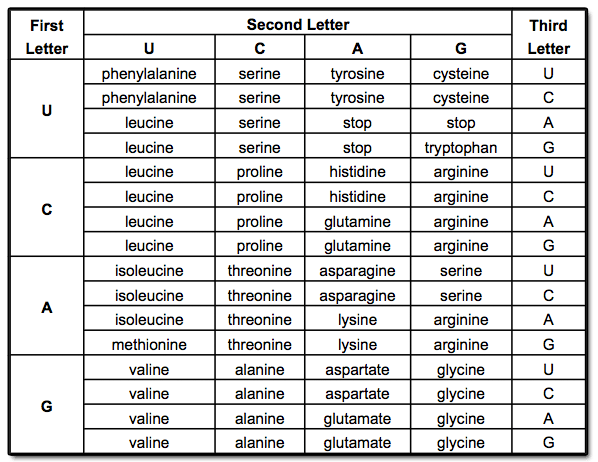
What is the correct amino acid sequence for the mRNA code AUGCCAGUAUGA
a)
Met-Pro-Ala-Val
b)
Met-Pro-Val
c)
Tyr-Gly-His
d)
Tyr-Gly-Arg-His
55.
Every three letters (example: ATC) in DNA codes for what??
a)
Amino Acid
b)
Nucleotide
c)
Lipid
d)
Carbohydrate
56.
One difference between DNA and RNA is that RNA....
a)
is double stranded 
b)
contains the base Thymine
c)
contains the base Uracil 
d)
contained the base Guanine
57.
Which Seq could be found in RNA?
a)
ACCTGT
b)
CGCATT
c)
AUGCUU
58.

Which organelles are only found in plant cells?

a)

Cell Wall and cell membrane

b)

Cell wall and chloroplast

c)

cell wall and ribosomes

d)

cell membrane and vacuole

59.

An organism whose cells contain a nucleus surrounded by a membrane and whose DNA is bound together by proteins into chromosomes.

a)

Prokaryote

b)

cell

c)

organelle

d)

Eukaryote

60.

DNA is found in which cell organelle

a)

Ribosomes

b)

Lysosomes

c)

Nucleus

d)

Cytoplasm

61.

What is the basic unit of structure and function in living things called?

a)

an atom

b)

an organelle

c)

a cell

d)

an organ

62.

Which statement is NOT part of cell theory

a)

All living things are made of cells

b)

All cells are produced from other cells

c)

Cells are the basic unit of structure and function in living thigs

d)

Cells are very small

63.

Name the organelle labeled K.

a)

Chloroplast

b)

Mitochondria

c)

Vacuole

d)

Centrosome

64.

Name the organelle labeled J.

a)

Golgi Body

b)

Centrosome

c)

Mitochondria

d)

Ribosome

65.

Name the organelle labeled I.

a)

Nucleus

b)

Golgi Body

c)

Mitochondria

d)

cnetrosome

66.

Name the organelle labeled H.

a)

Cell wall

b)

Chloroplast

c)

Ribosome

d)

Mitochondria

67.

Name the organelle labeled G.

a)

Mitochondria

b)

Golgi Body

c)

Smooth ER

d)

Vacuole

68.

Name the organelle labeled F.

a)

Smooth ER

b)

Golgi Body

c)

Rough ER

d)

Mitochondria

69.

Name the organelle labeled E.

a)

Ribosome

b)

cell wall

c)

Cell membrane

d)

Cytoplasm

70.

Name the organelle labeled B.

a)

Lysosome

b)

Golgi Body

c)

Ribosome

d)

nucleus

71.

Name the organelle labeled A.

a)

Cell Wall

b)

Cell membrane

c)

cytoplasm

d)

mitochondria

72.
This variable in an experiment is the one being deliberately changed by the scientist. 
a)
dependent variable
b)
independent variable
c)
data
d)
control group
73.
There are two types of data. Which type of data involves numbers that are obtained by counting or measuring?
a)
quantitative
b)
qualitative
74.
Mr. S. sets up an experiment to see how the mass of a ball affects the distance it rolls off a ramp.  Identify the dependent variable.
a)
height of the ramp
b)
 distance traveled by the ball
c)
mass of the ball
d)
weight of the ball
75.
A possible explanation to a problem that has not yet been tested. 
a)
data
b)
theory
c)
hypothesis
d)
fact
76.
What is a result or conclusion?  
a)
step by step directions on how to complete the experiment
b)
the end of Mrs. Neill's all time favorite novel
c)
the purpose of your experiment 
d)
a statement of the outcome of the experiment
77.
Qualitative or Quantitative:
The cat has orange fur on his ears. 
a)
Qualitative
b)
Quantitative
78.
Examine the data shown in the graph below.
What conclusion can be reached by the data shown in the graph?
a)
During the months of May, June , and July, the rate of photosynthesis increases and decreases greatly during the winter months.
b)
During the winter months, photosynthesis increases and during the summer months, photosynthesis decreases.
79.
Which invention from the 17th century allowed for the development of modern cell theory?
a)
x-rays
b)
computers
c)
the light microscope
d)
the scanning electron microscope
80.
 Cells are the basic structural and functional units of life.
a)
Plants have cells but animals do not.
b)
 They are both made of one or more cells. 
c)
They both come from the same kind of cell.
d)
They both come from a non-living organism.
81.
The combined observations of Mattias Schleiden, Theodor Schwann and Rudolph Virchow resulted in the formation of the cell theory. Which of the following is not part of the cell theory?
a)
All cells contain a nucleus. 
b)
All cells come from other living cells.
c)
All living organisms are made of one or more cells
d)
 Cells are the basic unit of structure and function of all living things.
82.
What is the study of organisms at the early stages of development?
a)
DNA studies
b)
embryology 
c)
extinction
d)
fossil record
83.
What is another name for natural selection?
a)
survival of the smartest
b)
survival of the fastest
c)
survival of the biggest
d)
survival of the fittest
84.
The cause of artificial selection is…
a)
The environment
b)
Humans
c)
Mutation
d)
Gene Flow
85.
Structures with the same parts have different functions; suggests that organisms share a common ancestry
a)
vestigial structures
b)
homologous structures
c)
adaptive radiation
d)
fossil
86.
When an organism is completely wiped out of existence, we call it?
a)
extinction
b)
adaptation
c)
evolution
d)
inbreeding
87.
What are the evidences for Evolution?
a)
Fossil Records
b)
Embryology
c)
Similar body structure
d)
All the above
88.
Two organisms that are closely related would have
a)
very similar DNA sequence
b)
exactly the same DNA sequences
c)
no proteins in common
d)
completely different DNA sequence
89.
Genetic variation can arise from a random change in the DNA of a gene.  The change is called a(n)
a)
mutation
b)
gene flow
c)
gene pool
d)
allele
90.
the hind leg bones in a whale are examples of
a)
homologous structures
b)
analogous structures
c)
fossils
d)
vestigals
91.
The study of the past and present geological distribution of species and the patterns that emerge from such analysis.
a)
Common Ancestry
b)
Biogeography
c)
Stasis
d)
Sequential
92.
A remnant or trace of an organism from the past is called a _______.
a)
Ancestor
b)
Skeleton
c)
Fossil
d)
Imprints
93.
Which macromolecule is shown?
 View Figure 1 (if not visible)
a)
lipid
b)
protein
c)
nucleic acid
d)
carbohydrate
94.
What is the function of nucleic acids?
a)
store genetic information
b)
store energy (long-term)
c)
store energy (short-term)
d)
build skin, hair, nails, muscles
95.
Which macromolecule stores energy, insulates us, and makes up the cell membrane?
a)
lipids
b)
proteins
c)
carbohydrates
d)
nucleic acids
96.
Lipids can be digested into what smaller subunits?
a)
nucleic acids
b)
amino acids
c)
fatty acids
d)
glucose
97.
Building blocks of the body, hair , muscles etc.
a)
protein
b)
nucleic acid
c)
lipids
d)
carbohydrates
98.

Organism in the kingdom Animalia are:

a)

a.Multicellular and heterotrophic

b)

a.Multicellular and autotrophic

c)

a.Unicellular and autotrophic

d)

a.Unicellular and heterotrophic

99.

Which of the following group would contain the largest number of organism?

a)

order

b)

class

c)

Phylum

d)

Family

100.

Scientific names are _________________ because they consist of two words.

a)

Hierarchical

b)

binomial

c)

ordered

d)

taxonomic

101.
The cell below is in a _________ solution.
a)
Hypotonic
b)
Hypertonic
c)
Isotonic