
 Worksheets
CAT 3 BIOLOGY EOC
Total questions: 100
Worksheet time: 3hrs 33mins
Name
Class
Date
1.
The scientific name for an organism is made from the:
a)
class and family
b)
genus and species
c)
domain and kingdom
d)
kingdom and phylum
2.
Members of which kingdom live in unusual conditions such as deep ocean trenches or volcanoes?
a)
Eubacteria
b)
Protista
c)
Fungi
d)
Archaebacteria
3.

The 8 levels of classification, most broad to most specific.
a)
Domain, Genus, Family, Order, Class, Phylum, Kingdom, Species
b)
Domain, Species, Kingdom, Genus, Phylum, Family, Class, Order
c)
Domain, Kingdom, Phylum, Class, Order, Family, Genus, Species
d)
Order, Kingdom, Species, Domain, Phylum, Family, Class, Genus
4.
Members of which kingdom are multicellular and heterotrophic?
a)
Plantae
b)
Protista
c)
Animalia
d)
Achaebacteria
5.
What is the term given to describe the 2 name naming system?
a)
dichotmous key
b)
binomial nomenclature
c)
2 scientific names
d)
binomial key
6.

Answer the question on the figure.
a)
A
b)
B
c)
C
d)
D
7.
What is the smallest classification group or level?
a)
Genus
b)
Species
c)
Class
d)
Kingdom
8.
In addition to observing living organisms, Darwin studied the preserved remains of ancient organisms called
a)
fossils
b)
adaptations
c)
homologies
d)
vestigial structures
9.
An inherited characteristic that increases an organism's ability to survive and reproduce in its specific environment is called (n)
a)
vestigial structure
b)
adaptation
c)
speciation
d)
analagous structure
10.

Structures that have different mature forms but develop from the same embryonic tissue are called
a)
analagous
b)
adaptations
c)
homologous
d)
fossils
11.
Darwin's observation that finches of different species on the Galapagos have many similar physical traits supports the hypothesis that these finches
a)
have the ability to interbreed
b)
acquired traits through use and disuse
c)
all eat the same type of food
d)
descended from a common ancestor
12.
Which Kingdom contains multicellular, eukaryotic, and autotrophic organisms?
a)
Eubacteria
b)
Archaebacteria
c)
Plantae
d)
Animalia
13.
Who first proposed binomial nomenclature as a way of classifying organisms?
a)
Carolus Linnaeus
b)
Aristotle
c)
Charles Darwin
d)
Louis Pasteur
14.

A student discovers an arachnid with a segmented abdomen, long legs, and a tail with no stinger. The student uses the dichotomous key below to identify it. Which arachnid has the student found?
a)
Whip Scorpion
b)
Wind Scorpion
c)
Daddy long legs
d)
Scorpion
15.
A tool used by a taxonomist to identify an unknown organism is known as a __________.
a)
dichotomous key
b)
binomial nomenclature
c)
scientific name
d)
binomial key
16.
The science of classifying and naming organisms is ______________.
a)
evolution
b)
taxonomy
c)
grouping
d)
scientific names
17.

An illustration and a dichotomous key are given. What is the correct classification for this organism?
a)
Class Insecta
b)
Order Amblygygi
c)
Order Araneae
d)
Order Scorpiones
18.

What is the most primitive organism shown on the cladogram?
a)
chimp
b)
perch
c)
hagfish
d)
salamander
19.

Which organisms pictured on the cladogram have hair?
a)
prosimians only
b)
prosimians and humans
c)
humans only
d)
prosimians and birds
20.

Which group(s) of organisms do not have vertebrae?
a)
lampreys and lancelets
b)
lampreys and tuna
c)
lancelets only
d)
salamanders, tuna, and lampreys
21.
A class is made up of a bunch of ___________________
a)
Phylum
b)
Order
c)
Genus
d)
Species
22.

Cladograms classifies organisms based on
a)
Behavioral characteristics
b)
Physical Charactersistics
c)
Evolutionary Characteristics
d)
None of the above
23.
Which of the following is not one of the 3 main Domains are
a)
Protists
b)
Archaeae
c)
Bacteria
d)
Eukarya
24.
Which of the following has a nucleus and is part of Domain Eukarya
a)
Protists
b)
Archaea
c)
Bacteria
d)
All of the above
25.

which of the folllowing is an exammple of a vestigial structure?
a)
the wings of a red-tailed hawk
b)
the hind limbs of a house cat
c)
the fins of sharks
d)
the wings of an ostrich
26.

An earthquake causes an ocean channel top open and separate an island into two. the species on each section are now in
a)
geographic isoliation
b)
behavioral isolation
c)
disruptive selection
d)
temporal isolation
27.
Charles Darwin called the ability of an organism to survive and reproduce in its specific environment
a)
diversity.
b)
evolution
c)
adaptation.
d)
fitness.
28.

Genetic variation can arise from a random change in the DNA of a gene. The change is called a(n)
a)
mutation
b)
gene flow
c)
gene pool
d)
allele
29.

Two organisms that are closely related would have
a)
very similar DNA sequence
b)
exactly the same DNA sequences
c)
no proteins in common
d)
completely different DNA sequence
30.

Which type of evidence is illustrated in this picture
a)
fossil evidence
b)
molecular
c)
anatomical
d)
embryological
31.

Which of the following is a term for a group of similar organisms that can reproduce fertile offspring?
a)
individual
b)
population
c)
species
d)
fossil
32.

These structures are shaped similar, but they do not come from a common ancestor, this would be a ______________ structure
a)
Homologous
b)
Analogous
33.
There are three species of birds on an island. Bird A has a heavy bill for eating seeds. Bird B has a pointed bill for eating insects. Bird C has a sharp bill for eating both insects and seeds. If all insects on the island suddenly disappeared, which bird or birds would be the LEAST affected?
a)
Bird A
b)
Bird B
c)
Bird C
d)
Bird A and Bird B
34.
What is survival of the fittest?
a)
It is where the fittest die out and therefore reproduce and pass on their genes
b)
It is where the fittest die out and therefore can't reproduce and pass on their genes
c)
It is where the fittest don't die out and therefore can't reproduce and pass on their genes
d)
It is where the fittest don't die out and therefore reproduce and pass on their genes
35.
The goal of every species on earth is...
a)
to survive and reproduce
b)
divide and conquer
c)
survive and conquer
d)
reproduce and die
36.
Where the better adapted organisms survive to pass traits along to offspring.
a)
Evolution
b)
Natural Selection
c)
Extinction
d)
Artifical Selection
37.
The theory of evolution by natural selection means that what is changing over time?
a)
The inherited traits of a population.
b)
The acquired traits of a population.
c)
Hair color and eye color
d)
Attractive features.
38.

What increases genetic variation when animals move from one population to another
a)
genetic drift
b)
sexual selection
c)
bottleneck effect
d)
gene flow
39.
A reduction in the genetic diversity of a population caused by a reduction in its size is called:
a)
a bottleneck effect
b)
the founder effect
c)
genetic drift
d)
mutation
40.
A change in the genetic composition of a population as a result of descending from a small number of colonizing individuals is called:
a)
founder effect
b)
bottleneck
c)
genetic drift
d)
gene flow
41.
Embryos of chickens, fish and humans look very similar. They all have folds known as gill pouches in the neck region. What may this suggest?
a)
they all formed in the ocean
b)
they all evolved from a common ancestor
c)
they are all going extinct
42.
Individuals who are considered fit, have:
a)
Stronger genes
b)
Fewer mutations
c)
More food
d)
More offspring
43.
We often call evolution "Darwin's Theory of Natural Selection." Why is it a theory?
a)
Because it is a guess
b)
Because a few other scientists agreed with him
c)
There have been many studies on the topic over time, and the evidence they all gather supports it
d)
It has been proven and nobody had to study it again
44.

Which best describes these fossils?
a)
The oldest fossils can be found on the lower layers
b)
The oldest fossils can be found at the top layers
c)
The youngest fossils are always found on the bottom layers
d)
You can not tell the age of any of these fossils
45.
Which is the correct order of The Levels of Taxonomy?
a)
Kingdom, Phylum, Class, Order, Family, Genus, Species
b)
Kingdom, Phylum, Order, Class, Family, Genus, Species
c)
Kingdom, Phylum, Family, Class, Order, Genus, Species
d)
Species, Genus, Family, Class, Order, Phylum, Kingdom
46.
Which organisms are closely related?
a)
Equus caballas (Horse) & Equus burchellii (Zebra)
b)
Cyanea artica (Jellyfish) & ctenodiscus (Starfish)
c)
Naja naja (cobra) & Glycine max (soya bean)
d)
Josh kruger (Legendary) & Mike tyson (Plebe)
47.

Occurs when different species develop similar traits for similar functions (fish,dolphin,penguin)
a)
convergent evolution
b)
divergent evolution
c)
co-evolution
d)
active evolution
48.

Genus of bacteria known for causing strep throat
a)
streptobaccillus
b)
streptosprillus
c)
streptococcus
d)
streptopnuemmonia
49.

Two part system of naming an organism
a)
taxonomy
b)
biology
c)
binomial nomenclature
d)
speciation
50.

Occurs when two or more species evolve to be more and more different over time
a)
divergent evolution
b)
convergent evolution
c)
parallel evolution
d)
co-evolutaion
51.

Occurs when two or more populations evolve at the same time
a)
Divergent evolution
b)
convergent evolution
c)
adapative radiation
d)
co-evolution
52.

The emergence of a new species
a)
Binomial nomenclature
b)
divergent evolution
c)
phylogeny
d)
speciation
53.

Occurs when a species evolves into many new species in a short period of time
a)
divergent evolution
b)
parallel evolution
c)
co-evolution
d)
adaptive radiation
54.

I am a eukaryote, microscopic, and unicellular. What kingdom do I belong to?
a)
Animalia
b)
Fungi
c)
Plantae
d)
Protista
55.

I am a eukaryote, photosynthetic, and autotrophic. What kingdom do I belong to?
a)
Archaebacteria
b)
Plantae
c)
Protista
d)
Eubacteria
56.

I am a prokaryote and live where others can't. What kingdom do I belong to?
a)
Animalia
b)
Archaebacteria
c)
Eubacteria
d)
Protista
57.
Artificial selection is...
a)
the process by which humans select who lives and dies based on traits of animal or plant.
b)
the process by which natures selects who lives and dies.
c)
the process by which animals adapt to their surroundings.
d)
the process by which people take over ecosystems.
58.
A wolf's scientific name is Canis rufus. Which genus does it belong to?
a)
Canis
b)
rufus
c)
wolf
d)
animal
59.

Which animal is directly connected to the oldest ancestor?
a)
Birds
b)
Mammals
c)
Lampry
d)
Turtle
60.
Which animal is has the closest ancestor with mammals?
a)
Reptiles
b)
Birds
c)
Lampry
d)
Ray-finned fishes
61.

What do phylogenic trees do?
a)
Help you visualize how species are related.
b)
Provide windbreaks in your yard.
c)
Provide DNA details.
d)
Show the distribution of organisms
62.
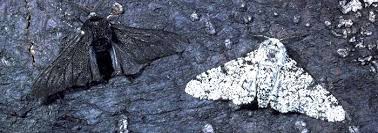
Predict which moth would increase in population
a)
light
b)
dark
63.
What does sexual reproduction allow for?
a)
Increased genetic diversity
b)
Increased offspring
c)
Decreased genetic diversity
d)
Decreased rate of evolution
64.
The finches on the Galapagos island were similar in form except for variations of their beaks. Darwin observed that these variations were useful for:
a)
attracting a mate
b)
defending territory
c)
building nests
d)
gathering food
65.

Which of the three graphs shows stabilizing selection?
a)
A
b)
B
c)
C
66.

Which of the three graphs shows disruptive selection?
a)
A
b)
B
c)
C
67.
If finches with large beaks and finches with small beaks increase in a population while finches with average sized beaks decreases, which pattern of natural selection has occurred?
a)
Directional selection
b)
Disruptive selection
c)
Stabilizing selection
68.

What type of selection?
a)
Directional
b)
Stabilizing
c)
Disruptive
69.
Only populations can evolve.
Individuals can not evolve.
Individuals can not evolve.
a)
True
b)
False
70.

What type of natural selection is this?
a)
Disruptive Selection
b)
Directional Selection
c)
Stabilizing Selection
d)
Sexy Selection
71.

What is the correct explanation for what is happening in this graph?
a)
There are a lot of average-sized beaks
b)
There are no beaks
c)
There are a lot of small beaks only
d)
There are a lot of small and large beaks, but not average-sized ones
72.
Scientists find that most feral cats in a neighborhood have whiskers about 12 cm long. After about 15 generations of stabilizing selection, what would you expect to see?
a)
even more cats with 12 cm long whiskers
b)
most cats with less than 12 cm long whiskers
c)
most cats with more than 12 cm long whiskers
d)
most cats with whiskers either less than or more than 12 cm long, very few with whiskers 12 cms
73.

What type of selection is depicted in the picture?
a)
stabilizing
b)
directional
c)
disruptive
d)
the answer is not here
74.
Changes in the gene pool can occur due to various mechanisms. In 1989, a large oil spill occurred in Prince William Sound, Alaska, when the Exxon Valdez oil tanker ran aground. Approximately 11 million gallons of oil were spilled and spread 1,300 miles along the Alaskan coastline. The damage from the oil spill affected thousands of animals in the area, including killer whales, harbor seals, sea otters, fish, and sea birds. Which mechanism most likely affected the gene pools of the organism populations in the areas around the oil spill?
a)
genetic drift
b)
gene flow
c)
gene mutation
d)
genetic variation
75.
Which of the following examples can cause gene flow between populations?
a)
an increase in predators to a population of zebra
b)
a volcanic eruption that kills half of a population of mice
c)
bird droppings that contain seeds from a different location
d)
a person that sprays a toxin on a group of mosquitoes
76.
In a population of seals, most of the seals have similar coloring. However, one seal has albinism. This seal is white and is almost completely blind. What is most likely the cause of this difference from the rest of the population?
a)
gene flow
b)
natural selection
c)
gene mutation
d)
genetic drift
77.
Which two organisms are the most closely related according to their DNA sequence?
Critter A--> ATG CTT AAC CCG TTA
Critter B--> ATC GTT TTC CCG TAA
Critter C--> ATG CTA TAG GCG TAA
Critter A--> ATG CTT AAC CCG TTA
Critter B--> ATC GTT TTC CCG TAA
Critter C--> ATG CTA TAG GCG TAA
a)
Critter A and B
b)
Critter A and C
c)
Critter B and C
d)
They are all equally related
78.
Antibiotics are frequently given to humans that have strep throat. Why might this practice be considered a problem?
a)
Antibiotics cause mutations which could change to something deadly.
b)
The human body can metabolize the antibiotic to quickly, not allowing the antibiotic to reach the bacteria.
c)
A mutation can occur in the bacteria making it resistant to the antibiotic.
d)
Nothing will happen. It takes thousands of years for bacteria to evolve and become antibiotic resistant.
79.
Why are advantageous traits more likely to be passed on to the offspring?
a)
Because parents with those traits can teach their offspring
b)
Because parents with those traits can surive and reproduce better
c)
Because parents with those traits care more about their offspring
d)
None of the above
80.
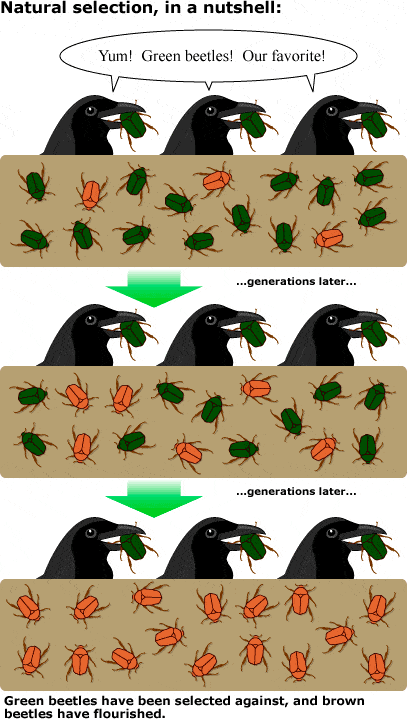
Which of the following is REQUIRED for the process of natural selection to occur?
a)
Members of the same species must compete with one another.
b)
Members of different species must compete with one another.
c)
There must be a sudden environmental change.
d)
Traits must be inherited from one generation to the next.
81.
Horse breeding for specific desired traits is an example of which type of evolutionary evidence?
a)
Artificial selection
b)
Embryology
c)
Fossils
d)
Biochemical molecules
82.
Happens only in small populations, and is the change in the frequency of a gene variant (allele) in a population due to random sampling of organisms.
a)
Extinction
b)
Genetic Drift
c)
Bottleneck Effect
d)
Founder Effect
83.

Why do all of these organisms have long legs?
a)
Behavioral adaptation
b)
Physical adaptation
c)
None of the organisms have a recessive gene.
d)
The berries are high off the ground, so the species adapted to teach the food.
84.
What are the evidences for Evolution?
a)
Fossil Records
b)
Embryology
c)
Similar body structure
d)
All the above
85.
Almost all adaptations started off as?
a)
selective breeding
b)
physiological
c)
structural
d)
mutation
86.
Why do frogs and other organism reproduce so many eggs or offspring?
a)
so that their babies can have friends to play with
b)
the more offspring the more likely the offspring will survive
c)
the more offspring the less likely offspring will survive
d)
the more offspring the less competition
87.

What term describes this image?
a)
Vestigial Structure
b)
Homologous Structure
c)
Analogous Structure
d)
My poor poor butterflies....
88.

If I lift a lot of weights at the gym after school and have a child. My offspring will be born super strong.
a)
True
b)
False
89.
Survival of the Fittest and Evolution were proposed by what scientist?
a)
Charles Darwin
b)
Albert Einstein
c)
Steven Hawking
d)
Isaac Newton
90.

Light green, the same color as the leaf, proves to be the best __________ in order to avoid being eaten.
a)
Variation
b)
Adaptation ( a change or the process of change by which an organism or species becomes better suited to its environment )
c)
Adaptation ( a beneficial trait)
91.
the hypothesis that evolution proceeds chiefly by the accumulation of gradual changes
a)
founder effect
b)
adaptive radiation
c)
gradulism
d)
artificial selection
92.
The process by which two species, for example, a flower and a pollinating insect, evolve in response to each other is called
a)
convergent evolution
b)
adaptive radiation.
c)
coevolution.
d)
punctuated equilibrium.
93.
The idea that evolution seems to occur in spurts of time.
a)
stabilizing selection
b)
directional selection
c)
disruptive selection
d)
puntuated equilibrium
94.
Scientist theorize that oxygen buildup in the atmosphere resulted from _________________ .
a)
respiration
b)
photosynthesis
c)
chemosynthesis
d)
rock weathering
95.
most organisms produce more offspring than can possibly survive.
a)
overproduction
b)
variations
c)
natural selection
d)
competition
96.
members of a population leave or new organisms join a population which causes a change in the gene pool.
a)
migration
b)
mutation
c)
geographic isolation
d)
reproductive isolation
97.

The study of the past and present distribution of species
a)
Biogeography
b)
Behavioral Isolation
c)
Speciation
d)
Fossils
98.

The diagram on the left is _______? The diagram on the right is _______?
a)
Stasis, Punctuated Equilibrium
b)
Gradualism, Punctuated Equilibrium
c)
Punctuated Equilibrium, Gradualism
d)
Gradualism, Stasis
99.

Two organisms cannot mate because of a land barrier.
a)
Temporal Isolation
b)
Speciation
c)
Biogeography
d)
Geographic Isolation
100.

In simplified terms Darwin's finding says
a)
Monkeys were human's parents
b)
Starvation made changes
c)
Life changes over time
d)
The Earth is 5 billion years old
100 %

