wayground logo

Free Printable Worksheets

Font size

S
M
L
XL
Worksheets

Chapter 2 Biochemistry

Total questions: 101

Worksheet time: 1hrs 20mins

Name
Class
Date
1.
What property of water makes it the 'universal solvent'?
a)
it is a polar molecule
b)
it is an ionic compound
c)
it contains hydrogen bonds
d)
it steals electrons from other atoms
2.
Carbohydrates are made of... 
a)
C H O
b)
C H O N
c)
C H O N P
d)
C H O N S
3.
Glucose is a _____.
a)
carbohydrate
b)
lipid
c)
protein 
d)
nucleic acid
4.
Proteins are composed of what smaller building blocks?
a)
amino acids
b)
nucleic acids
c)
fatty acids
d)
nucleotides
5.
Which of the following is LEAST likely to dissolve in water?
a)
nonpolar fats and oils
b)
polar sugar molecules
c)
salt made of a positive sodium ion and a negative chloride ion
d)
all of the substances will dissolve easily in water
6.
Building blocks of polymers.
a)
monomer
b)
polypeptide
c)
monosaccharide
d)
glycerol
7.
Attractions between water molecules are called
a)
Covalent bonds
b)
Ionic bonds
c)
Polar bonds
d)
Hydrogen bonds
8.
any organic compound that is made of carbon, hydrogen, and oxygen and that provides nutrients to the cells of living things; 1:2:1 ratio
a)
carbohydrate
b)
protein
c)
lipid
d)
nucleic acid
9.
a simple sugar that is the basic subunit, or monomer, of a carbohydrate
a)
disaccharide
b)
monosaccharide
c)
polysaccharide
d)
carbohydrate
10.
a sugar formed from two monosaccharides
a)
disaccharide
b)
monosaccharide
c)
polysaccharide
d)
carbohydrate
11.
an organic compound that is made of one or more chains of amino acids and that is a principal component of all cells
a)
lipid
b)
nucleic acid
c)
carbohydrate
d)
protein
12.
a type of protein or RNA molecule that speeds up metabolic reactions in plant and animals without being permanently changed or destroyed
a)
hydrolysis
b)
amino acid
c)
enzyme
d)
peptide bond
13.
a part, substance, or element that lies beneath and supports another part, substance, or element; the reactant in reactions catalyzed by enzymes
a)
monomer
b)
functional group
c)
active site
d)
substrate
14.
a large, nonpolar organic molecule, including fats and steroids; lipids store energy and make up cell membranes
a)
carbohydrate
b)
lipid
c)
protein
d)
nucleic acid
15.
the site on an enzyme that attaches to a substrate
a)
active site
b)
substrate
c)
functional group
d)
monomer
16.
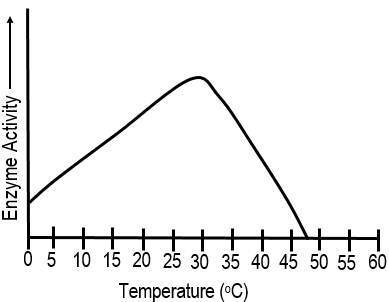
Based on the graph, what temperature does this enzyme work best? 
a)
15 C
b)
40 C
c)
30 C
17.
Which of the following binds to the active site of an enzyme? 
a)
substrate
b)
product
c)
codon
d)
none of the above
18.
What happens when enzymes are heated to a high temperature?
a)
The enzymes die.
b)
The shapes of the enzyme are altered or denatured
c)
The enzymes' amino acid sequence changes.
d)
The enzymes remain the same
19.
Letter D...
a)
active site
b)
enzyme
c)
substrate
d)
products
20.
Letter C...
a)
active site
b)
enzymes
c)
substrate
d)
products
21.
Enzymes are
a)
nucleic acids
b)
proteins
c)
lipids
d)
carbohydrates
22.
ATP is...
a)
a unit of energy in the cell
b)
a type of lipid
c)
a molecule of DNA
23.
Enzymes are _________ that __________ chemical reactions.
a)
proteins, slow down
b)
proteins, speed up
c)
lipids, slow down
d)
lipids, speed up
24.
Amino acids are the subunits of ...
a)
proteins
b)
carbohydrates
c)
nucleic acids
d)
lipids
25.

Water is a _ molecule.

a)

nonpolar

b)

polar

26.

Water _ heat when it evaporates.

a)

absorbs

b)

releases

27.

Water molecules are

a)

cohesive

b)

adhesive

c)

nonpolar

d)

fatty

28.

Which pair is incorrect?

a)

carbohydrates - provide energy

b)

lipids - provide insulation

c)

nucleic acids - store hereditary information

d)

proteins - provide energy

29.

Which is the strongest acid?

a)

ph of 1

b)

ph of 4

c)

ph of 7

d)

ph of 9

30.

Which is the strongest base?

a)

ph of 1

b)

ph of 4

c)

ph of 7

d)

ph of 9

31.

Which is false?

a)

Enzymes bind to a substrate.

b)

Enzymes slow down chemical reactions.

c)

Enzymes lower the activation energy.

d)

Enzymes are affected by temperature and pH.

32.

Enzymes _ activation energy

a)

raise

b)

lower

33.

Because enzymes speed up chemical reactions, they are called

a)

catalysts

b)

metabolism

c)

viruses

d)

living

34.

Some celery sticks were placed in distilled water. What type of solution are they in? What will happen to the celery sticks?

a)

hypotonic, the cells will swell

b)

hypertonic, the cells will shrink

35.

Some celery sticks were placed in salt water. What type of solution are they in? What will happen to the celery sticks?

a)

hypotonic, the cells will swell

b)

hypertonic, the cells will shrink

36.
Water is classified as an inorganic compound because it
a)
does not contain carbon
b)
does not contain nitrogen
c)
contains hydrogen
d)
contains oxygen
37.
Which statement describes all enzymes?
a)
They control the transport of materials.
b)
They provide energy for chemical reactions.
c)
They affect the rate of chemical reactions.
d)
They absorb oxygen from the environment.
38.
Which substance plays a major role in most of the chemical reactions that occur in a living cell?
a)
water
b)
glycogen
c)
glycerol
d)
maltose
39.
Base your answers on the graph and your knowledge of biology.
Neither enzyme works at a pH of
a)
1
b)
5
c)
3
d)
13
40.
Two examples of carbohydrates are
a)
fatty acids and glycerol
b)
fats and waxes
c)
sugars and starches
d)
amino acids and alcohol
41.
In the reaction illustrated in the diagram below, which structure represents the enzyme?
a)
A
b)
B
c)
C
d)
D
42.
In which type of molecule is the ratio of hydrogen to oxygen usually 2 to 1?
a)
lipid
b)
protein
c)
carbohydrate
d)
glycerol
43.
Vegetable oils, such as corn oil, belong to which general class of organic substances?
a)
lipids
b)
proteins
c)
carbohydrates
d)
salts
44.
Amino acids are the building blocks of which class of macromolecules?
a)
proteins
b)
lipids
c)
carbohydrates
d)
nucleotides
45.
Which of the following best describes an atom?
a)
protons and neutrons grouped together
b)
protons and electrons grouped together
c)
a core (center) of protons and neutrons surrounded by electrons
d)
a core of electrons and neutrons surrounded by protons
46.
Which of the following is found farthest from the center of an atom?
a)
nucleus
b)
proton
c)
neutron
d)
electron
47.
Use your periodic table to answer the following question.
Which of the following atoms has 14 electrons?
a)
Carbon (C)
b)
Silicon (Si)
c)
Sulfur (S)
d)
Argon (Ar)
48.
Use the picture of an atom below to answer the question.

Which statement best describes the part of the atom that is shown by the letter B?
a)
It is an electron, and it has a negative charge.
b)
It is an electron, and it has a positive charge.
c)
It is a proton, and it has a negative charge.
d)
It is a neutron, and it has a neutral charge.
49.
Cobalt (Co) has 27 protons in each atom. Based on this information, which of the following also describes an atom of Cobalt?
a)
It has no neutrons.
b)
It has 27 electrons.
c)
It has 13 neutrons and 14 electrons.
d)
It has a total of 86 neutrons and electrons.
50.
Manganese has an atomic mass of 55 and an atomic number of 25. What does this information reveal about most phosphorus atoms?
a)
They contain more neutrons than protons.
b)
They contain more protons than neutrons.
c)
They contain the same amount of protons and neutrons.
d)
They contain more electrons than neutrons.
51.
Which of the following identifies the number and location of protons in a Sulfur atom (S)?
a)
32 protons, located in the nucleus
b)
16 protons, located in the nucleus
c)
32 protons, located outside the nucleus
d)
16 protons, located outside the nucleus
52.
Iodine (I) has 53 electrons in each atom. Based on this information, which of the following also describes an atom of silver?
a)
It has 53 neutrons.
b)
It has 53 protons.
c)
It has 27 neutrons and 26 electrons.
d)
It has a total of 180 neutrons and electrons.
53.
An element with an atomic number of 37 and an atomic mass of 85 has how many neutrons in each atom?
a)
37
b)
48
c)
85
d)
122
54.
What makes an atom have a positive charge?
a)
more electrons than protons
b)
more neutrons than electrons
c)
more protons than electrons
d)
less protons than electrons
55.
An atom has 54 protons, 54 electrons, and 131 neutrons. What is the atomic number of the atom?
a)
54
b)
77
c)
131
d)
185
56.
How many protons and neutrons are there in an atom of Gallium (Ga)?
a)
31 protons and 31 neutrons
b)
31 protons and 70 neutrons
c)
31 protons and 39 neutrons
d)
31 protons and 101 neutrons
57.
The protons in an atom’s nucleus have what kind of charge?
a)
positive
b)
negative
c)
neutral
d)
no charge
58.
What kind of charge do neutrons have?
a)
positive 
b)
negative
c)
neutral
d)
-3
59.
What is the basic unit of matter (smallest part of an element)?
a)
atoms
b)
elements
c)
protons
d)
compounds
60.
All atoms of an element have the same number of _____________.
a)
neutrons
b)
electrons
c)
protons
d)
atomic mass
61.
The periodic table is arranged in different ways. One way is by ______________.
a)
atomic mass
b)
atomic number
c)
neutrons
d)
whether they share neutrons
62.
Another way the periodic table is arranged is by family. Families are determined based on the _______________ of an element.
a)
characteristics
b)
atomic mass
c)
number of neutrons
d)
name
63.
The periodic table is also arranged by _________________.
a)
atomic mass
b)
names
c)
temperature
d)
metallic character
64.
How do you find the number of neutrons in an atom?
a)
It is also the atomic number
b)
It is also the atomic mass
c)
Add the atomic mass and the atomic number
d)
Subtract the atomic number from the atomic mass
65.
What are the 4 most abundant elements in living things?
a)
hydrogen, oxygen, nitrogen, carbon
b)
hydrogen, helium, oxygen, carbon
c)
carbon, manganese, iron, hydrogen
66.
The element _______is found in all of the organic compounds.
a)
Iron
b)
Nitrogen
c)
Carbon
d)
Oxygen
67.
DNA and RNA are examples of 
a)
Carbohydrates
b)
Lipids
c)
Proteins
d)
Nucleic Acids
68.
The organic molecules that stores and transmits hereditary and genetic information are
_____________.
a)
Carbohydrates
b)
Lipids
c)
Proteins
d)
Nucleic Acids
69.
What is the function of proteins?
a)
store genetic information
b)
store energy (long-term)
c)
store energy (short-term)
d)
build skin, hair, nails, muscles
70.
What is the function of carbohydrates?
a)
store genetic information
b)
store energy (long-term)
c)
store energy (short-term)
d)
build skin, hair, nails, muscles
71.
If you change the shape of a protein, will it work the same/properly?
a)
Yes
b)
No
72.
What element is this?
a)
calcium
b)
chlorine
c)
carbon
d)
hydrogen
73.
How many electrons are present in this element?
a)
12
b)
6
c)
7
d)
9
74.
How many neutrons are in this element?
a)
12
b)
6
c)
7
d)
9
75.
A(n) __________ one particular type of atom, and it cannot be broken down into a simpler substance by ordinary chemical means.
a)
molecule
b)
isotope
c)
element
d)
compound
76.
A solution's acidity or basicity, or H+ ion concentration,
a)
acids
b)
bases
c)
pH
d)
none of these
77.
substance made of atoms of different elements bonded together in a certain ratio.
a)
molecule
b)
compounds
c)
elements
d)
atoms
78.
Cohesion means 
a)
the attraction among molecules of different substances.
b)
an attraction between a slightly positive hydrogen atom and a slightly negative atom, often oxygen or nitrogen.
c)
a compound that releases a proton-a hydrogen ion (H+) in water
d)
the attraction among molecules of the same substance.
79.
__________ an attraction between a slightly positive hydrogen atom and a slightly negative atom, often oxygen or nitrogen.
a)
hydrogen bond
b)
ionic bond
c)
covalent bond
d)
peptide bond
80.

Enzymes are an example of

a)

lipids

b)

proteins

c)

nucleic acids

d)

carbohydrates

81.

The specific substance that an enzyme works on is called a

a)

lock

b)

substrate

c)

catalyst

d)

active site

82.

Letter D represents

a)

enzyme

b)

substrate

c)

active site

d)

product

83.

Letter C represents

a)

enzyme

b)

substrate

c)

active site

d)

product

84.

Letter B represents

a)

enzyme

b)

substrate

c)

active site

d)

product

85.

Letter A represents

a)

enzyme

b)

substrate

c)

active site

d)

product

86.
Is hydrogen considered a metal or a non-metal?
a)
A metal
b)
Nonmetal
c)
Metalloid
87.
What is a valence electron?
a)
The sum of neutrons and protons.
b)
The # of electrons in the last shell.
c)
A type of bond.
d)
A popular compound.
88.
Atoms are most stable when their outer shell is complete.
a)
true
b)
false
89.
How are covalent bonds formed?
a)
Sharing of electrons
b)
Transfer of electrons
90.
How are ionic bonds formed?
a)
Transfer of electrons
b)
Sharing of electrons
91.
Why do elements bond?
a)
To be friends
b)
To create a new element
c)
To become stable
92.
The following statements are true for ionic bonding EXCEPT
a)
bonding between metal and non metal
b)
electrostatic forces between opposite charges
c)
transferring of electrons
d)
sharing of electrons
93.
Which of the following describes the strength of a covalent bond?
a)
Middle - Each atom shares an octet
b)
Middle - One atom gains an octet & the other loses.
c)
Weakest - it only forms because of another bond forming
d)
Strongest - each atom receives a "permanent" octet.
94.
Gain or lose electrons
a)
Ionic Bonds
b)
Covalent Bonds
c)
Both bonds
d)
Neither bond
95.
Share electrons
a)
Ionic Bonds
b)
Covalent Bonds
c)
Both bonds
d)
Neither bond
96.
Between metals and nometals
a)
Ionic Bonds
b)
Covalent Bonds
c)
Both bonds
d)
Neither bond
97.
Between  nonmetals
a)
Ionic Bonds
b)
Covalent Bonds
c)
Both bonds
d)
Neither bond
98.
This picture shows a...
a)
Ionic Bond
b)
Covalent Bond
c)
Both bonds
d)
Neither bond
99.
This picture shows a...
a)
Ionic Bond
b)
Covalent Bond
c)
Both bonds
d)
Neither bond
100.
Why do covalent bonds form?
a)
Opposite charges attract
b)
Outer energy level shells become full
c)
Both
d)
Neither
101.
Why do ionic bonds form?
a)
Opposite charges attract
b)
Outer energy level shells become full
c)
Both
d)
Neither