
 Worksheets
CA 5 BIOLOGY EOC
Total questions: 104
Worksheet time: 2hrs 35mins
Name
Class
Date
1.
An organism that produces its own food supply from inorganic compounds is called a(an)
a)
heterotroph
b)
consumer
c)
detritivore
d)
autotroph
2.
What is the term for each step in the transfer of energy and matter within a biological community?
a)
energy path
b)
food web
c)
trophic level
d)
food pyramid
3.
Autotrophs make up the _______ level in all ecosystems.
a)
First
b)
Second
c)
Third
d)
Fourth
4.

which symbiosis is this
a)
parasitism
b)
mutualism
c)
commensalism
d)
nonalism
5.

symbiotic relationship in which both organisms benefit
a)
competition
b)
Mutualism
c)
nitrogen fixation
d)
energy pyramid
6.

A living relationship between two species in which one organism is harmed is called...
a)
mutualism
b)
commensalism
c)
parasitism
d)
niche
7.

What does a food web represent?
a)
All connections of energy flow throughout all organisms in a habitat.
b)
The specific ways that mutualism is carried out.
c)
A single pathway or energy flow between organisms.
d)
How carnivores get their food.
8.

The image provided is an example of a(n):
a)
Carnivore
b)
Herbivore
c)
Producer
d)
Autotroph
9.

The image provided is an example of a(n):
a)
Producer
b)
Autotroph
c)
Consumer
d)
Insect
10.
The amount of energy that usually transfers from one trophic level to the next...
a)
10%
b)
20%
c)
80%
d)
50%
11.
Which of the following would be the definition of a detritivore?
a)
Animals that eat insects.
b)
Organisms that feed on rocks, recycling the nutrients back into the ground.
c)
Organisms that eat only pants
d)
Things that feed on dead organisms, recycling the nutrients back into the ground.
12.
An illustration that uses arrows to show the many possible directions in which matter and energy can pass through the organisms in an ecosystem.
a)
Food chain
b)
Food web
c)
Energy Pyramid
d)
Succession Map
13.
The nonliving aspects of an ecosystem.
a)
Abiotic factors
b)
Biotic factors
14.
The living portions of the ecosystem.
a)
Biotic factors
b)
Abiotic factors
15.
A collection of organisms that belong to different populations but all live in the same area and interact with one another.
a)
Population
b)
Ecosystem
c)
Community
d)
Ecosphere
16.
A place where an organism lives.
a)
Terrain
b)
Habitat
c)
Community
d)
Population
17.
A collection of organisms that make up a community as well as all of the nonliving aspects of the environment.
a)
Population
b)
Community
c)
Habitat
d)
Ecosystem
18.
Organisms that feed on both living producers and other consumers.
a)
Carnivores
b)
Omnivores
c)
Herbivores
d)
Detritivores
19.
A graphic illustration that shows each trophic level and the amount of useable energy contained within.
a)
Food chain
b)
Food web
c)
Energy Pyramid
d)
All of these
20.
A fox kills and eats a rabbit. What type of relationship is this?
a)
parasitism
b)
predation
c)
commensalism
21.
Certain gases (carbon dioxide, methane, and water vapor) trap sunlight energy in Earth's atmosphere as heat
a)
Green House Effect
b)
Biotic Factor
c)
Abiotic Factor
22.
Organism that breaks down and obtains energy from dead organic matter
a)
Detritovore
b)
Decomposer
c)
Omnivore
23.

All of the living and nonliving things in an area that interact with each other are called a/an ______.
a)
community
b)
habitat
c)
population
d)
ecosystem
24.

An individual belonging to a specific species
a)
Biotic
b)
Community
c)
Organism
d)
Reptile
25.
Nitrogen fixation processes nitrogen from which of the following sources?
a)
lightning
b)
fertilizers
c)
dead plants
d)
atmosphere
26.

In the energy pyramid here, how much of the energy in the producers gets passed to the herbivores?
a)
10%
b)
20%
c)
80%
d)
90%
27.

What may happen if the snowshoe hare was removed from the food web pictured?
a)
The insects in the habitat would increase.
b)
The shrew population would decrease due to being only hawk food source.
c)
The willow tree population would decrease.
d)
Foxes would dies due to no food source.
28.

In the food web shown, the snail would be considered...
a)
primary consumer
b)
secondary consumer
c)
tertiary consumer
d)
producer
29.

What is it called when water is changed from a liquid to a gas?
a)
EVAPORATION
b)
PRECIPITATION
c)
TRANSPIRATION
30.

symbiotic relationship in which one organisms benefits and the other organism is not affected
a)
invasive (non-native) species
b)
mutualism
c)
nitrogen fixation
d)
commensalism
31.
Study of interactions between organisms and their environment
a)
niche
b)
community
c)
ecology
d)
ecosystem
32.

A pond ecosystem is shown in the diagram below. Which statement describes an interaction that helps maintain the dynamic equilibrium of this ecosystem?
Which statement describes an interaction that helps maintain the dynamic equilibrium of this ecosystem?
Which statement describes an interaction that helps maintain the dynamic equilibrium of this ecosystem?
a)
The frogs make energy available to this ecosystem through the process of photosynthesis.
b)
The algae directly provide food for both the rotifers and the catfish.
c)
The green-backed heron provides energy for the mosquito larvae.
d)
The catfish population helps control the populations of water boatman and waterfleas.
33.

The diagram below shows the cycling of nutrients in an ecosystem.
The removal of which of the following groups would cause an immediate decrease in the amount of energy flowing through the system?
The removal of which of the following groups would cause an immediate decrease in the amount of energy flowing through the system?
a)
Producers
b)
Consumers
c)
Decomposers
d)
Inorganic nutrients
34.
Form of metabolism when you break a bond and release energy
a)
Hannbolism
b)
Metabolism
c)
Anabolism
d)
Catabolism
35.
Form of metabolism when you make a bond and store energy?
a)
Homeostasis
b)
Catabolism
c)
Anabolism
d)
Covalent
36.
The sum of all the chemical reactions that occur in the body is termed?
a)
Homeostasis
b)
Dehydration Synthesis
c)
Metabolism
d)
Hydrolysis
37.

What makes Fungi so unique when it comes to trophic levels?
a)
They are producers so they can be high or low
b)
They are consumers of only plants
c)
They are consumers of all types of organisms because they decompose
d)
They are consumers of only the primary trophic level
38.
How many biospheres exist on Earth?
a)
1
b)
2
c)
8
d)
0.5
39.

A farm has decided to abandon his field. What type of succession will occur?
a)
primary succession
b)
secondary succession
c)
pyramid of energy
d)
abiotic community
40.

Which type of succession will have the greatest amount of species diversity as it begins to develop?
a)
primary succession
b)
secondary succession
c)
no differences in species
41.

What is the order of succession shown in this figure?
a)
A, B, C, D
b)
B, A, D, C
c)
C, D, A, B
d)
D, A, B, C
42.
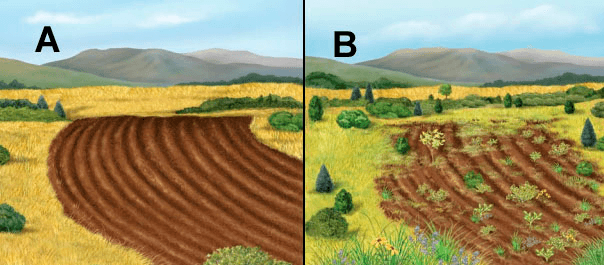
What type of succession is shown going from figure A to figure B?
a)
primary succession
b)
ecological succession
c)
secondary succession
d)
intermediate
43.
What is the goal of the pioneer species in Primary Succession?
a)
To kill the dead materials after a disaster
b)
To rebuild soil
c)
To feed Johnny
d)
To put fresh oxygen into the air
44.
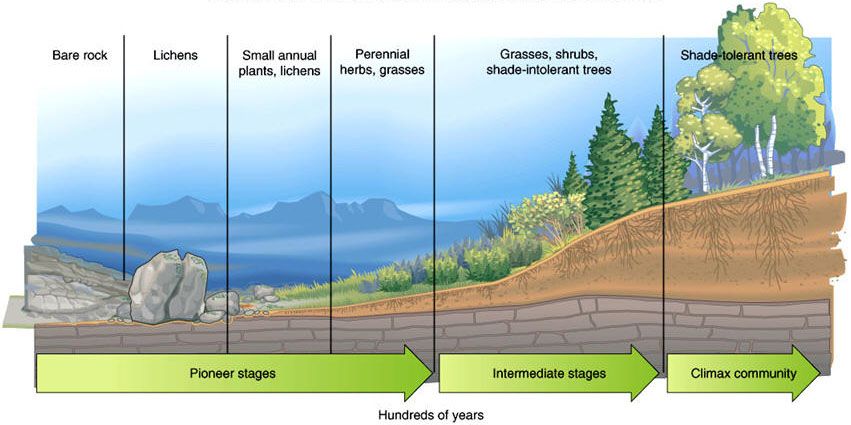
The picture shows what type of succession?
a)
primary
b)
secondary
c)
tertiary
d)
quadanary
45.
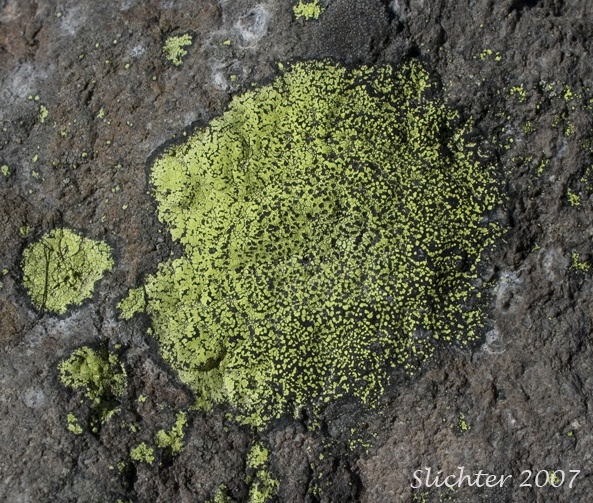
What is the name given to lichen or algae after a primary succession?
a)
pioneer species
b)
volunteer species
c)
founder species
d)
conqueror species
46.
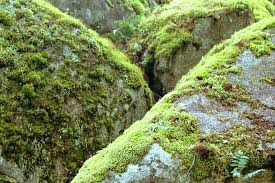
What are examples of pioneer species in a primary succession?
a)
Bushes and Shrubs
b)
Oak trees
c)
Mossess and Lichens
d)
A rose Bush
47.
After a volcanic eruption, lava covers the land. What is the order that plants grow to repopulate the area?
a)
Lichens → Shrubs → Grasses → Trees
b)
Lichens → tree → shrubs→Grasses
c)
Grasses → Lichens → Shrubs → Trees
d)
Lichens → Grasses → Shrubs → Trees
48.

the process by which a new community forms where no community lived before
a)
resource
b)
invasive (non- native) species
c)
primary succession
d)
competition
49.
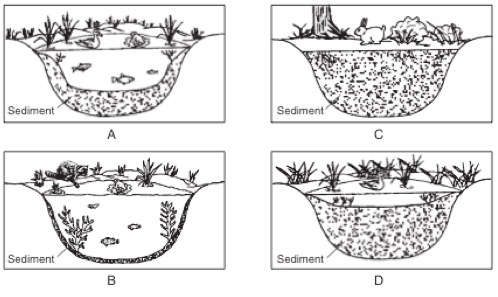
What is the correct order from oldest (happened first) to youngest (happened last) in this pond succession?
a)
A, B, C, D
b)
D, C, B, A
c)
B, A, D, C
d)
C, D, A, B
50.
Reaches a climax community quicker because soil is already present
a)
primary succession
b)
secondary succession
c)
both types of succession
51.

Final illustration (#8) shows
a)
pioneer species
b)
climax community
c)
only biotic factors
d)
only abiotic factors
52.

This is an example of...
a)
Climax communities
b)
Secondary succession
c)
Lichen
d)
Pioneer species
53.

In an ecological pyramid, which type of organism always has the least amount of energy available?
a)
Producers
b)
Herbivores
c)
Carnivores
d)
Top Predator
54.

In this ecosystem, what is there the LEAST of?
a)
hyperparasites
b)
herbivores
c)
producers
d)
parasites
55.

The diagram represents different levels of a marine food pyramid. Between which two levels is the least amount of energy transferred
a)
R and Q
b)
S and R
c)
T and S
d)
U and T
56.
Only about ten percent of the energy stored in an organism can be passed on to the next trophic level. Of the remaining energy, some is used for the organism’s life processes, and the rest is typically
a)
used in reproduction
b)
stored as body fat
c)
stored as body tissues
d)
converted to heat and lost
57.

What type of pyramid does this show?
a)
biomass
b)
energy
c)
numbers
d)
producers
58.

Identify the cycle pictured.
a)
The Water cycle
b)
The Carbon cycle
c)
The Nitrogen cycle
d)
The Phosphorus cycle
59.
What is the most abundant gas in our atmosphere?
a)
carbon dioxide
b)
oxygen
c)
nitrogen
60.
True/False- Bacteria in the soil convert nitrogen in the atmosphere into a form that plants can use.
a)
True
b)
False
61.
Which trophic level contains Apex Predators?
a)
Quaternary
b)
Primary
c)
Autotrophs
62.

What is the role of autotrophs in the carbon cycle?
a)
autotrophs take in carbon as CO2 and make glucose from it
b)
autotrophs release CO2 into the atmosphere
c)
autotrophs make carbon
d)
autotrophs destroy carbon
63.

If the primary producers have 10,000 kcal how much do the secondary consumers have?
a)
1,000 kcal
b)
100 kcal
c)
10 kcal
d)
1 kcal
64.
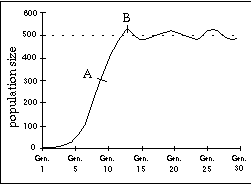
What is the carrying capacity of the graph?
a)
around 500
b)
more than 500
c)
less than 500
d)
around 600
65.

What is the carrying capacity of the following graph?
a)
1000
b)
8000
c)
800
d)
600
66.

If there is 1000 Kcal available in the producers in trophic level 1, how much energy is available in the herbivores in trophic level 2?
a)
10 Kcal
b)
1 Kcal
c)
100 Kcal
d)
1000 Kcal
67.
A population of deer belongs to the forest community. Which change to the community would most likely cause the deer population to increase?
a)
A new disease strikes mountain lions, a predator of deer
b)
A new beetle arrives that lives in the bark of trees, food supply for the deer
c)
Human activities divert water away from the forest
d)
Human activities reduce the size of the forest
68.
A severe wildfire has been reported in a densely forested region of the state. The forest ecosystem sustained extensive damage; for much of the forest, only soil and charred remnants of the once towering trees remain. What predictions can you make about how the ecosystem will change over time?
a)
Primary succession will occur
b)
Lichens will be the predominant species in the forest for the next 20 years.
c)
Large mammals will migrate in to claim the newly available territory.
d)
Grasses and small shrubs will appear in the next few years, eventually followed by taller vegetation.
69.
Ramora fishes have an adhesive disk on their heads that they use to attach themselves to whales. When food floats away from the whale’s mouth, unused, the remora unhitches itself from the whale and eats the food the whale let float away. The relationship between the remora and the whale is an example of
a)
Mutualism
b)
Parasitism
c)
Predation
d)
Commensalism
70.
Which of these relationships is an example of competition?
a)
A bird that picks and eats insects off a cattle
b)
Squirrels and chipmunks living in the same habitat and eating the same seeds
c)
A tapeworm living inside an organism and absorbing nutrients form the organism
d)
A lion that hunts hyenas for food
71.
A keystone species is a species that is not usually abundant in a community yet has a strong impact on the structure of the community. In one coastal community, mangroves are keystone species. The roots of these trees provide food and shelter for many organisms, and keep sand, mud, and organic matter in place, preventing soil erosion and local flooding. Which of the following environmental changes would have the greatest impact on the coastal community?
a)
A severe hurricane that uproots most of the mangroves
b)
The planting of marsh grasses near the mangroves
c)
The reintroduction of native fish to the community
d)
A period of unusually high rainfall
72.
Bees fly from flower to flower to gather nectar. In the process, they help the plants reproduce by spreading pollen. The relationship between bees and flowering plants is an example of
a)
Competition
b)
Commensalism
c)
Mutualism
d)
Parasitism
73.

The diagram to the right represents different levels of a marine food pyramid. Between which two levels is the greatest amount of energy transferred?
a)
R and Q
b)
S and R
c)
T and S
d)
U and T
74.
A snake that eats a frog that has eaten an insect that fed on a plant is
a)
first-level producer
b)
first-level consumer
c)
second-level producer
d)
third-level consumer
75.
Which change would most likely reduce the rate at which carbon dioxide is increasing in the atmosphere?
a)
A decrease in the combustion of fossil fuels
b)
A decrease in total photosynthesis among Earth's plants and algae
c)
An increase in the population of denitrifying bacteria
d)
An increase in the population of denitrifying bacteria
76.
Which of the following is an adaptation that helps animals survive in hot, dry climates?
a)
hunting at night
b)
thick fur
c)
layer of fat
d)
wings
77.
A scientist observed these sea turtles. The scientist most likely said that their legs were adapted for
a)
swimming
b)
catching fish
c)
eating plants
d)
walking on sand
78.
What is the name for consumers that are eaten?
a)
carnivores
b)
fossils
c)
predators
d)
prey
79.
What happens to a population if there are too many first-level consumers in a habitat?
a)
the number of producers gets too low
b)
there aren't enough 2nd level consumer
c)
the climate changes
d)
nothing happens
80.

relationship in which two species live closely together
a)
resource
b)
mutualism
c)
succession
d)
symbiosis
81.
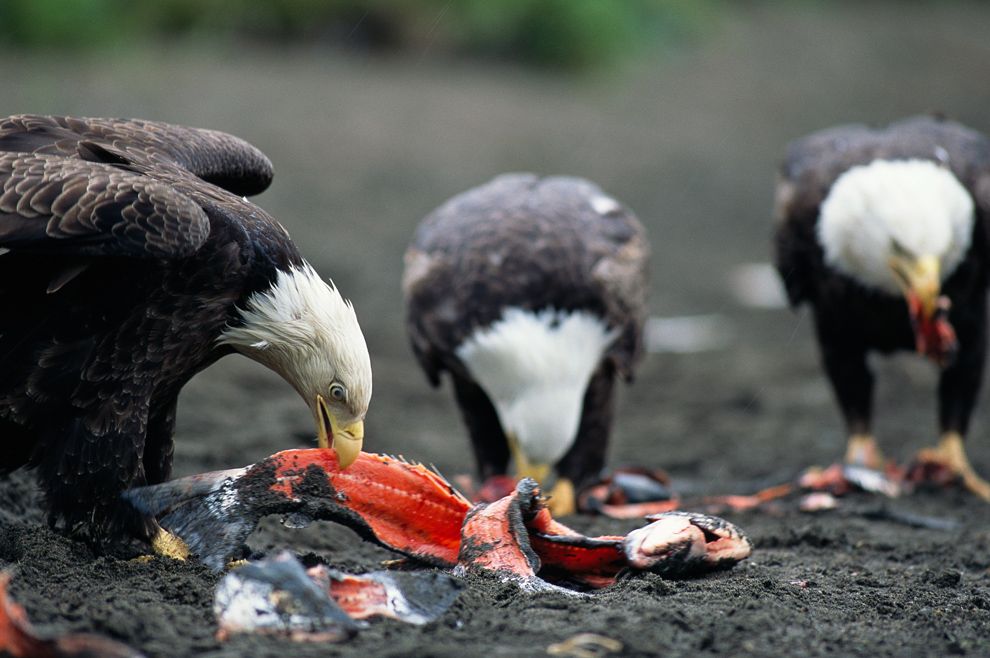
These eagles are eating a herbivore. What role are they playing?
a)
producer
b)
primary consumer
c)
secondary consumer
d)
decomposer
82.
What is a tropism?
a)
a plant's response to its environment
b)
a change in climate
c)
something found in the soil
d)
an animal's adaptation
83.
When a plant is eaten by a caterpillar and the caterpillar is eaten by a frog, and the frog is eaten by a snake, the snake belongs to
a)
Producer
b)
Primary consumer
c)
Secondary consumer
d)
Tertiary consumer
84.
These gases, such as carbon dioxide, trap heat in the Earth's atmosphere causing global warming
a)
Global warming gases
b)
Hot House gases
c)
Green House gases
d)
Thermal pollution
85.
A particular golf course is using large amounts of nitrogen fertilizer. What process could move this nitrogen into a local stream?
a)
volatilization
b)
nitrogen fixation
c)
runoff
d)
ammonification
86.
Which of the following describes the role of nitrogen-fixing bacteria in the nitrogen cycle? Nitrogen-fixing bacteria convert
a)
nitrates intro nitrogen gas
b)
ammonia into proteins
c)
nitrogen gas into ammonia
d)
proteins into nitrates
87.
what kind of feedback loop is this?
Wolf eats rabbit Rabbit population decreases because of being eaten Wolves population increase because they are eating all of the food No food sources for the wolves, so wolves start to die off Less predators and the rabbit population increases.
Wolf eats rabbit Rabbit population decreases because of being eaten Wolves population increase because they are eating all of the food No food sources for the wolves, so wolves start to die off Less predators and the rabbit population increases.
a)
positive
b)
negitive
88.
What kind of feedback loop is this?
Humans cut down trees for lumber Deforestation weakens the trees roots Weak tree roots loosen the soil Water flow erodes unstable soil Remaining unstable, low quality, soil can no longer sustain trees.
Humans cut down trees for lumber Deforestation weakens the trees roots Weak tree roots loosen the soil Water flow erodes unstable soil Remaining unstable, low quality, soil can no longer sustain trees.
a)
positive
b)
negitive
89.

What curve is Line B demonstrating
a)
Primary Succession
b)
Exponential Growth
c)
Secondary Succession
d)
Carrying Capacity
90.

What curve is Line A demonstrating?
a)
Exponential Growth
b)
Primary Succession
c)
Carrying Capacity
d)
Secondary Succession
91.
Which of the can limit a population from growing?
a)
Disease
b)
Food
c)
Competition
d)
All of the above
92.
Water returns to the atmosphere during what process?
a)
combustion
b)
evaporation
c)
precipitation
d)
decomposition
93.
Which form of nitrogen is readily used by plants and animals?
a)
ammonium
b)
nitrates
c)
nitrogen gas
d)
carbon dioxide
94.
Bacteria are particularly important in which nutrient cycle?
a)
water
b)
carbon
c)
nitrogen
d)
phosphorus
95.
Carbon is removed from the atmosphere by...
a)
photosynthesis
b)
cellular respiration
c)
burning fossil fuels
d)
burning forests
96.

An aquatic biome classified as marine would have...
a)
Fresh Water
b)
Salt Water
c)
Either Fresh Water or Salt Water
d)
Neither Fresh Water or Salt Water
97.
This biome is found around the equator and is home to a large amount of biodiversity.
a)
Deserts
b)
Tropical Rain Forests
c)
Savannas
d)
Chaparral
98.

A wetland defined by having trees
a)
swamp
b)
marsh
99.

If you visited a savanna, you would likely see
a)
large herds of grazing animals, such as rhinos, gazelles & giraffes
b)
a dense forest.
c)
snow and ice.
d)
a coastal ecosystem.
100.

Identify the biome pictured.
a)
Tundra
b)
Grassland
c)
Temperate Rain Forest
d)
Deciduous Forest
101.

Identify the biome pictured.
a)
Tundra
b)
Grassland
c)
Desert
d)
Deciduous Forest
102.

Identify the biome pictured.
a)
Tundra
b)
Grassland
c)
Deciduous Forest
d)
Temperate Rain Forest
103.

The land that is sometimes underwater and contains water soaked soil are called _______________________
a)
wetlands
b)
drylands
c)
evaporation
d)
creeks
104.

________________________ have needle shaped leaves.
a)
Snow Cone Trees
b)
Coniferous Forests
c)
Tepee Trees
d)
Needle Forests
100 %

